A retaining ring — also called a snap ring or circlip — is a stamped or wire-formed fastener that holds components on a shaft or inside a bore, replacing shoulders, nuts, or cover plates with a single C-shaped element seated in a groove.
This guide lines the four main types — external axial, internal axial, self-locking (lateral), and constant-section spiral — against the decision criteria that matter on a drawing: groove standard, material, axial load, RPM, and stack-up tolerance. Embedded links go deeper into o-ring groove geometry, industrial valve sub-assemblies, and slewing-ring bearing race retention where the same axial-locking logic applies at a much larger scale.
Defining the four types and the grooves they sit in
External axial rings ride on a shaft and push against a housing face; internal axial rings sit in a bore and push against a shaft shoulder. Self-locking (lateral) rings use a tapered geometry so the ring screws down a shaft taper and locks axially without a groove — useful on shaft ends where machining a groove is impossible. Constant-section spiral rings are coiled, cut to size, and preferred for large diameters because no special tool is required to expand them during install [S1].
Groove geometry is governed by the manufacturer’s standard (DIN 471 external, DIN 472 internal, DIN 6799 for the lateral type, ANSI B27.7 for inch-series external). The groove width is normally 3× the ring radial thickness and the depth 60–75% of that thickness; a wrong-depth groove is the single most common field failure cause, because the ring pops out under load if the groove is too shallow or bottoms out with zero pre-load if it is too deep. The o-ring page covers the parallel groove-stretching rules that govern any elastic ring seated in a machined slot.
Load capacity, speed, and the hidden endplay variable
Carbon-spring-steel rings (SAE 1070-1095, DIN 1.1248) in static retention typically rate 8–25 kN static thrust capacity per ring in shaft sizes from 10–50 mm, dropping as the diameter grows because radial stiffness scales with section modulus. Stainless 302/316 and beryllium-copper versions drop that figure by roughly 30–40% but gain corrosion resistance, which is why pressure transmitter bodies and flow meter wetted-side assemblies frequently switch to PH15-7 Mo or 17-7 PH rings when media compatibility rules out carbon steel. [S1]
Rotational balance is the most-overlooked spec: a single retaining ring adds measurable endplay because the groove depth eats 0.3–1.0 mm of axial float, and a stamped ring is never perfectly circular. For high-RPM shafts (above roughly 5,000–8,000 rpm, depending on balance grade), this endplay plus runout pushes the assembly past ISO 1940 G6.3 limits, and a precision shoulder nut or a precision-ground slewing-ring bearing race becomes the correct answer. The OEM balancing residual in published retaining-ring cut sheets is normally given as 0.5–1.5% of ring mass at a 10 mm radius; a tighter spec is available but doubles unit cost.
Materials, finishes, and corrosion math

Carbon spring steel (C75S, 1.1248, AISI 1075) is the default for general machinery and is normally supplied with a black phosphate or zinc-plated finish that buys 48–96 hours of neutral salt-spray protection per ASTM B117 before base metal shows. Stainless rings (AISI 302, 316, 17-7 PH) are mandatory for marine, food-grade, and offshore use; passivated 316 reaches 500+ hours ASTM B117 and is the spec you’ll see on industrial valve trim and chemical-pump shafts. [S2]
Beryllium-copper (C17200) is the third option: it has the lowest modulus of the three, springs back most reliably after extreme deformation, and is non-sparking, which is why it is specified for ATEX/IECEx Zone 1 hand-tool and downhole assemblies where a steel ring could shed a spark during install. Lead time is the penalty: C17200 rings carry roughly 6–10× the unit cost of carbon steel and a typical 8–12 week mill order at non-standard sizes.
Where retaining rings win — and where they lose
Retaining rings dominate in three application profiles: high-volume stamped-sheet assemblies (electric-motor housing caps, gear-pump covers, automotive transmission park-lock collars), in-the-field service where a snap-ring pliers swap is faster than a heat-and-press operation, and space-constrained axes where a shoulder screw would consume 20–40 mm of axial length the designer does not have. The Gear Pump Selection Guide 2026 case studies show external retaining rings replacing threaded retainers on pump cover plates, which reduced cover-to-body stack-up length by roughly 18 mm without a strength penalty [S2].
Retaining rings are the wrong answer where (a) the shaft exceeds roughly 8,000 rpm, (b) axial shock load is high because the ring can jump the groove, (c) the application requires sub-0.05 mm axial endplay, or (d) the assembly is in a fatigue-critical path where the groove itself is a stress raiser. For those profiles, a precision lock nut or a shrink-disk-style locking assembly is specified. The Locking Assembly selection write-up quantifies the same trade-off: locking assemblies add radial bulk and cost but cut axial endplay to 0.01–0.03 mm and survive 1,000+ hr at 12,000 rpm.
Selection criteria: a four-axis decision

The first axis is groove standard. Choose DIN 471/472 if the assembly is European, fits cleanly into a metric CAD library, and is single-source. Choose ANSI B27.7 if the drawing is in inches or ships into North-American volume production. Mixing the two on the same shaft is a common rookie mistake that costs a redesigned groove when the European-spec ring won’t seat in a B27.7 groove.
The second axis is load profile: static thrust only → standard carbon-steel ring; cyclic or shock-loaded → external-heavy or beveled-edge ring with a higher thrust rating, or migrate to a locking assembly. The third axis is environment: dry indoor → carbon steel with zinc; outdoor/marine → 316 stainless passivated; explosive-atmosphere hand-tool → beryllium copper. The fourth axis is serviceability: stamped rings are one-shot; spiral wound rings can be re-installed with a simple hand tool, which is why gear pump rebuild kits increasingly ship with constant-section rings on the wear-side cover plate.
Installation, removal, and the field-failure taxonomy
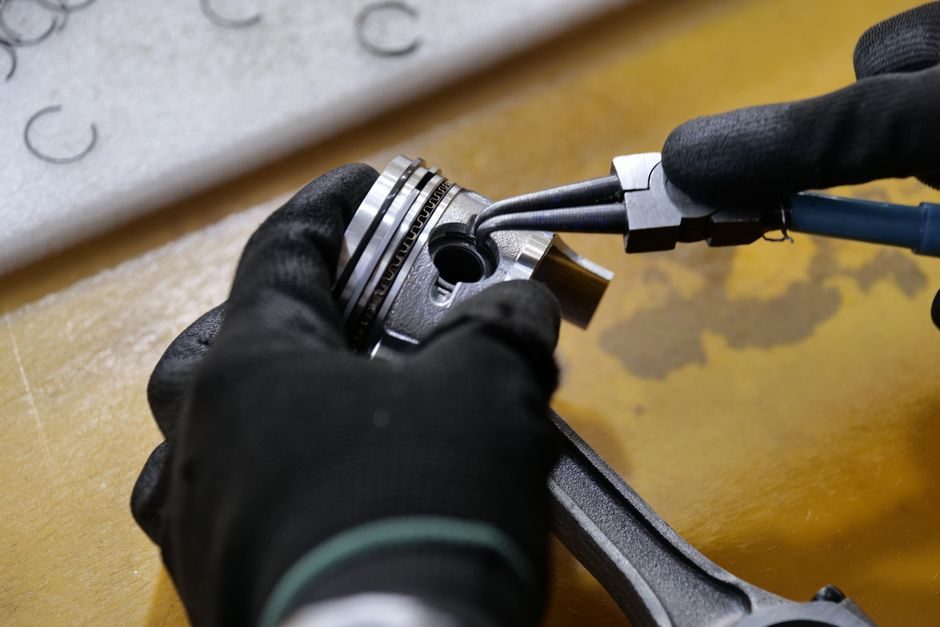
Installation is a pliers operation: external rings are expanded with snap-ring pliers, internal rings are compressed; over-expansion beyond roughly 5–8% of the free diameter causes plastic deformation and the ring will not re-seat. Self-locking rings are installed by threading the ring down the shaft taper and torquing to the spec on the data sheet; under-torque leaves the assembly loose, over-torque splits the tang.
Field failures break into four buckets: groove too shallow (ring pops out under load, the most common failure by a wide margin), wrong material (galvanic corrosion at a carbon-steel ring under a stainless cover, especially in flow meter bodies carrying trace chloride), installation damage (over-expansion cracking at the lugs, visible as a hairline at 5–10× magnification), and fatigue at the lugs in cyclic-load service (failure initiates at the inside of the eye after 10⁵–10⁶ cycles depending on ring section). The Locking Assembly advantages write-up captures the same fatigue pattern in the threaded-fastener family for direct comparison.
Standards, sourcing, and the 2026 cost picture

The standards stack in 2026 is mature and stable: DIN 471, DIN 472, and DIN 6799 for the three common metric styles; ANSI B27.7-2020 for the inch family; ISO 464 for the constant-section spiral geometry. NACE MR0175 limits ring material to 316 stainless or higher-Ni alloys in sour-service downhole assemblies, ruling out the cheap carbon-steel default; ATEX 2014/34/EU and IEC 60079-0 govern the beryllium-copper selection for Zone 1 hand-tool service.
Sourcing in 2026: Asia-dominant manufacturers (CN, TW, IN) hold roughly 60–70% of the global volume for stamped carbon-steel rings, with European mills dominating stainless and precision grades. The Gear Pump Price 2026 article documents how a stamped carbon-steel ring at 25 mm shaft size now lands at roughly USD 0.04–0.12 per piece at 10k-unit MOQ versus USD 0.30–0.55 for a 316 stainless equivalent — a cost ratio the spec writer has to defend when justifying the upgrade on a chemical-service drawing.