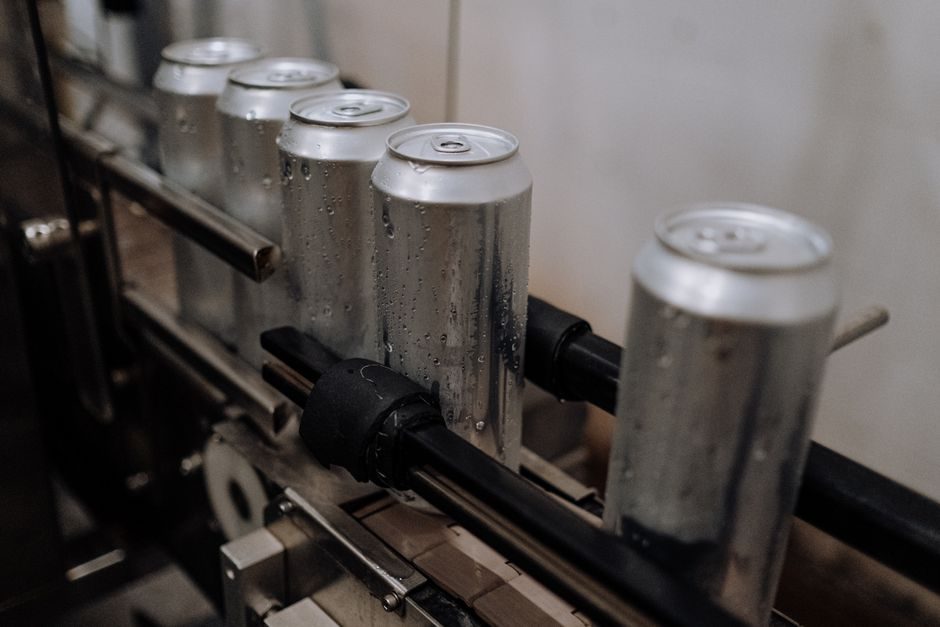
Roller conveyor selection collapses to a load-per-roller calculation: a 1,180 lb live load on a 10' ULINE H-3411 gravity section with 3" roller centres means each 1.9" diameter roller carries roughly 29 lb when the 18" frame is fully populated [S7]. Most selection errors start there — undersized rollers deform, overspecified frames waste money.
The decision is driven by package weight, footprint, drive method and environment. A non-motorized Interroll RM 8110 modular gravity line is rated at 100 kg per module for box, container and order-picking duty in food, automotive and logistics [S6], while a galvanized Ashland UG-series slip-on roller handles up to 496 lb per roller at 2-1/2" O.D. on a 14-gauge tube with a 7/16" hex spring-retained shaft [S1]. Pick the wrong cell and the whole line slips, stalls or sags.
Load Per Roller: The First Gate
Roller conveyor sizing starts with the static and dynamic load on a single roller — every other spec cascades from that number. A 2-1/2" O.D. × 14-gauge galvanized tube with light-oil swaged bearings on a 7/16" hex axle (UG series) is a typical light-to-medium cell, rated at 496 lb per roller [S1]. Going past that threshold means stepping to a thicker tube wall, a larger hex axle or a heavier bearing class.
For heavier unit loads, the ULINE H-3411 frames a 10' × 18" section rated at 1,180 lb live load on 1.9" diameter rollers at 3" centres inside a 10-gauge steel frame [S7]. Divide the section's live-load rating by the roller count to see what each roller is being asked to do — that single number is the gate for tube gauge, axle diameter and bearing type. The same arithmetic is what separates a roller conveyor cell that runs for a decade from one that cold-forms a groove in the tube within six months.
Roller Diameter, Centres and Tube Gauge
Roller diameter, centre distance and tube gauge set the line's stiffness, noise level and conveyor-belt or package handling behaviour. The Ashland UG-series pairs a 2-1/2" O.D. tube with 14-gauge wall on a 7/16" hex shaft — a common light-duty combination for carton handling [S1]. Smaller diameters (down to 1") and larger diameters (up to 2" minimum shown) bracket the same product family, so engineers typically pick diameter by package length: short rigid cartons run fine on 1-1/2" rollers, long flexible bags need larger diameters to prevent sag between centres.
Roller centres control the "sag ratio" — the gap between adjacent rollers as a fraction of package length. The ULINE H-3411 uses 3" centres, a tight spacing for boxes that cannot be allowed to dip between rollers [S7]. Wider centres cut roller count and price but force the tube gauge upward. The DNC Automation guide lists nine primary roller types — carrying idlers, return idlers, impact rollers, gravity rollers, motorized drive rollers, anti-buildup rollers, guide/training idlers, and rubber-lagged pulleys — each with its own diameter-and-centres envelope [S9]. For a deep dive on how those roller types fit a complete handling line, see the belt conveyor selection guide.
Drive Method: Gravity, Line-Shaft or Motorized
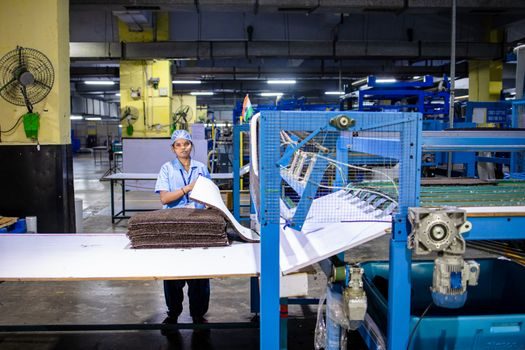
Drive method is the second big axis after load. A non-motorized, manual Interroll RM 8110 is gravity-only and rated at 100 kg per module for box and order-picking duty in food, automotive and assembly lines [S6]. No motor means no controls, no zone wiring, and no PLC — but also no controlled acceleration, so heavy totes need a brake or an incline limit to avoid runaway.
Powered options split into motorized drive rollers (MDR), line-shaft, and chain drive. The item industrial applications chain-driven roller conveyor (article number 0.0.463.53) is built for automated transport where each roller is positively driven through a chain loop — the right call when package geometry or accumulation logic rules out gravity [S3]. For washdown or food-grade lines, a stainless-steel ERIMAC CRL XL horizontal height-adjustable roller conveyor adds cleanability at the cost of frame rigidity — a 100 kg-class cell in a stainless build is not the same cell as a mild-steel 1,180 lb gravity frame, and it should not be specified as if it were [S4].
Frame, Axle and Bearing Choices
Frame gauge, axle cross-section and bearing class are the hidden cost drivers. The 10-gauge steel frame of the ULINE H-3411 is the structural backbone that lets the section carry 1,180 lb of evenly distributed live load on 1.9" rollers [S7]. Drop to a 12- or 14-gauge frame and deflection at mid-span will show up long before the rated load is reached — a classic field failure mode for gravity sections that have been "value-engineered" past the steel thickness.
Axle choice tracks roller size. The Ashland UG-series uses a 7/16" hex steel spring-retained axle with commercial light-oil swaged bearings — adequate for the 496 lb per roller rating, but not interchangeable with a 1" round axle on a 3,000 lb cell [S1]. For a self-centralizing troughing idler set on belt conveyors, Rulmeca's S/F/R series uses rollers arranged in a trough to correct belt tracking and hold the belt centred under load [S2]. Idler and roller selection live on the same engineering tree, so when the spec sheet moves from idlers to line rollers, the same bearing-class discipline applies — outlined in the roller conveyor reference page.
Environment and Material Compatibility

Environment — temperature, moisture, chemical exposure, food-contact rules — usually trumps raw capacity once the line is going into anything other than a dry ambient warehouse. Galvanized steel rollers (UG series) tolerate humidity and mild washdown but not long-term chloride exposure; stainless frames (CRL XL) are specified for food and pharmaceutical clean rooms where mild steel would corrode or shed [S1][S4].
Modular carton-handling racks add another option. The FlexQube Q-100-0844 roller rack (1,540 × 910 mm) is a stationary, modular horizontal conveyor for pallets and containers, designed to slide fully loaded pallets or containers on and off easily [S5]. The Interroll RM 8110 is rated for the same general-payload envelope (100 kg) but is built around a flexible modular strip the OEM markets at food, automotive, logistics and assembly-line sites [S6]. When the line has to coexist with pallet jacks and forklifts, that pallet-handling spec is the gate — see the plastic pallet price and cost guide for matching pallet spec to conveyor cell.
Comparison: Four Real Roller-Conveyor Cells
Lining four current OEM cells against four decision criteria makes the trade-off visible. Ashland UG-series slip-on roller — 496 lb/roller, 2-1/2" O.D. × 14 ga galvanized tube, 7/16" hex shaft, light-oil bearings; light-to-medium carton duty, slip-on (no bolted flange) [S1]. ULINE H-3411 gravity section — 1,180 lb live load per 18" × 10' frame, 1.9" rollers at 3" centres, 10-gauge steel frame, non-motorized, evenly distributed load only [S7]. Interroll RM 8110 — 100 kg per module, straight non-motorized modular gravity, food/auto/logistics/assembly sectors, flexible modular construction [S6]. ERIMAC CRL XL — 100 kg-class stainless height-adjustable, food and pharmaceutical clean rooms, horizontal handling, non-motorized [S4].
Read across the four columns: capacity per roller (496 lb / 1,180 lb section / 100 kg / 100 kg), material (galvanized steel / 10-ga mild steel / modular OEM finish / stainless), drive (none / none / none / none), and environment (general / general warehouse / multi-sector / clean room). The cells are not interchangeable: the 1,180 lb ULINE frame is a warehouse beast, the 100 kg Interroll is a picking-line workhorse, the ERIMAC is a hygienic cell, and the Ashland UG is a drop-in replacement roller.
Limits, Failure Modes and What to Watch

Published ratings carry conditions. The ULINE 1,180 lb figure is "based on evenly distributed live load" — concentrating that mass in one spot drops the per-roller load past the design point and bows the frame [S7]. The Ashland 496 lb/roller figure assumes the standard light-oil swaged bearing at ambient temperature; high-temperature, dusty or high-speed service derates the bearing long before the tube is stressed [S1]. The 100 kg Interroll and ERIMAC figures assume rigid modules on flat, level supports — a tilted frame or a soft floor will let a loaded tote creep [S6][S4].
Common in-service failures: tube flattening on 14-gauge rollers running near 496 lb with sharp-edged steel pallets; hex-axle spin in the spring retainer when the bearing seizes from lack of relube; frame twist on 10-gauge gravity sections when stands are spaced wider than OEM guidance. The DNC Automation guide notes that primary roller types include anti-buildup and guide/training rollers specifically because bare carrying rollers are not the whole answer on dirty, mis-tracking or impact-loaded belts [S9]. For lines that handle bulky bagged loads, the FIBC bulk bag spec-first selection guide covers SWL, SF and electrostatics that drive roller spacing on the receiving end of the conveyor.
Sourcing, Standards and What to Confirm With the OEM
Public OEM pages give the headline numbers but rarely the test method, so a senior engineer treats the rating as a starting point and asks for the test certificate. Key documents to request: a load test per ISO 5048 / ISO 21181 (idler and conveyor roller test methods) or equivalent, the bearing L10 life calculation for the application's rpm and radial load, and the frame deflection at rated load. [S1]
Material certifications matter as much as the headline rating. Galvanized rollers (UG series) should ship with a zinc-coating weight; stainless frames (CRL XL) should cite the actual grade (304 vs 316) and surface finish (Ra value) for hygienic lines [S1][S4]. For lines carrying palletized or containerized loads where shrink wrap or stretch film is part of the throughput story, the stretch film price and cost guide covers the load-stability angle downstream of the roller spec. Confirm the cell, the bearing, the frame and the test report before signing the PO.
Trackable signals to watch over the next procurement cycle: published per-roller load curves from at least three of the OEMs above (currently only headline ratings are listed); the migration of galvanized 14-ga tube cells to 12-ga as e-commerce package weights trend upward; and the spread of stainless height-adjustable cells (CRL XL class) into non-pharmaceutical food lines as hygienic design moves downstream from the filler to the palletizer.
For component-level specifications, see crossed roller guide, and linear guide.