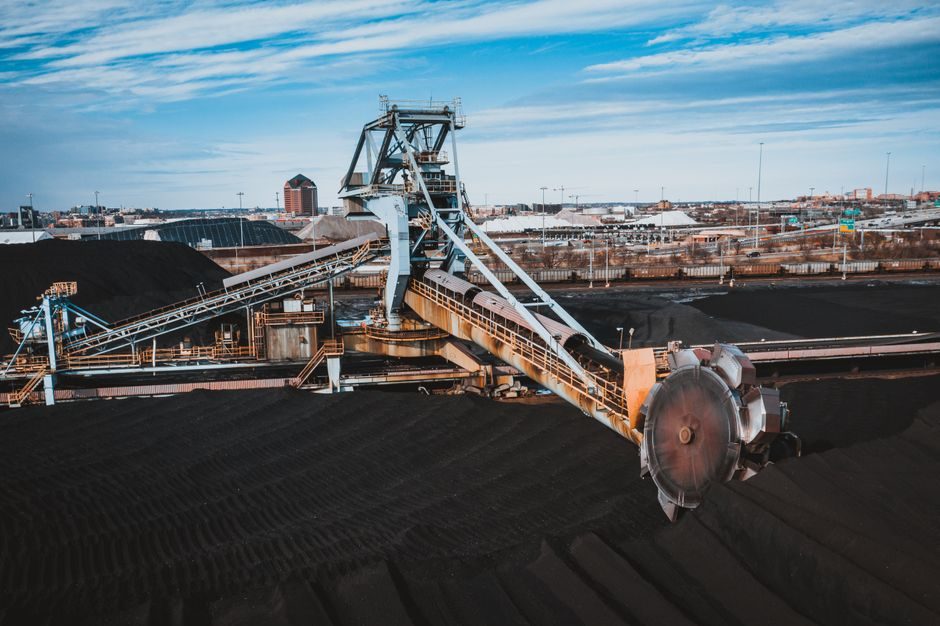
Roller conveyors divide first by drive class — gravity, chain-driven live roller (CDLR), belt-driven live roller (BDLR) and motorized drive roller (MDR) — and second by load band, with documented OEM envelopes spanning 90 kg/m for light parcel handling [S3] up to 4,500 kg per pallet station on S235JR frames [S1].
The live market as of 2026-07-13 still centres on four functional families: straight horizontal pallet handling, telescopic vehicle loading, curved accumulation, and stainless/pharma extendable. Roller diameters in active OEM catalogues cluster at Ø48 mm, Ø50 mm, Ø76 mm and Ø89 mm, with 3 mm wall zinc-plated steel the default and PVC/HDPE specified where corrosion or noise dominate [S1][S3][S4][S7].
Drive Class: Gravity, Chain, Belt-Pulley and Motorized Roller
Gravity roller conveyors carry no motor — Codimar's G30/G50/G51/G60/G61/G70 lines run unpowered with bearing-supported steel or PVC tubes, accepting down-slope accumulation only [S3]. Chain-driven live roller (CDLR) conveyors use a single or double row chain as both traction and support element; BCS SIA documents "up to several tons" per unit load, with optional rubber coating or attachments for high-temperature product [S2].
Belt-driven live roller (BDLR) replaces the chain with a Poly-V belt looped between rollers — roll-ven spa's BETA3 1PV fits 50 mm Ø steel tubes with thermoplastic pulleys, runs 200 mm minimum length per roller, and is rated for high-speed low-noise straight runs [S4]. Motorized drive roller (MDR) integrates a 24 VDC or 400 VAC motor inside the tube itself; the ANTIPODA pallet line uses an external SEW gearmotor at 230/400 V 50 Hz IP55 CE (or 330/575 V 60 Hz CSA), 12 m/min, bidirectional [S1]. The relevant sub-discipline is covered in the roller conveyor reference, and the power-transmission sister topic sits at roller chain.
Load Bands: 90 kg/m Light Parcel vs 4,500 kg Pallet Station
Codimar's G8 series caps at 90 kg uniform per metre on Ø50 mm PVC/zinc/inox rollers with Ø8 mm shaft, 600 mm turning radius for the G80 and 400 mm for the G81, adjustable height 500-1100 mm [S3]. SIAT's GT series telescopic loader runs 400-650 mm effective width on 0.5-4.5 m lengths, targeted at pharmaceutical, e-commerce, food and vehicle-loading bays [S6].
At the heavy end, ANTIPODA documents 1,500-4,500 kg per pallet with Ø89 mm x 3 mm and Ø76 mm x 3 mm zinc-plated rollers, lengths 930/1130/1330 mm, 150 mm and 175 mm pitch, 0.2 m/s fixed speed, 5-50 °C operating envelope, and 930-1330 mm effective width [S1]. Cincinnati's CV series shear conveyor, integrated with HS/SE/G series shears, covers 1,678-2,585 kg per load for metal-fabrication scrap removal [S5]. For comparison, the bearing spec that sits under any powered live-roller gearbox is the tapered roller bearing family.
Construction Class: Rigid Pallet, Telescopic Loader, Extendable Curved
Rigid pallet-handling frames use reinforced double-formed 3 mm S235JR carbon steel, powder-coated RAL 9006, with bolt-on walkover plates, fixed or pneumatic blade stoppers, and pneumatic pallet indexers as field-options [S1]. Telescopic/extendable loaders — SIAT GT and Codimar G8 — are designed for multi-point truck or conveyor loading, with the Codimar G80/G81 stowing to closed lengths of 0.7-6.6 m from open 2-12.5 m on 2-9 legs [S3][S6].
Curved accumulation sections rely on either chain (BCS SIA, "two or more lines of chain depending on the size and weight of the load" [S2]) or gravity taper (Codimar G70, G50 bearing-supported). Belt-driven roller modules for non-accumulating straight runs (BETA3 1PV) deliberately avoid the chain and are specified where low noise and cleanroom wash-down matter, accepting the trade-off of no zero-pressure accumulation [S4].
Materials and Finishes: Zinc-Plated Steel vs PVC vs Stainless vs HDPE
Zinc-plated mild steel is the default — Ø76 mm and Ø89 mm x 3 mm wall tubes for pallet handling [S1], Ø48 mm and Ø50 mm for light duty [S3]. PVC rollers (Ø50 mm G80) reduce noise and protect carton edges in parcel handling [S3]. Stainless steel (Inox) versions of the same Ø50 mm G80 line are the spec choice for food, pharmaceutical and wash-down environments [S3].
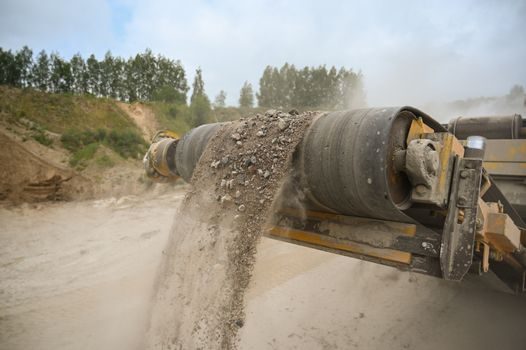
HDPE, UHMWPE, rubber-coated, impact and rubber disc rollers come from dedicated bulk manufacturers such as the SY conveyor range — quoting composite, steel, impact, rubber-coated, rubber disc, HDPE and UHMWPE options aimed at quarry, coal-prep, port, cement, steel and power-plant operators [S7]. For the most abrasive dry environments, ceramic-alloy anti-slip lagging is still quoted as a wear-resistant roller finish, manufactured in Liuzhou, Guangxi [S9]. Material context for idler shells matches the road roller compaction-shell family and the precision sleeve class at crossed roller guide.
Who It Is For vs Who It Is Not
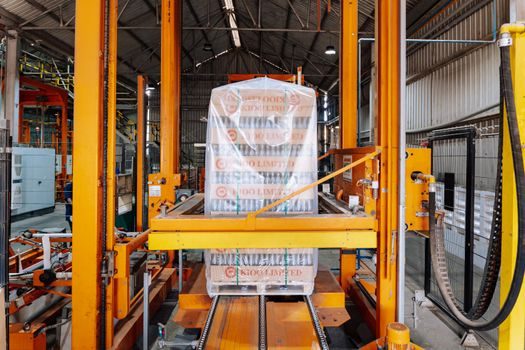
Roller conveyors fit: pallet flow on 1-3 station lines up to 4,500 kg each with 0.2 m/s fixed speed [S1]; parcel and e-commerce telescopic loaders in 0.5-4.5 m lengths [S6]; shear-scrap evacuation at 1,678-2,585 kg per load off hydraulic or mechanical guillotines [S5]; and stainless or HDPE wash-down lines for food, pharma and quarry/port bulk [S3][S7].
Roller conveyors do not fit: inclined product lifts above the gravity taper limit (use a belt or slat conveyor instead); cleanrooms requiring zero particulate shedding (spec stainless MDR with sealed bearings, not bare zinc); sanitary meat or dairy lines without specifying Inox or HDPE shells; and high-temperature product above the standard 50 °C envelope [S1] without an explicit rubber-chain or specialty bearing review [S2]. Sourcing and supplier screening logic is the same discipline applied across spherical roller bearing selection and the jaw coupling torque-band map.
Comparison Table: Four Drive Classes on Five Selection Criteria
On the criteria that drive a buying decision, the four drive classes line up as follows. (1) Load per station: gravity 90 kg/m [S3] up to ~250 kg/m typical; chain-driven "several tons" [S2]; belt-driven 90 kg/m-class up to medium duty [S4]; motorized/SEW-driven 1,500-4,500 kg per pallet [S1]. (2) Speed control: gravity none, downstream-dictated; chain fixed by gearmotor ratio; belt fixed but easily ratio-changed; MDR 0.2 m/s fixed in the ANTIPODA build, variable with VFD in others. (3) Zero-pressure accumulation: gravity yes by taper, chain no without sensor logic, belt no, MDR yes with zone controller. (4) Noise: gravity silent, chain loud, belt low, MDR low. (5) Cleanroom/wash-down suitability: gravity excellent in Inox [S3], chain poor (lubrication), belt fair with sealed pulleys [S4], MDR good in stainless variant.
For the spec engineer the gate order is: load per metre, accumulation requirement, environment (wash-down / cold / hot), then noise, then speed. Cross-check the gearbox output stage against the roller bearing catalogue page and any driven accessory such as an encoder or fixed gas detector mounted to the conveyor frame.
Limitations, Failure Modes and Trackable Signals
Known constraints across the live OEM set: the ANTIPODA pallet frame is rated 5-50 °C operating temperature and excludes conveyor supports from the standard scope (specified separately) [S1]. The Codimar G80 turning radius is locked at 600 mm (G81: 400 mm) — tighter layouts force a belt conveyor substitution. Chain-driven conveyors (BCS SIA) inherit the chain's stretch, lubrication and noise burden and are best kept off pharmaceutical Class A spaces [S2].
Two trackable signals for the next 90 days: (a) any 2026-Q3 release of curved or zero-pressure-accumulation MDR controllers from the Codimar G-series line; (b) any new ceramic-alloy or HDPE roller price lists from Guangxi/Liuzhou bulk makers [S9] that shift the stainless-vs-coated cost crossover. Bulk supply of composite, HDPE and steel rollers remains a Chinese-led category, with the SY conveyor catalogue (composite, steel, impact, rubber disc, HDPE, UHMWPE, ceramic-rubber pulley) covering quarry, coal-prep, port, cement and steel-plant use-cases at 600 PCS/year capacity reference for ceramic-lagged product [S7][S9].