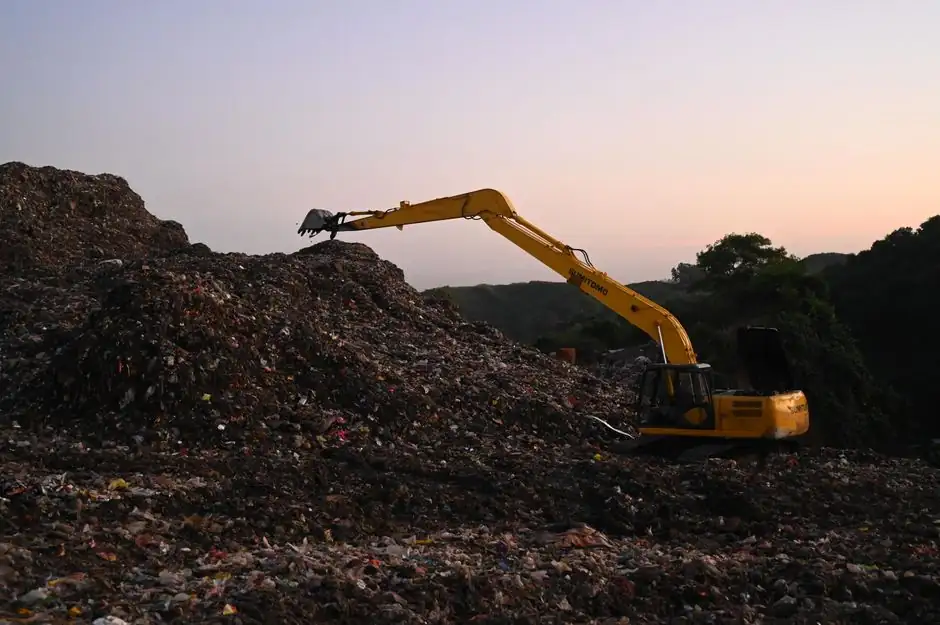
Landfill drilling programs in 2026 overwhelmingly pair a small-footprint direct-push/rotary hybrid (e.g., DM250-class platforms with 22 ft / 6.7 m stroke) with hollow-stem auger (HSA) tooling in the 3.25-6.25 in. range to install gas-monitoring probes, leachate wells, and depth-discrete groundwater clusters [S1][S3][S4].
The defining selection pressure at a landfill is not raw penetration rate but containment integrity: boreholes must seal against landfill gas (LFG) migration, sample trace VOCs without cross-contamination, and meet the field discipline of crews carrying 40-Hour HAZWOPER certification [S3]. Rotary method (mud or air) is therefore chosen around waste-matrix behaviour, not the other way round.
Landfill Drilling Methods: What Each Tool Does in Waste
Auger drilling uses a rotating helical screw to extract soil or other material and is suited to shallow investigations, soft soil, and clayey deposits, with the chief advantage of relatively low cost, limited equipment footprint, and good undisturbed samples for lab testing [S2]. In a municipal solid waste (MSW) cell, that translates to the top 3-5 m of daily cover and weathered waste, where auger refusal is rare and cuttings are easy to log.
Rotary mud drilling circulates a water/clay/additive mix to cool the bit, lift cuttings, and stabilize the borehole; it is the default for variable soil and rock conditions and unconsolidated formations, at the price of more complex equipment, higher operating cost, and potential mud-related environmental issues [S2]. On older landfill benches with buried demolition debris, mud rotary keeps the hole open where HSA would wall-collapse, and it allows wireline coring for waste characterization.
Rotary air (RAB) drives a down-the-hole hammer with compressed air and is fast, cost-effective in consolidated rock, but limited in unconsolidated or fractured formations, and produces lower-quality samples at higher noise levels [S2]. For landfill gas probe installation in competent native subsoil below the waste, RAB is often the right tool; inside the waste mass, the high noise and uncontrolled air path usually disqualify it.
Tooling Stack: HSA, Dual-Tube, and Mud-Rotary Sizing
Geoprobe's environmental/tooling catalog lists HSA replacement parts in 2.25 in., 3.25 in., 4.25 in., and 6.25 in. IDs, dual-tube samplers DT22, DT325, DT37, DT45, and DT60, and SPT sampling explicitly under the mud-rotary method, confirming that direct-push/rotary hybrids are designed to swap between HSA strings, driven-casing SPT, and mud-rotary coring on the same mast [S1]. For landfill work this means a single DM250-class carrier can run a 3.25 in. HSA for a shallow gas probe, then re-tool to a DT22 dual-tube string for a deeper VOC profile without a crane swap.
Standard probe rod diameters in the same catalog run 1.25, 1.5, 1.75, 2.25, 3.25, 3.75, 4.5, and 6.0 in., which sets the coupling envelope for any rotary string added on top of direct-push tools [S1]. Picking a rig that supports the full 1.25-6.0 in. rod matrix lets a field crew cover everything from 1 in. soil-gas implants to 6 in. diameter leachate wells on one carrier.
For deeper landfill-cell characterization (typically 15-30 m below grade), rotary mud with a 4.25 in. or 6.25 in. HSA lead string followed by a DT45/DT60 dual-tube sampler is the conservative 2026 default cited in environmental drilling practice [S1][S3]. A DM250 with 22 ft stroke reaches ~6.7 m per pass, so deeper cells require multiple rod-add cycles, which is why mast stroke is the first number to check on a landfill spec sheet [S4].
Selection Criteria: Mast, Pullback, and Carrier Class
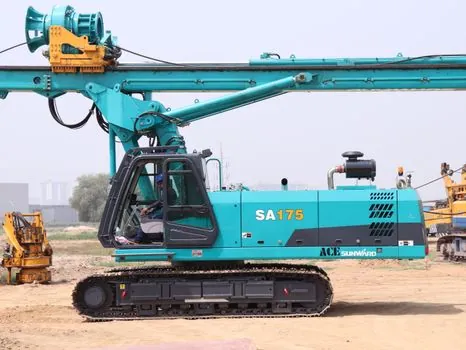
For a DM250-class water-well/environmental carrier, Geoprobe publishes a 22 ft (6.7 m) stroke and non-CDL footprint aimed at shallow water-well drilling, and the same carrier is also marketed for geothermal and cathodic protection work where site access is tight [S4]. That profile maps directly to landfill cells: short stroke limits single-pass depth but lets the rig sit on a 2 m wide access path between leachate manholes.
When deeper cells (20-40 m) are in scope, the same vendor's larger DM450 and DM650 water-well drill rigs are positioned one and two model tiers up, implying greater mast length, higher pullback, and heavier carrier class [S1]. The rule of thumb for landfill selection: pick the smallest carrier that still reaches target depth plus 20% contingency for rod-trip tolerance; oversizing brings unnecessary ground pressure on weak landfill cover.
Hole-sealing hardware is a separate decision. Permanent well abandonment on landfill projects is "completed using compliant procedures to permanently seal wells and protect groundwater resources from future impacts," per environmental drilling guidance, and grout mix, tremie pipe, and pressure monitoring are specified to the depth profile of each well [S3]. A rig candidate should be evaluated on its ability to tremie-grout in 3-6 m stages without lifting the casing, not just on raw rotary torque.
For Whom It Is (and Is Not) the Right Rig
A DM250-class direct-push/rotary hybrid is the right match for landfill gas (LFG) probe networks, depth-discrete groundwater monitoring clusters, and small-diameter soil-vapor implants in cells up to roughly 15-20 m deep; the platform also handles soil boring for permeability tests and most routine SPT work via the mud-rotary path [S1][S3][S4]. For deeper cells, larger-diameter leachate wells, or any program that needs continuous wireline core through dense demolition debris, step up to a DM450/DM650-class mud-rotary rig or a top-head drive on a tracked carrier [S1].
The same platform is a poor match for high-production mineral exploration (RAB or top-head drive is faster), for driven-only geotechnical programs (CPT rigs like the 20CPT or direct-push rigs like 6712DT/6011DT/540MT/420M are purpose-built), and for any job where the waste matrix contains free product or aggressive leachate that would attack standard HSA carbon steel without a coating upgrade [S1][S2]. Crews on the wrong carrier end up either over-spending on mud or losing holes to collapse in unconsolidated fill, both flagged as core limitations of the underlying methods [S2].
Comparison: Auger vs. Mud Rotary vs. RAB on a Landfill Site

On three core decision criteria the main options rank as follows. Cost: auger is the lowest, RAB is competitive in hard rock, mud rotary is the most expensive due to mud plant, lost circulation material, and disposal. Depth: auger is limited to shallow investigations, RAB and mud rotary both reach greater depths, with mud rotary holding the edge in unconsolidated fill. Sample quality: auger delivers good undisturbed samples in soft soil, mud rotary allows detailed core and geophysical testing, RAB returns only rock cuttings and cannot deliver undisturbed samples [S2]. For a typical landfill gas monitoring program, that combination of criteria pushes selection toward HSA-auger for probes and mud rotary only when waste-matrix refusal or collapse risk forces it.
A landfill program that needs a single carrier for the full job should prioritize dual-mode rigs (HSA + mud rotary on one mast, with DT-series dual-tube tooling) over single-method units, because the same project can transition from soft cover to buried debris to competent native subsoil within a single 20 m profile [S1][S3]. The DM250 platform's 22 ft stroke, non-CDL footprint, and dual-mode HSA/mud-rotary compatibility position it as the entry-level match for that profile [S4].
Standards, Crew Certification, and Field Discipline
Environmental drilling guidance treats 40-Hour HAZWOPER certification as the baseline for crews performing monitoring well installations, and that expectation now extends to routine landfill drilling programs where waste contact is plausible [S3]. Method selection itself is driven by project goals, site geology, contaminants, and regulatory requirements rather than by rig availability [S3].
On the equipment side, landfill operators increasingly expect rigs to support dual-tube sampling systems (DT22 through DT60) for VOC work, SPT sampling under the mud-rotary path, and driven-casing SPT (DT325 / DT37 OTE variants) where waste-derived overburden makes standard SPT impossible, all features present in the current direct-push/rotary hybrid catalog [S1]. Rotary machines paired with slewing bearings sized for the mast and crowd system are a related load-path decision covered in slewing bearing selection for mining when landfill rigs are tracked-mounted for soft-cell access. For ancillary process control on the mud circuit, landfill gas monitoring ties into the same pressure transmitter selection logic used in plant service, and flow on the recirculation loop is metered by an in-line flow meter.
Two signals worth tracking into the next quarter: the release of any updated 2026 environmental drilling guidance that tightens tremie-grout staging rules for vertical LFG cut-off walls, and the appearance of DM450/DM650-class carriers on rental rosters with factory-installed dual-tube handling, since both directly determine whether a single carrier can finish a deep multi-cluster landfill program without a second mobilization.