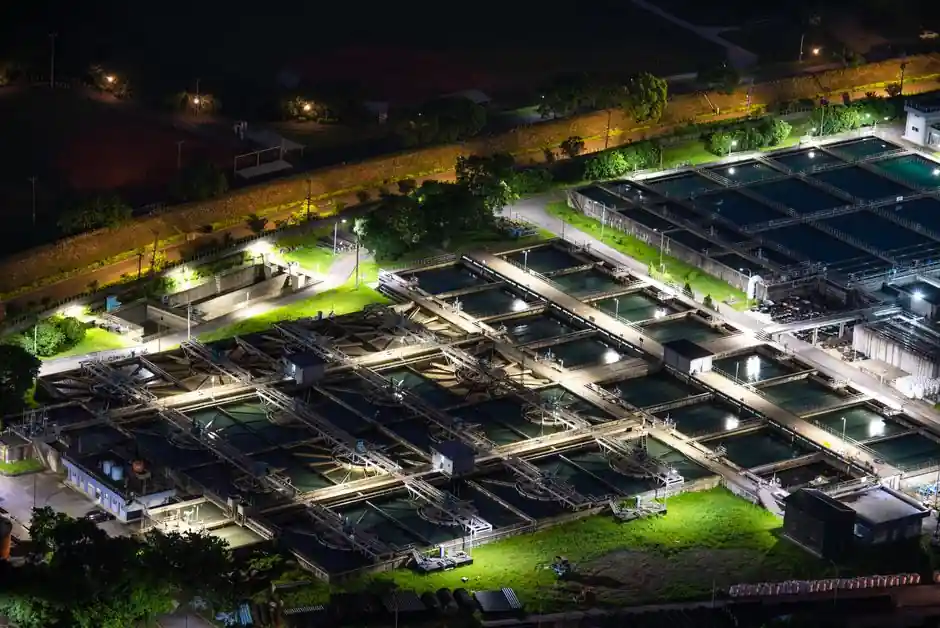
A submersible pump for raw sewage lift stations is selected by intersecting four engineering constraints: the true duty point (flow, total dynamic head, force-main friction, 1.5-3.0 m/s carrying velocity), the worst-case solids profile (rag, grit, wipe), the wet-well geometry, and the maintenance access path [S1][S2].
Municipal wastewater is a non-Newtonian, solids-laden stream, not clean water, so a pump that looks correct on a clear-water curve will still rag, cavitate, or wear prematurely if the impeller, seal, and motor-cooling package are not matched to the actual influent [S1][S3]. The same selection logic that applies to a submersible pump used in dewatering has to be tightened when the medium is unscreened sewage, because the failure modes (clogging, seal grit embedment, motor overheat from frequent starts) are operationally and compliance-relevant.
Start with the True Duty Point, Not the Catalog Curve
The duty point for a municipal lift-station submersible pump is built from minimum, average, and peak inflow, static lift, and force-main friction, then plotted against the pump curve to confirm the operating point sits inside the preferred operating region (POR) rather than at the end of the curve [S1][S3].
A carrying velocity of 5-7 ft/sec (1.5-2.1 m/s) is the commonly cited rule of thumb for municipal wastewater force mains, and the figure rises as the specific gravity of the carried solids increases, because heavier grit drops out of suspension below this band [S3]. Undersized sumps force the pump to short-cycle (more than ~10 starts/hour on most NEMA motor designs), which burns motors and accelerates seal fatigue; oversized sumps let grit settle instead of being entrained to the pump suction [S3][S5]. The operating envelope should be re-checked at the end of the force-main life when pipe roughness has increased, not just at commissioning.
Match the Impeller Family to the Solids Profile
Impeller family is the single largest selection lever for a solids-handling submersible pump: closed impellers clog fastest, semi-open and non-clog channel impellers pass 2-4 in (50-100 mm) spheres, vortex impellers pass the entire stringy solid without touching it, and grinder or chopper impellers macerate wipes and rags before they enter the volute [S1][S4][S9].
SSPMA defines the sewage class as pumps that pass 1-1/2 in (most codes call for 2 in) and larger solids, with grinder pumps specified where a gravity system is not practical and the discharge is forced through 1-1/4 in pipe at high head [S4]. For rag-heavy raw sewage, a vortex or chopper impeller in a centrifugal pump casing is the typical first-pass answer; for grit, sand, or settled sludge streams, the selection shifts to a heavy-duty slurry or chopper build with hardened cutters and abrasion-resistant wear parts [S1][S4]. Long stringy solids generally call for a vortex passage; large soft solids are often better handled by a grinder that shears them before they enter the volute [S3].
Solids Loading, Volumetric Limits, and Piping Geometry
Most solids-handling submersible pump designs are limited to roughly 5% solids by volume; above that threshold, the sump must be resized or dilution water added, because the pump will clog regardless of impeller choice [S3].
Three piping-system details drive field failures more than the pump curve does: (1) check valves must sit as close to the pump as possible, because remote or elevated check valves let solids fall back into the volute on every cycle and re-foul the impeller; (2) a high static lift combined with an undersized pump causes solids to recirculate inside the volute and bind; (3) pipe diameter must be large enough to pass the design sphere, but small enough to keep velocity inside the 5-7 ft/sec carrying band [S3]. For new lift-station designs, the same front-end discipline used in hydraulic pump skids (matching reservoir, valving, and actuator response) applies in miniature to the wet well, float stack, and discharge run.
Materials, Seals, and Motor Cooling for the Wet Well
Seal-face selection for a submersible wastewater pump is typically silicon-carbide vs. silicon-carbide for the wetted seal faces, paired with a secondary lip seal or oil chamber, because grit embedment in a softer seal face is the leading cause of premature seal failure in sewage service [S4][S5].
Motor cooling is the second materials-driven decision: submersible pumps in sewage sumps often rely on the surrounding fluid for cooling, so a pump that runs partially unsubmerged (because the level control is mis-set or rags block the suction) will thermally overload. Specifying a motor with a higher temperature class (Class H insulation, with the frame sized so the service factor stays inside nameplate at the worst-case operating point) is the conservative answer. A similar service-first logic shows up in diaphragm pump chemical skids, where material compatibility and duty cycle drive the build before brand does.
Configuration, Controls, and Serviceability
Configuration choices that materially affect reliability in a municipal wet well include guide-rail (auto-coupling) installation for one-person retrieval, VFD compatibility for matching pump output to variable inflow, and redundant level sensing (floats plus a hydrostatic or ultrasonic backup) so a single failed switch does not overflow the basin [S1][S5].
For collection-system pump stations the same trade-off space shows up across industrial pump categories: the cheapest nameplate is rarely the lowest lifecycle cost. SSPMA also notes that grinder pumps require scheduled maintenance, because the hardened stainless cutters dull with use and the service interval, not the pump curve, becomes the operational constraint [S4]. Specifying the discharge size, basin geometry, and check-valve trim in the same review as the impeller family is the cheapest way to avoid a ragging lift station six months after startup.
Selection Matrix: Impeller vs. Service Condition
Match the impeller family to the worst-case solids in the stream, and the rest of the spec follows: vortex for stringy rags at low head, non-clog channel for unscreened sewage at moderate head, grinder for high-head pressure sewers with small discharge piping, and chopper/heavy-duty slurry for grit and abrasive sludge [S1][S3][S4].
The same process-first sizing logic that drives a magnetic drive pump chemical build applies here: the fluid and the duty point pick the pump, not the catalog. Skipping this step is how plants end up with a $20,000 service contract on a pump that should never have been installed.
Common Failure Modes and What to Watch For
Five failure modes dominate submersible wastewater pump field service: ragging/clogging at the impeller, seal failure from grit embedment, motor overload from frequent starts on a short-cycling sump, cavitation from a blocked suction or NPSH loss in a long force main, and corrosion of cast-iron components exposed to high-temperature or low-pH industrial discharge [S1][S3][S9].
The cheapest mitigations are upstream of the pump: bar screens and grit removal at the headworks, a check valve mounted within ~1 m of the discharge flange, and a level-control scheme that holds starts/hour inside the motor manufacturer's curve [S3][S5]. In a gear pump skid the analogous failure is gear wear from abrasive ingestion; the wastewater equivalent is impeller tip and wear-plate wear from grit, which is why chopper pumps, not standard non-clog pumps, are specified for raw sewage with measurable sand load [S1][S4].
What Specifying Engineers Get Wrong
Three mistakes show up repeatedly on failed lift stations: sizing to average flow instead of peak, picking a non-clog pump where a grinder or chopper is required by the discharge piping, and skipping the wet-well geometry review, which leaves the pump operating outside its POR for most of its life [S1][S2][S5].
Standards to anchor on: SSPMA solids-class definitions (sump, effluent, sewage, grinder) and the carrying-velocity rule of thumb (5-7 ft/sec) cited across the municipal pump literature, with local plumbing and collection-system codes layered on top [S3][S4]. For adjacent process skids, the same service-driven logic that governs submersible sewage pump selection shows up in needle valve Cv sizing, where the line condition, not the catalog number, drives the part number.
Trackable Signals for the Next Selection Cycle
Two signals to watch between now and the next bid cycle: updated SSPMA and Hydraulic Institute guidance on non-clog solids passing for 3-4 in (75-100 mm) sphere handling in raw-sewage service, and the spread of VFD-driven, IE5-efficiency submersible pump platforms in municipal lift-station retrofits, where energy and ragging behaviour both move at the same time [S1][S3][S4].