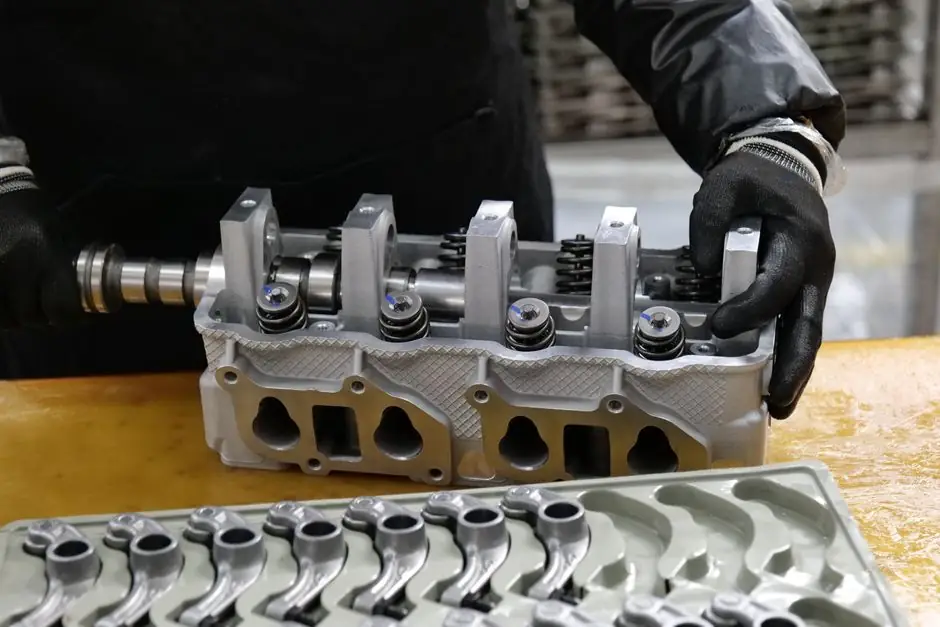
Rail-component cores fall into a 10–30 kg band for bogie bolsters, brake housings, and wheel-center inserts, with shot pressure held at 6–7 bar and phenolic-resin-coated sand cured against platens at 200–260 °C, per the working baseline used by Indian and Chinese railway foundries [S5][S6].
The Z95 platform is the dominant Chinese-built envelope for this duty: the Z956K shoots 20 kg cores from a 650×400 mm platen at 30 kW, while the Z959K reaches 40 kg from a 950×600 mm platen at 60 kW, all at 0.55–0.7 MPa system pressure and 12-month warranty [S1]. The Rollytech Z95 range extends the same envelope up to 60 kg max shot from a 1000×1000×600 mm box, with hydraulic drive replacing pneumatic above 40 kg [S3]. For thin-walled hollow rail cores, the folding-down hollow-core variant is the standard mechanism because the sand tank rotates into a high position before injection, avoiding sand fill behind the cured shell [S4].
Core Weight and Platen Footprint: the Sizing Envelope
Core weight per cycle is the binding constraint, not platen area, because the blow tank capacity sets the maximum cured core mass the resin-coated sand envelope can sustain [S4]. The Z95 series ladders cleanly against typical rail SKUs: 15 kg on the Z954K (450×400 mm platen) covers small brake-shoe cores, 20 kg on the Z955K/Z956K covers most bolster side-core work, 25–30 kg on the Z957K/Z958K covers wheel-center inserts, and 40 kg on the Z959K covers large bogie-frame cores [S1].
Cross-vendor mapping keeps the same parameter set readable: Harrison 1016-SS shoots 20 lb (5 L), 1616-SS shoots 35 lb (9 L), 1818-SS shoots 40 lb (10 L), and 2424-SS shoots 70 lb (20 L), while Redford 16 and 43 hold 40 lb, Redford 22 holds 70 lb, and Dependable 400 / EMI U-180 hold 100 lb on platens 13×15 in to 30×20 in [S4]. For rail foundries running a mixed SKU pool, the EMI dual-station family keeps box dimensions comparable to single-station frames while doubling the cycle window per box, since one station cures while the operator unloads the other [S2]. A practical spec gate: any rail core over 30 kg pushes selection out of the Z95 mid-range and into the Z958K–Z959K band, where cover-half thickness reaches 200–250 mm and compound-die course runs 400–450 mm [S1].
Heating Medium: Electric vs Gas-Fired Platens
Electric platen heating dominates the Z95 family, with 20 kW on the Z954K rising to 60 kW on the Z959K, and it is the right pick for clean-room or laboratory settings, for foundries without a gas supply, or where cure temperature uniformity across the platen matters more than ramp rate [S1][S4]. Quoted heating capacity ranges from a few kilowatts on small electric machines to several hundred thousand BTU per hour on large gas-fired shell machines, with the operational requirement being closed-loop thermocouple control holding the working surface within a few degrees of set point [S9].
Gas-fired platens dominate heavy foundry service where larger platens must reach 230–260 °C fast, and Supreme Cores' Wisconsin plant runs 18 gas-fired units including Redford 16, 22, 43, 44 and Dependable 400 / EMI U-180 sizes with core capacities from 40 lb to 100 lb and platen footprints from 13×15 in to 30×20 in [S4]. For rail components specifically, electric heating is the typical default because shot weight stays inside the 10–40 kg band and exhaust duty is manageable on a 0.55–0.7 MPa pneumatic supply, while gas becomes attractive only above the 40 kg threshold where a 50–60 kW electric draw starts competing with a gas burner on operating cost [S1]. PLC-based digital temperature control with separate zones for each core-box half is now standard on Indian auto/roll-over shell shooters, mirroring the Rollytech LCD parameter-setting pattern on the Z95 [S3][S5].
Architecture: Single-Station, Dual-Station, and Roll-Over

Single-station shell core machines carry one heated core box and one blow head and remain the right pick for foundries below ~50 cores/shift or where floor space is constrained; dual-station pays back when continuous duty and a labor-light cell are the goal [S4]. The Z95 single-open mold model suits a single core SKU running flat-out, while the Z95S double-open mold model can complete the production of two sets of molds at the same time and adds lateral mold-block extraction [S3].
Roll-over architecture (Core Box Mounting ROLLOVER, 10–20 kg core weight, 6 bar blow pressure, 440 V 3-phase, electric heating, floor mounting) is the Indian export configuration of choice for rail-adjacent foundries, because the rollover action drops the cured shell cleanly without a separate stripper stroke [S5]. For rail foundries running both thin-walled hollow cores and solid cores on the same cell, the Z95 platform supports both modes: the template turns over 180° to empty residual sand for shell cores, while solid cores are made without turning over [S3]. Drive mode typically ladders pneumatic below 25 kg shot, pneumatic/hydraulic around 25–40 kg, and full hydraulic above 40 kg, matching the Rollytech Z95 spec table [S3].
Blow Pressure, Cycle Time, and Pneumatic Duty
Rail-core blow pressure sits in a 6–7 bar band: 6 bar on the auto shell and roll-over shooters with 20 kg shooting capacity, 7 bar on the 100 kg horizontal hot-box unit used for larger solid rail cores [S5]. System pressure on the Z95 platform reads 0.55–0.7 MPa, which is the same 5.5–7.0 bar working window and explains why a 7 bar shop supply is the standard compressor spec for a Z95 line [S1].
Single-cycle time on the Z95 family ladders 15 s on the Z955-15 (15 kg shot) up to 35 s on the Z9510-60 (60 kg shot), with the 25–40 kg mid-band (Z956-25 and Z957-40) sitting at a 20 s cycle, the practical baseline for a medium-duty rail cell [S3]. For thin-walled rail cores (brake-housing webs, bolster windows), the cycle floor is set by cure time on the heated platen, not by the blow itself, which is why electric heating with closed-loop thermocouple control is the operational must-have [S9]. For sand-recovery economics, the shell process allows uncured sand to be re-used after collection, which matters for rail foundries running high-mix, low-volume SKUs where binder cost is otherwise a dominant line item [S2].
Selection Gates and Sourcing
A rail foundry spec should be gated in this order: core weight and box footprint first, then sand thermal demand and resin class, then exhaust duty, then cycle time, and finally automation tier; brand and control platform come last, not first [S7]. The wrong pick shows up fast: under-sized shot leaves cold cores that crack on the conveyor, the wrong binder locks the buyer into a hazardous-gas handling retrofit, and the wrong cycle time bottlenecks the molding line upstream [S8].
For Chinese-built Z95 supply, Qingdao Powerfu Mechanical & Electrical Co. offers a 12-month warranty with engineers available to service machinery overseas, ISO9001 certification, and a 4–7 day delivery window after payment, with system pressure and operation mode uniform across the Z954K–Z959K ladder [S1]. For North American heavy rail service above 40 kg core weight, the EMI dual-station shell core machine family is the conventional choice, with shell cores spec'd as solid and smooth with high definition and minimum cleaning-room processing [S2]. For thin-walled rail hollow cores, the folding-down hollow-core variant of either platform uses a hydraulic control unit to tilt and close the heated plates, rotating the sand tank into a high position before sand injection, which is the standard mechanism for making thin-walled hollow shell cores without sand fill behind the cured shell [S4].
Track these signals over the next procurement cycle: Z95 platform extensions above 60 kW / 60 kg shot for heavy rail bogie frames, roll-over shooter take-up among Indian Tier-1 rail suppliers, and any dual-station retrofit announcements from the EMI / Redford / Dependable installed base covering 230–260 °C platen service. For related silicon-nitride bearing-grade sourcing for the same rail assemblies, the Silicon Nitride Selection for Rail spec map covers the matching material gate.
Component reference pages worth checking: shell core machine, shell core shooter, and shell molding machine.