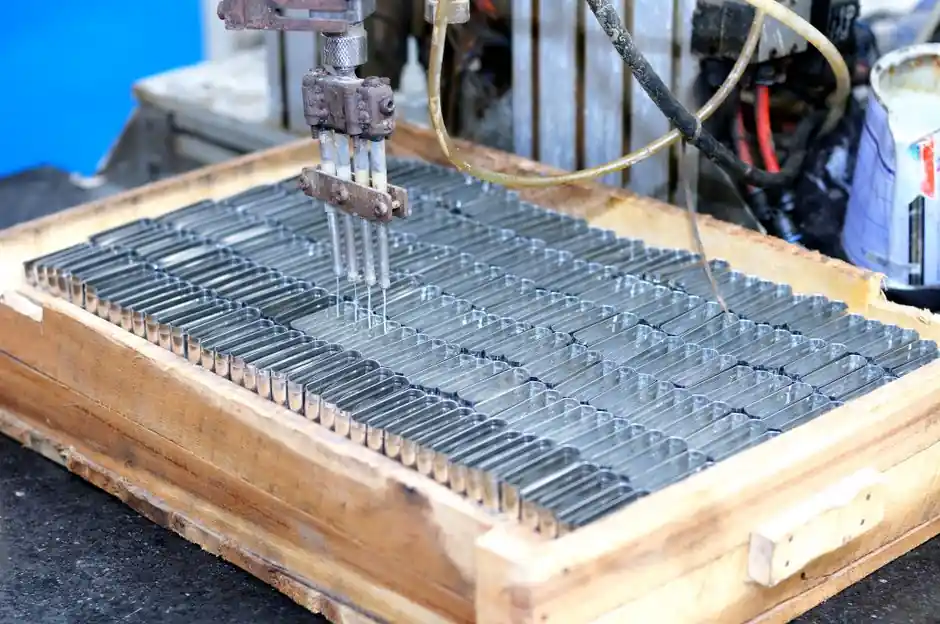
Hardware-grade shell core shooters in the 2026 Indian and Chinese OEM catalogues share a tight spec envelope: 4-6 bar blow pressure, 5-20 kg core weight, 440 V 3-phase supply, electric core-box heating to 350 deg C, and PLC/HMI cycle control [S1][S2].
Selection is driven less by peak shot rate than by core-weight range, parting orientation, and resin-coated sand compatibility, because hardware castings (valve bodies, pump impellers, gear housings) punish dimensional drift more than they punish a 5 s slower cycle [S3][S4].
Core Weight and Blow Pressure Envelope
Two spec brackets dominate 2026 hardware-foundry quotations: the 5-10 kg class running 4 bar blow pressure with 12 kg shooting capacity, and the 10-20 kg class running 6 bar with 20 kg shooting capacity [S2].
Operating pressure across the broader category spans 5-8 kg/cm squared (roughly 4.9-7.8 bar) on pneumatic or hydraulic actuation, with high-pressure shot reserved for dense, thin-wall cores [S1]. Hardware buyers specifying valve or pump bodies typically land in the 6 bar, 20 kg bracket, while general engineering brackets (small brackets, covers, light housings) sit in the 4 bar, 5-10 kg tier [S2][S3].
Parting Orientation: Horizontal vs Vertical vs Roll-Over
Horizontal-parting top-shooting machines are the workhorse for automated high-volume lines; Indian foundries running 28 horizontal core shooters report 600x600 mm and 500x600 mm core-box capacity as the standard 2026 footprint [S3].
Vertical-parting top-shooting machines suit automated high-volume runs where sand flow into deep cavities matters more than rollover access; a typical vertical cell is 500x500 mm with 2 machines paired against 28 horizontals in a mixed shop [S3]. Roll-over (swing-door) machines tilt the core box to dump excess resin-coated sand and form a controlled hollow centre, which is the standard choice for hollow cores and complex internal passages in hardware castings [S1][S2]. Fixed-shot top or bottom machines cover simple solid cores and basic hollow cores respectively, so they are usually skipped on hardware lines that need both geometries in one shift [S1].
Heating, Sand, and Cycle Time
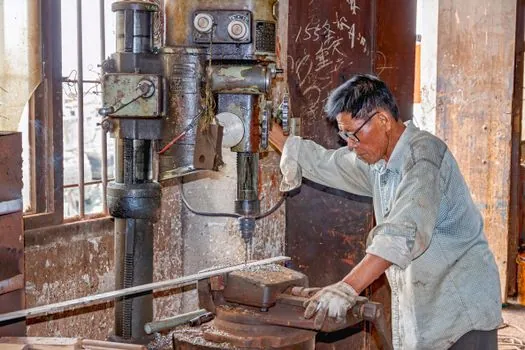
Electric core-box heating is the 2026 default at 440 V 3-phase, with optional LPG backup, and box temperature is regulated to roughly 350 deg C for phenolic resin-coated sand [S1][S2].
Cycle time spans 10-45 s depending on core complexity, and the sand hopper carries 40-150 kg of resin-coated phenolic sand with automatic sand feeding [S1]. Hardware foundries running thin-wall valve cores sit at the 10-15 s end; deep-cavity pump-impeller cores sit at 35-45 s [S1]. For tooling geometry, adjustable core-box thickness runs 100-200 mm with adjustable clamping strokes to absorb the variation between bracket-type and impeller-type cores on the same machine [S1].
Control Architecture: PLC, HMI, and the Industry 4.0 Layer
PLC-based control with HMI touch screens is the baseline on every 2026 OEM spec sheet, with Mitsubishi PLC and SCADA as the most common upper-tier stack [S2].
Higher-end hardware cells add Industry 4.0 interfaces, sand-level sensors, and individual temperature controllers for each core-box half, which is what closes the loop on core weight and surface-finish drift between shifts [S2]. Fault diagnosis and alarm interlocks, safety enclosures, and digital temperature control are now standard fitment, not options, on the 6 bar / 20 kg class [S2]. For a sense of the broader spec evolution on automated foundry cells, see the hot box core shooter sizing for telecom enclosure foundries reference, which uses the same Mitsubishi-PLC + SCADA control architecture.
Selection Criteria for Hardware Foundries
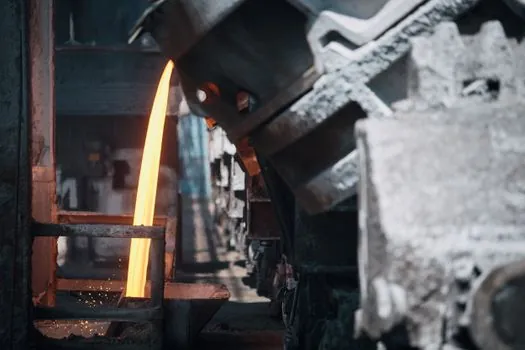
Five criteria separate the right machine from a 2026 quote that looks good on paper and underperforms on the floor: core weight band, blow pressure, parting orientation, control stack, and heating method. [S2]
For a hardware foundry producing valve bodies, pump impellers, and gear housings at 10-20 kg per core, the minimum 2026 spec is 6 bar blow pressure, 20 kg shooting capacity, horizontal or roll-over mounting, Mitsubishi or equivalent PLC with HMI, and electric heating with digital temperature control [S2][S3]. Shops running mixed bracket-and-impeller work in the same shift need adjustable 100-200 mm core-box thickness and dual sand-level sensors, while pure thin-wall production can drop to 4 bar / 12 kg [S1][S2]. Cycle-time targets should be set against the actual core, not the brochure: 10-15 s is realistic for thin-wall valve cores, 35-45 s for deep-cavity impeller cores, and any 2026 quote claiming 10 s on a 20 kg deep-cavity core is a red flag [S1]. For related process detail on how a comparable shooter class is specified for higher-tonnage castings, the hot box core shooter specs for railway castings reference lays out a useful comparison anchor.
Material and Standards Anchors
Resin-coated sand with phenolic resin is the universal 2026 consumable for shell cores in hardware casting, and the equipment envelope (5-8 kg/cm squared operating pressure, 350 deg C box temperature, 100-200 mm box thickness) is sized around that material's cure window [S1].
Production capacity on a fully automated shell core line reaches up to 300 tons per month in the high-volume bracket, which is the throughput target hardware foundries should validate against cycle time and core weight when comparing 2026 quotes [S1]. Aluminium and non-ferrous hardware castings are the primary fit, and phenolic-resin sand is what makes the 10-45 s cure window practical at 350 deg C [S1]. For shops also evaluating adjacent coring equipment, the hot box core shooter selection for energy equipment foundries reference covers the gas-heated alternative path that some hardware foundries use for larger steel-side cores. A useful sister-encyclopedia page on shell molding machine configuration helps frame the upstream moulding line, while the shell core machine reference covers the broader core-cell spec map, and the shell core shooter entry breaks down the actuation and clamping logic that the 4-6 bar / 5-20 kg envelope sits on top of.
Limits and Common Failure Modes

Three failure modes show up repeatedly on 2026 hardware-foundry shell core cells: inconsistent core density from under-regulated blow pressure, surface drag from uneven core-box heating, and dimensional drift from PLC programs that were never tuned to the actual resin batch [S4].
The economic penalty is downstream, not at the shooter: a 1-2 mm core variation can drive scrap, rework, and extra machining across the rest of the casting cell, which is why 2026 OEM literature is now pushing stability metrics over peak shot rate [S4]. Hardware buyers should ask for sand-level sensor data, per-half temperature logs, and a documented fault-diagnosis alarm list before accepting a 2026 quotation, because those three data streams are what separate a stable 5-20 kg shooter from a fast one that costs more in scrap than it saves in cycle time [S2][S4].
Trackable signals to watch over the next two quarters: any 2026 OEM release that pairs 6 bar / 20 kg shoot capacity with closed-loop sand-weight feedback, and any retrofit kit that adds per-half temperature logging to existing 4 bar / 5-10 kg cells, because both would shift the cost-of-quality math on hardware-grade shell cores.