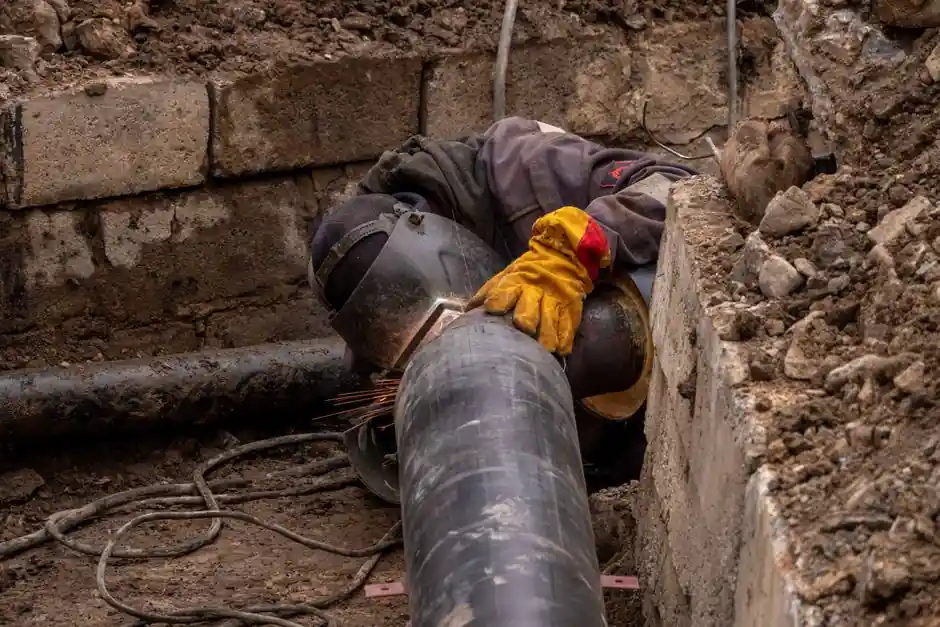
Pipeline construction yards handling prefabricated spools, valve assemblies, and pipe sections typically specify single girder overhead cranes in the 1-10 t range with FEM/ISO duty class A3-A5, electric wire-rope hoists, and runways matched to the longest spool or vessel lift on site [S1][S2].
Where the yard sits inside an ATEX/IECEx zone 1 or zone 2 envelope (gas-group IIA/IIB, temperature class T4 typical), the same single girder frame is delivered with explosion-proof motors, flameproof enclosures, and intrinsically safe pendant or radio controls, while keeping the mechanical envelope identical to a standard unit [S2]. For non-hazardous fabrication halls, a standard single girder crane with a CD/MD type wire-rope hoist remains the lowest-cost fit, and shares the same runway geometry as a single girder crane reference design.
Where a Single Girder Crane Fits in Pipeline Work
Single girder cranes serve three distinct pipeline-construction lifts: pipe-rack loading in fabrication yards, spool-to-truck transfers, and in-shop valve or fitting handling on assembly jigs [S2][S4]. Compared to mobile crawler cranes used for field cross-country stringing, an overhead single girder is the right pick when lifts repeat on a fixed path inside a covered hall or open-side shed, and the heaviest single piece stays under 10 t [S1][S3]. Tower and crawler units dominate the open-field pipe-stringing side, where the work envelope is irregular and a single rail cannot be installed [S3]. For yard-internal pipe handling, a gantry crane on rails is the alternative when the runway cannot be hung from the building structure, but at the cost of more foundation work per ton lifted.
The practical ceiling is module weight: a single girder selection brief for modular steel and prefabricated assembly lists module weight, dimensions, lifting height, and span as the four non-negotiable inputs, with the heaviest single pick (not the average) setting the hoist class [S4]. For typical 12-24 m line-pipe spools in API 5L X65/X70, a single 3-5 t pick is common; heavy-wall fittings, large-diameter fabricated headers, and pig-launcher vessels push the requirement to 8-10 t, which is still inside the I-beam monorail envelope of 0.5-10 t cited in the 2026 single girder reference [S1].
Capacity, Span, and Duty-Class Selection
Capacity selection is governed by the heaviest single pick plus the rigging weight (slings, spreader beams, lifting beams), and the hoist class should be derated to the next standard size rather than chosen at the exact pick weight [S4]. For an I-beam single girder monorail running a single hoist, the published working range is 0.5-10 t with A3-A5 duty, track span customised to facility steelwork, and a straight or configurable curved travel path [S1]. Where a lighter assembly line feeds fittings to a welding station, the KBK-style monorail system covers 0.125-2 t on cold-rolled or aluminium-alloy track at A2-A4 duty, which is too light for pipe-spool picks but adequate for small-bore valve and instrument handling [S1].
Span on a top-running single girder is set by the building column grid; for pipe-rack bays this typically lands at 12-30 m, and the girder is sized as a simply supported beam with end-carriage wheel loads back-calculated into the runway beam design [S1][S4]. Lifting height is set by the tallest object plus clear hook travel and a safety margin, and is often the limiting factor in low-bay fabrication shops where pipe sections are stood vertically for fit-up. For pipeline yards handling prefabricated modular assemblies, the single girder crane selection for quarrying reference is a useful cross-check on bulk-handling duty patterns, even though the media (rock vs. steel pipe) differ.
Power Supply, Hoist Type, and Control

Standard pipeline-yard single girder units run on 380-480 V, 50/60 Hz three-phase supplies, with a CD-type (single speed) or MD-type (dual speed) wire-rope electric hoist sized to the duty class [S1][S2]. Variable-frequency drives on hoist and cross-travel are now standard on A5 duty builds, giving soft start/stop that protects crane-scale loads and lined pipe from shock loading. Pendant control remains the default; radio control with 2.4 GHz or 433 MHz systems is specified for yards where the operator cannot stay beside the load during traverse.
For hazardous-area operation, the same frame uses explosion-proof motors (Ex d IIB T4 Gb typical), flameproof junction boxes, and intrinsically safe control circuits; standard supply voltages are 380 V or 415 V at 50 Hz, with 460 V at 60 Hz available for export markets [S2]. Selection must quote the exact gas group, dust type, and temperature class to the manufacturer so the Ex rating matches the hazardous-area classification, a discipline reinforced in the 2026 single girder product guidance [S2]. Crane scales integrated into the hoist hook block are commonly specified for spool weigh-checking and load-centre verification; the underlying load-cell and indicator selection is covered separately in the crane scale reference.
Comparison: Single Girder vs. Alternatives for Pipeline Yards
Against the main alternatives, a single girder overhead crane wins on installed cost per ton and on energy use, but loses on coverage of irregular work envelopes: [S1]
Single girder overhead (1-10 t, A3-A5): best for fixed-path yard work, lowest headroom, lowest cost per ton; constrained to a single runway and unable to follow the pipe string into the field [S1][S2].
Mobile crawler or rough-terrain crane: best for open-field stringing, tie-ins, and lifts outside the rail envelope; higher mobilisation cost, no fixed-path repeatability [S3].
Gantry crane on rails: best when no building structure is available to hang a runway from, or when the crane must serve multiple bays; higher foundation cost, similar capacity envelope to top-running single girder.
Tower crane: best for tall pipe-rack erection in long-term projects with a fixed tower position; over-specified for repetitive yard lifts and inefficient at low hook heights [S3].
For pipeline-construction yards that combine a covered fabrication hall with an adjoining open storage area, the common spec is a single girder overhead inside the hall plus a rubber-tyred gantry or mobile crane outside, with the two handing the spool off at the building threshold.
Safety Devices and Compliance Points
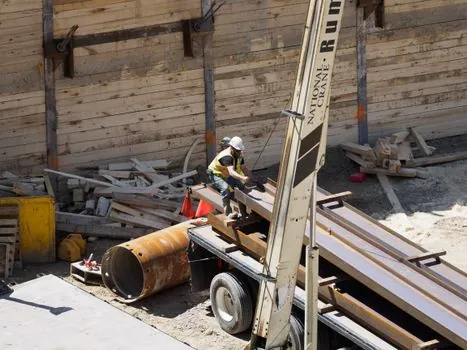
Standard build includes upper and lower hoist limit switches, overload limiter, long-travel and cross-travel limit switches, anti-collision buffers where two cranes share a runway, and a main isolating switch with padlock facility [S2]. For hazardous areas, all electrical enclosures must match the Ex rating quoted at order entry, and the control pendant or radio must be rated for the same zone [S2]. Manufacturer quality systems referenced in the 2026 product literature include ISO 9001, CE conformity under the Machinery Directive, and SGS third-party inspection [S2].
For routine yard work, the construction tools reference covers the broader rigging and lifting-accessory envelope (shackles, slings, spreader beams) that sits underneath any crane selection. Where a pipeline yard also operates diesel-driven pipeline pumps for hydrostatic testing, the pipeline pump reference is the right adjacent spec to keep on the engineer's desk.
Limits and Failure Modes to Watch
Single girder cranes are not the right tool when any of the following apply: the heaviest single pick exceeds 10 t (move to a double girder build); the work envelope is not a straight or gently curved rail (use a mobile crane); the building headroom cannot accommodate the hoist plus a safe hook travel plus the tallest object (use a low-headroom hoist or a different crane type); or the hazardous-area classification requires a gas group or temperature class outside the standard Ex d IIB T4 offering [S1][S2][S4]. The most common field failure mode is overload limiter bypass or mis-set, which removes the only automatic protection against girder overstress and is the single most frequent root cause in single girder incidents during spool fit-up. Misalignment of runway beams, typically ±5 mm or more across the span, produces end-carriage skewing and wheel-rail wear, and is the second-most common chronic defect on top-running single girder units.
A trackable next node for engineers specifying pipeline-yard single girder cranes in Q3-Q4 2026: confirm the explosion-proof build's exact gas group (IIA vs. IIB vs. IIC) and temperature class (T4 vs. T5 vs. T6) with the site hazardous-area classification report before issuing the purchase order, since changing the Ex rating after fabrication is not practical. The second signal is hoist-class confirmation: a 5 t heavy pick on an A3-rated hoist will derate the service life of the wire rope and motor, so ordering the next duty class up (A5) is the lower-total-cost-of-ownership choice for yards running two or more shifts [S1][S2].