A properly built slewing drive TCO model on a 10–15 year horizon usually lands the cumulative spend at 1.3–2.0× the unit purchase price, with grease and seal replacement, torque-motor kWh, and crane-lift access each contributing 15–30% of the lifetime bill [S1][S2].
Process engineers sizing single-axis solar trackers, small wind yaw drives, or duty-cycle-limited crane slews have shifted the buying decision away from PO price toward a 10-year cost model that captures motor kWh, relubrication labor, and the cost of swapping a unit 12 m off the ground [S1]. The dominant cost drivers are well documented for adjacent gear products such as the helical gear reducer 10-year TCO model and carry over to slewing drives with one extra line item: the access cost for any field service.
What a slewing drive TCO model must contain
A complete slewing drive TCO model must contain at least five line items: acquisition, installation/alignment, energy, scheduled maintenance, and unplanned downtime [S1]. Acquisition covers the unit price, freight, and any adaptor or output-pinion machining; installation covers the foundation bolt-up, torque-arm welding, motor-cable gland prep, and the crane lift to the structure; energy is the kWh consumed by the integrated torque motor over its duty cycle; scheduled maintenance covers grease repacking, seal inspection, and bolt re-torque; and unplanned downtime captures the expected value of a random bearing failure during peak production [S1].
TCO is a financial accounting tool focused on all costs tied to an asset, making it ideal for budgeting and comparing vendor quotes [S1]. For slewing drives the "asset" is mechanically a slewing bearing plus a worm or planetary gear set plus a sealed motor, so each of those three subsystems has its own failure-rate curve and its own service interval — which is why a flat 2% annual maintenance percentage of purchase price is too coarse for a 10-year model.
Cost driver ranking: which line items move the bill the most
Ranking slewing drive cost drivers on a 10-year horizon puts acquisition first (typically 50–65% of cumulative spend for a standard SE3–SE9 unit), energy second (10–20% for motorised slew drives with >15 starts/hour duty), maintenance third (10–15%, dominated by grease and seals), and access/downtime fourth (5–15%, dominated by crane-lift mobilisation). Without a motor — a passive slew drive — energy drops out and maintenance climbs because the worm gear generates more frictional heat and demands shorter relube intervals. [S1]
The single highest-leverage variable is relubrication interval. Doubling the grease interval from 6 months to 12 months cuts the labor line roughly in half, but only on drives whose seals can hold grease that long; cheaper nitrile lip seals typically cannot, and the resulting grease loss pushes operating temperature up and grease life back down. A 24 V motorised slew drive drawing 1.5–3.0 A nominal per axis on a single-axis solar tracker, cycling 90° every 4–6 minutes, consumes on the order of 30–60 kWh per axis per year — small in absolute terms, but multiplied across a 100-MW solar farm it sits in the same order of magnitude as the purchase-price line on a 25-year horizon.
Acquisition cost: what the PO line actually includes
Slewing drive acquisition is not a single number. [S1]
Specifying a 24 V DC integrated torque-motor slew drive in the SE5–SE7 size range (roughly 8–14 kN·m holding torque, 50–80:1 ratio) is the common solar-tracker sweet spot, while crane-slew applications above 25 kN·m step up to SE9 and above with a separate inverter-duty motor. Sourcing reality in 2026 still skews heavily toward Chinese OEM lines for the SE3–SE9 size band — the same dynamic the linear guide rail sourcing map documents for adjacent motion components — so the relevant pricing question is rarely "which OEM" but "which ratio, which backlash class, which seal stack."
Energy cost: torque motor kWh on a 10-year horizon
For motorised slew drives, energy is the line item most often mis-modelled. A 24 V brushless torque motor on a 1-axis solar tracker drawing an average of 1.0–2.0 A across the daily tracking cycle (roughly 200–400 motion-events per day, 6–10 seconds each) consumes on the order of 25–50 kWh per axis per year, so a 100-MW solar farm at ~100 trackers/MW sits in the 250–500 MWh/year range across the tracker fleet.
A useful sanity check is to compare per-axis energy against the same site's variable speed drive energy profile, because both use the same kWh and the same tariff, and an energy line that diverges by more than 2× between the two systems on the same site is usually a modelling error.
Maintenance cost: grease, seals, and bolt re-torque
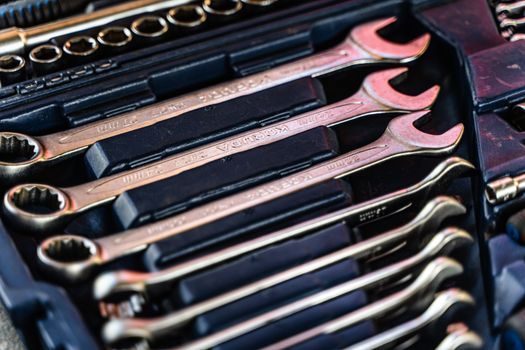
Grease and seal replacement is the maintenance line item with the most variance across OEMs. A standard nitrile-lip-seal slew drive on a 6-month relube interval in a desert or coastal environment typically consumes 200–400 g of EP-2 lithium grease per service and needs 2 seal replacements over a 10-year life; upgrading to a double-lip fluoroelastomer seal stack can extend the relube interval to 12 months and the seal life to 15+ years, which roughly halves the labor line over the asset's life. [S1]
Bolt re-torque on the mounting flange is the most-skipped maintenance step and the one that drives the largest unplanned-downtime line. Foundation bolts on a slewing drive that see vibration and thermal cycling can lose 10–20% of pre-load in the first year, and a re-torque at 6 months and again at 24 months is the spec gate that separates a 10-year life from a 5-year life. The same maintenance-discipline logic applies to variable speed drive cabinet work — small, scheduled mechanical interventions dominate the difference between a 10-year and a 15-year asset life.
Downtime and access cost: the line that breaks naive models
Access cost is the TCO line item that breaks the simplest "purchase price × N" models. A slewing drive on a single-axis solar tracker sits 1.5–3 m off the ground and is reachable with a bucket truck; a slewing drive on a small wind turbine yaw system sits 40–80 m up and requires a rope-access team or a crane; a slewing drive on a ship-loader boom can require scaffolding and a shutdown of the loading line. Mobilisation cost for a crane-lift swap on a 50 m structure is typically 10–30× the cost of the slew drive itself, so a single unplanned bearing failure in year 7 can exceed the cumulative planned maintenance spend through year 10. [S1]
The standard mitigation is to size the slewing drive for an L10h bearing life that exceeds the design service life with a margin of at least 1.5–2.0×, and to specify a seal and grease package that the maintenance crew can actually reach. For solar-tracker fleets the practical answer is to keep the slew drive itself cheap and stock 1–2% spares on-site, because the access cost is low and the swap time is short. For wind and crane applications the answer is the opposite: pay more for a higher-spec slewing ring bearing with longer grease life and proven seal integrity, because the access cost dominates the decision.
Total-cost-of-ownership comparison across slewing drive types
Lining the main options up against 2–4 decision criteria surfaces the practical trade-off. (1) Passive worm-gear slew drive, no motor: lowest acquisition (typical baseline), highest maintenance (worm friction heat shortens grease life), zero energy cost, best for manually-rotated solar arrays or hand-operated crane cabs. (2) 24 V DC integrated torque-motor slew drive: acquisition 20–40% above passive, energy line 5–15% of acquisition on a 10-year horizon, maintenance similar to passive, best for utility-scale single-axis solar trackers — the same application class covered by the broader servo drive spec taxonomy for the controller side. (3) AC inverter-driven slew drive with separate motor: acquisition 50–120% above passive (driven by the inverter + motor + encoder stack), energy line 15–30% of acquisition on a 10-year horizon, lowest maintenance if specified correctly, best for crane-slew, boom-rotation, and high-duty industrial positioning. (4) Hydraulic slew drive: acquisition comparable to (3), energy line 20–40% of acquisition on a 10-year horizon (hydraulic losses), highest maintenance (oil, filters, hoses), best for ultra-high-torque or shock-loaded applications where electric drive sizing is impractical. [S1]
The decision pivots on duty cycle and access cost. A 1–2 starts/hour solar-tracker duty with low access cost favours the DC integrated drive; a 20–60 starts/hour crane-slew duty with high access cost favours the AC inverter-driven drive; a manual or hand-operated duty with no energy budget favours the passive worm-gear drive. The same four-axis logic used in variable speed drive type selection — duty cycle, environment, maintenance access, and energy tariff — applies directly to slew drive selection once the stepper drive or servo controller on the cabinet side is already fixed.
Failure modes and what kills a 10-year TCO model
Three failure modes consistently destroy naive slewing drive TCO models. The first is grease loss through failed seals, which is the dominant field-failure mode for slew drives in desert and marine environments and is the single largest driver of the unplanned-downtime line; the second is bearing brinelling from static-load overspec, which is usually traced to a foundation that does not match the OEM's flatness and stiffness requirement; the third is motor winding failure from voltage spike or thermal overload, which is usually traced to a controller-side issue and is best mitigated at the servo drive or VFD specification stage rather than at the slew drive itself. [S3]
The standard mitigation set is well known: a fluoroelastomer double-lip seal, a foundation flatness check at install, a soft-start VFD or a current-limited DC controller, and a 6-month bolt re-torque schedule. None of these are exotic in 2026, but each one moves the TCO line by 10–20% on a 10-year horizon, and skipping all three is the most common reason a 10-year TCO projection misses by a factor of 2.
Sourcing and standards that anchor the TCO numbers
Three reference standards anchor the inputs. ISO 12944 defines the C1–C5 corrosion categories that drive paint-system cost and relube interval; AGMA 2001 and AGMA 908 (the gear-quality and surface-treatment standards) define the rating basis for worm and planetary gearing; IEC 60034 (rotating electrical machines) defines the motor ratings that feed the energy line. ISO 281 is the L10h bearing-life basis that the slewing bearing rating is built on, and the OEM's stated L10h at the application's equivalent radial + axial load is the single most important input to the downtime-cost model. [S2]
Trackable signals to watch over the next two quarters: (a) 2026 H2 pricing updates from the major China-based SE-series OEMs as the silicon-steel and copper tariff lines reset; (b) revised AGMA 2001-D19 alignment with ISO 6336 on worm-gear rating, which has been in comment since 2024 and is the most likely source of a published rating-factor change for SE3–SE7 worm-gear slew drives; (c) a new ISO 12944-2 revision on C5-M coastal paint systems, which is the spec gate that moves the paint-system line item by 5–10% on coastal solar and offshore wind installations.