A 2026 solar glass line is selected first by end product, then by capacity, then by tolerance: rolled-pattern hot ends for textured PV cover glass run 1200-1260 t/d at ±0.2 mm thickness tolerance, BIPV laminated cold ends hold ±0.3 mm assembly accuracy at up to 99% yield, and continuous tempering furnaces deliver 3-5x the throughput of legacy batch units [S1][S3][S5].
Scope of this map covers three line classes: the rolled-glass hot end (melting through annealing), the BIPV/laminated glass cold end (loading through autoclave), and the continuous tempering/conveyor section that bridges substrate and module assembly. Each class has a different dominant spec gate, and confusing them is the single most common procurement error on multi-million-dollar bids.
Rolled-Glass Hot End: Capacity, Thickness Range, and Roller Control
The rolled-glass hot end is governed by tonnage-per-day output, sheet thickness range, and roller-surface temperature stability rather than by optical transmittance targets. A 2026 production reference specifies 1200 t/d hot-end capacity for 1.4-2.0 mm industrial mass production (1.1 mm is documented as laboratory scale) with max raw-sheet width of 3650 mm, finished yield ≥92%, and glass thickness tolerance of ±0.2 mm [S1]. Roller-surface temperature control is held within ≤±1.5°C across the rolling section, with smart temperature loops tightening that to roughly ±1°C on premium configurations; the textured surface produced in this step drives light transmittance up to 93.5% on high-transparency grades, which is the optical property that downstream PV cell makers care about [S1].
Selection on the hot end boils down to four numbers: thickness range, width, daily tonnage, and yield. Industrial buyers who need 2.0-3.2 mm patterned cover glass for double-glass modules can target the cold-end configuration supporting 1260 t/d across six lines fed by one annealing lehr, with Line 1/Line 5 cutting 1129×2273 mm, 1297×2384 mm, and 985×1955 mm panels from 3400-4200 mm raw sheet [S1]. Buyers targeting ultra-thin (≤2.0 mm) cover glass for lightweight double-glass modules should not assume the same width/tonnage combination, since ultra-thin runs in the research are documented at the lower 1.4-2.0 mm range with narrower widths on Lines 2-4 (2350-2800 mm raw, 1970-2600 mm finished) [S1]. For background on how patterned glass fits into a broader glass taxonomy, see the optical glass and sight glass reference pages.
BIPV and Laminated Cold End: Assembly Accuracy, Yield, and Footprint
BIPV cold-end lines in 2026 are differentiated by assembly accuracy, layup speed, and autoclave class rather than by melting throughput. A documented 2026 BIPV line holds ±0.3 mm assembly accuracy with finished-product yield up to 99%, supports max glass size 3300×6000 mm for BIPV and 3300×20000 mm for laminated (customizable), and operates on 3-19 mm glass thickness with pre-lamination stack thickness 6-100 mm [S3]. Vacuum lifter travel runs 60 m/min (servo-driven) and buffer conveyors run 30 m/min (VFD), with compressed air at 0.6-0.8 MPa and total installed power ranging from roughly 19.7 kW (BIPV excluding autoclave) to 570 kW (BGF30120 autoclave configuration) on AC 380 V, three-phase, 50 ± 2 Hz [S3].
Selection on the cold end is dominated by three questions: what is the largest BIPV panel the line must lay up, does the project need an in-line autoclave, and how is MES integration handled. Buyers specifying continuous lamination should confirm whether the quoted line includes the autoclave (385.1 kW for the laminated line alone, plus 405-570 kW per autoclave unit) and whether the MES package supports remote order monitoring from mobile devices, which is a documented feature on 2026 BIPV equipment [S3]. Layout flexibility (U-shaped, L-shaped, parallel) and convection heating that reduces energy use by 30% versus conventional systems are differentiators that matter more on brownfield retrofits than on greenfield sites [S3]. For a comparison anchor against adjacent solar manufacturing decisions, see Solar Cell OEM vs ODM Manufacturing: 2026 Spec, Cost, and IP Trade-Offs.
Continuous Tempering and Conveyor: Throughput Multiplier vs Batch Furnaces
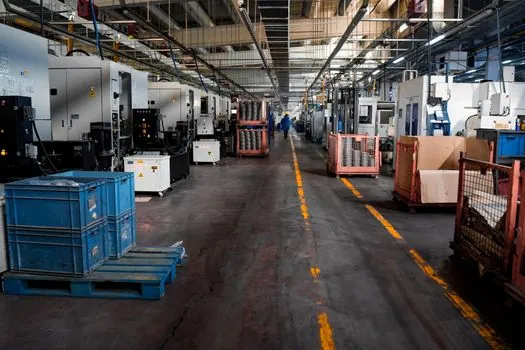
Continuous conveyor tempering is the throughput lever that turns a 1200 t/d hot end into a finished, shippable solar cover-glass output. 2026 continuous furnace designs claim 3-5x the production capacity of traditional batch furnaces by eliminating load/heat/unload idle cycles, holding glass at constant velocity through multi-zone radiant elements, and using composite insulation to cut thermal loss [S5]. Thickness range on documented continuous lines is 3-10 mm, with multi-zone radiant heating and an Industrial PC control system synchronized across heating zones, CE certification for European projects, and 220V/380V/415V at 50/60 Hz power compatibility [S5].
The tempering decision gate is throughput per square meter, not energy savings alone. Batch furnaces waste energy on reheating chambers between cycles, while continuous lines hold steady-state thermal load and reduce per-square-meter electricity cost, but require a constant incoming glass flow to justify the capital cost; plants below ~200 t/d of finished cover glass rarely see ROI on continuous tempering versus a well-run batch furnace [S5]. For solar-specific lines, the same vendor class also markets dedicated solar glass continuous tempering configurations targeted at PV backsheets and oven-door-grade appliance lites with synchronized cooling and constant roller velocity [S7]. Adjacent comparison material on how solar manufacturing decisions link to broader construction-glass procurement is covered in School Window and Door Spec Map: Safety Glass, Aluminum Framing, and Code Gates.
Line-Type Comparison: Hot End vs BIPV Cold End vs Continuous Tempering
The three line classes do not compete with each other; they sit in series on a finished-glass line. The hot end (melting + rolling + annealing) is selected on tonnage per day, thickness range, and roller temperature stability, with 1200-1260 t/d and ±0.2 mm tolerance as the 2026 reference point [S1]. The BIPV/laminated cold end is selected on assembly accuracy, max layup size, and autoclave class, with ±0.3 mm and up to 99% yield as documented [S3]. Continuous tempering is selected on throughput multiplier and thickness range, with 3-5x batch capacity and 3-10 mm thickness as documented [S5]. Buyers who spec all three at once should match tonnage out of the hot end to layup capacity at the cold end and to tempering throughput downstream, since a 1200 t/d hot end feeding a 19.7 kW BIPV layup station without an in-line autoclave creates a bottleneck the MES will not paper over.
Sourcing Standards, Environmental Limits, and Practical Constraints
Two non-optical constraints decide whether a 2026 line is bankable in regulated markets: NOx emissions and energy recovery. A documented 2026 rolled-glass line holds NOx below 200 mg/m³ via low-emission melting technology and recovers furnace waste heat to cut overall energy use by roughly 15%, both of which are explicit gates for EU-aligned project finance [S1]. On the BIPV cold end, the documented 30% energy reduction versus conventional convection heating is achieved through stainless-steel heating elements and high-performance convection arrays, with safety architecture including protective covers, safety fencing, and radar sensors [S3].
Practical constraints that do not appear on glossy spec sheets: AI visual inspection on premium 2026 lines claims defect-detection accuracy up to 99.5%, but only when lighting, glass velocity, and roller cleanliness are held inside the vendor's envelope, and a 2.0 mm ultra-thin rolled glass is documented as roughly 30% stronger in impact resistance than the thicker commodity grades, which matters for hail-zone project specifications [S1]. Buyers should also confirm that any quoted tonnage-per-day figure includes the annealing lehr, since one lehr is documented as supporting six production lines, not one [S1]. For a broader view of how industrial process lines are evaluated against throughput and code gates, see the reference page on molding line selection logic, which uses a comparable criteria-based comparison approach.
Trackable signals for the next procurement cycle: published NOx limits below 200 mg/m³ as an EU baseline, ±0.2 mm thickness tolerance becoming the de facto tender floor on hot-end bids, and BIPV line MES packages standardising on mobile remote order monitoring by mid-2027. Buyers specifying in Q4 2026 should lock tonnage and tolerance clauses against the references above, since both move against the buyer's favour as continuous-tempering capacity comes online.