
Portable 110-125mm cut-off saws rated 1400W at 220-240V and 50/60Hz cover the bulk of on-site electrical conduit, trunking, and small-section steel work; the heavy 355mm class at 2200W and 3800-4000 rpm covers panel-room steel and busbar cutting [S2][S4][S5].
Electrical installers typically need both classes on a job: a 110/125mm portable for overhead cable tray and conduit, plus a 355mm machine for switchboard frame and large-bar work. Selecting the wrong diameter costs cycle time; selecting the wrong abrasive vs diamond wheel for the material ruins the cut and the workpiece.
Portable 110-125mm Class: Where the Work Actually Lives
Model 61215 from Zhejiang Minli specifies a 110/125mm blade diameter, 1400W rated input, 220-240V, and 50/60Hz, in the small-format portable class that field electricians carry to the panel [S4]. This size bracket matches the 1-2 inch conduit and 25-50mm cable tray work that dominates commercial fit-out; the 1400W input is enough to drive a thin abrasive wheel through 3mm steel sheet without bogging.
The cutoff decision at this size is abrasive wheel vs diamond wheel: abrasive silicon-carbide or aluminium-oxide wheels are the default for mild steel, stainless, and copper; diamond wheels are mandatory for masonry, concrete, and ceramic channel. Substituting a diamond wheel on steel generates heat the bond cannot shed and typically destroys the wheel in seconds. This 110/125mm class draws 1400W continuously, so the on-site supply must be rated for sustained 6A+ draw at 220-240V [S4].
355mm Stationary / Heavy-Duty Class: Panel Rooms and Busbar
The 355mm class is defined by blade diameter 355mm, no-load speed 3800-4000 rpm, 2200W rated input, and 220-230V at 50/60Hz, as published on Made-in-China product listings for the Chuanben 2200W portable steel cutter and the KD4355T [S2][S5]. The KD4355T datasheet shows a maximum cutting capacity of 115mm, which is the practical limit for solid round stock in this class [S5].
Use this class where the workpiece is too large or too heavy to move: switchboard cubicle frames, support steel, and thick-wall trunking. A 2200W motor at 3800-4000 rpm produces peripheral blade speed in the 70-75 m/s band, which is fast enough for clean mild-steel cuts but requires respect for kickback. For comparison, the industrial Rema PS swing-frame grinding series runs at 60 m/s on its standard configuration and offers an 80 m/s option, indicating that 60 m/s is the conservative lower bound for foundry-class grinding [S1].
Power, Voltage, and Frequency: Match the Site, Not the Catalogue
110-125mm portable machines are published at 220-240V, 50/60Hz, 1400W; 355mm class machines at 110/220V or 220-230V, 50/60Hz, 2200W [S2][S4][S5]. That dual-frequency rating matters on cross-border sites: a 50Hz motor on 60Hz supply runs ~17% faster with ~17% less torque, while a 60Hz motor on 50Hz supply overheats because the cooling fan slows.
The 2200W class at 220-230V draws roughly 10A continuous; on a 16A European site circuit that is acceptable, but on a 15A North-American 120V branch it is not. The 110V variant of the 355mm Chuanben saw exists specifically for construction-site transformers and is the only practical choice on 110V site distribution [S2]. The 355mm KD4355T ships as 1 piece per case at a published 2200W rating and 4000 rpm no-load speed, which is the upper end of the speed band for this diameter [S5].
Gasoline vs Electric: When the Engine Has to Replace the Cable
Gasoline cut-off machines such as the STIHL TS 420 are specified for 14" abrasive wheels and built around road, landscaping, and remote-site work where no power cable can reach [S3]. The TS 420 carries a low-maintenance cyclone-routed air filter and the STIHL anti-vibration system for cut guidance, both of which target operator endurance on long kerf cuts rather than precision panel work [S3].
For inside electrical installation, the gasoline option is usually wrong: exhaust fumes, fuel storage on the floor of an energised panel room, and the noise footprint of a 2-stroke on a finished fit-out all argue for the corded 2200W class. The 14" / 350mm gasoline class is the right answer only for outdoor substation civils, ground-rod trenching, and concrete-encased duct-bank work. Where electrical-installation work overlaps heavy civils, the Excavator selection for landfill operations: 2026 spec map reading list is the closer reference than indoor tool specs.
Abrasive Wheel vs Diamond Wheel: Material Drives the Choice
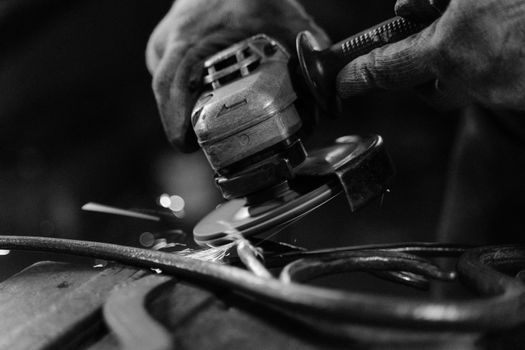
Abrasive wheels (silicon carbide for masonry, aluminium oxide for steel) are consumable: expect 1-3 cuts per wheel on heavy steel at this power. Diamond wheels last longer on masonry but cut steel poorly and overheat on it. The 60 m/s peripheral speed of the Rema PS series is the lower bound for foundry grinding; portable cut-off saws running at 3800-4000 rpm with a 355mm wheel operate at ~70-75 m/s peripheral, which is the upper end of the safe abrasive band [S1][S2][S5].
Bond type matters as much as abrasive: resin-bonded wheels are standard portable-saw fitment and tolerate the lateral loads of a hand-guided cut; metal-bonded diamond wheels are for wet-cutting masonry on a sliding table and will shatter if used dry in a hand saw. The published cutting capacity of 115mm on the KD4355T assumes an abrasive wheel; with a diamond wheel of the same diameter the practical depth drops because of the thicker kerf and bond wear [S5].
Selection Criteria Checklist for the Electrical Installer
Match blade diameter to the largest section you must cut plus 10-15mm clearance, not to the average workpiece. A 110mm saw cannot cut a 90mm solid bar; a 355mm saw cuts a 20mm conduit but wastes kerf and cycle time. The Minli 61215 at 110/125mm covers the 0-50mm steel range; the KD4355T at 355mm covers 50-115mm solid and most standard structural sections [S4][S5].
Match power to duty cycle: 1400W is sufficient for intermittent cuts in 1-3mm sheet, conduit, and tray; 2200W is required for continuous production cutting or any workpiece above 6mm wall thickness. Match voltage to site supply: 220-240V for European and most Asian commercial sites, 110V via transformer for UK-style construction sites and North-American residential. Match frequency to motor nameplate; the 50/60Hz universal motor in this class tolerates either, but induction motors (uncommon in handheld saws) do not. A 4-step decision on diameter, power, voltage, and wheel type covers most site-procurement calls [S2][S4][S5].
Common Failure Modes and When to Replace, Not Repair
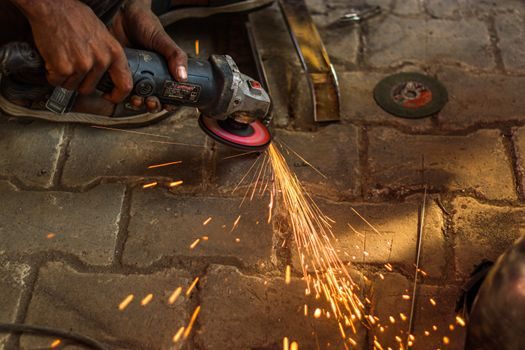
Symptom: cut-off saw stalls mid-cut. Root cause: insufficient power, dull wheel, or wrong wheel for material. Corrective action: replace wheel, verify 2200W input under load; if voltage at the plug drops below 200V on a 230V nominal supply, the supply cable is too long or too thin. Acceptance: clean cut at published feed rate without motor stall [S2][S5].
Symptom: cut quality degrades, wheel wears fast on one side. Root cause: bearing failure or bent spindle. Corrective action: replace bearings as a unit; do not attempt to true a bent spindle. Acceptance: runout under 0.05mm at the flange. Symptom: cut-off saw trips the site RCD on start. Root cause: brush dust or moisture ingress in the motor, or a wet-cut application without an isolation transformer. Corrective action: dry out, replace brushes, or specify an isolating transformer rated for the saw; for residual-current device selection, see the Residual Current Circuit Breaker Selection Guide for 2026 Spec Maps reference. Symptom: cracked wheel after a glancing impact. Action: discard the wheel; do not reuse. Abrasive wheels are not repairable. Replace when any visible chip, crack, or burning pattern appears [S1][S2].
For a deeper cross-reference on power tool selection frameworks, the Industrial Oven Types and Applications: A 2026 Spec-Driven Selection Map reading covers motor-duty matching principles that apply to any continuous-duty electrical tool. Watch for two signals in the next procurement cycle: vendors publishing 110V 355mm class machines for the North-American retrofit market, and the wider adoption of brushless motors in the 1400W portable class, which would push continuous-duty ratings upward without changing the published input wattage.
For the relevant spec sheets and selection criteria, see electrical fire monitor, explosion proof electrical, and coding machine.