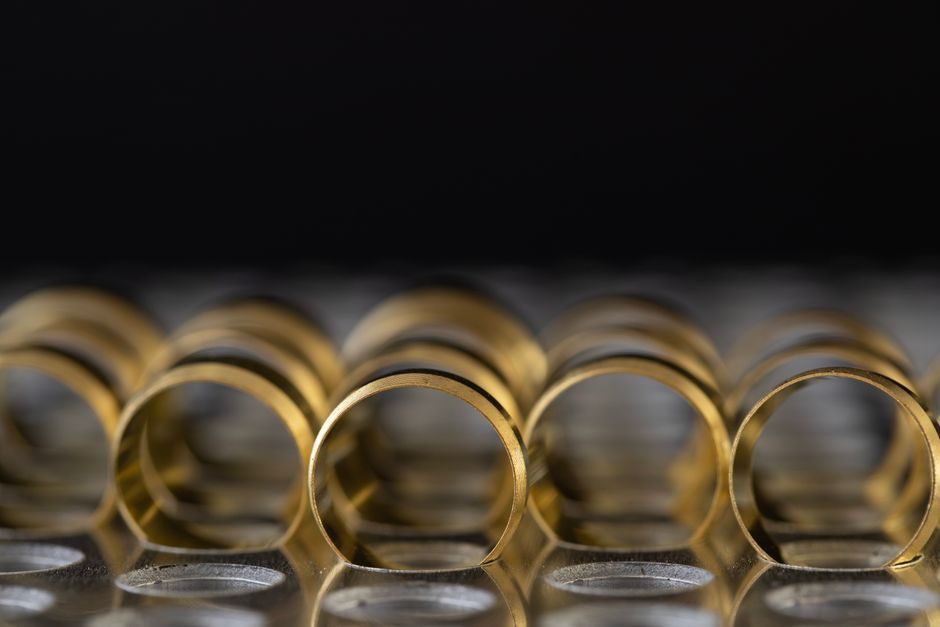
Spring washers are grouped into five functional families — Belleville, curved, wave, finger, and split-ring lock — with selection driven by load-deflection behaviour, material grade, and standard size call-outs (DIN 7980, BS 4464, IS 3063) [S1][S7].
The most common metric geometry, DIN 7980 Type A square-section spring lock washers, covers nominal screw sizes M3 through M33, with inside-diameter clearances stepping from 3.1 mm at M3 to 33.5 mm at M33 and section thickness rising from 1.0 mm (M3) to 6.0 mm (M30/M33) [S7]. Materials listed by stockists include hardened spring steel, A2/SS-301, and A4/SS-316 stainless, with natural finish as standard and black coating available on request [S1].
Belleville (Conical Disc Spring) Washers
Belleville washers provide the highest load-bearing capacity per unit axial space of any spring-washer family, per Huyett's classification of the major spring-washer groups [S3]. Lee Spring's catalogue (series W1–W3) lists Type 300 stainless passivated Belleville parts with a recommended service ceiling of 260 °C (500 °F); parts are 100 % magnetic for the 300-series grade in their standard form [S2].
Load behaviour is set by the height-to-thickness ratio h/t: ratios above approximately 1.3 give a non-linear curve that drops to zero at the flat position, while low h/t ratios (≈ 0.4) deliver a near-linear response up to roughly 60–80 % of Pmax [S2]. For a single W1 250-020-500 part, Pmax is 31.3 kg (69.1 lb) at full flat; the heavier W2 250-038-500 reaches 161.2 kg (355.3 lb) at the same 12.7 mm OD, demonstrating how the 0.020 → 0.038 in material-thickness change drives a ~5× load increase at constant diameter [S2].
Stacking rules are explicit in the Lee Spring datasheet: parallel stacking multiplies load (2×, 3×, 4×) at constant deflection, series stacking multiplies deflection (2×, 3×, 4×) at constant load, and mixed series-parallel stacks give intermediate load-deflection points — the design lever for thermal-expansion compensation and bolted-joint relaxation control [S2][S3].
Curved, Wave, and Finger Spring Washers
Curved (single-wave) washers are rated for relatively light thrust loads and are typically specified for absorbing axial end-play or as light lock washers, with linear spring rate as a defining characteristic [S3]. Wave washers extend the same concept with three-point contact and sharper crests, which raises load capacity at small deflections and makes them a standard pick for bearing pre-load and shock-absorption in confined radial spaces [S3].
Finger washers combine curved and wave geometry, with stamped fingers that counter wear, vibration, noise, and end-play — frequently used to pre-load ball bearings where internal clearance is unavoidable [S3]. Compared with split lock washers, the wave family expands less under compression and avoids the sharp bite-edges that can gall the mating surface, which is why spec sheets consistently list them for thrust-loading and small-deflection applications [S3].
Split-Ring and Single-Coil Lock Washers
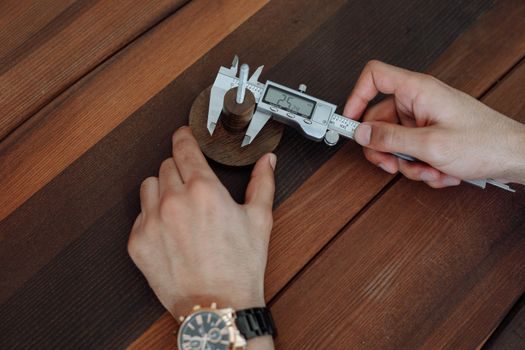
Split lock washers — the "single coil rectangular section" geometry — are the most widely specified anti-loosening washer in DIN 7980 and IS 3063 builds, with IS 3063 (1994) covering bolt/nut assemblies using property class 5.8 or lower in sizes 2–100 mm [S6]. The split-ring action generates outward spring force against the bolt face and mating surface, providing a low-cost anti-vibration bite suited to general machinery [S4][S5].
For metric DIN 7980 Type A, the standard dimensions pair a free OD and free height (H) with a section thickness (s) at each nominal size: M3 free OD 5.5 mm / H 2 mm / s 1 mm; M6 free OD 9.6 mm / H 3.2 mm / s 1.5 mm; M10 free OD 15.9 mm / H 5 mm / s 2.5 mm; M16 free OD 24.3 mm / H 7 mm / s 3.5 mm; and M24 free OD 35.7 mm / H 10 mm / s 5 mm [S7]. Hardness for spring-steel split lock washers typically falls in the 44–53 HRC range for the rectangular section, while A2/A4 stainless variants are used where corrosion resistance outranks bite-force [S6][S1].
Material, Finish, and Standard Cross-Reference
Standard material options carried by Indian and UK stockists (J C Gupta & Sons, Farnell) are spring steel with zinc-and-clear finish, SS-301, SS-316 (A4), and black-finish spring steel on request, all in DIN 7980 square-section form [S1][S7]. BS 4464 is the British Standard equivalent to DIN 7980 for Type A metric spring washers, so the same M3–M33 table applies on both sides of the standard cross-reference [S7]. For high-temperature service above the 260 °C Type-300 stainless limit, Inconel or other nickel alloys are typically substituted, though those grades are not part of the DIN 7980 stock programme [S2].
When the bolted joint must survive thermal cycling, the spring washer is one option, but the same function is sometimes achieved with a properly loaded sealing washer where leak-tightness is the priority — the families overlap in catalogue listings but serve different design intents. Where the joint is part of a pressurized instrument assembly, the upstream selection of a pressure sensor or pressure transmitter is typically reviewed before the washer is frozen, because the gasket stack height drives the spring rate the washer must compensate.
Selection Criteria: Comparison Across Types

The five families are not interchangeable. On four standard decision criteria — load capacity per unit height, deflection range, vibration-loosening resistance, and cost — the rough ordering from OEM catalogue data is: Belleville > wave > finger ≈ split lock > curved on load density; curved ≈ wave > finger > split lock > Belleville on maximum deflection; split lock ≈ finger > wave > Belleville > curved on bite/anti-vibration; and split lock ≈ curved > wave > finger > Belleville on unit cost [S2][S3][S4][S5].
Specifying engineers can map the family to the duty: Belleville for high-load, low-deflection thermal-compensation joints (stacked in series/parallel to tune rate) [S2]; wave or curved for bearing pre-load where radial space is constrained [S3]; finger washers where end-play and noise control dominate and a curved/wave hybrid is acceptable [S3]; and DIN 7980 / IS 3063 split lock for general-purpose bolt/nut anti-loosening up to M33 [S6][S7]. The h/t ratio of a Belleville stack, the section thickness s of a DIN 7980 split lock, and the number of fingers on a finger washer are the three numerical levers a designer should lock down before release, because each one drives a different failure mode — flat-bottoming, loss of bite, or finger fatigue respectively [S2][S3][S6].
Limits, Failure Modes, and Sourcing Signals
Spring washers fail by three documented mechanisms: flat-bottoming (Belleville) when the joint closes past the calculated h deflection and Pmax is exceeded; loss of hardness in split-ring parts when the carbon-steel grade is exposed above its tempered range; and fatigue cracking at the split ends of DIN 7980 washers in high-cycle vibration, which is why property class 5.8 is the documented upper limit for IS 3063 single-coil lock washers [S6][S7]. Wave and finger washers fail by finger/crown fatigue at the bend radii, with no single standard governing cycle life — sourcing has to rely on the OEM's published load-deflection curve and salt-spray data rather than a standard number [S3].
Sourcing signals in 2026 are mixed: DIN 7980 spring steel with zinc-clear finish remains the lowest-cost, highest-availability metric format (M3–M33 stocked in both A2 and A4 stainless by J C Gupta & Sons and Farnell) [S1][S7]; Belleville Type-300 stainless in 0.5–1.6 mm thickness is broadly available with 2–4 week custom lead times from Lee Spring and equivalents [S2]; and finger/wave washers continue to be sourced application-specific, with no dominant stock standard. Engineers specifying a sealing washer for a flanged connection should verify whether the same supplier stocks both the spring and the sealing element, since the flow meter or industrial valve assembly may be built around a single gasket stack height and a mixed-source stack risks tolerance drift.
Trackable next nodes for spec engineers: confirm whether the bolted joint requires property class 5.8 (IS 3063 limit) or higher, since that single decision rules split-ring vs Belleville selection [S6]; and for any Belleville stack above 200 °C service, request the OEM's elevated-temperature relaxation curve rather than relying on the 260 °C Type-300 stainless ambient rating [S2]. Related background on fastener and material-grade selection in 2026 is covered in the cutting tools 2026 material and qualification roundup and the abrasives 2026 grain-standards brief, both of which feed the same upstream metallurgical supply chain that produces spring-washer raw stock.