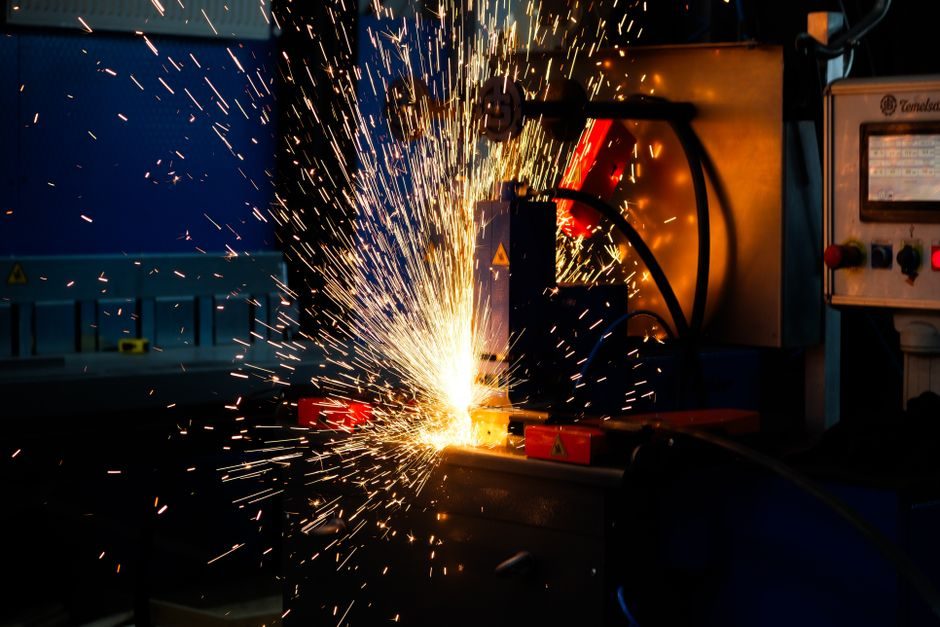
Steel smart manufacturing in 2026 is built on a four-layer stack — plant-floor IoT sensors, AI-driven machine vision, MES/MOM orchestration and cloud analytics — retrofitted onto existing EAF, BOF, continuous-casting and rolling lines [S1][S3]. Chinese plate and special-steel producers have moved from pilot cells to multi-workshop integrations covering plate cutting, profile processing and surface finishing, with ZYT and Weben shipping turn-key robotic cells, stereo-camera QA and smart-crane dispatching as packaged reference architectures [S3][S6].
The procurement question is no longer "do we need a smart-factory roadmap" but which platform, which sensor density and which robotics vendor will integrate with the existing DCS and PLC base. The reference flow looks like: smelter → caster → reheat furnace → roughing/tandem mill → laminar cooling → coiler → surface-inspection vision → automated packing, with each node generating structured data and a discrete automation island.
Reference Architecture: From Furnace to Coiler
A 2026-vintage steel digital stack layers Industrial IoT (temperature, vibration, force, laser-width gauges) on the field level, AI vision at the QA gate, MES above the PLC/DCS layer, and a cloud/edge analytics tier doing predictive models [S1][S3]. ZYT packages this for the steel cell as three product lines: steel-manufacturing robotics (spray-painting, ladle-handling, slag-skimming arms), stereo-camera industrial-vision QA, and smart-crane dispatching [S3]. Weben layers an MES-equivalent on top, with explicit modules for steel-plate cutting-shop integration, profile-line integration and a cross-workshop scheduler that sequences plate nesting, bevel cutting and downstream welding [S6].
The Renishaw smart-manufacturing data platform — built around its probing/encoder hardware — targets closed-loop in-process measurement: encoder feedback, ballbar/datum checks and probing cycles feed a process-control platform that closes tolerances on machined and rolled features [S4]. A 2026 platform comparison also surfaces Cratus ASSET-Rx and the Plex Smart Manufacturing Platform (Rockwell Automation) as competing software layers for asset performance, OEE and batch genealogy, with Plex shipping with a Production Monitoring module that delivers 100% historical part-and-process records [S5].
AI Vision, Stereo Cameras and the QA Gate
Surface-defect detection on cold-rolled strip and plate is now a standard stereo-camera-and-deep-learning cell, with ZYT offering industrial-vision modules that classify scale, scratches, slivers and edge cracks at line speeds typical of 1200–1800 m/min strip mills [S3]. Pairing the vision cell with laser-width gauges and a width/thickness profile scanner is the cheapest single upgrade on a legacy finishing line, because the data is already there — it just isn't being closed-loopped to the mill screwdown or the coiler tension set-point.
The economics work because the same cell that classifies defects also drives automated downgrading, rerouting and re-coiling decisions, removing the operator bottleneck that defines OEE on a 1.5 Mt/yr line. For an in-depth look at how vision systems layer into MES and laser-based spec gates, the PV smart manufacturing 2026 spec-gate workflow walks the same architecture on a solar line. Steel cells differ in throughput envelope and radiation-hard sensor needs, but the MES-vision-laser pattern is identical.
Robotics Cells for Steel: Spray, Ladle, Slag, Crane
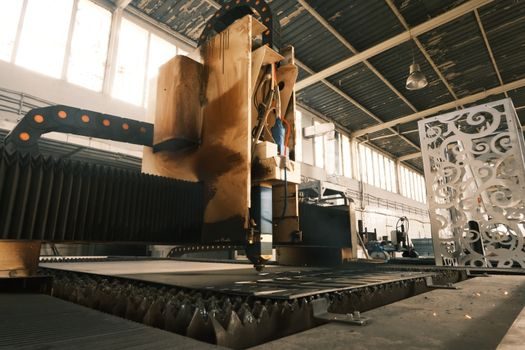
Steel-mill robotics is no longer a "future trend" — it is a purchased SKU in 2026. ZYT's catalogue lists robot painting/spraying machines as a stock product for plate and section coating, alongside ladle-handling and slag-skimming arms for EAF/BOF aisles [S3]. Weben integrates the cutting-shop cell with robotic plate-positioning, automated torch-height control and a vision-guided bevel head, with the workshop scheduler optimising plate nesting, off-cut reuse and the cut→weld hand-off [S6].
Smart cranes close the loop on heavy logistics: the crane knows ladle grade, temperature-loss budget and the next heat's start time, and dispatches itself into the bay without operator joystick input. The crane cell plus a ladle-level radar plus a slag-detection vision system is the highest-ROI retrofit in a BOF shop, because every minute of tap-to-tap compression is direct capacity gain on an asset that already has 20–30-year life. The line between "smart manufacturing" and "industrial automation" is increasingly thin — Rockwell's own 2026 industrial-automation catalogue frames smart-manufacturing software as a layer over the same PLC, VFD and safety stack shipped since the 2010s.
Selecting Sensors and Materials for Harsh Mill Environments
Mill-floor sensors have to survive ambient temperatures of 60–80 °C near the reheat furnace, EMI from VFD-driven roller tables, vibration on the runout table, and water/scale splash in the descaler zone. Specifying the wrong housing grade is the single most common cause of failed smart-factory rollouts on legacy lines. For structural frames, gear housings and base plates inside the cell, alloy steel grades (4140, 4340) are preferred where shock and fatigue dominate, while carbon steel (A36, A516-70) remains the default for fabricated guarding, racks and non-critical brackets where weldability and cost dominate. Bearings and pins still follow standard AISI/SAE grade codes; the selection rule has not changed because of the digital layer — the digital layer just exposes which grades were over- or under-specified. [S1]
For the OT network itself, smart valve positioners, smart meters and smart cameras form the field-side triad that feeds the MES: valve positioners close the cooling-water, gas-mixing and oxygen-lance control loops, smart meters close the electricity, gas and water mass-balance used in energy-KPI reporting, and smart cameras close the surface-QA and load-positioning loops. None of these are "new" — what is new in 2026 is the deterministic, on-prem gateway that aggregates the four protocols (HART, IO-Link, PROFINET, EtherNet/IP) into one OPC-UA broker at the cell edge.
Comparing the 2026 Platform Options
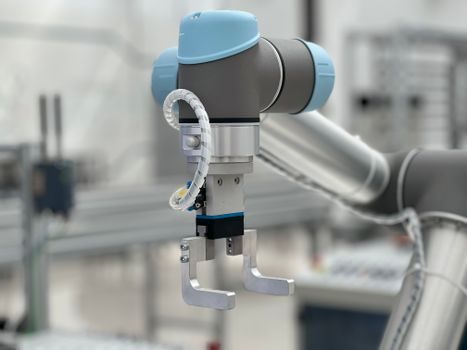
Four software stacks dominate the steel-mill MES/MOM layer in 2026: Plex Smart Manufacturing Platform (Rockwell, asset-and-batch focused, native OEE and genealogy) [S5]; Cratus ASSET-Rx (asset performance and reliability, narrower than Plex) [S5]; the Renishaw smart-manufacturing data platform (closed-loop measurement-centric, best when probing/encoder feedback is the primary data source) [S4]; and the Weben steel-shop scheduler (workshop-and-cell scheduling, strongest on cutting-shop nesting and cross-workshop flow) [S6]. The selection criteria are: depth of batch/heat genealogy (Plex), strength of asset-reliability analytics (ASSET-Rx), tightness of measurement-to-actuator closed loop (Renishaw), and breadth of steel-specific workshop scheduling (Weben).
For a greenfield integration, the common reference architecture is a Weben-style steel MES at the workshop layer, a Plex/ASSET-Rx-style MOM at the plant layer, a Renishaw-style closed-loop measurement platform on the cells that need micron-class control, and a Rockwell-style automation backbone carrying the PLC/VFD/safety stack underneath [S4][S5][S6]. For retrofit on a 1990s-vintage mill with an existing ABB or Siemens DCS, the most common compromise is to leave the DCS untouched, bolt a Rockwell or Siemens Industrial Edge gateway on top, and let the MES layer read DCS tags over OPC-UA rather than rewriting the control system.
Limitations, Failure Modes and Sourcing Signals
Three failure modes dominate 2026 retrofit rollouts. First, sensor-data quality — vibration, force and temperature sensors installed on 1980s bearings and housings return noisy data that any AI model will over-fit to; the fix is mechanical refurbishment, not more software. Second, network determinism — running AI inference on a vision cell over a shared plant Wi-Fi is the most common cause of missed defect callbacks; the fix is a dedicated 5G NR-U or wired EtherCAT/TSN segment per cell. Third, data-model lock-in — plants that standardised on a single vendor's data model in 2018–2022 are now paying 2–4× migration cost to expose that data to a second MES; the fix is an OPC-UA companion-spec from day one. [S2]
For buyers comparing total cost, the cost-defining levers in 2026 are not the software licence (commoditised across Plex, ASSET-Rx, Weben and Renishaw) but the per-cell integration hours, the sensor density per metre of line, and the network backbone. A typical hot-strip mill retrofit in 2026 budgets roughly 8–15% of capex on the digital layer, with 2–3% on software licences and the remainder on sensors, edge gateways and integration. The next trackable signal is how mills with nuclear-grade I&C pedigree apply IEC 61511 SIL-2/3 design discipline to the gas-mixing and ladle-preheating safety loops — that is where 2026 vendor literature is still thin and where 2027 spec sheets are likely to converge.