
Stud welding on concrete anchor and shear-connector work is governed by three wear parts in a predictable failure order: the chuck/weld tip, the contactor or thyristor stack, and the DC bus capacitor bank, with a documented 5-15 year working life when daily, monthly, and annual checks are observed [S4][S3].
For headed concrete anchors (1/2 in and under shorten roughly 1/8 in during welding, 5/8 in roughly 3/16 in) and shear connector studs (3/4-7/8 in shorten roughly 3/16 in direct, 3/8 in thru-deck; 1 in and larger roughly 1/4 in), tip wear directly changes the lift gap and is the most common root cause of cold or blown welds on site [S1].
Symptom: Cold or Blown Welds, Frequent Rejects on Anchor Studs
A cold or blown stud on a concrete-anchor production line is almost always a tip or lift problem: the chuck leg has worn past the OEM etch line, the ferrule is mismatched to the diameter, or the lift mechanism has drifted 0.5-1.0 mm out of the OEM setpoint, all of which shift arc energy enough to flip a passing weld into a porosity reject [S4][S2]. Daily operator action is to run a 5-10 stud lift test at the start of the shift, log any missed ignition or excessive spatter, and replace the tip every 200-500 welds on a CD dent-repair gun, with industrial drawn-arc rigs using the OEM leg-wear mark as the swap trigger [S4]. When the symptom persists after a fresh tip, the next check is the lift brass ball and set-screw, then the rear-cap torque, before condemning the contactor or capacitor bank [S4].
Symptom: Power Source Trips, Weak Ignition, Inconsistent Fillet
Weak ignition combined with a healthy-looking tip is the classic signature of capacitor or contactor degradation, and the two faults are indistinguishable from the operator's side without a meter [S4]. On transformer-based units, a mechanical contactor pits and welds closed at 50,000-100,000 cycles, and on modern SCR stages the heatsink fan or a stud/ferrule mis-match forces overcurrent trips that scar the thyristor [S4]. The cheapest discriminator is a capacitance check with an ESR meter: a DC bus capacitor bank that has lost more than 10-15% of nameplate capacitance will produce exactly the weak-ignition, blown-stud pattern of a worn contactor, so a capacitor reading should be taken before a contactor is condemned [S4]. Annual contactor-resistance checks across the main contacts (replace above roughly 50 milliohm on typical industrial contactors, with the exact threshold taken from the model manual) belong in the same service window [S4].
Cable, Ground-Clamp, and Ferrule Path: The Often-Skipped Failure Mode
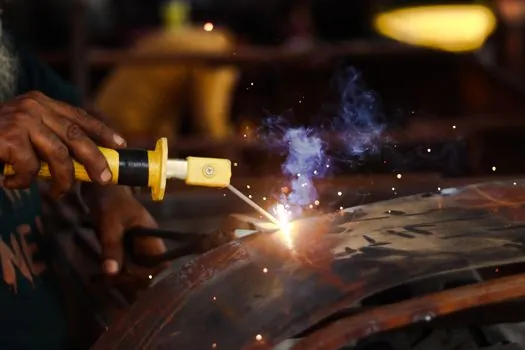
Three of the four main cables in a stud welding system carry welding current, and the fourth carries the trigger and lift signal, so a single chafed jacket at the gun strain relief can produce erratic lifts that look like a tip or control fault [S3][S8]. The four cables are the incoming power lead, the weld cable to the gun, the ground cable returning current to the source, and the control cable carrying trigger and lift signals, and all four need a visual inspection on a weekly-to-monthly cadence, with the weld-cable strain relief and the ground-clamp bite as the two highest-priority spots [S3]. Damaged cable insulation is a documented fatal hazard, not just a weld-quality issue, so any cuts, exposed conductor, or stiff-flex jacket sections trigger immediate replacement rather than splice repair [S3].
Decision Criteria: Repair, Rebuild, or Replace the Stud Welder
Repair makes sense when the fault is a consumable. A chuck, leg, ferrule, O-ring, or ground clamp sits under 5% of the cost of a new gun and is stocked as standard inventory on body-shop and construction sites, so the maintenance play is to swap, not to tear down the power source [S4]. Rebuild becomes the right call when the failure is inside the power module, namely the contactor, SCR stack, or capacitor bank, and the parts should be replaced as a matched OEM service kit, because mixing non-OEM capacitors with the original charging-resistor network changes the RC time constant and produces inconsistent arc ignition even when the new parts test good individually [S4]. Full replacement of the chassis is justified when the unit is 15-20 years old with a saturated transformer core, an obsolete control PCB, or wet or impact damage, since rebuild labour plus parts typically crosses 60-70% of a comparable new unit, the same break-even ratio plant engineers use for rotary hammers and similar capital tools [S4].
Concrete-Site Service Schedule vs Shop-Class Schedule
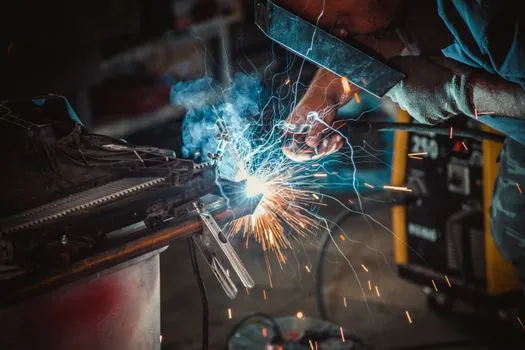
Concrete-anchor and shear-connector work sits between body-shop and heavy-fab duty cycles, so the service schedule should be tuned accordingly. Northland Fastening Systems recommends stud guns used 500,000 times per year or more are cleaned and inspected four times annually, while guns under 250,000 welds per year are serviced twice annually, and Taylor Studwelding recommends monthly housekeeping plus a 12-month OEM service interval as a baseline [S3][S5]. Nelson's NCD+ Auto-Gap gun manual goes further and prescribes a full gun disassembly and clean at least every 3 months, with the welder unplugged and the trigger released before any service work [S9]. On a construction deck, dust load is the swing factor, because cooling fans draw construction dust into the contactor and control area faster than in a shop, so weekly compressed-air clearing of vents and fans, plus monthly internal inspection for loose connections and damaged wiring, is the practical floor for a deck-mounted stud welder [S5][S8].
Comparison: Three Consumable Paths for a Construction Stud Gun
Operator daily, OEM monthly, OEM annual service. The daily path is a 5-10 stud lift test, cable-insulation and ground-clamp visual, chuck-tightness check, and a log entry for any missed ignition or spatter drift, costing minutes per shift and predicting the next failure before it trips the welder [S4]. The monthly path re-sets the lift per OEM procedure, confirms the brass ball and set-screw are intact, torques the rear cap, and clears the heatsink fan, with a 0.5-1.0 mm lift error on a 3/8 in stud being the threshold that flips welds into porosity rejects [S4]. The annual path is a capacitor health check with an ESR meter, a contactor resistance check across the main contacts, and a dielectric inspection of the weld-cable jacket at the gun strain relief, the cheapest combination of tests that catches the three wear parts before they cause a reject [S4].
When NOT to Repair: Obsolete Controls and Saturated Cores
Two failure modes end the repair conversation. A 15-20 year old transformer with a saturated core cannot be re-wound economically, and a control PCB that is no longer supported by the OEM blocks the rebuild path because no matched kit exists [S4]. A wet or impact-damaged chassis, including deck drops and rain ingress during overnight outdoor storage, falls into the same replace category because internal contamination migrates into the contactor and capacitor bank, and the rebuild parts-plus-labour cost crosses 60-70% of a comparable new unit at that point [S4]. When the rebuild quote sits in that band, the arc welder class comparison (replacement vs mid-life capital tools on the shop floor) is the correct decision frame, not a service-kit conversation [S4].
Standards and Sourcing Anchors
Stud welding principles and embedment behaviour in concrete are documented in the PCI Journal state-of-the-art paper by Harry A. Chambers, which is the commonly cited reference for the failure-mode list of base-plate condition, weld settings, equipment condition, operator training, and quality control as the five root causes of stud weld failures in construction anchors [S2]. The same paper notes that the 2000 IBC and ACI 318-02 carried the design provisions for cast-in-place and post-placed anchorages, with stud welding principles, equipment settings, and inspection procedure as the bridge between embedment design and field performance [S2]. For sourcing and maintenance parts, the practical route on a deck is OEM service kits for the contactor, SCR, or capacitor bank, and standard inventory for chucks, legs, ferrules, O-rings, and ground clamps, with the rebuild-vs-replace break-even pinned at 60-70% of new-unit cost [S4].
Trackable next signals for a maintenance programme on a construction deck are: lift-test reject rate per 1,000 studs (drift upward predicts tip and contactor wear before failure), annual capacitor ESR trend (above 10-15% capacitance loss schedules the bank for replacement), and a 12-month OEM service log entry, with the gun-side TIG welder-class cable-strain-relief inspection due at the same annual window [S4][S5].
Related analysis: 5G Industrial Module Production Line: 2026 Design Specs and Build-Out.