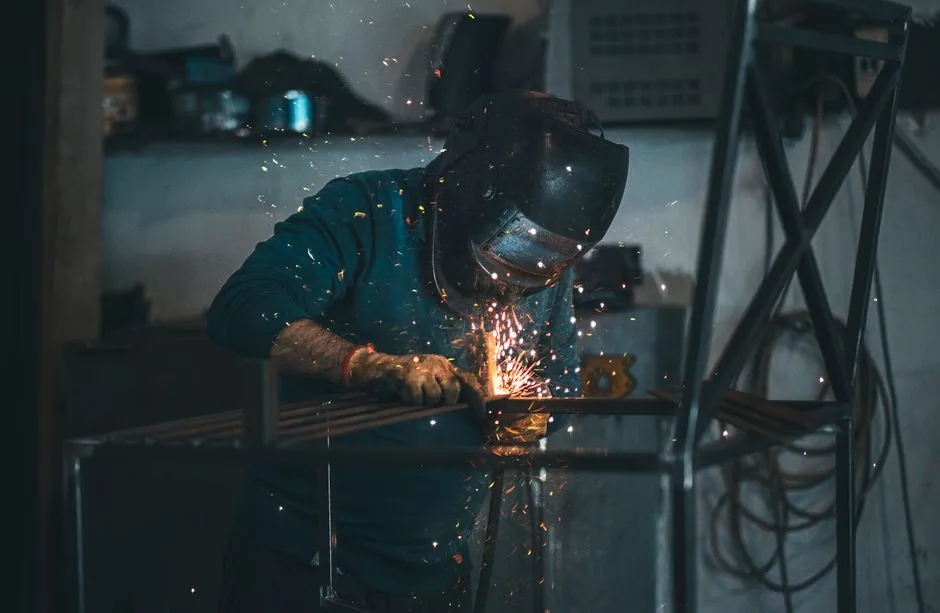
Plumbing installation needs stud welding primarily for pipe hangers, support brackets, backing plates, equipment anchors, and occasionally for thin-gauge stainless clips on drainage and water systems; the right stud welder is selected by matching process type to stud diameter, base-metal gauge, and the qualification route required by the inspection authority [S1][S2].
Two process families dominate the plumbing field: capacitor discharge (CD) stud welders covering roughly M3 to M8 (3-8 mm) studs, and drawn-arc stud welders covering M6 upward into large-diameter structural anchors, with the dividing line driven almost entirely by base-metal thickness and stud diameter rather than by plumbing trade preference [S2].
Capacitor Discharge vs Drawn-Arc: What Plumbing Actually Needs
CD stud welders complete the weld with a brief, low-total-heat discharge, which is what allows them to fuse a stud to thin-gauge sheet without burn-through; the Sunbelt PC-S, for example, is rated for M3 to M8 (3-8 mm) studs or #4 to 5/16 inch studs as standard, which covers the majority of clip-and-bracket attachments on galvanized and stainless plumbing support steel [S2].
Delta Stud Weld manufactures stud welding equipment alongside refractory materials and stud-weldable threaded studs, with its products intended for securing structural components, attaching hatches and covers, and fastening flanges in high-stress marine and industrial settings [S1].
The selection line is simple in practice: anything below about 3 mm base-metal thickness or under M8 stud diameter goes CD; anything over 6 mm base-metal or over M10 stud goes drawn-arc; the 3-6 mm base-metal / M8-M10 zone is where contractors most often mis-spec, and the failure mode is almost always either burn-through on CD or cold-set on drawn-arc [S1][S2].
Stud Diameter, Base-Metal Gauge, and Power-Source Sizing
For plumbing work, the smallest practical stud is roughly M3 (3 mm), used for light gauge clips on duct and pipe-trace; mid-range M6 to M8 (6-8 mm) studs cover most pipe-hanger and bracket work on 1.5-3 mm galvanized or stainless support steel, and M10 to M16 (10-16 mm) covers equipment anchors into 6 mm+ structural plate [S1][S2].
Power-source sizing follows the same logic: a portable CD unit in the 400-1500 W class handles M3-M8 work in a plumbing service van, while a drawn-arc stud welder for M10+ anchors typically needs a 3-phase supply or a heavy single-phase inverter and a stud gun rated for the larger diameter range [S1].
AWS D1.1 clause 7 covers stud welding qualification and requires, in plain terms, that the operator, the equipment, and the lead configuration be qualified together; any change in lead length, stud gun, or power source invalidates that day's production welding until re-qualification, which is why plumbing contractors running mixed service vans tend to standardize on a single stud gun and lead set per crew [S3].
Material Compatibility and Corrosion Considerations
Studs for plumbing service are commonly supplied in mild steel (zinc or cadmium plated for dry interior) and stainless steel (typically 304 or 316 for potable-water rooms, chlorinated environments, and exterior service); matching stud alloy to base-metal alloy matters because dissimilar-metal couples accelerate galvanic corrosion in wet rooms [S4].
Stainless-to-stainless stud welding requires lower heat input and a tighter time window than mild-steel work, and 316 stainless is generally the safer default for any plumbing support within about 1.5 m of a chlorinated water line or in a coastal-mechanical room; NACE MR0175 is the standard reference for sour-service environments (typically not residential plumbing, but it shows up in mechanical rooms attached to oilfield or refinery infrastructure) [S4].
For interior dry plumbing (above-ceiling copper or PEX, fire-protection risers in conditioned space) plated mild-steel studs on galvanized or black-steel base metal are usually the lowest-cost fit and do not require special welding procedure changes; the trade-off is corrosion life, not weldability [S4].
Portable vs Stationary Units and Site Logistics
Plumbing is largely a field trade, so portability dominates the buying decision over the headline maximum stud diameter; compact CD units allow a plumber to complete welds in ceiling cavities, vertical chases, and narrow mechanical-room aisles where dragging a full-size drawn-arc cabinet is impractical [S1].
Stationary or cart-mounted drawn-arc units make sense in two specific plumbing scenarios: a fabrication shop pre-building hanger assemblies and rack frames, and a large mechanical-room build where the unit can sit on the deck and the leads run out to the work point; for everything else, the CD unit in a service van is the higher-utilization choice [S1][S2].
Lead length matters because it changes the welding procedure, which in turn requires re-qualification under AWS D1.1; plumbing contractors running long ceiling-cavity pulls should stock one or two standardized lead-extension sets and treat the extended-lead configuration as its own qualified procedure rather than a casual swap [S3].
Selection Criteria: A Side-by-Side Comparison

The plumbing decision collapses to four criteria: stud diameter, base-metal thickness, material (mild vs stainless), and worksite power availability; a CD unit in the M3-M8 / up to 3 mm base-metal range, portable, single-phase 115/230 V, suits roughly 70-80% of residential and light-commercial plumbing support work, while a drawn-arc unit in the M10-M16 / 6 mm+ base-metal range, heavier and typically 3-phase or large single-phase, covers the remaining equipment-anchor and structural-plate applications [S1][S2].
Stud-welder rental fleets are widely available for occasional drawn-arc work, so a plumbing contractor does not need to own both process types; the common ownership pattern is a CD unit owned outright for daily service, plus a drawn-arc rental pulled in for specific equipment-anchor days [S4].
Qualification, Inspection, and Failure Modes
Daily stud-welder qualification under AWS D1.1 clause 7 is the inspection gate on commercial and industrial plumbing work, and the operator, equipment, lead configuration, and stud type must all match the qualified procedure; the practical implication is that a plumbing crew changing lead length or swapping stud guns mid-shift triggers a re-qualification test before production welds can resume [S3].
The four most common plumbing stud-welding failure modes, in order, are: burn-through on CD when the base metal is thinner than the recommended minimum, cold-set on drawn-arc when the weld time or current is set too low for the stud diameter, porosity from a contaminated base-metal surface (paint, oil, mill scale), and stud blow-off from excessive lift during the arc; the first is a base-metal problem, the second a parameter problem, the third a prep problem, and the fourth a gun-handling problem, and the corrective action differs in each case [S1][S3].
A stud weld that fails visual inspection (incomplete fillet, undercut, or visible porosity) is not repaired by re-welding over the same stud; the stud is removed by cutting or grinding below the base-metal surface, the area is ground flush, and a new stud is welded adjacent to the original location, not on top of it [S3].
Standards, Codes, and the 2026 Plumbing Specification Path
AWS D1.1 clause 7 (stud welding) and its associated tables 5.8 and 7.2 are the controlling welding-procedure reference for commercial plumbing stud work in North America, and any spec calling out "welded anchors" on plumbing drawings should reference D1.1 directly rather than leaving the procedure to the contractor's discretion [S3].
For plumbing supports in fire-protection, NFPA 13 also implicitly governs hanger attachment methods, and many local jurisdictions require that welded hangers meet AWS D1.1 even on residential-scale work; contractors working across residential, commercial, and industrial plumbing should default to the D1.1 procedure regardless of job size because the qualification overhead is the same and the rework cost of a failed field weld is not [S3].
For a broader steel-construction view of stud welder selection beyond plumbing, the stud welder selection guide for steel construction covers process, size, and power-source tradeoffs at larger diameters; for the demolition work that often precedes plumbing rough-in, demolition hammer specs for plumbing installation chases lines out the chisel and bit choices that match chase-cutting, and the foundational stud welder reference page covers the process types, weld controls, and gun configurations in more detail.
The underlying component specifications are covered under arc welder, and tig welder.