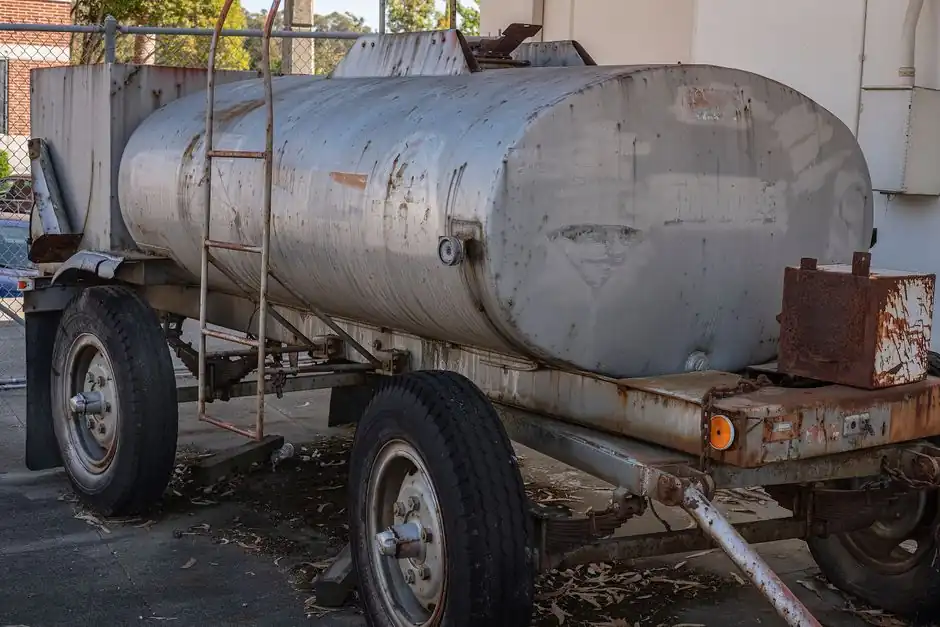
Shield tunneling mud-water circuits demand a tank container sized to the TBM slurry flow rate rather than to back-shift site convenience, with frame volumes typically 4-200 m³ and standard shell sizes of 6,058 mm × 2,438 mm × 2,591 mm for a 20-ft ISO 1496/3 unit [S6][S2].
Free-standing and containerised contact tanks used as TBM slurry buffers, grout-mix holding vessels, and bentonite make-up tanks overlap in capacity but diverge sharply in mobility, frame-rated stacking, and lining chemistry [S2][S8].
Slurry System Flow Rate as the Sizing Gate
Shield TBM slurry circuits circulate a volume that scales with cutterhead diameter, advance rate and the density of the excavated muck, so the first engineering gate is the hourly slurry throughput at peak advance [S8]. A 6-8 m diameter EPB or slurry shield typically demands 200-400 m³/h of bentonite or conditioning fluid circulation, and the holding tank should buffer at least 5-10 minutes of that flow to absorb TBM stroke-cycle surges [S8].
Undersizing the buffer trips overflow events during continuous cutting cycles, while oversizing starves the desander and degrades the cut-point, so the working volume is sized from the TBM flow rate, the desander residence time, and the grout return stream together [S8].
Frame Geometry: 20-ft ISO 1496/3 vs Free-Standing Skid Tanks
A standard 20-ft ISO tank container holds 21,000-26,000 L (≈21-26 m³) of liquid within a 6,058 mm × 2,438 mm × 2,591 mm frame, corners cast to ISO 1161, and is rated for 192 kN corner-post stacking, so it lands on a standard rail wagon, container ship cell-slot, or low-loader without re-engineering [S1][S4]. Free-standing field tanks for tunneling sites stretch to 4-200 m³ but ride on skids or civil foundations and lose the intermodal corner-casting edge [S2].
For tunneling project work, the practical compromise is a containerised unit (1,500-10,000 mm length, 1,200-2,400 mm width, max 2,300 mm height) when the site needs occasional road-rail shift, and a free-standing vessel (up to 5,000 mm height) when the tank is welded into a fixed slurry-handling skid for the life of one drive [S2].
Barrel Material and Lining for Bentonite, Grout, and Spent Slurry
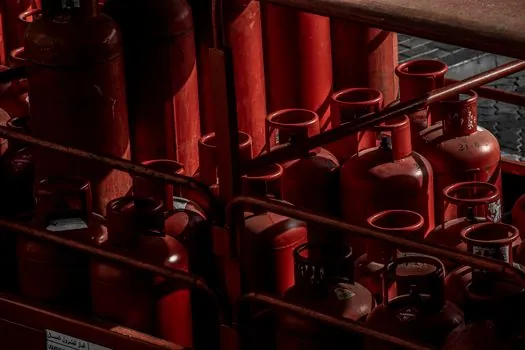
Bentonite slurry sits at pH 9-11 with high solids loading and steady sand content, and cementitious grout runs pH 12-13 with Ca²⁺ saturation, so the standard pick is 316L stainless steel, optionally rubber-lined, with PTFE reserved for aggressive chemical-conditioning additives [S3][S4]. 316L tolerates chloride-bearing make-up water that would pit 304 at the weld seam within a few cleaning cycles [S3].
For sodium silicate or polyacrylamide flocculant service, PTFE or rubber-lined barrels extend the chemical envelope at a 30-50% cost premium over plain 316L and a temperature cap of roughly 80 °C for natural rubber lining [S4].
Working Pressure, Test Pressure, and T-Code for Tunneling Service
Slurry holding and grout mix tanks run at near-atmospheric pressure, so a T11 or T14 design code with 4.0 bar MAWP and 6.0 bar test pressure is the common configuration for water, bentonite, and cementitious grout, while compressed-air slurry-shield circuits step up to 17.7-22 bar MAWP per the T50 schedule [S1][S3]. T11 covers non-hazardous chemicals, T14 covers hazardous chemicals and acids such as HCl and zinc chloride, and T50 is reserved for LPG and ammonia side-streams that occasionally appear on industrial tunneling utility crossings [S1].
Specifying the wrong T-code is a port-state and depot-survey failure, not a commercial nuance, and re-coding an existing frame after build is rarely cheaper than ordering the correct class up front [S3].
Heating, Agitation, and Abrasive-Wear Considerations
Grout and bentonite tanks are routinely fitted with paddle or vortex agitators sized to keep 1.2-1.6 SG suspensions in suspension, and on cold-weather drives a heat-exchange coil or external steam jacket is added to keep grout above the pour point; the coil consumes barrel length, which is the engineering reason 30-ft and 40-ft frames (9125 mm and 12,192 mm) exist for heated bitumen or warm-grout service [S3][S4].
Spent slurry returned from the desander carries coarse sand and clay fractions, so a 4-6 mm shell with 5-8 mm head is the baseline abrasive-wear specification, and the inside surface should be smooth and weld-ground to keep tank cleaning machine cycle times inside depot turnaround windows [S4].
Site Constraints: Containerised vs Skid-Mounted on a Tunnel Jobsite
Tunnel jobsites rarely have a finished civil slab on day one, so the ISO 1496/3 corner-casting frame doubles as a crane-lift, trailer-tow, and rail-load handling interface that free-standing vessels cannot match [S6]. For a diaphragm wall grab shaft where the slurry returns to ground level before pumping back to the TBM, containerised tanks in 4-55 m³ sizes drop straight onto a compacted stone pad and tie into the desander feed [S2].
When the tank is welded into a permanent slurry-treatment plant next to a shaft head, free-standing vessels up to 200 m³ take over, and the operator trades intermodal mobility for larger settling volume, deeper freeboard, and simpler industrial valve manifolds on the inlet and overflow lines [S2].
Comparison of Tank Options for Tunneling Duty
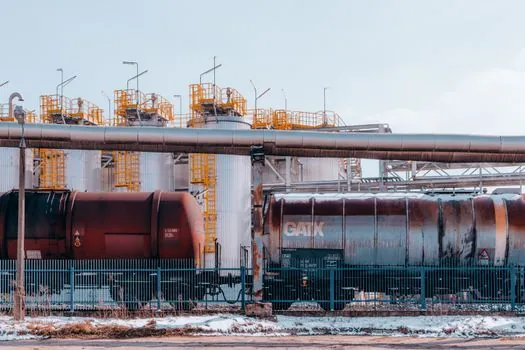
Side-by-side, the three credible options for a TBM slurry buffer and grout mix service run as follows: 20-ft ISO tank container (4.0 bar MAWP, 21-26 m³, 316L, ISO 1496/3 frame, intermodal, ~3,700 kg tare); 30-40 ft ISO tank (same MAWP class, 30-45 m³, heated-coil ready, ~5,000-6,700 kg tare); free-standing skid tank (atmospheric to 4.0 bar, 4-200 m³, fixed-site only, lowest unit cost per m³) [S1][S2][S3]. For depot hygiene, pair the chosen tank with a tank cleaning machine cycle matched to the next-cargo list so turnaround does not bottleneck the next TBM shove [S4].
Track the next project-level signal on 2026-09-15: tender close for the next urban metro slurry-handling package, where bidders are expected to disclose whether the 20-ft ISO 1496/3 frame or a 40-m³ free-standing skid tank wins on the bill of quantities, and whether heated-coil service is written into the grout-tank line item.