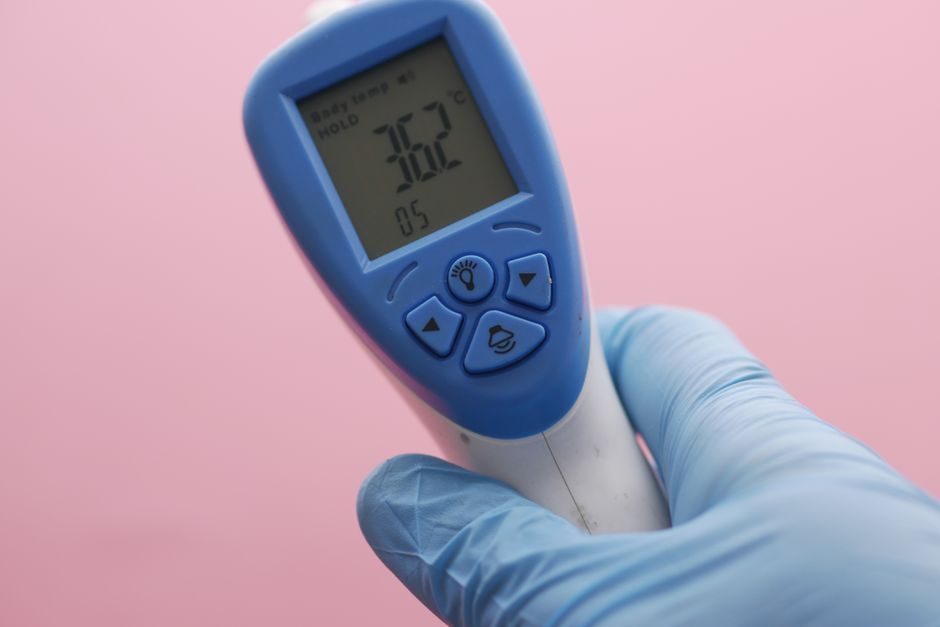
The 2026 market for industrial temperature monitoring devices is structured by four hard engineering constraints: probe technology (RTD, thermocouple, bimetallic, Bourdon tube), output interface (4-20 mA, RS485 Modbus RTU, IEPE, wireless), ingress protection (IP65 to IP67), and operating envelope (-40 to +75°C process side, down to -30°C cold-chain side) [S1][S2][S3].
Buyers in 2026 are no longer asking whether to add remote temperature visibility; they are choosing between disposable wireless loggers for cold-chain compliance, multi-channel IEPE-based data acquisition for predictive maintenance, and rugged dial thermometers paired with a temperature controller for substation and transformer duty [S1][S2][S3].
Four Product Families and What Each Actually Measures
The wireless, battery-powered 1SPO1ES001 (essentim SPOT) family records temperature down to -30°C, door state, and motion, paired with up to twelve months battery life and an IP67 housing for cold-chain freezers and transport monitoring [S1]. The SmartSense Z Sensor & Gateway from Thermo Controles is positioned for compliance, real-time alerts, and remote access in Australian cold-chain and inventory applications, with live temperature recording and instant threshold alerts [S4].
For transformer duty, MESSKO COMPACT and MESSKO TRASY2 use Bourdon tube measuring systems without additional mechanical parts, with optional RS485 Modbus RTU or 4-20 mA analog output; both are specified for extreme climatic conditions and vibrations, and require no readjustment or recalibration across their service life [S3]. MESSKO BETECH uses expansion bellows technology, and the CEDASPE VT (stainless steel housing, stem, capillary, Bourdon-tube measuring system) is a DIN-style oil thermometer for DT distribution transformers; CEDASPE BM is a contact-less bimetallic oil temperature indicator in 80 mm (BM80) and 100 mm (BM100) dial sizes [S3].
For rotating machinery and structural health monitoring, the Recovib Monitor (Monitor-4 / Monitor-8) integrates temperature, vibration, and machine condition channels; the IP65 fanless enclosure operates from -40°C to +75°C with a dynamic range above 120 dB, NTP time synchronization, and IEPE / current-loop / voltage sensor support over 100/10 Ethernet [S2].
Decision Criteria: Probe, Output, Environment, and Compliance
Match the probe to the medium: Bourdon tube and bimetallic for transformer oil and winding thermal-image reading; Pt100 / Pt1000 RTD or thermocouples for industrial process lines; semiconductor or NTC for cold-chain to -30°C; IEPE-compatible accelerometers with a temperature channel for vibration-heavy machinery [S1][S2][S3].
Output selection is dictated by the receiving system: 4-20 mA remains the default for long cable runs into a temperature monitor or PLC; RS485 Modbus RTU multi-drop is the 2026 default for new substation builds because it returns digital diagnostics and reduces copper [S3]. Wireless, battery-powered units with encrypted cloud upload are the default for cold-chain compliance, where cable runs are not feasible and gateways bridge to a SCADA layer [S1][S4].
Ingress and operating envelope drive housing choice: IP65 with -40°C to +75°C is the minimum for outdoor industrial cabinets and bridge-mounted vibration data acquisition [S2]; IP67 is required for wash-down, freezer, and transport applications where condensation forms on the housing [S1]. Thermometer pockets installed in compliance with EN50216-4 are specified for power-transformer thermometers such as the MESSKO ZT-F2 transmitter [S3].
Comparison of Main Options Against Four Decision Criteria

Comparing the four dominant types against cost, signal type, environment, and lead time, the matrix is clear: cold-chain wireless loggers (essentim SPOT, SmartSense Z) win on rapid deployment and battery life (up to 12 months) but lose on real-time control; the Recovib Monitor-4/8 wins on multi-channel vibration + temperature data acquisition and -40 to +75°C range but adds per-channel cost; MESSKO TRASY2 / COMPACT and CEDASPE VT / BM win on field-proven mechanical reliability and 4-20 mA / Modbus integration in substations but require thermometer-pocket planning per EN50216-4 [S1][S2][S3][S4].
For a high-voltage substation, a Bourdon-tube dial paired with a 4-20 mA or Modbus transmitter, installed in an EN50216-4 pocket, is the lowest-risk choice; for a pharma cold-chain retrofit, an IP67 wireless multi-sensor with cloud gateway is the lowest-disruption choice; for predictive maintenance on pumps and engines, an IEPE-front-end multi-channel data acquisition unit with 120 dB dynamic range is the only option that gives diagnostic-grade vibration alongside temperature [S1][S2][S3].
Use Cases Mapped to Specific 2026 Products
Pharmaceutical cold-chain freezers: wireless, battery-powered multi-sensor (temperature, door, motion) in IP67 with encrypted cloud delivery and 12-month battery life, suitable for the -30°C to ambient range [S1]. Australian food and pharmaceutical inventory: SmartSense Z with live temperature recording, instant threshold alerts, and gateway-based remote access for compliance [S4].
Distribution and power transformer monitoring: MESSKO COMPACT or TRASY2 for oil and winding temperature (thermal image) with RS485 Modbus RTU or 4-20 mA output, paired with MESSKO ZT-F2 transmitter in an EN50216-4 pocket, a Multi-Ballast to transform CT secondary currents of 1 A, 1.5 A, 3 A, 4 A, and 5 A to the thermal-image input, and either a PQ96 / PQ144 coil indicator or a D1272AT digital indicator for the control panel [S3].
Structural health monitoring, wind turbines, and field measurement campaigns: Recovib Monitor-4 or Monitor-8 with IEPE / current / voltage / differential-voltage inputs, 100/10 Ethernet, NTP sync, and an IP65 -40 to +75°C fanless enclosure, integrated with Recovib.Suite locally and Recovib.io for remote visualization [S2]. A direct cross-reference for buyers also comparing electrical and process variables is the Power Monitoring System vs Temperature Monitoring Device spec map, which lines the two duty domains against output, accuracy, and integration paths.
Limits, Failure Modes, and When Not to Pick the Mainstream Option
Cold-chain wireless loggers are not a substitute for closed-loop control: their update interval, battery duty cycle, and gateway dependency make them unsuitable for processes that need actuation within a fraction of a second, and their -30°C floor is the published spec, not a guarantee in every freezer profile [S1].
Mechanical Bourdon and bimetallic transformer thermometers fail differently from electronic ones: they can drift after long thermal cycling if installed without proper immersion length, and they need a CT-driven Multi-Ballast (1 A / 1.5 A / 3 A / 4 A / 5 A) to scale the thermal-image current, otherwise winding-temperature readings are wrong by tens of degrees [S3].
Multi-channel IEPE-based vibration data acquisition (Monitor-4 / Monitor-8) is overkill if the question is just "is the bearing hot" — a single Pt100 RTD into a 4-20 mA transmitter is cheaper, simpler, and less dependent on NTP sync and 120 dB dynamic range [S2]. Conversely, picking a basic bimetallic dial for a high-voltage bushing where remote trending is required misses the digital output that a Modbus transmitter provides.
Standards, Sourcing, and Sourcing Signals in 2026
Transformer pocket geometry and installation are governed by EN50216-4 for components such as the MESSKO ZT-F2 transmitter [S3]. Industrial enclosure ratings cited by 2026 product lines follow the IEC 60529 IP-code family, with IP65 for fanless outdoor data acquisition and IP67 for sealed cold-chain and transport sensors [S1][S2].
Recovib.Monitor will be exhibited at DI Buy In Wallonia 2026, 8-10 September 2026 in Liège, Belgium, providing a sourcing checkpoint for buyers evaluating industrial multi-channel monitoring in the second half of 2026 [S2]. The Reinhausen Group continues to consolidate transformer temperature measurement under the MESSKO and CEDASPE brands with both legacy dial instruments and the new Modbus-compatible BETECH generation [S3].
For motor and rotating-machine protection, the spec criteria that share signal types (4-20 mA, Modbus, IP65) with transformer and process temperature monitoring are detailed in the motor protection relay selection guide for LV, HT, and hazardous-area motors, and the broader duty split between electrical and thermal monitoring is mapped in the power monitoring vs temperature monitoring spec-driven decision guide. Related mechanical positioning hardware, for example linear guide or crossed-roller guide rails used in sensor-mounting brackets and probe-stroke stages, is a separate spec domain and not part of the temperature instrument itself.