
For a small hydraulic power unit in the 0.25-3 kW bracket, the motor-phase question is decided by three facts: available supply, duty cycle, and starting torque. Three-phase asynchronous motors deliver 2-3x the output power of single-phase units at the same frame size, making them the default wherever three-phase supply exists [S4].
Single-phase capacitor-start capacitor-run (CSCR) motors remain the only practical option in residential workshops, mobile trailers, and farms where only L+N is present. One typical HPU-motor family covers 0.25-3 kW in either single-phase (CSCR) or three-phase, 2- or 4-pole, from 110 V up to 690 V [S8]. Above 5 hp (~3.7 kW), single-phase motors are rarely encountered, and most retrofit decisions resolve to keeping or adding a three-phase feed [S2].
Phase Count and How It Maps to Hydraulic Torque
Three-phase power uses three hot conductors, each waveform offset by 120°, so the rotating field in an induction motor never collapses to zero. The result is constant torque delivery and smoother pump speed under load [S1][S5]. Single-phase power uses one hot and one neutral conductor, producing a single AC waveform that pulses between peak and zero; that pulsing is why single-phase motors need auxiliary windings (CSCR, split-phase, shaded-pole) to develop starting torque [S5].
For a hydraulic power unit, constant torque matters whenever the pump is asked to deliver high pressure at low flow (dead-heading) or to accelerate a fully loaded cylinder. The rotating field on a three-phase asynchronous motor lets the pump reach working pressure within 1-2 seconds, while a comparably rated single-phase CSCR motor will draw higher locked-rotor current and take longer to bring the system up to cut-in pressure [S3].
Power Density, Efficiency, and the 5 hp Crossover
At the same frame size and displacement, a three-phase asynchronous motor outputs 2-3x the mechanical power of a single-phase motor. That ratio reflects the absence of start/run capacitor losses and the higher power factor of the balanced three-phase supply [S4]. Three-phase motors also run cooler per kW delivered, because the current is split across three windings rather than one; lower I²R losses translate directly into longer winding life on continuously duty HPUs [S7].
On the small end, both topologies are stocked. One HPU-motor family spans 0.25-3 kW in single-phase CSCR or three-phase, with 2- or 4-pole options and a 110-690 V voltage range covering global mains standards [S8]. Practical field experience puts the crossover at roughly 5 hp (~3.7 kW): below that, single-phase is acceptable where three-phase is unavailable; above that, single-phase industrial motors are uncommon and the three-phase supply is usually justified by the running-load hours [S2].
Selection Criteria: When Each Topology Fits

Specify three-phase when any of the following apply: the site has a 380-480 V (or 200-240 V three-wire) feed, the HPU runs more than 4-6 hours per day, the pump is larger than group 2 (cc ~16-23 cc/rev), or the load includes high-inertia elements such as a flywheel or large reservoir circulation pump. In these cases the higher starting torque and lower running losses pay back the cost of the three-phase drop within months on industrial tariffs [S3][S4].
Specify single-phase CSCR only when: the site supply is L+N at 110/220/240 V, total running hours are short (under 4 h/day, intermittent duty), peak power stays inside 0.25-3 kW, and starting torque demand is moderate (gear pump or low-pressure vane pump, not a piston pump at full relief). A common shop retrofit pattern keeps a 3-phase motor on the pump and adds a VFD or rotary phase converter, because three-phase asynchronous motors are widely available as surplus and cheaper than equivalent single-phase CSCR units at the same power [S2][S7]. For related decisions on inverter-driven motors, see the MG1 Part 30 vs Part 31 VFD compatibility breakdown.
Comparison Matrix for Pump-Side Decision Making
On power density, three-phase asynchronous motors win 2:1 to 3:1 over single-phase at the same displacement [S4]. On starting torque, three-phase NEMA B designs typically deliver 150-200% FLT without auxiliaries, while CSCR single-phase units reach 150-250% FLT but draw 4-6x FLC during the start [S3]. On running efficiency, three-phase IE2/IE3 small motors commonly reach 82-88% at 0.75-3 kW, versus roughly 68-78% for single-phase CSCR units of the same rating [S7]. On supply availability, single-phase is the universal fallback in residential and light-commercial sites; three-phase is standard in industrial feeders above 15 kW aggregate load [S5].
Under 0.75 kW with intermittent duty and L+N only, a single-phase CSCR motor paired with a group 1 or small group 2 gear pump is the rational pick. From 0.75-3 kW, the choice tracks duty cycle more than supply: 2-shift operation pulls the decision toward three-phase even if it requires a phase converter. Above 3 kW, three-phase asynchronous is the only practical option, and the three-phase asynchronous motor line becomes the default catalogue entry.
Real Use Cases and Failure Modes to Avoid
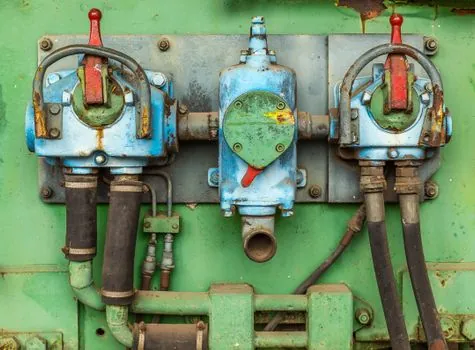
Mobile hydraulic power units on trailers, log splitters in rural yards, and farm shop presses are the canonical single-phase CSCR applications. In each case the pump is a low-pressure gear or vane unit, peak load is under 2.2 kW, and total daily run time rarely exceeds 1-2 hours. CSCR motors handle this envelope reliably; the failure mode to watch is the start capacitor drying out after 20 000-40 000 starts, which manifests as a humming motor that does not turn [S8].
Industrial HPU retrofits in plants that already have a 380 V three-phase feed are the canonical three-phase case. A common mistake is to substitute a single-phase motor on a piston pump that needs high starting torque; the motor stalls against relief pressure, the start capacitor overheats, and the winding fails within minutes. A second common error is to wire a three-phase motor to single-phase supply without a phase converter or VFD, which produces a severe phase imbalance and locked-rotor burnout. Phase converter sizing and VFD programming are outside the scope here, but the rule of thumb is: rotary phase converter kVA rating should be at least 1.5x motor kW, and VFD-rated motors (MG1 Part 31) should be specified on any new VFD-driven hydraulic power unit build [S2][S6].
Limitations, Constraints, and Standards Anchors
Small-horsepower single-phase motors are physically larger per kW and cost more per kW than three-phase equivalents above 1.5 kW, once you include the start and run capacitors and the centrifugal switch [S6][S8]. Three-phase asynchronous motors require a balanced three-wire supply, which is the binding constraint on residential and most light-commercial sites. Voltage range compatibility is broad: one motor family accepts 110 V, 220 V, 230 V, 380 V, 400 V, 415 V, 440 V, 480 V, 500 V, 525 V, 550 V, 575 V, 600 V, 660 V, and 690 V, which covers IEC 60038 standard voltages across 50 Hz and 60 Hz regions [S8]. Insulation class, IP rating, and IE efficiency class should be specified per IEC 60034-30-1 for the IE2/IE3 efficiency tiers, and per NEMA MG1 for North American builds.
Frame sizes follow IEC 63-100L for the 0.25-3 kW bracket, with C-Face and foot-mount options to mate with gear-pump and vane-pump bell housings. Starting current on direct-on-line started three-phase motors is typically 6-8x rated current; soft starters or star-delta starters are used on larger units to stay inside the utility's inrush limits, but on small HPUs under 3 kW DOL starting is standard. The control-side components (relays, contactors, overloads) are sized to the single-phase or three-phase FLC, not to the kW, which is where many retrofit electrical BOMs go wrong when the phase count changes [S8].
Track for future spec work: (1) the IE4 efficiency tier adoption in IEC 60034-30-1 for sub-3 kW three-phase motors, which will widen the efficiency gap with single-phase CSCR units; (2) the wider rollout of VFD-rated single-phase input / three-phase output drives that let small workshops run a standard three-phase asynchronous motor from a 220 V single-phase feed without a rotary phase converter.
Detailed specification references: single girder crane.