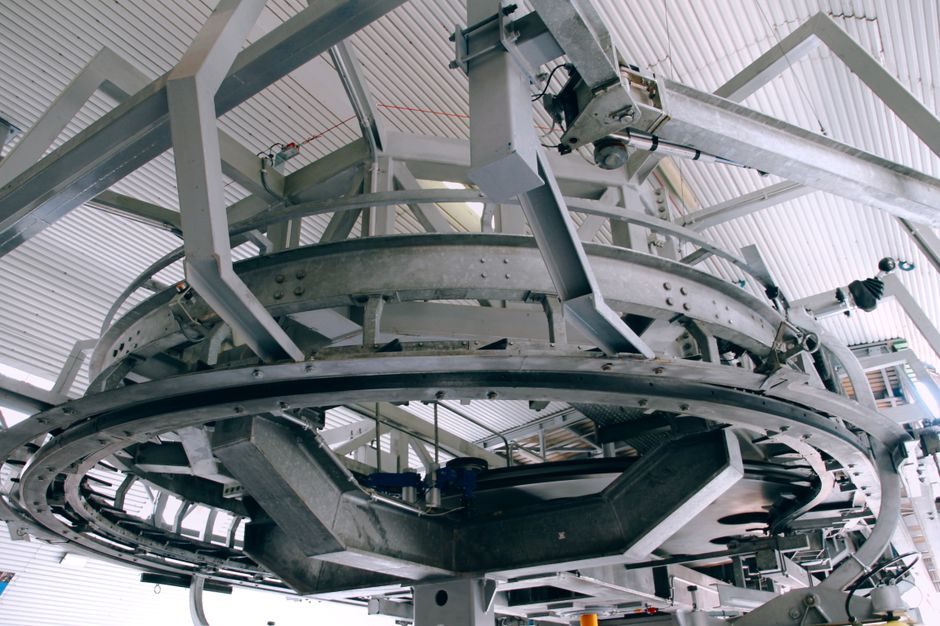
Cross-checking Chinese trading-platform listings, Indian maker catalogs, and one Polish specialist active since 1991, the vibratory feeder market in July 2026 resolves into three sourcing tiers — Ningbo/Yantai OEM/ODM exporters with 1-piece MOQs, Bangalore mid-tier integrators selling at ₹1.40 Lac (~US$1,680) per piece, and a small European alliance of 30+ year specialists whose 2024 consolidation has measurably raised their capacity [S1][S2][S3][S6].
For an automation engineer, the first decision is drive topology, not brand: electromagnetic feeders suit short-stroke, high-frequency parts orienting in the 20–25 t/h range with motor power in single-digit kW, while electromechanical and linear feeders cover heavier bulk-mineral or aggregate duty. A second decision is hygienic construction: SS304 contact surfaces and quick-release perforation decks (as on the Vibeng de-watering feeder) are now table stakes for food, cosmetic and pharmaceutical lines, while Chinese export lines default to painted carbon-steel frames for mine/chemical duty [S2][S3][S5].
Drive Topologies and Where Each One Earns Its Keep
Electromagnetic vibratory feeders (EMF) use an AC-driven coil pair to oscillate a leaf spring at 50/60 Hz mains frequency, giving high frequency / low amplitude — ideal for small-parts orienting in the sub-1 kg class. A 2026 Made-in-China listing for a large-hopper EMF quotes US$1,290–1,580 per piece at 1-piece MOQ with 20–25 t/h capacity and adjustable motor power, positioned for mine and chemical-industry bulk transfer. [S1]
Electromechanical feeders add an eccentric-rotor or vibrator-motor drive; the Vibeng Solutions de-watering unit runs at 440 V, 50 Hz with 10–15 kW draw, semi-automatic grade, 500 kg/hr capacity (6 t/h headline), 600–800 kg machine mass, and a one-year warranty backed by 4–6 week delivery from Bangalore [S2]. Linux Machines' electromagnetic feeder line in India spans electromechanical and electromagnetic variants built for "sturdy, precision engineered" service, indicating the same dual-drive mix is standard in South-Asian mid-tier catalogs [S5].
For linear or step-feeder duty (where parts must be delivered in single-file, single-orientation to a downstream pick station), Chinese OEMs such as Ningbo YBSUN publish dedicated product lines: linear feeders, vibratory bowl feeders with soundproof enclosures, and 4-step feeder systems for automotive and electronics assembly — a category that is functionally separate from a "vibrating feeder" used as a hopper discharge [S1]. Engineers specifying linear indexers should consult a flow-meter or pressure sensor reference only for adjacent instrumentation; the feeder itself is a mechanical-orienting module, not a process variable transmitter.
Country-of-Origin Map: China, India, Europe
China dominates the export-catalog tier. Made-in-China's weigh-feeder and small-vibrating-feeder channels surface thousands of products with 1-piece MOQ, FOB pricing, and OEM/ODM customization, including a "good performance small vibrating feeder" at US$2,500–12,000 per set [S4][S6]. The Ningbo cluster (YBSUN, Hysan) and the Yantai/Shandong mining-equipment cluster (Hysan crusher) both publish English-language catalogs aimed at overseas automation integrators [S1]. Hysan's small-vibratory-feeder page is co-listed with cone-crusher and vertical-impact-crusher spares, a structural signal that Chinese mid-tier makers bundle feeders into a broader "crushing and screening" rather than treating them as automation components.
India occupies the engineering-integration tier. Bangalore-based Vibeng Solutions quotes ₹1.40 Lac (~US$1,680) per piece for a SS304 de-watering vibratory feeder with custom Vector-Lock clamping and a perforated-sheet deck designed for hygienic wash-down; lead time 4–6 weeks, port of dispatch Bangalore, payment by T/T [S2]. Linux Machines (electromagnetic feeder range) sits in the same tier with semi-automatic and automatic grades and is a typical vendor for FMCG and bulk-solids lines that need an in-country service footprint [S5].
Europe is a small, consolidated tier. Wibramet, a Polish vibratory-feeder maker operating since 1991, joined the Techfeeder Alliance in 2024, a grouping the maker describes as giving "many times over" greater production capacity and positioning it among "the largest manufacturers of feeding systems in Europe" [S3]. Wibramet uses in-house subassemblies, designs in Solid Works, and supplies 3D models on request — the engineering-support posture typical of this tier, where unit prices are higher but feeder geometry, tooling life and CE documentation are project-engineered rather than catalog-driven [S3].
Selection Criteria: Capacity, Material, Stroke and Drive
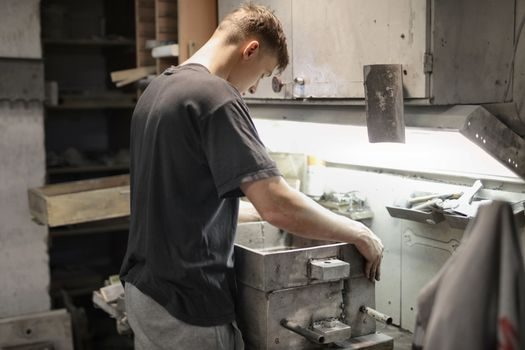
Capacity is the first hard gate. Electromagnetic units from Chinese export lines reach 20–25 t/h with electromagnetic drive and adjustable-speed motor; Indian semi-automatic de-watering units are specified at 6 t/h and 500 kg/hr on SS304 contact surfaces; mini/small vibrating feeders for laboratory or light-industrial duty sit in the 1–5 t/h band [S2][S6]. Hysan's "small vibratory feeder" channel is the clearest single signal of the entry-level capacity floor for OEM buyers.
Material of construction follows the application. Hygienic and de-watering duty defaults to SS304, with quick-release perforated decks and water-collection chutes; the Vibeng spec sheet also lists inspection holes and an "open frame" geometry that lets wash-down water drain out of the frame rather than pool [S2]. Mining and aggregate duty defaults to carbon steel with a hopper, and Chinese listings frequently describe the frame as "Heavy Duty Automatic" with adjustable-speed motor [S4]. For abrasive or chemically aggressive bulk solids, OEM/ODM customization is the standard procurement path on Made-in-China.
Drive, voltage and frequency must be matched to plant mains. Indian 440 V / 50 Hz units and Chinese 380 V / 50 Hz units are not electrically interchangeable; specifying the wrong coil voltage is the single most common commissioning failure on imported EMF drives. Stroke and frequency tuning is the next gate: leaf-spring EMFs need a set-point matching part mass, and Wibramet's parts-orienting service explicitly handles "intricate shape parts made of various materials" — a clear sign that tooling set-up, not just the feeder frame, is where European suppliers earn the price premium [S3].
Lead Times, MOQ and Total Cost of Ownership
Lead time differs by an order of magnitude between tiers. Indian mid-tier makers quote 4–6 weeks ex-Bangalore for a built-to-order de-watering unit with 1-year warranty and 1-year after-sales service [S2]. Chinese export channels advertise 1-piece MOQ and rely on stock-plus-finishing slots, so a configured unit is typically shippable in 2–4 weeks; bulk weigh-feeder orders are quoted by container on the same channels [S4][S6]. European alliance-tier delivery is project-driven and not catalog-listed, but the trade-off is on-site service and tooling engineering rather than speed [S3].
Price bands for a 1-piece export order in 2026 are roughly: US$1,290–1,580 per piece for a 20–25 t/h EMF large-hopper unit, US$2,500–12,000 per set for mini/small vibrating feeders, and ~US$1,680 per piece for a 6 t/h SS304 Indian de-watering feeder [S2][S6]. Add freight, customs duty, and commissioning travel for European-tier orders; for Chinese-tier orders, the dominant risk is spare-parts documentation and after-sales responsiveness rather than sticker price.
Total cost of ownership is dominated by tooling wear and tuning drift, not purchase price. Wibramet's value proposition rests on "eliminating spare-parts availability problems" by using in-house subassemblies, and the Indian Vector-Lock clamping system is positioned around "easy and quick" deck removal to cut downtime on wash-down cycles [S2][S3]. For high-mix parts-orienting cells, this tooling-change speed outweighs a 20–30% premium on frame cost.
Common Failure Modes and Specification Pitfalls

Three failure modes recur in 2026 spec sheets and field service notes. First, leaf-spring fatigue on EMFs: the spring pack is the wear part, not the coil, and on Chinese export units the springs are typically matched to a narrow band of part mass — running them outside the rated mass range cracks the springs in months, not years. Second, perforation-deck fouling on de-watering units: without quick-release latches and a wash-down chute, product builds up and unbalances the trough, driving bearings to fail prematurely; the Vibeng design's inspection holes address this directly [S2]. Third, electrical incompatibility on imported units: a 440 V coil on a 380 V plant, or vice versa, draws the wrong current and either trips the breaker or burns the coil. Match the rating, not the plug pattern.
For automation integrators, a frequent spec error is conflating a vibratory bowl feeder (a parts-orienting module feeding a pick station) with a vibrating feeder used as a hopper discharge to a crusher or screen. The former is sized by part geometry, stroke and orienting-tooling lead time; the latter is sized by tonnage, lump size and trough angle. Cross-referencing a PLC integration guide and a servo motor sizing note will not help either selection — they are different machines sold under overlapping names. Similarly, an industrial valve or pressure transmitter reference is only relevant when the feeder is gated by a process instrument on a slurry or bulk-solids line, not for the feeder itself.
Application Fit and Sourcing Decisions
For a high-volume automotive or electronics assembly cell needing single-file orienting of fasteners, springs or small stampings, a Chinese OEM/ODM linear or bowl feeder with 1-piece MOQ and 2–4 week delivery is the default commercial choice, with YBSUN-type suppliers publishing the application video library expected by automation integrators [S1]. For hygienic FMCG, dal or snack processing where wash-down is daily, an Indian SS304 de-watering feeder with a 1-year warranty and 4–6 week delivery is the practical middle ground [S2][S5]. For complex, low-volume parts-orienting in medical, cosmetic or food-pharma with CE documentation and on-site service, a European alliance-tier maker such as Wibramet is the appropriate spec, accepting the higher unit cost in exchange for engineered tooling and 3D-model handover [S3].
Trackable signals for the rest of 2026: (1) Chinese export channels continue to compress mini-feeder prices toward the US$1,000 mark as more Yantai/Shandong makers add feeder lines to existing crusher-spare catalogs; (2) the Techfeeder Alliance's 2024 capacity expansion starts to surface in 2026 EU lead times, and competing European alliance members will be worth re-quoting; (3) Indian semi-automatic feeder prices are stable in rupee terms but FX-sensitive, so 2026 quotes locked at ₹1.40 Lac need a re-validate if the USD/INR rate moves more than 5%.
For related coverage, see Battery Electrolyte Supply Chain 2026: LiPF6 Bottlenecks, China Concentration and.