
A machine-vision vision light source sits in the same hostile envelope as a proximity sensor: coolant splash, robot-arm collision, and constant vibration on a moving gantry. Specifying it on luminous flux alone is the single most common procurement mistake, because the optical head usually fails mechanically long before the LED derates electrically.
Four physical interfaces decide fit: the housing impact rating, the window/filter retention under thermal cycling, the mount-thread shear capacity, and the cable-gland pull-out strength. Each maps to a defined test, and the article below walks the values, the standards behind them, and the failure modes that pass a datasheet check yet fail on the line.
IK impact rating vs IP rating: two different jobs
IP65 only certifies the housing against dust and water jets; it says nothing about a 0.5 kg steel ball dropped from 40 cm onto the lens window. That second test is the IK code, governed by IEC 62262, with IK08 corresponding to a 5 J strike and IK10 to 20 J [S4]. A food-line vision light on a robotic pick-and-place head typically needs IK08 at the lens face, while a stamping-press station directly under a 50 kg slide should be specified at IK10 or fitted with a separate polycarbonate shield. Mixing these two codes is the root cause of the "IP-rated but smashed" failure pattern seen on automotive welding cells, where coolant ingress is rare but impact is daily.
Diffuser and window materials also drive survivability. Microprismatic PET and cast PMMA diffusers with anti-wet-out coating for edge-lit light guides perform well on depixellation and color uniformity [S4], but PMMA loses roughly 40% of its impact strength below -10 degC and is unsuitable for cold-store vision stations. Polycarbonate (PC) windows at 3 mm thickness reach IK08 with a 250% safety margin over cast acrylic, at the cost of roughly 8% lower transmittance in the visible band.
Lens-window retention and thermal cycling: where the seal actually fails
The window-to-housing interface is the most common leak path on a vision light installed near a CNC chip pan. Two retention methods dominate: a silicone O-ring under a bezel clamp rated to roughly 85 Shore A, or a bonded gasket cured in place. The O-ring design survives thermal cycling from -10 degC to +60 degC and is repairable in the field; the bonded gasket holds tighter against chemical washdown but cannot be re-torqued after the first thermal excursion above the cure temperature. [S1]
LED junction heat pushes the internal cavity 20 to 30 degC above ambient in a sealed unit, so the pressure cycle on a 100 mm x 100 mm housing is roughly +/- 15 kPa per shift. That is why most reputable vision light vendors derate their IP rating by one code when the housing is mounted horizontally facing down, where any seal micro-defect becomes a direct path for oil mist. Specifiers should ask for the IP rating in the actual mounting orientation, not the lab test orientation, and require a minimum 5 J IK rating on the window face when the unit sits within 600 mm of a moving robot tool [S4].
Mount thread, M5 vs M6 vs 1/4-20: shear and torque numbers
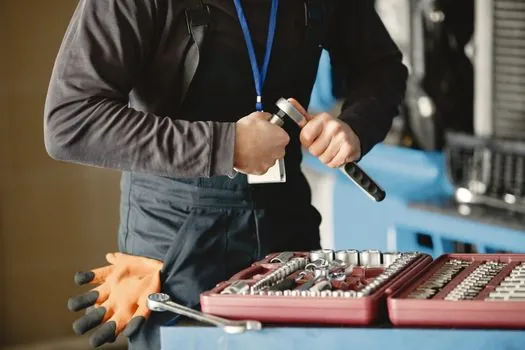
Most industrial vision lights use an M5 or M6 T-slot mount on the housing, while photo-eye and bracket stacks commonly use 1/4-20 UNC. The shear capacity of an M5 stainless cap screw at the head-bearing surface is roughly 2.4 kN in 4.8 steel and 3.6 kN in 8.8 steel, while a 1/4-20 in the same grade is about 30% lower in absolute terms but matches a wider North American bracket ecosystem. Spec mismatch is a routine field issue: ordering an M6 light for a 1/4-20 bracket and shimming with a washer drops the shear margin by half and introduces a bending moment that fatigue-cracks the housing boss within 6 to 12 months on a vibratory feeder. [S2]
For high-acceleration lines, a four-bolt M6 pattern on 30 mm centers outperforms a two-bolt pattern on the same footprint, and a captured split-ring lock washer retains torque roughly twice as long as a flat washer under 10 g vibration. The machine vision system spec sheet rarely lists the boss geometry, so the procurement check has to be a drawing, not a catalog page.
Cable gland, strain relief, and the 100 N pull-out test
Most industrial-grade vision lights use an M12 connector or a fixed cable with a brass or nylon compression gland. The relevant mechanical check is the cable pull-out force: 100 N applied for 1 minute must not displace the conductor more than 2 mm at the termination, per the typical interpretation of IEC 61076-2-101 for M12 and IEC 60512 for fixed-cable harnesses. Drag-chain (cable carrier) operation drops this limit dramatically: a 5 million-cycle chain at 1 m/s and 5 m travel radius is a separate qualification, and a gland rated for static 100 N will fail inside 2 million cycles in a chain unless the cable is clamped externally within 200 mm of the gland.
For vision imaging cells on a linear motor stage running 5 m/s, the cable rating has to be drag-chain grade (typically 5 to 10 million cycles) and the gland must be metal, not plastic. Plastic glands creep under sustained 30 N side load and lose seal compression within 18 months in a 24/7 cell, which is the typical root cause of intermittent IP67 failures on automotive battery inspection lines.
Compatibility check: the four-interface matrix
Four criteria, four failure modes: housing impact (IK code), window retention (O-ring vs bond), mount shear (M5/M6/1/4-20 grade), and cable pull-out (static vs drag-chain). A food-line diffuse backlight on a 304 stainless bracket wants IK08, silicone O-ring, four-bolt M6 in 8.8 steel, and a fixed PUR cable with metal gland; an automotive weld-cell ring light wants IK10, bonded window, M6 10.9 steel with lock washer, and a drag-chain rated M12 pigtail.
A clean-room semiconductor machine vision id reader wants IK07, bonded anti-static window, M5 in stainless, and a static cable with no exposed threads; a heavy stamping-press vision light wants IK10 plus a separate 5 mm polycarbonate shield, four-bolt M8 pattern, and armored cable. None of these come from a one-line spec; all four interfaces have to be cross-checked against the same drawing.
Standards, controllers, and what to ask the vendor
Two standards dominate the mechanical check: IEC 62262 for the IK impact code and IEC 60529 for the IP code; the M12 connector is qualified under IEC 61076-2-101, and cable drag-chain endurance is typically quoted against the manufacturer's own cycle test, not a published IEC number. The vision controller and trigger side carries no mechanical load, but the cable between the two inherits the same gland and chain rules, so the controller cabinet entry gland is often the weakest link in the whole chain.
On the procurement side, ask for the IK code in the actual mounting orientation, the mount-boss drawing, the window material and retention method, and the cable spec with chain-cycle rating. For comparison across vendors, a structured light scanner spec map and a roller conveyor types and applications reference use the same four-interface logic, so the same checklist format transfers to adjacent equipment buys on the same line. Verifiable next signal: IEC 62262-aligned IK test certificates per housing face, not a single overall datasheet line.