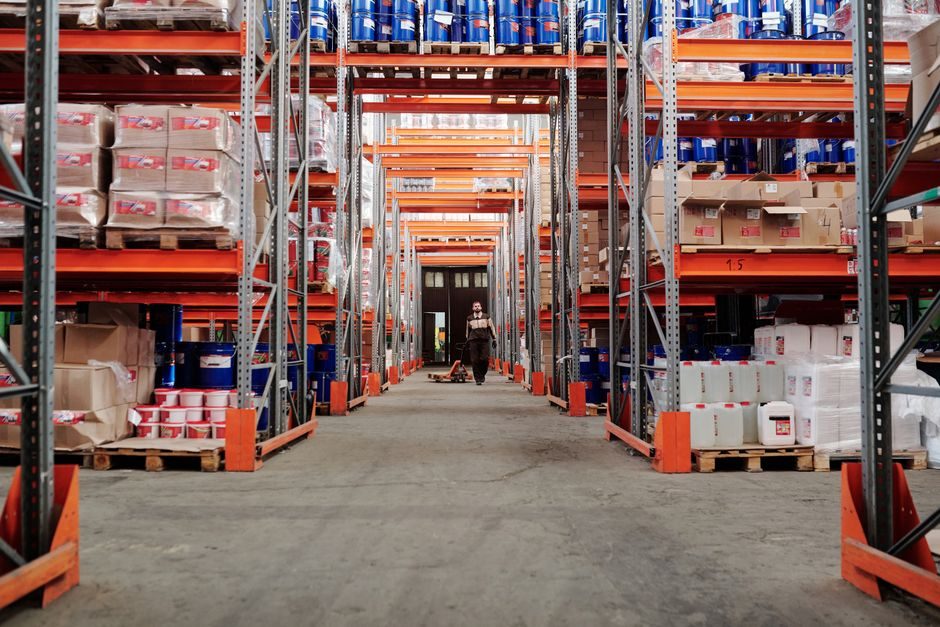
The warehouse robotics market was valued at $7,069.1 million in 2023 and is projected to reach $31,343.7 million by 2032, growing at an 18.2% CAGR from 2024 to 2032 [S1]. Online retail is forecast to climb to 30% of total retail sales versus 20% in the baseline year, the single demand-side variable pulling every upstream component decision on the chain [S1].
Upstream the chain runs through servo motors, precision reducers (RV and cycloidal), motion controllers and PLC hardware, LiDAR, machine-vision cameras, lithium battery cells, and structural aluminum extrusions. Downstream the same stack feeds e-commerce fulfillment centers, third-party logistics (3PL) hubs, cold-chain distribution, and pharmaceutical / medical-device warehousing, with retail-D2C and B2B auto-parts as the two fastest-growing end-use segments [S1][S2].
Upstream component stack: servos, reducers, sensors, batteries
Each autonomous mobile robot (AMR) and goods-to-person (G2P) shuttle consumes a documented bill of materials: 4-8 brushless servo motors for drive and lift axes, 4-6 cycloidal or RV reducers, 1-2 safety-rated LiDAR units, an industrial PC or motion controller, and a 24-48 V LFP or NMC battery pack sized 60-200 Ah [S1][S2]. Reported U.S. robotics sales of 12,305 units in a single quarter, up 25% year-over-year, imply proportional pull-through on servo and reducer volume, since every drive wheel is a motor-reducer pair [S1].
Component sourcing concentration is high: precision reducers are dominated by Japanese suppliers (Harmonic Drive, Nabtesco) and a growing Chinese tier (GreenHarm, Leaderdrive), while servo motors split between Japanese (Yaskawa, Mitsubishi, Fanuc), European (Beckhoff, Siemens), and Chinese (Inovance, Estun) vendors. Cell-level battery cost is the single largest BOM swing factor; switching from NMC to LFP at 60 Ah pack sizing typically drops $/kWh 18-25% but raises pack mass 12-15% at the same energy budget, a trade-off that drives the chassis-design decision between payload-heavy and range-heavy AMRs [S1][S2].
Mid-stream integrators and software
Warehouse management system (WMS) and warehouse execution system (WES) software sit in the mid-stream and bind the upstream hardware to downstream order flow, with REST and ROS 2 as the dominant integration APIs. Vendor share is described as marginally fragmented, with named players including KION Group, Honeywell International, KUKA Industries, BlueBotics, Omron, ABB, FANUC, Kawasaki Heavy Industries, Hirata Corporation, and Delta Electronics [S1].
Comau frames its mid-stream pitch around integration rather than OEM hardware, citing mobile robotics, vision-guided picking, and collaborative palletizing as the three work-cells it packages for greenfield 3PL sites [S2]. Open-source reinforcement-learning frameworks for warehouse navigation (DQN-based multi-agent stacks) have appeared on public GitHub repos, signalling that navigation-policy software is following the same commoditization curve that motion-control firmware took 2018-2023 [S5].
Downstream end-use: e-commerce, 3PL, cold-chain, pharma
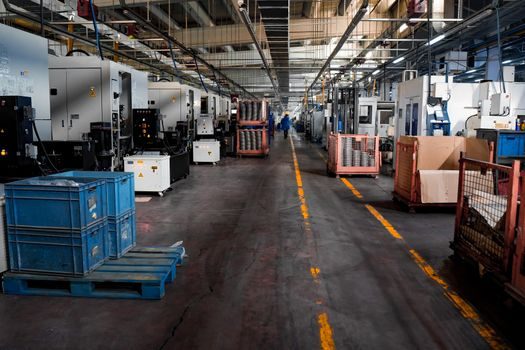
Downstream demand is heavily e-commerce-tilted: the projection that online retail rises from 20% to 30% of all retail is the single biggest pull on AMR and ASRS deployments [S1]. Amazon has earmarked $1 billion for robotics and AI, and Walmart has announced $14 billion in warehouse automation investment, the two largest named downstream capital commitments in the public research record [S1].
Beyond e-commerce, the cold-chain sub-segment is the fastest-growing downstream for low-temperature-rated AMRs (typically -25 °C capable) and pharmaceutical-grade G2P systems, where the IEC 61508 SIL-2 rated safety scanners and FDA 21 CFR Part 11 compliant WES become hard specifications rather than differentiators. Auto-parts B2B fulfillment is the third downstream pocket where tote-handling AMRs and bin-picking arms replace conveyor-only layouts, with measurable order-pick-rate gains of 2-3x over manual stations [S1][S2].
Upstream vs mid-stream vs downstream: criteria comparison
The chain can be lined up against four engineering decision criteria: BOM cost share, qualification lead-time, switching risk, and margin profile.
Mid-stream integrators and WMS/WES software hold 20-30% of cost, longer 6-12 month qualification cycles (a 3PL will not re-cut its WMS API for a 5% better fleet manager), high switching risk due to workflow lock-in, and the highest gross margins at 25-40% [S2]. Downstream end-user sites (fulfillment, 3PL, cold-chain) absorb the remaining 10-20% of cost as integration and facility retrofit, with low switching risk once a site is live, but margins vary widely by region and contract structure [S1][S2].
Selection gates for specifying engineers
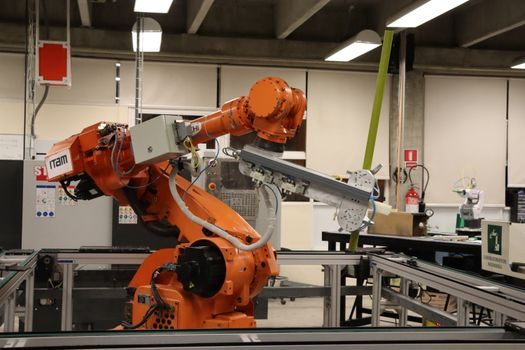
Three selection gates separate a workable robot spec from a tender-ready one. Gate 1 is duty cycle: continuous three-shift 3PL sites must size servos at 60-70% of peak torque, not the 30-40% sizing typical of single-shift e-commerce cells [S1].
Gate 2 is safety architecture: ISO 3691-4 compliant AMRs require dual-channel safety scanners, SIL-2 rated E-stops, and a defined PLd performance level on the drive-by-wire path; cold-chain sites add IP65 sealing and -25 °C grease [S1][S2].
Limitations, failure modes, and what the chain still cannot absorb
Three limitations bound the chain. First, payload ceiling: most AMRs top out at 1,500-2,000 kg, and any pallet above that falls back to AGV or human-forklift handling, no integrator currently closes that gap [S1][S2].
Second, narrow-aisle pick accuracy degrades above 1.0-1.2 m/s travel speed for vision-guided AMRs; that ceiling is the binding constraint on G2P shuttle throughput, not servo torque. Third, brownfield integration cost is 2-3x greenfield once structural steel, fire-safety zoning, and existing WMS migration are priced in, which is why so much downstream growth is concentrated in new-build 3PL parks rather than legacy DC retrofits [S1]. Battery cell supply and rare-earth magnet price for servo rotors remain the two upstream choke points most likely to swing lead-times across 2026-2027.
Trackable signals through the rest of 2026: quarterly robot-shipment counts published by the Association for Advancing Automation (A3) and any new SIL-2 or ISO 3691-4 updates from the IEC, both of which reset the Gate 2 specification baseline. For a parallel view on the actuator side, the cycloidal reducer trade-off map covers the upstream reducer bottleneck in detail, and the cobot upstream-and-downstream industry map lays out a comparable chain for collaborative arms sharing the same servo and reducer suppliers.
Spec-level background on the components involved: pressure transmitter.