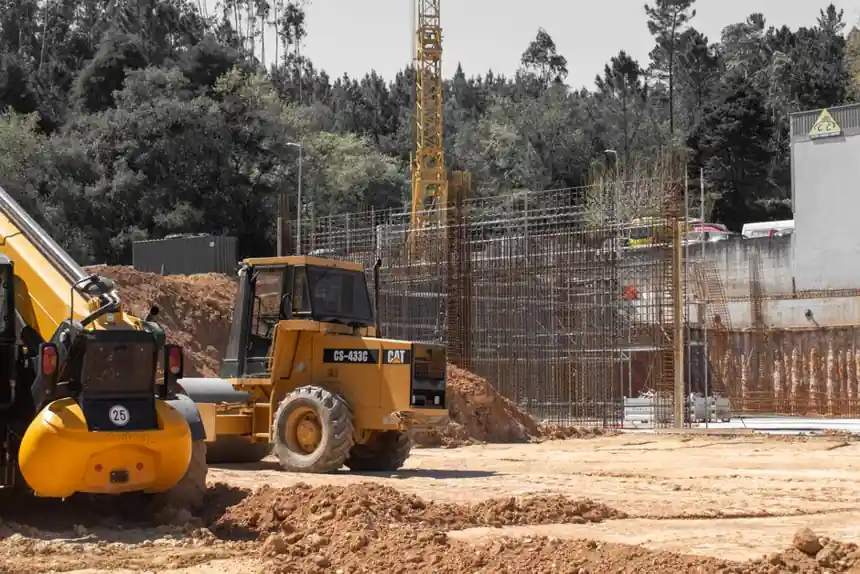
On a 2026 masonry site, the dominant rebar workflow is pre-straight 6 m or 12 m stock delivered to footing and grade-beam pours, which means a portable rebar cutter sized to the largest bar on the drawing is the working tool, not a coil-fed straightener [S3][S5]. A rebar straightener earns its slot only when the job is factory-floor: coil-to-length, mesh-line, or stirrup-tying, with D6-D16 hot-rolled wire rod at 30-50 m/min [S1][S5].
Masonry crews typically process ASTM A615 grade 40 or grade 60 bar, where grade 40 equals 40,000 psi (≈276 MPa) minimum yield and grade 60 equals 60,000 psi (≈414 MPa), in the 10-32 mm diameter band, which is a different motor and roller class than the 1.5-3.0 kW portable straighteners sized for residential decorative work [S1][S3]. The right call for a footing crew is usually a 110 V hydraulic shear at 180 lb two-person carry, not a stationary YG-frame straightener requiring 25 MPa (C25) pad cure and 1.25× full-load current contactor sizing [S2][S3].
Why masonry sites rarely need a straightener at all
Pre-straight 6 m and 12 m rebar is the default delivery format to North American masonry sites, so the on-site process reduces to cut, place, tie; straightening is already done at the mill, and the only residual bow tolerance that matters is the ≤2 mm/m straightness floor required downstream of a rebar coupler threading station, not at the slab edge [S1][S4]. Fascut's FC-800 portable shear cuts up to 1" (#8) grade 60 bar from a 110 V outlet, and the 180 lb FS-600 combo handles 3/4" (#6) grade 60 with one main moving part and a single grease fitting, which is the field-service profile masonry crews actually need [S3].
For decorative concrete, residential slabs, and small commercial footings, a portable straightener in the 1.5-3.0 kW band at 15-20 m/min is the maximum class a single crew can feed by hand, and even that is usually overkill because the bar arrives pre-straight [S4]. A 50-employee steel-fixing crew placing 1,300 t of rebar on a six-storey residential block is sized to a 3.0 kW three-phase machine; a decorative-concrete crew cutting one driveway mesh per week is not [S4].
The four binding selection criteria for a masonry straightener (if you really need one)
When a masonry project does call for coil-fed stock, e.g. on a remote site with no rebar yard nearby or in a precast yard feeding a CNC mesh welder, the selection logic is diameter range, bar grade, motor class, and straightness tolerance; the bid floor on tolerance is 2 mm/m or better for D6-D16 [S1][S4]. For D6-D12 mm coil, a 1.5-3.0 kW servo-drive straightener running the mandrel at 30-50 m/min delivers 0.8-1.5 t/h; for D12-D16 mm the same frame needs a 4.0-5.5 kW motor at slower 20-35 m/min to keep mandrel slip below tolerance [S1].
Heavy fabrication in the D16-D25 mm band jumps to 5.5-7.5 kW with 15-25 m/min mandrel speed and typically a two-roller pre-straightener upstream to defeat coil-set memory, and a heavy-class 14-25 mm unit with 6-roll geometry is the right default for precast yards feeding a CNC mesh welder [S1][S6]. When a yard runs both light coil stock and heavy bar, a dual-mandrel machine with swappable cartridges (6-16 mm and 16-25 mm) is the engineering choice over a single oversized unit, because mandrel wear on a 6 mm bar accelerates sharply when the frame is sized for 25 mm [S1].
Comparison: straightener class by diameter, motor, speed, and tolerance
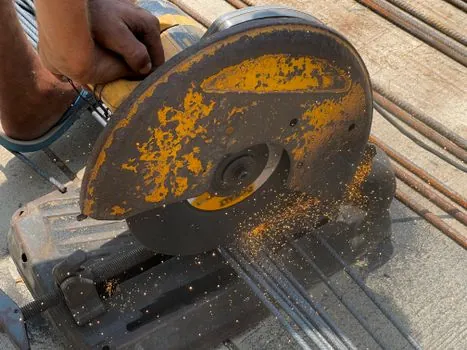
The four dominant straightener classes line up against masonry-relevant work as follows, with the caveat that only the light coil class is even a candidate for site work: light coil D6-D12 mm, 1.5-3.0 kW, 30-50 m/min, ≤2 mm/m tolerance, 0.8-1.5 t/h; mid D12-D16 mm, 4.0-5.5 kW, 20-35 m/min, ≤2 mm/m; heavy D16-D25 mm, 5.5-7.5 kW, 15-25 m/min, often with a pre-straightener; shop hydraulic D16-D40 mm, 4.0-7.5 kW three-phase, 25-35 m/min, fixed install only [S1][S4]. The light coil class is the only one portable enough to set on a cured 25 MPa pad and run from a 110 V or 220 V single-phase supply; everything heavier requires three-phase power and dedicated 1.25× full-load current contactor sizing [S2].
For Australian rebar processing yards, AS/NZS 4671 covers the steel reinforcing material and AS 3600 covers the concrete structure, and the straightness tolerance feeding the compliance chain is typically 2 mm/m or better for D6-D16; the straightener itself is not separately certified [S4]. For European fabricators running welded assemblies to EN 1090-2 Execution Class 2 or above, the straightener output is judged on residual bow and end-cuts clean enough to feed couplers without re-handling [S1].
Installation gates that decide whether a stationary straightener survives on site
A stationary YG-frame straightener (YG-6 5.5 kW, YG-9 9 kW, dual-motor YG-16 9 + 5.5 kW, 230-550 kg machine mass) requires concrete floor compressive strength of at least 25 MPa (C25) cured a minimum of 7 days before anchor bolts are torqued, and the YG-15 footprint of 2050 × 650 × 1100 mm needs at least 800 mm of feed-side clearance and 1500 mm of exit-side clearance for coil payout and cut-length stacking [S2]. Early loading on green concrete is the leading cause of pad cracking under 500 kg+ units, and a 0.5 mm shim error at the base typically shows up as 2-3 mm/m lateral drift at the exit die [S2].
The six-gate install sequence is non-negotiable: position and check diagonal measurements within ±5 mm; drill and set M16 × 200 mm anchor bolts in a 4-bolt pattern and torque to 110 N·m after grout reaches design strength; shim and level the base frame to ≤0.2 mm/m on the die-housing reference surface; terminate power with strain relief, verify forward rotation on a no-load jog, and confirm the mode-control lever; fill gearbox to the plug and grease roller bearings (oil-level check before every shift); run a 10-minute no-load trial then feed 5 m of known-good scrap and accept ≤1 mm bow over 1 m on a 1 m straightedge [S2]. If any gate fails, do not start production; the failure mode compounds, and a 0.5 mm shim error at the base is the difference between a coupler-friendly bar and one that costs 30-45 seconds of re-threading bench time per 16 mm grade 60 piece [S1][S2].
Failure modes and constraints specific to masonry environments
Straightener output is by design destructive to surface condition: the roll pressure required to flex a 12 mm deformed bar past its yield point leaves micro-scratches and a measurable drop in ultimate tensile strength, and the controlled-spec claim is "little strength loss, good straightness and no scratch" rather than a default [S5]. On a masonry site that ties into welded splices, AWS Reinforcing Steel Welding Code ties preheat and interpass temperatures to bar size and carbon equivalent, so work-hardening from a worn mandrel can skew the carbon-equivalent reading and disqualify a weld [S1].
Position couplers, used for bars that cannot be rotated, are the most sensitive: any helical twist left in the bar after the straightener shows up as thread-runout at the coupler shoulder, and threading equipment should be specified from the same vendor class so cut, straighten, and thread stations share a common PLC bus [S1]. For yard economics, the dedicated 4-12 mm straightener at roughly ¥38,000-55,000 is the right default for coil-to-cage yards processing HRB400E 6-16 mm; a combo unit at ¥120,000-180,000 returns its premium in 9-14 months for yards mixing HRB500 and stirrup-tying workloads, while a heavy-class 14-25 mm unit with 6-roll geometry is the right default for precast yards feeding a CNC mesh welder [S6]. The same coil-to-length logic drives shotcrete machine integration on masonry shotcrete runs, where the straightener feeds the mesh that the shotcrete line embeds.
Standards, sourcing, and the next decision node
Governing standards line up by region: ASTM A615 grade 40, 60, 75, or 80 (minimum yield in thousand psi) for U.S. rebar, with rail-steel A616 and axle-steel A617 carrying higher carbon and falling into the hard-to-weld category that constrains downstream welding [S1]; AS/NZS 4671 plus AS 3600 for Australian yards, with the straightener itself uncertified but its ≤2 mm/m output feeding the compliance chain [S4]; EN 1090-2 Execution Class 2 or above for European welded assemblies [S1]. A simple control knob and reference fixturing on the matching rebar bender keeps bend-angle repeatability inside the same tolerance window the straightener sets upstream [S7].
The next decision node is mechanical versus welded splices: if the masonry project uses mechanical couplers, hold straightness inside 0.5° over the threading length and residual bow under 2 mm/m, and re-threading a 16 mm grade 60 bar at 30-45 seconds of bench time will compound across a 500-piece cage [S1]. If the project uses welded splices, audit the mandrel for surface work-hardening before the carbon-equivalent reading is taken, and spec the threading and straightening equipment from the same vendor class so the PLC bus matches across stations [S1]. For crews pairing a straightener with a portable cutter, the working combination is a dedicated rebar bender plus a separate cutter rather than a 3-in-1 line, because the operator skill floor and throughput math are different on a masonry site than on a factory cut-to-length line [S5][S7].