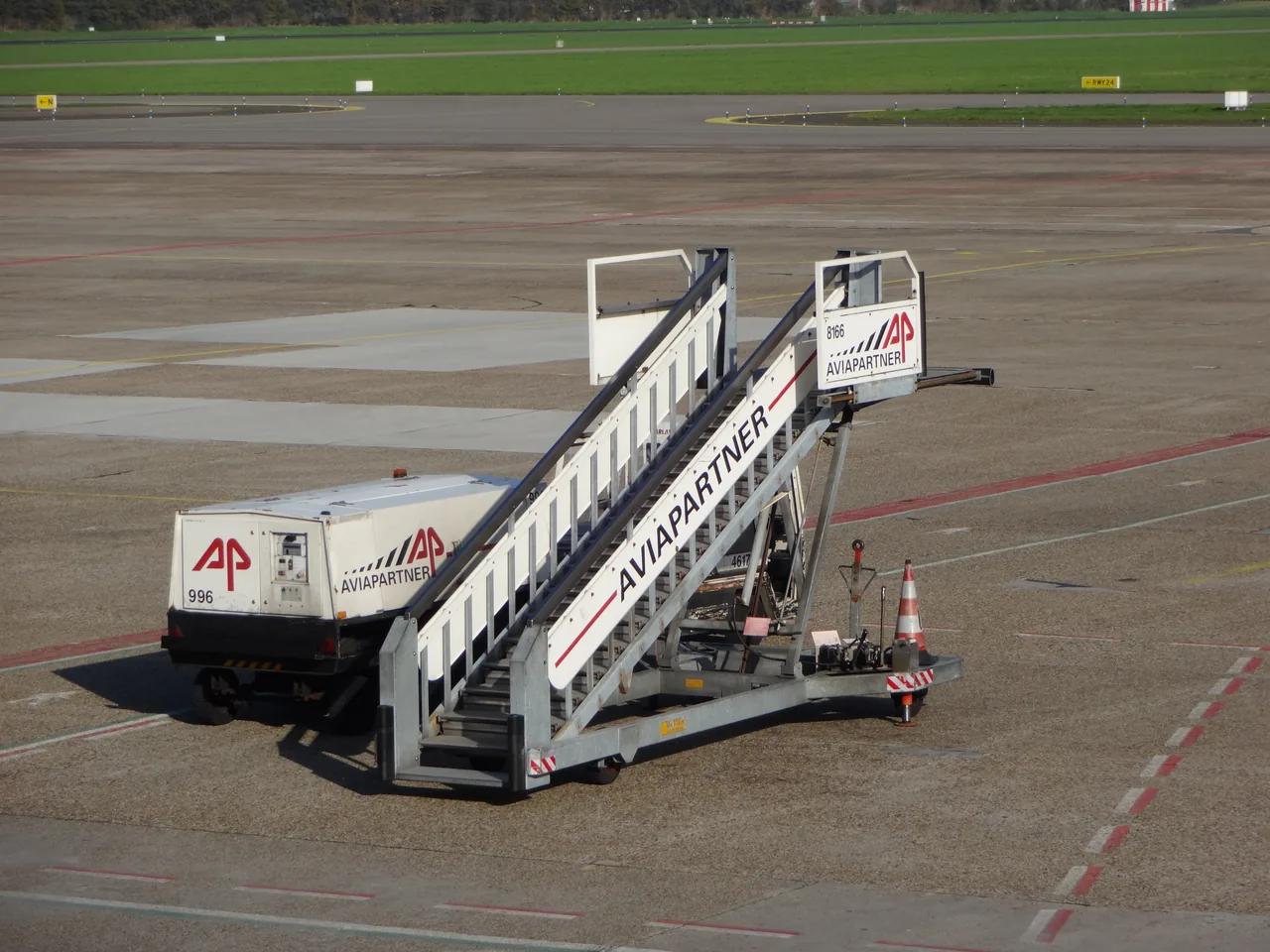
Aircraft boarding stairs are ground support equipment that give passengers and crew a fixed route between the apron and an aircraft door while the aircraft is parked on stand. The stair unit is an inclined flight of aluminum or steel steps with handrails on both sides, a level platform at the top, and a height adjustment that sets that platform level with the door sill. It rides on a chassis: a wheeled underframe with a drawbar on towable passenger stairs, a truck chassis or a battery-electric chassis on a self-propelled stair truck. Boarding stairs serve stands without a passenger boarding bridge, remote stands, and doors that no bridge can reach, and they decide how quickly an aircraft empties and fills.
The engineering problem is a moving target. A door sill stands between about 1.5 m (5 ft) above the apron on a regional jet and about 5.7 m (18.7 ft) on a wide-body, and it rises and falls as passengers, baggage and fuel load and unload the aircraft. The stair has to reach that sill, stay level with it across a gap small enough for a rolling suitcase, carry a crowd on a narrow flight in wind and rain, and never mark the fuselage with anything harder than a rubber bumper. It must then fold to its travel envelope, move to the next stand, and do it all again within minutes. Every dimension, rating and operating rule that matters follows from those conditions.
A boarding stair purchase settles on five decisions. The first is the sill height range against the aircraft types served. The second is the type of unit: a towable stair moved by a tug, or a self-propelled stair truck. The third is the geometry and strength of the flight: step size, stair angle, platform, load and handrails. The fourth is the height adjustment and how it follows the sill while the aircraft moves under load. The fifth is the set of apron rules that govern positioning, wind limits, towing speed and inspection. Fix those five and the stair is routine equipment; leave one open and delays and aircraft damage follow.
Chapter 1 / 06
What Aircraft Boarding Stairs Are and How They Work
A boarding stair does one job: it puts a level, guarded platform at the height of the door sill and holds it a short, safe distance from the fuselage. It stands on its own wheels and legs and carries its load to the apron, not into the aircraft. Only a transition plate or the platform edge bridges the last few centimeters, and if the unit comes too close a non-marking rubber bumper on the rails, commonly an EPDM rubber pad, takes the touch instead of the skin. The FAA boarding equipment circular calls the usual arrangement stairs attached to the aircraft, of the adjustable fixed-riser or variable-riser type, limits the transition ramp to a slope of 1:8, and lets the ramp rest on the door sill only if it induces no unsafe loads.
The height adjustment is the heart of the machine. Hydraulic cylinders raise or lower the upper end of the flight and change its slope until the platform is level with the sill; a hydraulic power unit drives them through a hydraulic pump and a hydraulic valve block, and an electric stair truck turns its pump with its own motor. A trimmer cylinder levels the platform, support leg cylinders plant the unit before passengers board, and an emergency electric pump stands by to lower the flight when the main pump is unavailable. The last movement is horizontal: on one electric design a moving platform extends 0 to 400 mm (0 to 16 in) toward the aircraft, so the operator closes the gap without moving the chassis.
The flight of both designs is telescopic: a structure of extruded aluminum alloy steps and anodized handrails whose sections slide to set the height step by step, with non-slip aluminum treads and lighting along the stairway. The platform is the working area at the door: a battery-electric design lists 2200 mm (87 in) wide by 4150 mm (163 in) deep, a truck-chassis design 2800 mm (110 in) by 1700 mm (67 in). Step dimensions are what passengers feel: both designs use a step 1500 mm (59 in) wide, with a going of 292 mm (11.5 in) or 270 mm (10.6 in) and risers of 192 mm (7.6 in) or 180 mm (7.1 in).
Under the flight sits the chassis, and the chassis decides how the stair travels. A self-propelled stair truck is built either on a truck chassis with a manual or automatic transmission or on a battery-electric driving chassis with its own traction motor and driveshafts; the electric design has an outer turning circle of 16.1 m (53 ft). A plain towable stair is positioned by hand or by a tug and has no road drive. Before boarding, the stair lands on support legs or stabilizers, and once parked it relies on its parking brake and wheel chocks, because a stair that rolls while loaded is a falling hazard.
The work fits a fixed sequence around the aircraft. Ground equipment waits in its marked areas until the aircraft is on stand, has stopped with brakes applied and engines shut down, and the anti-collision beacon is out; only then are the chocks placed and the steps positioned beside the aircraft. The handler confirms readiness with the crew before the doors open, passengers leave through the flight, and the steps stay until boarding is complete. Doors are then closed, the steps are withdrawn to their parking position, and the chocks come off. A stair that arrives late or leaves early breaks that sequence, which is why the FAA circular limits setup and deployment by a trained operator to 1 minute or less.
Loads on a boarding stair come from four directions at once: the crowd on the flight and platform, the weight of the structure and canopy, the forces of the height adjustment, and wind on a tall, open structure. US guidance for aircraft boarding equipment sets the design load for a single passenger with a mobility aid at 700 lb (318 kg), requires the surfaces along the passenger path to carry an average live load of 40 psf (195 kg/m2), and requires handrails to take 350 lbf (1560 N) at any point without permanent deformation. European practice treats the same problem through the stability and strength calculations and test methods of EN 1915-2.
Chapter 2 / 06
Aircraft Boarding Stairs Types and Structural Variants
The European standard for passenger stairs, EN 12312-1, sorts the product into three categories, and the categories follow the drive. Category A covers self-propelled stairs with a seated or standing driver and a top speed above 6 km/h (3.7 mph). Category B covers towable stairs with a docking drive of up to 6 km/h (3.7 mph), controlled from the ground, by remote control, or from a standing driver position. Category C covers towable stairs positioned by hand that still have powered means, such as height adjustment or stabilizers. The same standard covers automatic leveling systems, does not apply to stairs moved on public roadways, and offers its clauses as a guideline for towable stairs without powered means.
Towable passenger stairs are the simplest form: a stair unit on a wheeled underframe with a drawbar at the front, jacks at the corners and a parking brake. An airplane baggage tug or tractor brings one from the equipment area, the crew positions it by hand at the door, lowers the jacks until the unit is planted, and sets the platform height by hand or with a small powered unit. Needing no driver, towable stairs suit stands with a low turnaround rate and airports that already run a tug fleet. Their limits are speed and independence: a towable stair cannot move until a tug is free, and in strong wind UK guidance asks for parking brakes on all equipment and for anything not needed to be secured or moved to a protected area.
Self-propelled stair trucks carry the stair on their own chassis and take a driver. In the truck-chassis design the stair unit sits behind the cab of a truck with a manual or automatic transmission, which brings road speed between stands. One such design is 7700 mm (25.3 ft) long, 2500 mm (8.2 ft) wide and 3870 mm (12.7 ft) high, weighs 7200 kg (15,900 lb) unladen, carries up to 60 passengers on 29 steps, reaches sills from 2400 mm to 5800 mm (94 to 228 in), and lists a top speed of 80 km/h (50 mph). Its canopy is semi-closed or fully closed, and heating comes from a diesel-fired heater or from engine coolant.
The battery-electric stair truck replaces the engine with a traction motor on an electric chassis. A representative design uses a 60 kW (80 hp) motor, a 106.95 kWh battery at 618.24 V and a separate electric pump motor, on a chassis 7450 mm (24.4 ft) long, 2500 mm (8.2 ft) wide and 3600 mm (11.8 ft) high, with the flight split into a fixed ladder and a sliding ladder and a 24 V alarm light. It claims about 210 km of driving plus about 105 lifts on a small-airport duty cycle. Its range is a sill height of 2150 mm to 4800 mm (85 to 189 in) on a flight with 292 mm (11.5 in) going and 192 mm (7.6 in) risers at a maximum stair angle of 37.5 degrees.
Boundaries are worth fixing. A boarding stair is ground support equipment for passengers, not access equipment for work at height: an aluminum ladder, scaffolding and an aerial work platform serve maintenance and cleaning crews. It is not a belt loader, the airfreight conveyor truck that carries bags to the hold, nor the aircraft air conditioning and heating truck that conditions the cabin; those are other ground support equipment on the same stand. It is not a passenger boarding bridge, a fixed or mobile structure that docks onto the door, and it is not the integral airstair built into the fuselage. The boarding stair sits between the apron surface and the door sill.
Chapter 3 / 06
Key Specification Parameters and Standards
The first parameter is the door sill height the stair has to serve, read aircraft type by aircraft type. A CRJ has sills from 1.52 m to 1.73 m (5.0 to 5.7 ft); the 737 from 2.46 m to 2.79 m (8.1 to 9.2 ft); the A320 family from 3.42 m to 3.73 m (11.2 to 12.2 ft); and the 777 from 4.69 m to 5.66 m (15.4 to 18.6 ft). Stair families follow the same ladder: 1.20 m to 5.80 m (3.9 to 19 ft) across one maker's range, with the largest unit covering 2.40 m to 5.80 m (7.9 to 19 ft). One unit rarely spans the whole ladder, so the fleet list decides how many sizes to buy.
Geometry comes next, and it is constrained by the climb a passenger will accept. Both designs hold the stair at a maximum angle of 37.5 or 39.5 degrees, so going and riser are chosen carefully: 270 to 292 mm (10.6 to 11.5 in) of going and 180 to 192 mm (7.1 to 7.6 in) of rise on steps 1500 mm (59 in) wide. Capacity is stated in persons, 60 or 88, or as a live load of 40 psf (195 kg/m2) with a 700 lb (318 kg) design case for a passenger with a mobility aid. Handrails take 350 lbf (1560 N) at any point. Lighting along the boarding path is 15 foot-candles (161 lux) as a minimum, 20 foot-candles (215 lux) recommended, and 5 foot-candles (54 lux) for emergency lighting.
Standards define the product from three sides. EN 12312-1 is the European standard specific to passenger stairs and sets the three categories. EN 1915-1 gives the basic safety requirements for aircraft ground support equipment, and EN 1915-2 gives the stability and strength calculations and test methods that go with the specific part; it states that it adds no requirements for wind above the figures given in the document, so an exposed stand needs a check against those figures. FAA AC 150/5220-21C, issued in 2012, is scoped to boarding bridges, ramps, lifts and boarding chairs; its chapter of fundamental standards applies to all boarding equipment it discusses, and passes the stairway itself to an SAE recommended practice for boarding stairways. UK CAA CAP 642, published in 2018, adds the apron practice for positioning, chocking and inspection.
Parameter
Typical value or range
What it decides
Stair service range
1.20 m to 5.80 m (3.9 to 19 ft) across one family; 2200 mm to 5800 mm (87 to 228 in) on a wide-body self-propelled design
Which doors one unit serves
Door sill, regional and narrow-body
CRJ 1.52 to 1.73 m; 737 2.46 to 2.79 m; A320 family 3.42 to 3.73 m; envelope 1.52 m to 3.73 m (5.0 to 12.2 ft)
The small and mid-size stairs
Door sill, wide-body
767 3.99 to 4.50 m; 747 4.52 to 5.46 m; 777 4.69 to 5.66 m; A330 and A340 up to 5.70 m; envelope 3.99 m to 5.70 m (13.1 to 18.7 ft)
The tallest stair in the fleet
Stair angle
37.5 or 39.5 degrees maximum on two designs
Climb effort and flight length
Step going, riser and width
270 to 292 mm (10.6 to 11.5 in) going; 180 to 192 mm (7.1 to 7.6 in) riser; 1500 mm (59 in) wide
Walking comfort when wet or steep
Top platform
2200 mm (87 in) by 4150 mm (163 in), or 2800 mm (110 in) by 1700 mm (67 in)
Room for agents and bags
Capacity
60 or 88 persons on two designs; 40 psf (195 kg/m2) live load; 700 lb (318 kg) for one passenger with a mobility aid
60 kW (80 hp) motor; 106.95 kWh battery; about 210 km (130 miles) plus 105 lifts per charge
Shift autonomy and charging plan
Chapter 4 / 06
Selection and Duty Calculations
Selection starts with the aircraft and ends with a purchase order the maker can be held to. The calculations are short: the run a flight needs at a given height, the crowd load on the platform, the wind pressure on the structure, and the energy a shift consumes. Each uses datasheet figures and the conditions of the stand.
Start with a list of every aircraft type and every door the stair must serve, including rear doors. For each door read the sill height range and note what stands next to it: a wing, an engine, a propeller, or an airstair that cannot be retracted while the door is open. The stair's range must cover the tallest sill with a margin and its lowest position must still reach the lowest sill, because the largest unit in a range begins at 2.40 m (7.9 ft), above every CRJ door. A fleet that mixes regional jets with narrow-bodies usually needs two sizes of stair. US guidance expects the manufacturer to survey every aircraft model the purchaser names before delivery.
The run of the flight follows from the sill height and the stair angle. At the 37.5 degrees maximum of the electric design, the run to a 3.73 m (12.2 ft) A320 sill is about 4.9 m (16 ft); at 39.5 degrees it is about 4.5 m (15 ft). Add the platform, 1.70 m (5.6 ft) deep on one design and 4.15 m (13.6 ft) on the other, and the flight and platform occupy about 6 m to 9 m (20 to 30 ft) along the fuselage. Riser height gives the step count: a 3.73 m (12.2 ft) sill needs about 19 or 20 risers at 192 mm (7.6 in). The platform edge must then land within the 0.25 in (6.4 mm) vertical and 1.25 in (32 mm) gap limits.
Stability in wind is the second calculation. US guidance for boarding equipment requires its structures to withstand 3-second gusts up to 90 mph (about 145 km/h) while in use and occupied, and sustained winds up to 70 mph (about 113 km/h); these are design loads, not a permission to board. For operation, the dynamic pressure of a gust is roughly 0.6 times the square of its speed in meters per second, so a 40 m/s (131 ft/s) gust presses on the order of 1.0 kPa (21 psf) on the windward area of steps, rails and canopy. Ask for the EN 1915-2 stability case with stabilizers down and with them up, and write into the apron rule the wind speed, read on the airport's anemometer, at which boarding stops and the stair is lowered, stowed and parked with its brake on.
Crowd load is the third. The live load of 40 psf (195 kg/m2) applied to a 2.80 m by 1.70 m platform gives about 930 kg (2,050 lb) on the platform alone, and the flight below carries its share of the rated 60 or 88 persons. The number that matters to the structure is the sum of platform, flight and canopy weight plus this live load, applied with the stair at its highest and least favorable position. The number that matters to the airline is throughput: a flight of 1500 mm (59 in) wide steps takes a steady stream of passengers, and a second stair at a rear door shortens the disembarkation time on a wide-body.
Drive and energy close the calculation. For a battery-electric stair truck, take the distance driven per turnaround, the lifts per turnaround and the turnarounds per shift, and check the sum against the stated endurance, about 210 km (130 miles) of driving plus about 105 lifts for one electric design. Its longitudinal ramp angle of 16.3 degrees says how steep an apron slope it can approach without grounding. For a truck-chassis stair the questions are fuel, exhaust at the door and road speed between stands; its 80 km/h (50 mph) top speed is a road figure, and on the apron the aerodrome operator's speed limit governs. For every type, check the outer turning circle against the stand layout and the route from the equipment area.
Decision factor
What to check
What it changes
Aircraft types and doors
Sill range of every type, front and rear doors, obstructions beside the door
Number and size of stairs
Towable or self-propelled
Turnarounds per day, distance to the stand, tug and driver availability
Capital, labor and waiting time
Drive type
Airside emission and noise rules, charging points, shift length
Truck chassis or battery-electric chassis
Height adjustment and sill tracking
Hydraulic power unit, emergency pump, automatic leveling
Gust and sustained wind figures, stabilizer arrangement, canopy type
Stability case and the apron stop rule
Apron rules
Airport speed limits, banksman requirement, equipment inspection program
Driver training, inspection records
Compliance documents
EN 12312-1 category, EN 1915-1 and EN 1915-2 evidence, aircraft survey, training
Acceptance test and handover file
Chapter 5 / 06
Installation, Maintenance, and Typical Failure Modes
A boarding stair has no installation in the plant sense. Commissioning is the survey of each aircraft, the training of operators and technicians, the handover of manuals and the first entry in the vehicle record. What follows is the inspection routine that keeps a stair serviceable, and the faults it is looking for.
Commissioning begins before the stair reaches a stand. The manufacturer surveys every aircraft model the purchaser has named and confirms that the platform and rails clear the door surround, the airstair and the engine. Operators and technicians are then trained: US guidance calls for at least 2 hours for designated operators, covering controls and emergency procedures with a check ride, and at least 8 hours for technicians, with a certificate issued at the end. The handover should include the manuals, the maintenance schedule and the vehicle record. UK airside guidance expects every vehicle and item of equipment to carry an individual record of maintenance and fault history kept for airport audit.
The daily inspection is the base of the routine and belongs to the operator. UK guidance makes routine daily inspections the responsibility of vehicle owners and operators: the driver carries out a walk-round check of the whole vehicle, records any defect, enters a nil return when nothing is found, and signs the record. Before the stair is positioned on an aircraft, the serviceability of its brakes is checked. The items that let a stair down are usually simple: a parking brake that does not hold on a slope, a handrail that has worked loose, a lamp that has failed, a tread worn smooth, or an oil stain under a cylinder.
Seal and structural faults develop slowly and then quickly. A cylinder that drifts down under load points to worn nitrile rubber seals or a check valve that no longer seats; a wet or chafed industrial hose is a burst waiting for a passenger on the flight, because a burst hose drops the platform unless pilot-operated check valves hold it. Steps loosen where the extruded tread meets the stringer, welds crack where steel plate brackets carry the flight on the chassis, and steel bolted to aluminum sets up galvanic corrosion unless the joint is isolated, which is why stainless steel fasteners with isolation washers are the usual answer. Industrial lubricant on the pins and a sound industrial coating over every weld cost less than any repair.
Control faults are the ones that stop a turnaround. A limit switch at the end of a lift or at the stowed position drifts out of adjustment and the stair refuses to drive. A safety interlock switch, where one is fitted on the stabilizers or a platform gate, is bypassed after a nuisance fault and never restored. An emergency stop that no longer cuts the drive, a worn emergency stop button or a sticky selector switch between drive and lift, and a pushbutton pilot light that has failed leave the operator unsure what will move. A failed signal tower light, a reversing ultrasonic sensor or a cracked mirror is a small item with a large consequence on a crowded apron.
Weather adds its own list. Wind is handled by a stop rule read on the airport's anemometer: when the limit is reached, boarding stops, the stair is lowered, the canopy is secured, the parking brake is set, and equipment that is not needed is secured to a fixed object or moved to a protected area, as UK guidance asks in strong wind. Snow and ice on the treads turn a non-slip surface into a slide, so steps are cleared and treated before the first passenger arrives. Where a canopy is heated by a diesel-fired heater or by an engine coolant heating device on a 220 V supply, the heater, its flue and the canopy fabric join the winter check list.
Item
When
What is checked
Walk-round check
Each day before use, by the driver
Parking brake, tires, lights, horn, alarm light, leaks; defect or nil entry signed
Brakes before positioning
Every turnaround
Serviceability confirmed before the stair is placed
Cylinders, pump and hoses
Typically weekly
Cylinder seals, industrial hose chafe, reservoir level, drift under load
Height adjustment, emergency lowering and stabilizers
Typically monthly
Full travel, level with a spirit level, emergency pump, check valves, pins and full extension
Steps, treads and handrails
Typically weekly
Loose treads, worn non-slip surface, bent rails, loose fasteners
Controls and interlocks
Typically monthly
Limit switch, safety interlock switch, emergency stop button, pilot lights
Structure and corrosion
Typically annually
Welds at the chassis brackets, cracked steel plate, coating damage
Records
Continuous
Maintenance and fault history for airport audit
Chapter 6 / 06
Industry Applications and Procurement Checks
Boarding stairs earn their place wherever a bridge cannot or need not be used. Remote stands reached by bus are the classic case, and so are low-cost operations that turn an aircraft around with no fixed infrastructure at the stand. Fleets of regional jets and turboprops, whose sills sit between about 1.5 m (5 ft) and 3.15 m (10.3 ft), are served by towable or small self-propelled stairs; mixed fleets with narrow-bodies and wide-bodies use stair trucks that reach 5.8 m (19 ft). One truck-chassis design lists A310, A319, A320, A330, A340, A350, 737, 747, 757, 767, 777, 787 and C919 among the types it serves.
On the apron the stair is one item in a choreography. It leaves the equipment area only after the aircraft is chocked and the beacon is off, travels at the airside speed limit, takes a banksman when it has to reverse, and stops with its platform square to the door and clear of the flaps. The driver then confirms with the crew that the door is ready, raises and trims the platform, closes the gap, and then the door is opened. The passenger route to the terminal or the bus is marshalled, and stays clear of the belt loader, the cable of the ground power cart and the hose of an aircraft air start unit at the nose. A warning sign and cones mark where the route crosses a vehicle lane.
Acceptance is a paperwork exercise with real consequences. Ask for the declaration of the EN 12312-1 category, for the test evidence behind EN 1915-1 and EN 1915-2 conformity, for the aircraft survey, for the load and stability calculations with the wind case, and for the training certificates. Airlines that handle to the IATA Airport Handling Manual will ask which of its chapters the stair meets, and airports inspect the unit against their own ground support equipment rules, so the maintenance schedule, the daily inspection sheet and the fault record should arrive with it. A fleet buyer also standardizes the chassis, the cylinders and valves and the lamps and light fittings across stair trucks, belt loaders and other GSE.
A purchase order for boarding stairs should state, in numbers, what the unit has to do. List the aircraft types and doors to be served, with the lowest and highest sill. State whether the stair is towable or self-propelled, and for a self-propelled unit whether it is a truck chassis or battery-electric, with the battery capacity, the endurance expected per shift and the charging time required. Give the step going, riser and width, the maximum stair angle, the platform size, the rated persons and the live load, and the handrail strength. Ask for the height adjustment means and its emergency lowering, the stabilizer arrangement, the canopy type and heater, the alarm light, mirrors and reversing sensors. Ask in writing which interlocks prevent driving with the stair raised or the stabilizers down, what gates or safety barrier close the platform edges, and where the fire extinguisher is carried. Require the EN 12312-1 category, the EN 1915-1 and EN 1915-2 evidence, the wind case, the maintenance schedule, the daily inspection sheet, and operator and technician training with certificates.
FAQ
How do aircraft boarding stairs work?
A boarding stair is a flight with a platform at the top. The operator drives or tows it to the door, lowers its support legs or stabilizers, and uses hydraulic cylinders to raise the flight until the platform is level with the door sill. A trimmer cylinder levels the platform and, on some designs, a moving platform extends toward the aircraft to close the gap; one electric design gives that platform 0 to 400 mm (0 to 16 in) of travel. A transition plate or the platform edge bridges the last centimeters, and a rubber bumper protects the fuselage if the stair comes too close.
What types of passenger stairs are there?
EN 12312-1 defines three categories. Category A is a self-propelled stair with a seated or standing driver and a top speed above 6 km/h (3.7 mph). Category B is a towable stair with a docking drive of up to 6 km/h (3.7 mph), controlled from the ground, by remote control or from a standing position. Category C is a towable stair positioned by hand that has powered height adjustment or stabilizers. Towable stairs with no powered means fall outside the categories but may use the standard's clauses as a guideline. Self-propelled stairs are built on a truck chassis or on a battery-electric chassis.
Which aircraft can a boarding stair reach?
It depends on the stair's height range and the door sill. A CRJ's sills run from 1.52 m to 1.73 m (5.0 to 5.7 ft). A 737 needs 2.46 m to 2.79 m (8.1 to 9.2 ft), an A320 family jet 3.42 m to 3.73 m (11.2 to 12.2 ft) and a 777 from 4.69 m to 5.66 m (15.4 to 18.6 ft). Stair ranges span about 1.20 m to 5.80 m (3.9 to 19 ft), with the largest starting at 2.40 m (7.9 ft), so a mixed fleet usually needs two sizes.
What step and platform dimensions matter on boarding stairs?
Going, riser and width decide how the climb feels. Two designs use steps 1500 mm (59 in) wide, with a going of 292 mm (11.5 in) or 270 mm (10.6 in) and risers of 192 mm (7.6 in) or 180 mm (7.1 in), at maximum stair angles of 37.5 or 39.5 degrees. Platforms run from 2200 mm (87 in) wide and 4150 mm (163 in) deep to 2800 mm (110 in) by 1700 mm (67 in) on the other. Capacity is quoted as 60 or 88 persons, or as a live load of 40 psf (195 kg/m2), and handrails must take 350 lbf (1560 N).
How much wind can a boarding stair take?
The structural figures come from FAA guidance for boarding equipment, not for stairs alone: a structure must withstand 3-second gusts up to 90 mph (about 145 km/h) while occupied, and sustained winds up to 70 mph (about 113 km/h). Those are design loads, not an operating limit. In operation, the gust pressure is roughly 0.6 times the square of the wind speed in meters per second, so a 40 m/s (131 ft/s) gust loads about 1.0 kPa (21 psf). Each airport needs a stop rule tied to its anemometer: below it boarding continues, above it the stair is lowered, stowed and, if not needed, secured or moved to a protected area.
How is a boarding stair positioned at an aircraft?
The stair is brought to the door only when the aircraft is secured: stopped, brakes set, engines shut down, anti-collision beacon off, chocks in place. It approaches at the airport's airside speed limit, with a banksman walking it through any reverse move, and halts with its platform facing the door square and away from the flap arc. The platform is then raised and trimmed to the sill, the gap is closed, and the crew agrees that the door can open. Passengers are kept on a marshalled route to the terminal or their bus. For departure the sequence runs in reverse: door closed, stair withdrawn, chocks out.
What maintenance does a boarding stair need?
A daily walk-round check by the driver comes first: parking brake, tires, lights, horn, alarm light and oil leaks, with every defect written down and a nil return signed when nothing is found. Weekly attention goes to the steps, treads and handrails and to the lift system, where a cylinder that drifts under load points to worn seals or a check valve. Typically monthly checks cover full travel of the height adjustment, the emergency lowering pump, the interlocks and the stabilizers, and an annual inspection looks for weld cracks and corrosion at mixed-metal joints. Each unit needs its own maintenance and fault record for airport audit.