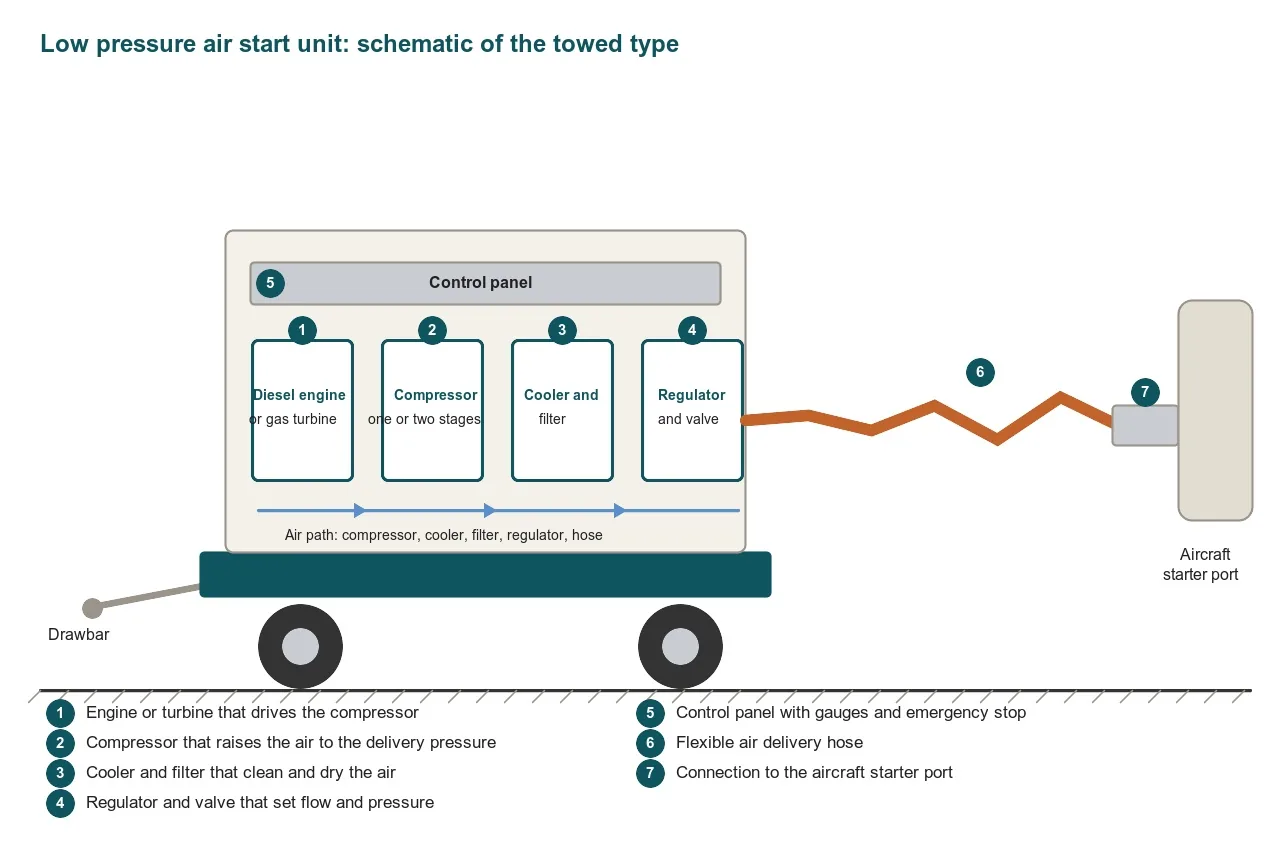
An aircraft air start unit, also called an air start cart or ASU, is a ground support machine that feeds compressed air to the starter of a turbine engine while the aircraft stands at a gate or on the apron. The starter is a small air turbine geared to the engine's high-pressure rotor, and the ground unit is the air source that spins it when the aircraft's own auxiliary power unit is out of service or switched off. The unit is built as a towed trailer or as a self-propelled truck and carries three things: a compressor with its diesel engine or gas turbine, a control system that holds the delivery pressure, and a flexible hose that ends in the aircraft connector.
Low pressure, high volume describes the delivery: enough mass flow at a few tens of pounds per square inch to keep the starter turning until the engine reaches the speed at which it accelerates on its own. Units of the 150 to 400 ppm class, where ppm reads as pounds of air per minute, cover commercial turbofan and turboprop engines, and smaller units serve business jets and helicopters. The purchase sits with airlines, ground handlers, maintenance bases and military units, and it concentrates on four points: the flow and pressure the largest aircraft needs, the drive and compressor that produce it, the hose and coupling that deliver it, and the proof that the unit keeps doing it in winter, at altitude and after years of starts.
Diagram: SpecForge original drawing of a towed low pressure air start unit, made for this page.
The mass flow and the pressure at the aircraft connection decide an air start unit, read from the start requirement of the largest engine on the fleet list and not from the rating painted on the cart. Around them sit the hose length that the stand layout forces and the lowest temperature and highest altitude at which the unit must still deliver. The last item is the maintenance record, because a cart that fails to build pressure strands an aircraft that has already lost its auxiliary power unit. Drive type, mobility and noise follow from these.
Chapter 1 / 06
What an Aircraft Air Start Unit Is and How It Works
An aircraft air start unit is a self-contained compressed air plant on wheels. Its only customer is the air turbine starter of a turbine engine: a motor on the engine's accessory drive that uses the energy of flowing air to turn the high-pressure rotor during the start. The aircraft normally feeds that starter from its auxiliary power unit, which also supplies electricity and conditioned air. With that unit unserviceable or kept off to cut noise and exhaust at the stand, the ground unit takes over the air side, and a 737 turning around without one needs the air start vehicle, the electrical vehicle and the conditioned air vehicle beside it. Nothing on board is altered: only the air source moves to the ground.
A start begins with the aircraft's start valve closed and the ground unit already at pressure. When the valve opens, air flows through the hose, into the aircraft's air duct and through the starter, and the starter motors the high-pressure rotor through a set of reduction gears and a one-way clutch. At a set rotor speed the crew introduces fuel and ignition, and the starter goes on helping the rotor until the engine is accelerating by itself; the valve then closes and the clutch lets the starter rest. On the 737 family the requirement is drawn for a start completed in 90 seconds, and the air arrives through one 3 in (7.6 cm) port that serves the engine start and the air conditioning packs alike.
The diesel-driven unit is the common build on commercial aprons. A turbo diesel engine drives a rotary screw compressor, in one build air-cooled as a package, in another a dry-running screw set with an integrated oil tank and an external oil cooler, and the air is cooled again before it reaches the hose. An electronic pressure and flow regulator commands both the engine speed and the compressor's output, running the engine between 1300 and 2000 rpm instead of at full speed all the time, which lowers fuel burn and noise. The chassis is a trailer with a steerable front axle, brakes that set when the tow bar is raised or lowered, batteries for starting, a hose tray and a metal body with wide doors for maintenance access.
The turbine-powered unit works on another principle. Its prime mover is a small gas turbine, and the air it delivers is bleed air taken from the compressor of that turbine, so the machine carries one rotating assembly instead of an engine plus a compressor. It burns jet fuel, diesel or any mixture of the two, and it operates in ambient air from -32 degrees Celsius (-25.6 degrees Fahrenheit) to 52 degrees Celsius (125.6 degrees Fahrenheit). A typical unit delivers 204 ppm at 56 psia (3.86 bar), weighs 2,100 kg (4,630 lb) without fuel and is declared from sea level up to 6500 ft. Some carry a generator as well, 90 kVA at 400 Hz, so that one machine serves two ground services.
Every start is a bargaining between pressure and flow. The starter is an air motor, and its torque comes from the pressure ratio across it multiplied by the mass flow through it, so a unit that holds pressure but cannot move enough mass leaves the rotor turning too slowly. The aircraft duct, the start valve and the hose all take a share of the pressure on the way, and the aircraft maker therefore states the need at its own connector: mass flow in pounds per minute against pressure in pounds per square inch absolute. A unit's rating means little without its reference conditions, and diesel units are commonly rated at sea level in air of 15 degrees Celsius (59 degrees Fahrenheit).
A pressure reducing valve or an electronic regulator holds the set delivery pressure; when the start valve opens and the flow rises, the regulator loads the compressor and brings the engine up, and when the valve closes it unloads again, by throttling the engine back or by passing surplus air through a blow-off valve that vents through a pneumatic silencer. A check valve at the outlet holds the hose pressure meanwhile. A dynamic compressor also needs the blow-off: below its minimum flow it surges, and a back pressure regulator keeps it clear of the surge line. Engines and compressors shut down on high temperature, low oil pressure and overspeed, a safety relief valve guards the air side, and a red mushroom button stops everything by hand.
Chapter 2 / 06
Aircraft Air Start Unit Types and Structural Variants
Two builds divide the field. The diesel-driven screw unit is the workhorse: in a typical range, a 180 ppm (82 kg/min) model carries a 360 kW engine and a 400 ppm (181 kg/min) model 783 kW, both at 2100 rpm, with fuel economy, low noise and low maintenance cost in its favour. It is heavy, from about 4,900 kg (10,800 lb) to 9,800 kg (21,600 lb) across that range. The turbine-powered unit answers with mass and reach: 4.33 m (170 in) long and 2,100 kg (4,630 lb) without fuel for 204 ppm (92 kg/min), air transportability and any fuel from jet fuel to diesel. Military users and handlers who fly their equipment to remote sites choose it.
Compressor principles sort the family a second way. The screw set and the sliding-vane machine are positive-displacement rotary compressors: the vane type works like a rotary-vane pump, with vanes sliding in an eccentric rotor, and both deliver a nearly constant volume against whatever back pressure the aircraft presents. The centrifugal compressor works dynamically, raising pressure with impellers and losing it again if the flow falls into surge, which is why the turbine unit blows air off. The European standard for air start equipment adds two kinds that have no compressor of their own: stored air systems, where an air receiver charged elsewhere feeds the hose, and air delivery systems built into a ramp or a passenger boarding bridge.
Mobility gives the third split. Most units ride on a towed trailer: a steerable front axle, a tow bar whose raised or lowered position sets the brakes, and a parking brake that must restrain the loaded unit on a slope. Any suitable tractor moves them, commonly the airplane baggage tug or tractor that already works the stand, and AHM 910 capped the towing speed at 32 km/h (20 mph) in 2012. The truck-mounted unit, an option in the diesel ranges, carries its own cab and reaches a remote stand without a tractor. The safety rules of the same manual divide ground support equipment into non-motorised and self-propelled categories and give each its own reflective markings, emergency systems and engine starting rules.
Capacity classes follow aircraft size and are graded by mass flow in pounds per minute. Units of 150 to 180 ppm (68 to 82 kg/min) serve business jets, turboprops and the lighter airliners; 270 to 300 ppm (122 to 136 kg/min) covers the larger narrow-body types; and 400 ppm (181 kg/min) is bought to cover the widest range of aircraft with one model. Delivery pressure sits at 42 psig (2.9 bar) in one range and up to 40 psig (2.8 bar) in another, which is about 56 psia (3.9 bar) absolute at sea level. Hose connectors rise with the class from one to three, and the standard hose is 30 ft (9.15 m).
Several neighbors share words with the unit. An aircraft air start unit is not an auxiliary power unit, which is installed in the aircraft, and not an engine starter, which is bolted to the engine; it supplies air to the starter and nothing else. Its diesel engine and its gas turbine are bought components rather than the product, and so is its screw compressor. It is not a diesel generator, which converts fuel into electricity, and not an aircraft air conditioning and heating truck, which delivers conditioned air to the cabin; in its air conditioning mode the unit only presses air at 36 psi (2.5 bar) into the aircraft's own packs. The belt loader, an airfreight conveyor truck, is a transport unit that works beside it.
Chapter 3 / 06
Aircraft Air Start Unit Key Specifications and Standards
The delivery specification is written at the aircraft connection, in mass flow and pressure. Commercial units deliver between 150 and 400 ppm (68 to 181 kg/min) at 40 to 42 psig (2.8 to 2.9 bar), and a turbine unit 204 ppm at 56 psia (3.86 bar). What the aircraft needs is a curve rather than a point: for the 737 family at sea level, one line for each supply-air temperature from 0 degrees Fahrenheit (-18 degrees Celsius) to 450 degrees Fahrenheit (232 degrees Celsius), with colder air asking for more flow, and a ceiling of 60 psia (4.1 bar). The air enters through a 3 in (7.6 cm) port, the hose end carries a coupling to ISO 2026, and the standard hose runs 30 ft (9.15 m).
Three entries on a datasheet deserve a second look. The first is the reference condition: a flow quoted at sea level in 15 degrees Celsius (59 degrees Fahrenheit) air falls on a hot day at a high airfield, one turbine unit is declared from sea level up to 6500 ft (1980 m), and a diesel rating needs the maker's derating. The second is the pressure basis: 42 psig and about 56 psia describe the same air, one on a gauge and one against vacuum, so an aircraft requirement in absolute units is matched by an absolute pressure transmitter. The third is air temperature at the connector, watched by a temperature sensor on the delivery line, because hot supply air lowers the flow the starter needs but is bounded by what the duct tolerates.
Four documents frame the product. EN 12312-16 is the European standard for air start equipment: it sets health and safety requirements and some functional and performance requirements for stored air systems, mobile diesel-powered units, mobile turbine-powered units and bridge or ramp air delivery systems serving civil aircraft, and leaves pressure vessels, noise and vibration and the automotive chassis to other rules. ISO 2026 fixes the dimensions of the connection for starting aircraft engines by air so that connectors and adaptors interchange. The Airport Handling Manual of the International Air Transport Association holds basic requirements for ground support equipment in AHM 910 and basic safety requirements in AHM 913, covering towing, brakes, emergency shut-downs and exhaust clearances. ICAO's Manual on Ground Handling asks each air operator to write its own rules.
Parameter
Typical value
What it decides
Air mass flow, diesel classes
150 to 400 ppm (68 to 181 kg/min)
Which engines it can start
Air flow and pressure, turbine unit
204 ppm (1.54 kg/s) at 56 psia (3.86 bar)
Military and remote starts
Delivery pressure, diesel units
40 to 42 psig (2.8 to 2.9 bar)
Starter torque, relief setting
Maximum pressure, 737 connector
60 psia (4.1 bar)
Regulator setting
Start time behind the 737 curves
90 seconds
Definition of the curves
Hose length
30 ft (9.15 m); 50 ft (15 m) optional
Stand position, pressure loss
Aircraft connection
3 in (7.6 cm) port, ISO 2026 coupling
Interchange of carts and aircraft
Ambient temperature, turbine unit
-32 to 52 degrees Celsius (-25.6 to 125.6 degrees Fahrenheit)
2,100 kg (4,630 lb) turbine; 4,900 to 9,800 kg (10,800 to 21,600 lb) diesel
Tow tractor class, air transport
Engine power, diesel units
360 to 783 kW at 2100 rpm
Fuel burn, heat rejected
Noise limit set by AHM 910 in 2012
85 dBA at 1.6 m (5 ft)
Apron noise rules
Tow speed and parking brake, as set in 2012
32 km/h (20 mph); holds on 4 degrees (7 percent)
Apron driving, chock policy
Chapter 4 / 06
Aircraft Air Start Unit Selection and Duty Calculations
Selection runs from the aircraft back to the cart. The engineer starts with the start requirement of the largest engine on the stand list, corrects it for the worst air the unit will ever breathe, adds the losses the hose run imposes, and only then reads the catalog of units.
The first calculation reads the aircraft's requirement. Its airport planning data give, for each engine type, a curve of mass flow against pressure at the ground connector for a stated start time, and the engineer takes the curve for the highest supply-air temperature the unit will produce. For the 737 family at sea level that is a family of lines between roughly 80 and 200 ppm across a pressure range of about 35 to 70 psia. The unit chosen must deliver more than that line at its own reference conditions, and a turbine unit of 204 ppm at 56 psia (3.86 bar) shows the order of margin. Where the data give one point only, the unit is sized to it with room to spare.
The second calculation corrects for ambient air. Engine and compressor breathe it, so their output follows its density; a turbocharged diesel loses less with altitude than a naturally aspirated one, but it loses some. Heat works on the aircraft side as well: the requirement curves are steeper for cold supply air and gentler for hot, so a unit that is ample in summer can be marginal on a winter morning when the air it delivers is cold. The cold itself then sets a floor: a diesel unit needs an engine preheating kit below -25 degrees Celsius (-13 degrees Fahrenheit) and a full system heating kit to work at -40 degrees Celsius (-40 degrees Fahrenheit), while the turbine unit is built for -32 degrees Celsius (-25.6 degrees Fahrenheit).
The third calculation is the hose run. The connector sits on the fuselage at a point the aircraft's planning data fix, and the unit must stand far enough from the engine intake to stay outside its hazard area, so the hose length decides where the cart can park. A 30 ft (9.15 m) hose is standard and 50 ft (15 m) is optional, and every extra meter costs pressure at the starter; a hose laid straight loses far less than one looped or kinked, and a hose squeezed under a wheel loses more still. Units of the larger classes come with two or three hose connectors instead of one. The hose diameter follows the flow, and a long, small-bore hose is the most common self-inflicted cause of a slow start.
The fourth calculation is duty. A hub unit may start engines all day and an outstation unit a few times a week, and the two want different answers. Frequent duty rewards the diesel engine run at variable speed, between 1300 and 2000 rpm, because an engine at part speed burns less fuel and makes less noise, and diesel maintenance stays cheap. Sparse duty at a remote or austere site rewards the turbine unit instead: it flies as air freight, runs on whatever fuel is on the airfield and needs no winter kit of its own. Where the aircraft has lost its auxiliary power unit, ground power is wanted at the same time, and a combined unit that gives 90 kVA at 400 Hz beside its air saves a stand position.
The last step is proving the unit. Compliance is declared against EN 12312-16 in Europe and against AHM 910 and AHM 913 where the handler follows the IATA manuals, with the ISO 2026 connection checked on the hose end, and the ground handling rules of ICAO Doc 10121 make the operator responsible for the minimum volume and pressure it accepts. The acceptance test measures what the datasheet promised: mass flow taken with a coriolis flowmeter, delivery pressure read on a pressure gauge checked against a pressure calibrator, and a tachometer on the engine to confirm that the regulator reaches full speed under load. The safety chain is tested with the unit running: every shutdown, the relief valve and the emergency engine stop, each by its own cause.
Decision factor
What to weigh
Typical choice
Largest aircraft on the stand list
Its start requirement curve at the highest supply-air temperature
150 to 400 ppm (68 to 181 kg/min) by class
Drive
Fuel, noise, mass and where the unit will work
Diesel on a fixed apron; turbine for air transport
Mobility
Tractor fleet, drivers and the distance between stands
Towed trailer; truck-mounted where no tractor waits
Ambient envelope
Lowest and highest temperature, airfield elevation
30 ft (9.15 m); 50 ft (15 m) where the cart stands clear
Second function
Air conditioning supply, ground power
Air conditioning mode at 36 psi (2.5 bar); 90 kVA combined unit
Noise and exhaust
Airport limits, stand neighbors, crew exposure
Canopy, intake enclosure, muffler
Rules to meet
Country of use and the operator's own policy
EN 12312-16, AHM 910, AHM 913, ISO 2026
Fuel supply
What the handler stores
Road diesel; jet fuel, diesel or mixes
Acceptance
Instruments and witnesses at handover
Mass flow, pressure and noise readings on test
Chapter 5 / 06
Aircraft Air Start Unit Positioning, Servicing and Failure Modes
An air start unit earns its keep between starts. How it is parked, plugged in and looked after decides whether it builds pressure on the third call of a busy morning, and the faults that stop it are few, well known and mostly preventable by daily attention.
Parking is the first safe act. The unit stands clear of the intake and exhaust hazard areas of the engine to be started, with the hose laid clear of the wheels and nothing holding the cart to the aircraft; the start of an engine on stand with an air start unit is a jet blast event, and ICAO's manual suggests closing the road behind the stand or warning its users. The parking brake goes on before the hose comes out, and chocks follow where the apron slopes. In 2012 AHM 913 asked a parking brake to restrain the fully loaded unit on an incline of 4 degrees (7 percent). Units fitted with stabilisers or jack stands get them down and locked before air flows.
The hose is the part that is handled most and the place where leaks show first. It comes off its storage tray with the coupling capped and clean, is walked to the aircraft rather than dragged, and is connected with the unit unloaded and the line free of pressure; the coupling goes home straight, and the hose is supported so that its weight does not pull on the connection. During the start the crew keep clear of the hose, which can whip if it lets go. Afterwards the operator waits for the crew to close the start valve, unloads the unit, vents the hose and only then disconnects, because a hose under pressure stores enough energy to swing its end across the stand.
Daily checks take minutes and prevent most call-outs. The operator walks round for fuel, oil and coolant leaks, checks the engine oil and coolant levels, looks at the v-belt that drives the fan and water pump and feels its tension, reads the differential pressure gauge across the intake filter element, confirms the battery charge and drains any water from the air system. The hose comes next, inspected for cuts, abrasion, bulges and soft spots, and its couplings for damaged lugs and worn seals. Periodic service follows the engine maker's hour schedule for oil and filters, renews compressor oil and coolant, tests the hose and couplings under pressure, and checks the delivery pressure gauge against a pressure calibrator. Records of every check travel with the unit.
Cold adds its own list. Below -25 degrees Celsius (-13 degrees Fahrenheit) a diesel unit needs the cold start kit with electrical engine preheating, and operation at -40 degrees Celsius (-40 degrees Fahrenheit) needs the kit that heats and controls the temperature of the whole system; the turbine unit is built to start and run from -32 degrees Celsius (-25.6 degrees Fahrenheit). Battery charge failure is among the conditions that shut a unit down, and cold exposes a flat battery first. Water is the second: a hose left coupled overnight or an air receiver drained only occasionally can freeze, and a stored air system needs its air dryer working through the winter. After use in snow the hose is drained, dried and stowed.
Noise and exhaust are the neighbors' problem and the crew's. In 2012 AHM 910 capped equipment noise at 85 dBA at 1.6 m (5 ft) from its perimeter and 1.5 m (5 ft) above the ground, measured with a sound level meter; a diesel unit meets it with a sound-attenuated canopy, an air intake noise control enclosure on the engine's inlet and a muffler on the exhaust. Exhaust matters as much as sound: AHM 913 wanted the exhaust at least 7.6 cm (3 in) from combustible material and 5 cm (2 in) from fuel, fluid and electrical parts, and the crew points it away from the aircraft's cabin air inlets and wears a hearing protector.
Check or symptom
What to look for
Action
Insufficient flow
Restricted intake filter element, a pressure switch that does not load the compressor, worn screw set
Clean or renew; check engine rpm and the regulator
Wet or contaminated air
Water or oil spitting from the hose, condensate in the air receiver
Test each by its own cause at every periodic service
Instruments
Delivery pressure gauge against a pressure calibrator
Recalibrate or renew the gauge
Hose
Cuts, bulges, soft spots, damaged coupling lugs, age
Pressure test; renew at the maker's limit
Noise and exhaust
Leaks at exhaust joints, damaged muffler, open canopy doors
Repair and re-measure with a sound level meter
Chapter 6 / 06
Aircraft Air Start Unit Applications and Procurement Checks
Airlines and ground handlers are the largest users, and their need is dispatch. An aircraft may leave with its auxiliary power unit unserviceable, and the air start unit then becomes the condition that lets it go: a failure of the unit at that moment turns a tolerable defect into an aircraft on ground. The operator writes the rules itself, as ICAO's manual asks, fixing the minimum volume and pressure of supply it accepts, where the unit stands for a safe start of each engine, and who is qualified to connect it and to speak with the flight crew. At a hub the units work every turn, so fuel per start and starts between services matter as much as peak flow.
Military and expeditionary users buy the other build. A fighter at a bare base depends on ground air to start, and the airfield holds whatever fuel it was given; the turbine-powered unit answers both needs: it travels as air freight, runs on jet fuel, diesel or a mixture, works in ambient air of -32 degrees Celsius (-25.6 degrees Fahrenheit) to 52 degrees Celsius (125.6 degrees Fahrenheit) and from sea level to 6500 ft (1980 m); in its combined form it supplies 90 kVA at 400 Hz as well. Civil users borrow the same properties at airfields that sit high or cold. The trade is fuel: diesel units are sold on the fuel they save against the conventional turbine route.
Three smaller markets complete the picture. Maintenance bases run engines on the test stand and on the wing, often for long enough to value a unit with a steady continuous flow and clean, dry air. Business aviation and helicopter operators use smaller units still, sized to light turbines. And every operator who parks an aircraft without its auxiliary power unit needs conditioned air as well as start air: an air start unit with an air conditioning mode presses air at 36 psi (2.5 bar) into the aircraft's packs, so that one machine covers both services at one air port. Hose length matters most here, because a test cell or a hangar door puts the aircraft further from the parking place than a stand does.
A purchase order should state six things and ask for three. State the aircraft types the unit must start and attach their start requirement curves, with the lowest temperature, the highest airfield elevation and the worst supply-air temperature at which the unit must still meet them. State the drive and the mobility, diesel or turbine, towed trailer or truck-mounted, and the fuel the handler holds. State the hose: 30 ft (9.15 m) or 50 ft (15 m), the number of connectors and the coupling to ISO 2026 at the aircraft end. State the second functions wanted, an air conditioning mode at 36 psi (2.5 bar) or an integrated generator, and the noise limit the airport applies. State the rules the unit is built to, EN 12312-16, AHM 910 and AHM 913, and the cold weather kit. Ask for the operation, maintenance and spare parts manuals; for an acceptance test that measures mass flow, pressure and noise with calibrated instruments; and for the first-line spares, the hose pressure test record and the training of the crew who will connect the unit.
FAQ
How does an aircraft air start unit start a jet engine?
The unit feeds compressed air through its hose into a port on the aircraft, and the air drives a small turbine starter driven by the engine's accessory drive. That starter motors the high-pressure rotor through reduction gears and a one-way clutch until the engine is turning fast enough for fuel and ignition, then keeps helping until the engine accelerates on its own and the start valve closes. For the 737 family the curves assume a start time of 90 seconds, and the air enters through one 3 in (7.6 cm) port shared with the air conditioning packs. The unit holds the pressure while the starter draws its flow.
What is the difference between a diesel and a gas turbine air start unit?
A diesel unit drives a rotary screw compressor and is the common build on commercial aprons. Its mass runs from roughly 4,900 kg (10,800 lb) to 9,800 kg (21,600 lb). A turbine-powered unit delivers bleed air from the compressor of its own gas turbine. It is lighter and more compact, 2,100 kg (4,630 lb) without fuel for 204 ppm (92 kg/min), air transportable, and declared between -32 degrees Celsius (-25.6 degrees Fahrenheit) and 52 degrees Celsius (125.6 degrees Fahrenheit). Some combine the air with a 90 kVA generator.
What air flow and pressure does an airliner need for an engine start?
Units for airliners are classed from 150 to 400 ppm (68 to 181 kg/min) and deliver at 40 to 42 psig (2.8 to 2.9 bar); a turbine-powered unit gives 204 ppm at 56 psia (3.86 bar). For the 737 family at sea level the need is a curve: one line serves each supply-air temperature from 0 degrees Fahrenheit (-18 degrees Celsius) to 450 degrees Fahrenheit (232 degrees Celsius), and the lines run from about 80 to about 200 ppm between 35 and 70 psia. A unit must deliver more than its own line at the worst temperature and elevation it will meet.
How long is an air start hose and what coupling does it use?
The standard hose on a commercial diesel unit is 30 ft (9.15 m) long, with 50 ft (15 m) as an option, and the larger classes come with two or three connectors instead of one. The aircraft end carries a coupling made to ISO 2026, the dimensional standard for the starting-air connection, so that connectors and adaptors interchange; on the 737 family the port is a 3 in (7.6 cm) opening shared by the engine start and the air conditioning packs. Custom coupler handles are offered for specific aircraft. Every extra length costs pressure at the starter, so the hose is bought for the stand it will serve.
Can an air start unit replace an auxiliary power unit?
On the ground, for the air side, yes; in the air, no. The auxiliary power unit is installed in the aircraft and supplies bleed air for engine starting, electricity and, through the packs, conditioned air. An air start unit takes over the bleed air only: it feeds the starter of a turbine engine so that the aircraft can be dispatched with its auxiliary power unit unserviceable or switched off. It cannot follow the aircraft into flight, and it does not by itself supply electricity, unless it is a combined unit with an integrated generator.
What maintenance does an air start unit need?
A daily round and a periodic service. Each day the operator checks fuel, engine oil and coolant levels, checks the fan and water pump belts, reads the restriction indicator across the intake filter element, confirms the battery charge and inspects the hose and its couplings for cuts, bulges and worn seals. Periodically, by engine hours, the engine oil and filters are changed, the compressor oil and coolant renewed, the hose pressure tested and the delivery pressure gauge checked against a pressure calibrator. The relief valve, every automatic shutdown and the emergency engine stop are tested with the unit running.
Which standards apply to an aircraft air start unit?
EN 12312-16 is the European standard for air start equipment. It covers stored air systems, mobile diesel-powered units, mobile turbine-powered units and the air delivery systems of ramps and boarding bridges that serve civil aircraft, with safety and a few performance points; pressure vessels, noise and vibration and the automotive chassis are left to other rules. The connection at the hose end follows ISO 2026, which fixes the dimensions of the starting-air connection. IATA's Airport Handling Manual adds basic requirements for ground support equipment in AHM 910 and safety requirements in AHM 913, and ICAO Doc 10121 leaves volume, pressure and unit positioning to the operator's own rules.