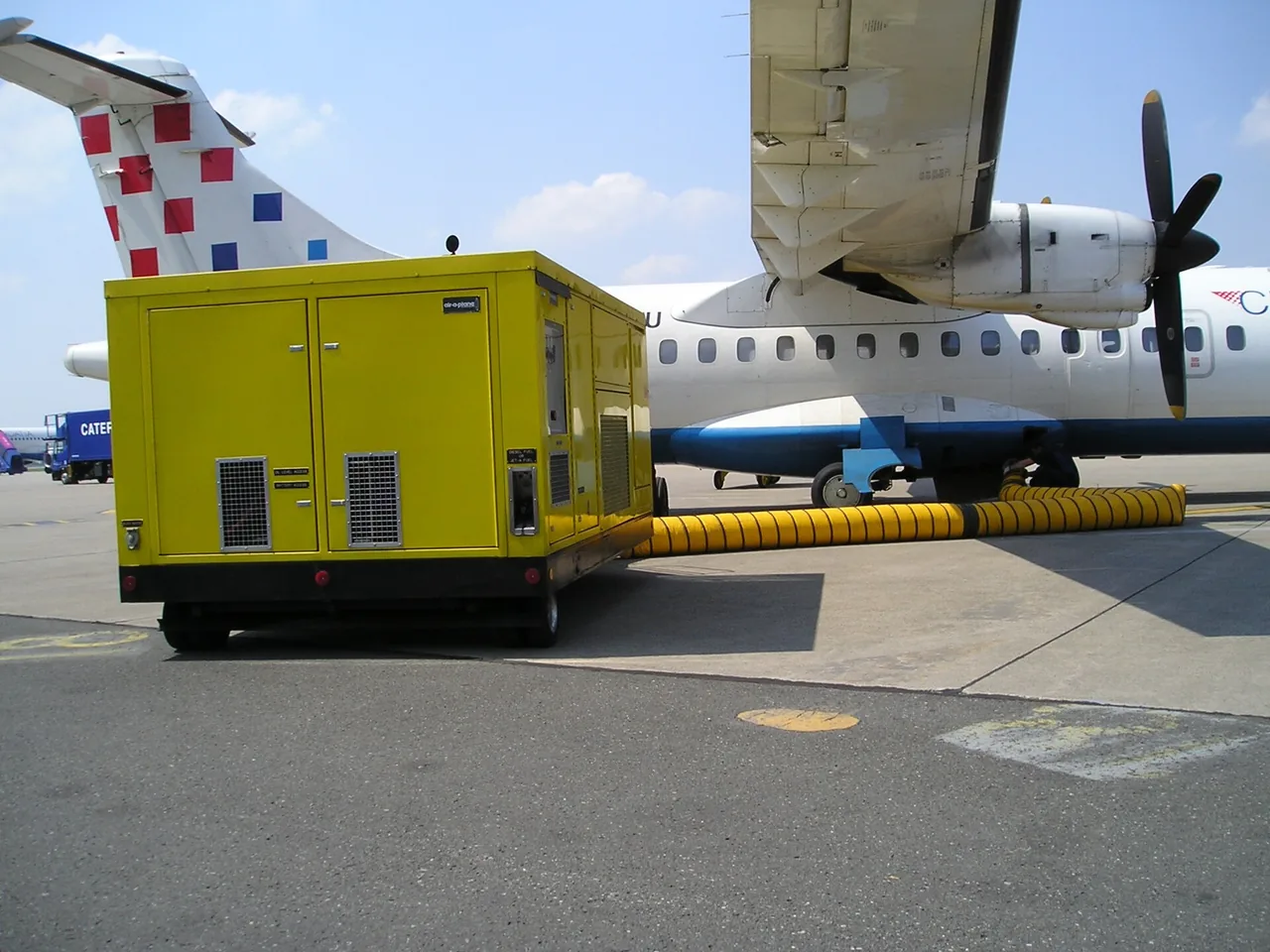
An aircraft air conditioning and heating truck is a self-propelled or towable ground support vehicle that supplies conditioned air to an aircraft parked on the stand. It cools, heats or ventilates the cabin and flight deck with fresh air while the aircraft's own environmental control packs and auxiliary power unit stay off, which keeps that fuel burn, noise and exhaust out of the turnaround. The vehicle carries a vapor-compression refrigerant circuit with its compressor, condenser and evaporator, a heating source, a high-pressure blower, controls and one or two flexible hoses that connect to the aircraft's ground air ports. The same equipment is sold as an air conditioning unit, a conditioned air unit or an air conditioning cart.
Units exist in every size, from a 4-ton cart that pushes air through a window or door opening of a small aircraft to a truck-mounted plant that its maker rates at 376 kW (110 tons) for the largest airliners. One towable unit of about 24 tons is built for narrow-body, regional jet and commuter aircraft, and larger towable or self-propelled machines with two supply hoses serve wide-body types. Airflow is quoted as a mass flow, 1.5 to 5.0 kg/s across one maker's three diesel-electric mobile sizes, at a static pressure high enough to push the air through a long hose and the aircraft's own ducting. The choice between diesel-electric and grid-powered electric drive is now a main purchasing question as airports restrict emissions and noise on the stand.
The buying decision concentrates on four numbers and one interface: cooling capacity, delivered airflow, static pressure at the outlet and supply air temperature at the worst ambient condition, all matched to the ground air ports of the aircraft to be served. A unit that is short on static pressure delivers far less than its rated airflow once two long hoses are attached, whatever its nominal tonnage. The second decision is the power source, diesel-electric, utility electric or both, because it sets fuel logistics, emissions and where on the apron the unit can work.
Chapter 1 / 06
What an Aircraft Air Conditioning and Heating Truck Is and How It Works
The unit exists to hold a cabin temperature while an aircraft is parked, during pre-flight preparation, boarding or maintenance. With the auxiliary power unit off, the aircraft has no bleed air to drive its own air cycle machines, and with the engines off it has no source of high-pressure air at all, so the cabin drifts toward the outside temperature. The airport planning data of one large twin-aisle airliner states the arrangement plainly: when the auxiliary power unit runs, the electrical, air start and air conditioning service vehicles are not required. When it does not run, ground conditioned air enters through a ground air connection directly into the passenger cabin, bypassing the air cycle machines.
The refrigerant side is a conventional vapor-compression circuit, built like a packaged chiller without the chilled-water loop. A compressor raises the pressure and temperature of the refrigerant vapor. The condenser, an air-cooled heat exchanger coil brushed by a propeller-type condenser fan, rejects that heat to the outside air. An expansion device then drops the pressure, and the evaporator coil absorbs heat from the supply air as the refrigerant boils. The evaporator is a direct-expansion coil over which the blower pulls outside air, so what reaches the aircraft is fresh air rather than recirculated cabin air. One design uses two hermetic scroll compressors of 15 tons each, automatic compressor capacity control and a frost-resistant evaporator.
Heating is a separate path in the same air stream. One self-propelled truck lists an electric heater, a liquid heat exchanger and the supply fan as its heating chain: the heater warms a heat transfer liquid, a pump circulates it, and the heat exchanger transfers the heat to the supply air. Such a loop carries an expansion tank, an air release valve and a three-way valve that mixes flow to hold the supply temperature. On one towable family the diesel-electric version gives heating air of 38 to 44 degrees Celsius (100 to 110 degrees Fahrenheit) with 68.5 kW (234,000 Btu/hr); the utility-powered electric version gives 19 to 24 degrees Celsius (65 to 75 degrees Fahrenheit) with 44 kW.
The air side decides how much of the rated capacity reaches the cabin. A high-pressure blower has to push the design mass flow through the evaporator, the outlet damper, the hose run and the aircraft's ducting, so a unit is rated for static pressure as well as airflow; the truck cited above is rated at 8.0 kPa (1.16 psi), and its heating chain lists a centrifugal fan. Capacity is controlled in three ways: compressors stage on and off automatically, an adjustable outlet damper regulates delivered pressure and flow, and the supply temperature is set on the temperature controller, within 1 to 20 degrees Celsius (34 to 68 degrees Fahrenheit) for cooling and 30 to 60 degrees Celsius (86 to 140 degrees Fahrenheit) for heating.
Controls keep the refrigerant circuit and the heater inside their limits. The standard protective set on a towable unit is a refrigerant high and low pressure shut down, a compressor discharge temperature shut down and a blower loss-of-pressure interlock: refrigeration may run only when the blower has proven airflow, by a flow switch or a pressure switch, or the evaporator would freeze solid. On units that accept utility power, a power quality relay trips on loss of phase, phase imbalance and under voltage, and a motor protection relay guards the fan and blower motors. A thermostat and an outlet temperature sensor close the loop, and a time relay keeps the blower running briefly after a shutdown.
The power train differs by type but always ends in electric drive for the refrigeration and air-moving parts. In a diesel-electric unit an engine turns a generator set rated at 60 kW (80 hp), and that set feeds the hermetic compressor motors, the condenser fans and the blower; the same set burns diesel or Jet A fuel. A pure electric unit takes 3-phase utility power at 380 to 480 volts, 50 or 60 Hz, and the smallest carts trail a power cord of up to 50 ft (15.3 m). Because motor speed follows supply frequency, a 60 Hz design loses capacity on a 50 Hz supply. A power transfer switch lets a dual-capable unit run from the grid.
Chapter 2 / 06
Aircraft Air Conditioning and Heating Truck Types and Structural Variants
The towable unit is the basic form: a factory-built module on a wheeled trailer, towed to the stand by a tug or tractor. The module has a galvanized and powder-coated steel frame, and the trailer base carries a towbar brake, applied when the trailer pushes against the towing vehicle, and fifth-wheel steering that keeps the turning radius narrow. One such unit, built for narrow-body, regional jet and commuter aircraft and described in a datasheet revised in 2008, is rated at 24 tons with airflow to 190 lb/min (86 kg/min); its diesel-electric version weighs 7,300 lb (3,311 kg) and the utility-powered electric version 4,700 lb (2,135 kg). A skid version without the trailer can be mounted on any properly rated chassis.
The self-propelled truck mounts the module on a truck chassis inside a box body, with a driver's cab in front. One such vehicle measures 8650 x 2600 x 3250 mm (341 x 102 x 128 in) and weighs 12500 kg (27,560 lb) in total, size and weight that place it among special purpose motor vehicles rather than hand-moved carts. The maker divides it into five systems: a power system built around a generator set, air supply temperature regulation, air supply, electric control and operation, and the box body with the automotive chassis. Its advantage is independence, since it moves between stands without a tug, and in cold regions a cold start device helps the generator set start on the first attempt.
Power source is the first dividing line. Diesel-electric units carry an engine-driven generator set of their own and work on any stand; one maker builds three such mobile units with nominal airflows of 1.5, 3.5 and 5.0 kg/s. Pure electric units have no engine and plug into the stand's 3-phase utility supply, but they need an outlet within cable reach. A newer middle way is the plug-in diesel unit, which runs on its engine or changes over to grid power for zero-emission operation. The smallest carts, a 4-ton design with 45,000 Btu/hr (13.2 kW) and 1,600 cfm (45 m3 per minute) of airflow, cool or heat a smaller aircraft through a window or door opening and come as utility-powered versions or with an engine fueled by gasoline or by liquefied petroleum gas.
The second dividing line is the number of supply hoses. A single-hose unit feeds one aircraft port and is the usual match for a narrow-body airliner. A dual-hose unit has two outlets, so it can feed both ports of a wide-body aircraft or supply the flight deck and the cabin separately; one FAA test campaign used such a unit, with one hose on the flight deck supply inlet and the other on the cabin supply ducting. Two hoses roughly halve the flow in each run and so cut the friction loss in both. Whichever arrangement is used, the aircraft-side requirement is stated as total airflow, not as flow per port.
The product stops at the hose end and at the aircraft's own machinery. The auxiliary power unit and the environmental control packs are aircraft systems: they are the neighbors this truck stands in for, not versions of it. A fixed pre-conditioned air plant under the stand or on a passenger bridge does the same job without wheels and is a different purchase. An air start unit delivers high-pressure air to turn an engine, a ground heater only heats, and a ground power unit supplies electricity, although combined air conditioner and generator units exist. The scroll compressor, the air-cooled condenser, the centrifugal fan and the heat exchanger inside it are bought as components. On the apron the unit works beside the aircraft baggage tug and the belt loader, the airfreight conveyor truck.
Chapter 3 / 06
Aircraft Air Conditioning and Heating Truck Key Specification Parameters and Standards
Three capacity figures define a unit, and they mean something only together. Cooling capacity is given in tons of refrigeration or in kW, heating capacity in kW or Btu/hr, and both are stated at a named ambient condition; the supply temperature of one towable unit, 2 to 10 degrees Celsius (35 to 50 degrees Fahrenheit), is specified at 38 degrees Celsius (100 degrees Fahrenheit) and 50 percent relative humidity. Delivered airflow is a mass flow, in kg/s, kg/min or lb/min, and one maker's 15000 kg/h is the same as 550 lb/min. Static pressure at the outlet completes the set: 8.0 kPa (1.16 psi) for the self-propelled truck, against an aircraft-side requirement of about 26 in (66 cm) of water at each port of a large twin-aisle airliner.
Environmental limits decide where a unit can hold those figures. The self-propelled truck is specified for an ambient range of -40 to 50 degrees Celsius (-40 to 122 degrees Fahrenheit), 95 percent relative humidity at 30 degrees Celsius (86 degrees Fahrenheit), altitudes up to 4000 m (13,100 ft), a working noise level of 85 dB(A) or less and a working duration of 8 h or more. Hose and port sizes are stated in inches: a 12 in (30 cm) hose on the small carts, two 8 in (20.3 cm) ports on the large airliner. Electric supply for the utility-powered version of one towable family is 3-phase, 50 or 60 Hz, 380 to 480 volts.
Standards come from three directions. EN 12312-17, the air conditioning equipment part of the European series of specific requirements for aircraft ground support equipment, covers the hazards of commissioning, operation and maintenance and adds the performance requirements that authorities, aircraft and GSE manufacturers, airlines and handling agencies regard as essential; the part is listed against the EU machinery directive. EN 1915-1 supplies the basic safety requirements common to all ground support equipment. The IATA Airport Handling Manual carries chapters on basic safety requirements for ground support equipment, ground heaters and air conditioning equipment. One Chinese maker builds to a GJB general specification for air conditioning vehicles, to MH/T standards for airport equipment and to HB standards that fix the basic dimensions of the ground air conditioning joint ends.
Parameter
Typical published value
What it decides
Cooling capacity
13 kW (45,000 Btu/hr) to 376 kW (110 tons)
Aircraft heat load and ambient temperature
Heating capacity
8.7 kW (29,700 Btu/hr) to 190 kW (648,000 Btu/hr)
Read with the supply temperature it can hold
Delivered airflow
1.5 to 5.0 kg/s (198 to 661 lb/min)
Must exceed the aircraft demand
Static pressure at outlet
8.0 kPa (1.16 psi) on one truck
Must cover hose loss plus 26 in (66 cm) of water at each port
Supply air temperature, cooling
2 to 10 degrees Celsius (35 to 50 degrees Fahrenheit)
Colder air carries more load per kilogram
Supply air temperature, heating
30 to 60 degrees Celsius (86 to 140 degrees Fahrenheit)
Sets the pull-up time on a cold day
Ambient limits
-40 to 50 degrees Celsius (-40 to 122 degrees Fahrenheit); up to 4000 m (13,100 ft)
Capacity falls above the rating point; derate at altitude
Hose and port size
12 in (30 cm) hose, 25 ft (7.6 m) long; 8 in (20.3 cm) ports
Hose ends must fit the ports served
Power source
60 kW (80 hp) generator set; 380 to 480 V, 3-phase, 50 or 60 Hz
Fuel type or outlet location
Weight
4500 to 12500 kg (9,920 to 27,560 lb)
Tug capacity and pavement limits
Chapter 4 / 06
Aircraft Air Conditioning and Heating Truck Selection and Duty Calculations
Selection starts at the aircraft, not at the catalog. The airport planning data of the airliner gives the airflow, supply temperature and port pressure that hold or change the cabin temperature under stated conditions. The unit is then chosen to deliver more than that at the hose end, at the worst ambient temperature the airport records.
The demand side has two cases. The steady-state case holds a cabin at temperature: for one large twin-aisle airliner on a hot day, with all doors closed, full solar and electrical heat load and the cabin maintained at 24 degrees Celsius (75 degrees Fahrenheit) in 39 degrees Celsius (103 degrees Fahrenheit) outside air, the planning graph plots the required supply temperature at the ground connection, 1.7 to 5.0 degrees Celsius (35 to 41 degrees Fahrenheit), against total airflows of 272 to 318 kg/min (600 to 700 lb/min). The transient case is the pull-down: the time to cool a cabin from 46 degrees Celsius (115 degrees Fahrenheit) to 24 degrees Celsius (75 degrees Fahrenheit) in the same outside air, as a function of airflow and supply temperature.
The heating case is set up the same way. For the same airliner the cold-day curve holds the cabin at 24 degrees Celsius (75 degrees Fahrenheit) with -40 degrees Celsius (-40 degrees Fahrenheit) outside and no occupants, and plots the supply temperature needed, from 32.2 to 65.5 degrees Celsius (90 to 150 degrees Fahrenheit), against airflow. The pull-up case starts from a cabin at -32 degrees Celsius (-25 degrees Fahrenheit) and gives the time to reach 24 degrees Celsius (75 degrees Fahrenheit) for supply temperatures of 49 to 71 degrees Celsius (120 to 160 degrees Fahrenheit) and total airflows of 136 to 318 kg/min (300 to 700 lb/min). A truck bought for a cold hub is checked on heat output and supply temperature, not on cooling tons.
Pressure is where selections most often fail. The port requirement is not a constant: the planning data gives the static gauge pressure at the connector as a function of airflow, and its worked example shows 250 lb/min (114 kg/min) into each of two connectors, a total of 500 lb/min (227 kg/min), needing about 26 in (66 cm) of water at each connection. The total airflow, not the flow per connector, sets the pressure when both ports are used. Against this the unit must deliver its static pressure after the loss of the hose run, and a long hose, a collapsed section or a throttling damper all consume the margin. A truck rated at 8.0 kPa (1.16 psi) therefore works with a modest margin.
The capacity check is a heat balance on the air. Sensible cooling or heating equals the mass flow times the specific heat of air times the temperature difference between supply air and cabin air, so colder supply air or a larger mass flow carries the same load as a bigger compressor. The evaporator must also take up the latent load when humid outside air is cooled below its dew point. Datasheets make the check awkward by mixing units: mass flow in kg/s, kg/min or lb/min, volume flow in cfm, capacity in tons or kW. Converting a maker's 15000 kg/h to 250 kg/min (551 lb/min) shows whether a unit can meet a 500 lb/min (227 kg/min) port demand.
Site conditions narrow the list. The climate fixes the ambient rating, and a truck specified for -40 to 50 degrees Celsius (-40 to 122 degrees Fahrenheit) covers a continental hub. Distance from the parking position to the port is a hard constraint, because the ports of the large airliner sit about 30.8 m (101 ft) aft of the nose, 42 in (1.07 m) out on each side of the centerline and at most 101 in (2.57 m) above the ground. Where the stand has 3-phase utility power, a pure electric or plug-in diesel unit removes exhaust and most of the noise; where it has none, only an engine-driven unit will do.
Decision factor
Question to answer
What tips the choice
Aircraft mix
Which aircraft, how many ports, what port size?
Port data from the airport planning document
Design temperature
How hot and how cold does the stand get?
Heating output for cold hubs; an ambient rating to 50 degrees Celsius (122 degrees Fahrenheit) for hot ones
Distance to ports
How long is the hose run from the parking spot?
Static pressure margin; a second hose to split the flow
Stand power
Is 3-phase utility power within cable reach?
Pure electric or plug-in diesel where it is; engine drive where it is not
Mobility
Does the unit move between stands under its own power?
A self-propelled truck; otherwise a towable trailer and a tug
Noise and emission rules
What limits apply on the stand?
Electric drive, low-GWP refrigerant and a stated noise level
Operating pattern
Short turnarounds or long stops?
Pull-down capacity for quick turnarounds; steady-state economy for long stops
Chapter 5 / 06
Aircraft Air Conditioning and Heating Truck Installation, Maintenance, and Typical Failure Modes
A truck of this kind has no fixed installation; its installation is repeated at every stand, with every aircraft. Each repetition follows the same sequence of positioning, hose connection, start-up and shutdown, and most incidents trace back to a step that was skipped or rushed.
Positioning sets the safety of the whole operation. The unit parks far enough that its body and hoses stay clear of propellers, engine pods and wing tips, with the parking brake or the towbar brake set and with stabilizers, where the design has them, lowered so that tension in a hose cannot move the unit. The outlet faces the port so that the hose runs straight and sags nowhere. Direction matters for air quality as much as for clearance: the intake must not draw the unit's own exhaust, the exhaust of a neighboring ground power unit or the bleed of an idling engine, or those fumes travel straight into the cabin.
Connecting the hose is the step that touches the aircraft. The industrial hose is dragged out by its coupling, not by the fabric, and lifted to the port rather than thrown; the coupling is seated fully and locked, and the run is supported so that its weight hangs on the unit's outlet or on a stand, not on the aircraft's port. Unused hose is not left coiled, because every extra meter of run costs static pressure. The control panel, recessed on one design so that gauges and the selector switch survive apron life, is checked before start-up: fuel level, supply temperature set point and damper position. A typical sequence for a towable or self-propelled unit then runs as follows.
Park clear of the aircraft, apply the parking brake or towbar brake, lower the stabilizers, and check that intake and exhaust point away from the aircraft.
Connect the hose couplings to the unit outlets and to the aircraft ground air ports, lock them, and lay the run without kinks.
Start the engine and generator, or connect the utility plug and switch the supply on, and let the set settle.
Select heating or cooling, set the supply temperature, start the blower, and let the controls stage the compressors or the heater.
At shutdown switch refrigeration or heating off, let the blower clear the duct, stop the engine or isolate the supply, then stow the hoses.
Maintenance is mostly about air paths and heat transfer surfaces. The intake filters ahead of the evaporator load with apron dust and are the first thing to check when airflow falls; a differential pressure gauge across them shows when the filter element needs cleaning or replacement. A film of dirt, de-icing fluid or insects on the condenser fins raises the discharge pressure until the high pressure switch stops the compressor. Belt tension on the small carts' belt-driven hermetic compressor is checked, refrigerant pressures are read with a manifold and a pressure gauge, and the evaporator drain pan and drain line must stay open. On the engine side, clean fuel matters, and low fuel shut down and an engine block heater are options on one design. Electric units need the supply cable, plug and contactor inspected for overheating.
Safety has four fronts. Exhaust gas is the first: carbon monoxide from the engine or from neighboring vehicles, drawn into the intake, ends up in the cabin, so placement and intake discipline come first. Pressure is the second: a hose that slips off a live outlet whips until the blower stops, which is why refrigeration and heating are interlocked to airflow and why couplings are locked before start-up. Proximity to the aircraft is the third: the unit is heavy and tall, so speed limits, a spotter when reversing and a hard rule about brakes belong in the procedure. Noise is the fourth; one maker states a working noise level of about 85 dB(A) for its self-propelled unit without giving a measuring distance, which puts hearing protection on the ramp list.
Symptom or service item
Likely cause
Action
Low airflow at the port
Loaded filter element, collapsed or over-long hose, damper nearly closed
Read the differential pressure gauge, clean the filter, shorten the run
Short cycling on high pressure
Dirty condenser coil, failed condenser fan, hot exhaust air recirculated
Clean the coil, check the fan contactor and motor, reposition the unit
Ice on the evaporator or low pressure cut-out
Low refrigerant charge, frosted or dirty coil, blower not proving airflow
Leak test and recharge, defrost and clean the coil, check the flow switch
Supply temperature drifts
Thermostat or temperature sensor out of calibration, three-way valve stuck
Loss of phase, phase imbalance, under voltage, motor protection relay tripped
Test the supply, inspect the plug and contactor, reset after finding the cause
Diesel engine stops or will not start
Empty tank, fuel too cold to flow, weak battery, air in the fuel line
Refill, use the engine block heater or cold start device, check the battery
Hose coupling leaks or blows off
Worn coupling, latch not locked, static pressure above the hose rating
Replace the coupling and hose end, lock before start, verify the static pressure
Chapter 6 / 06
Aircraft Air Conditioning and Heating Truck Industry Applications and Procurement Checks
The main users are airlines and ground handlers at hubs, where a fleet of units is dispatched to stands, and maintenance organizations that need a stable temperature inside an aircraft for days while systems are opened up. Regional and business aviation use the small electric or engine-driven carts that feed a cabin through a door or window opening. Cargo operators and armed forces use the large trucks to ventilate and temper wide-body and military transport aircraft during loading, an application named in the specification of one self-propelled unit. In cold regions the same unit doubles as the pre-heat plant, where heat output and supply temperature matter more than cooling tons. Airport operators with emission or noise limits on the apron increasingly ask for electric or plug-in units, which has turned the power source into a fleet-level decision.
Within a turnaround the unit is one of several vehicles working against the clock around one aircraft. It arrives once the aircraft is parked and chocked and is connected before boarding begins in hot or cold weather. The planning data of a large airliner notes that the air conditioning service vehicle is not required when the auxiliary power unit runs, so the decision to connect is an airline policy on fuel, noise and engine wear rather than a technical necessity. Combined units that carry an air conditioner and a generator on one chassis free a stand position and a driver. Whatever the arrangement, the unit belongs in the stand's equipment plan, with its parking position, hose route and exhaust direction fixed so that it does not conflict with catering, fueling and baggage vehicles.
Acceptance is a matter of measuring, not of reading a brochure. EN 12312-17 covers the safety and essential performance requirements that a European buyer expects to be met, with EN 1915-1 for the general safety of ground support equipment; elsewhere the IATA Airport Handling Manual and national specifications take that place. An acceptance test on site repeats the rating conditions as far as the airport allows: the unit runs at the agreed ambient temperature with the doors in the stated position, and a temperature humidity recorder and a differential pressure transmitter at the outlet log supply temperature and static pressure while the airflow is measured at the port. Manuals, the schedule of periodic checks and operator training belong with the delivery.
A buyer states the aircraft types to be served and their ground air port sizes; the design high and low ambient temperatures; the cooling capacity, the heating capacity, the delivered airflow as a mass flow and the static pressure at which it is delivered; the supply temperature range for cooling and for heating; the number of hoses, their diameter, length and pressure rating, and the coupling that fits the ports; the power source, the fuel or the stand supply; the noise limit at a stated distance; and the dimensions, weight, turning radius and brake type the stand allows. The buyer names the standards to be met, EN 12312-17 and EN 1915-1 in Europe, with test evidence, and asks for a capacity statement at the rating conditions, the 50 Hz derating, the list of protective devices and interlocks, the service intervals, regional spare parts, and a witnessed acceptance test on site.
FAQ
How does an aircraft air conditioning and heating truck work?
It is a vapor-compression air conditioner on wheels with a heater in the same air stream. Compressors raise the pressure of the refrigerant, a condenser coil and its fan dump the heat to the outside air, an expansion device lowers the pressure again, and an evaporator coil absorbs heat from the air that the blower pushes across it. That air is outside air, so the cabin receives fresh, cooled air through a hose connected to a ground air port. For heating, a heater warms the air directly or warms a liquid loop that feeds a heat exchanger in the supply air.
What types of aircraft air conditioning truck are there?
They divide along three lines. By mobility there are towable trailer units, which a tug moves between stands, and self-propelled trucks on a truck chassis. By power there are diesel-electric units with an engine and generator, utility-powered electric units that plug into a 3-phase supply, and plug-in diesel units that do both; the smallest carts also come with gasoline or LPG engines. By hose count there are single-hose units for one port and dual-hose units with two outlets. Size follows the aircraft, from a 4-ton cart for smaller aircraft through 24-ton towable units for narrow-body airliners to self-propelled trucks of 376 kW (110 tons).
Which specifications matter most on an aircraft air conditioning unit?
Four, read together: cooling capacity, delivered airflow, static pressure at the outlet and supply air temperature, each stated at a named ambient condition. Airflow is given as a mass flow, for example 1.5 to 5.0 kg/s across one maker's diesel-electric mobile sizes or 190 lb/min (86 kg/min) for a 24-ton towable unit, and the delivered flow falls quickly if the static pressure is too low for the hose run. Supply temperature runs from about 2 to 10 degrees Celsius (35 to 50 degrees Fahrenheit) on cooling, with heating air of 30 to 60 degrees Celsius (86 to 140 degrees Fahrenheit) on a large truck. Check the ambient rating, hose and port sizes, noise level and weight too.
How do I choose the right size of air conditioning truck for an aircraft?
Start from the aircraft's airport planning data, which gives the airflow, supply temperature and port pressure needed to hold or to change the cabin temperature under stated conditions. For one large twin-aisle airliner the hot-day curves cover 600 to 700 lb/min (272 to 318 kg/min) delivered at 35 to 41 degrees Fahrenheit (1.7 to 5.0 degrees Celsius), and about 26 in (66 cm) of water at each of two ports at 250 lb/min (114 kg/min) per port. Then add margin for the hose run, the airport's design temperature and any frequency derating. Finally choose mobility and power source from the stand: a towable unit and a tug, or a self-propelled truck.
How is the unit operated and connected to the aircraft?
Park well clear of propellers, engine pods and wing tips, with the parking brake or towbar brake set, any stabilizers down, and the intake and exhaust facing away from the aircraft. The hose is pulled out by its coupling, lifted to the ground air port, seated and locked, and laid out without kinks or sags. Then the engine and generator are started, or the utility supply switched on, a mode and a temperature are selected, and the blower is started; the control system brings compressors or heater in as needed. To finish, refrigeration or heating is stopped, the blower clears the duct, the engine is stopped or the supply isolated, and the hoses are uncoupled and stowed.
What drives the cost and lead time of an aircraft air conditioning truck?
Cost scales with capacity and with the power source. A large self-propelled truck carries a truck chassis, a box body, a generator set and far more refrigeration than a towable unit, which puts it at the top of the range, while the small carts sit at the bottom. Options move the figure too: heating, grid plug-in capability, a power transfer switch, cold start equipment and a low-GWP refrigerant. Lead time depends less on the refrigeration module, which is built from standard compressors, coils and fans, than on the vehicle: a truck chassis, a tailored trailer or a chassis-mounted skid module, and on engines that meet the emission rules of the country of use.
What safety points and standards apply to an air conditioning truck?
Exhaust from the unit or from neighboring vehicles can be drawn into the intake and sent to the cabin, so the intake must face clean air. A pressurized hose that comes loose whips, and a hot hose burns, so couplings are locked before start and refrigeration and heating are interlocked to blower airflow. The vehicle is heavy and works close to aircraft structure, so brakes, stabilizers, speed limits and a spotter for reversing belong in the apron procedure. A utility-powered unit needs protection against loss of phase, phase imbalance and under voltage. EN 12312-17 sets the European safety and performance requirements for air conditioning equipment, with EN 1915-1 for general safety; the IATA Airport Handling Manual is the common reference elsewhere.