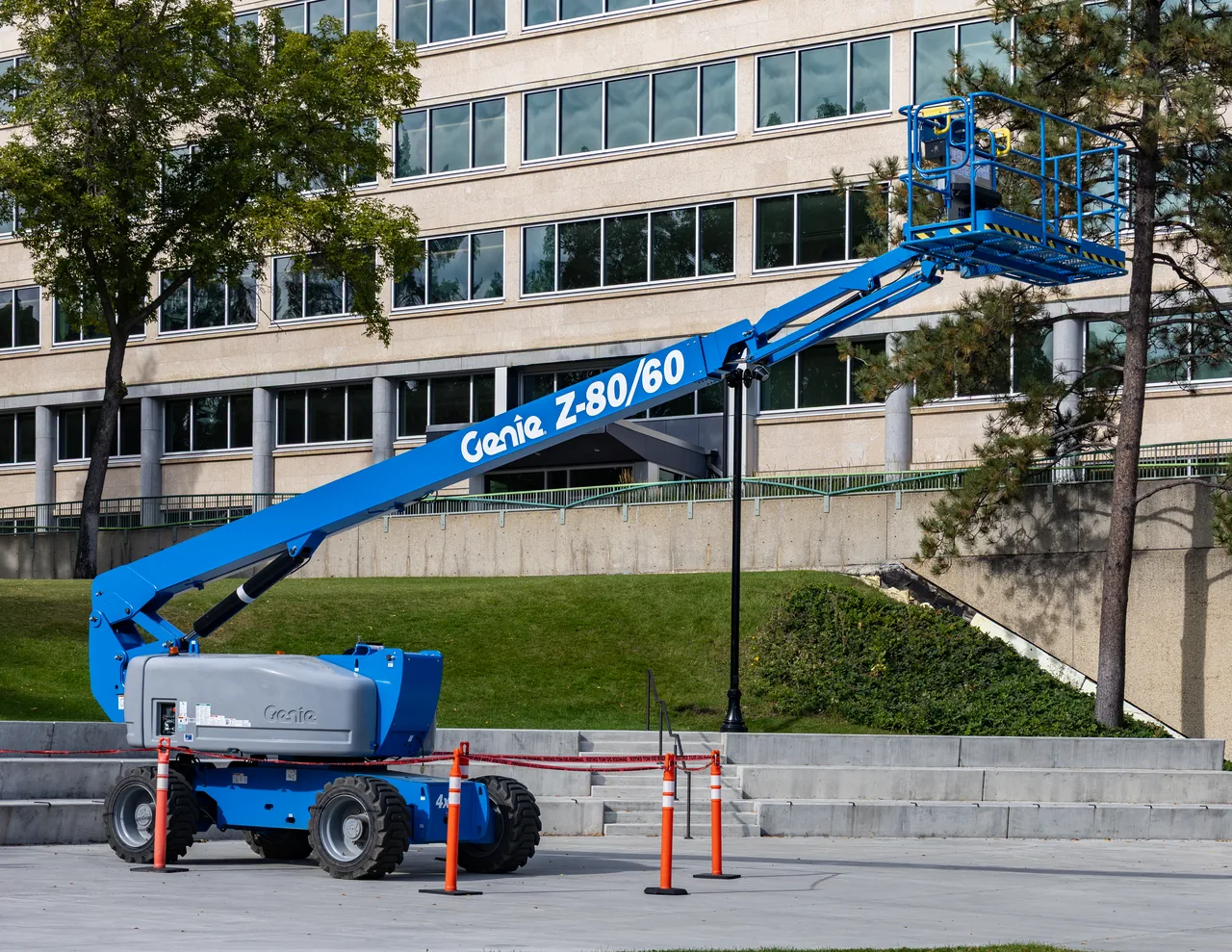
An articulating boom lift is a self-propelled mobile elevating work platform whose boom is hinged in two or more sections, so that the platform can be swung up and over an obstacle to a working position a straight boom cannot reach. A turntable on the chassis rotates the whole boom around, through a full circle on most machines, a first section lifts, a second section folds at the knuckle, and a jib keeps the platform level at the end. The operator drives from a control station in the platform, and the machine carries two workers and their tools from the 9.19 m (30 ft) platform height of a narrow electric model to the 41.1 m (135 ft) of the largest diesel machines.
The purchase concentrates on geometry and ground. The reach envelope, the up-and-over height and the tailswing decide whether one machine can serve every position on a job, and the stowed width, the mass and the floor loading decide whether it can enter the building or slab at all. Behind those sit the power choice, diesel, liquefied petroleum gas, battery or bi-energy, the inspection regime and the training the law attaches to the machine. The buyers are steel erectors, facade and glazing contractors, the maintenance departments of plants, airports and warehouses, and rental fleets serving many sites. The articulating boom earns its place where the work sits behind an obstacle and the floor under it is firm and level.
Five things decide an articulating boom purchase. First the reach envelope, because working height, horizontal reach and up-and-over height together decide whether the platform reaches every position. Second the ground, stowed width, mass and floor loading, which decide where the machine may travel at all. Third the platform capacity with the tools that will ride in it. Fourth the power and chassis, electric or diesel, two-wheel or four-wheel drive, wheels or tracks. Fifth the safety and inspection package, the load sensing, tilt cut-out and training that keep the machine legal on site. Get those five right and the boom is a routine tool.
Chapter 1 / 06
What an Articulating Boom Lift Is and How It Works
An articulating boom lift moves people, with their tools and a little material, to a position in the air and holds them there while they work. ISO 16368 places it among the mobile elevating work platforms, machines that move persons with their tools and materials to an elevated work location. The articulating version is set apart by its boom. A primary section hinged to a rotating turntable rises, a secondary section joins it at the knuckle, and on many machines a jib adds a third hinge ahead of the platform. Because each hinge bends independently, the platform travels an arc that rises above an obstruction and descends on the far side, hence the name knuckle boom.
The parts are a chassis, a turntable, a boom and a platform. The chassis carries the wheel drives, the engine or battery pack, the oil tank and the counterweight. On top sits the turntable, a weldment on a slewing bearing, turned by a hydraulic motor through a worm or planetary slewing drive. The boom is a set of steel plate box sections with a hydraulic cylinder at each hinge. At its tip a rotator swings the platform through 160 degrees. The platform is a guarded basket, 1.8 m (72 in) x 0.76 m (30 in) on one machine, with the control box, an entry gate or mid-rail and the anchorage point for a lanyard.
Oil under pressure does the work. The hydraulic power unit, an engine-driven or motor-driven pump, draws oil from a tank, feeds a valve block on the turntable, where a directional control valve routes it to the function selected, and returns it through a filter, with a main relief valve setting the pressure ceiling. Each hydraulic cylinder that raises a boom section, extends a fly section or levels the platform gets its oil through a proportional valve, and a load-holding check valve at the cylinder keeps the boom from falling when a hose lets go. Hoses run in a bundle along the boom and across the turntable, where flexing shortens their life.
Two control stations share the boom functions. The platform box carries a dual-axis proportional handle for drive and steer, toggle controls for turntable rotation, each boom section, the jib and platform level, a horn, a foot switch that must be held down before any function answers, and a red emergency stop button. The ground box on the chassis repeats the boom functions without drive. A level sensor commands a levelling cylinder so the floor stays horizontal as the boom folds; a three-position override switch lets the operator trim the level by hand. Because the boom can be swung past the rear wheels, a drive orientation light warns that forward on the handle may now move the machine the other way.
Several devices watch the load and the ground. A load sensing system cuts the boom functions when the occupants and tools exceed the rating, until weight is removed. A tilt sensor on the chassis, set at 4.5 degrees side to side and front to back on one model, sounds an alarm and disables drive with the boom raised or lift with the boom stowed until the machine is level again. A platform entry gate or chain, a guardrail system and a designated lanyard anchorage point for a fall arrest harness protect against falls, and a sensor bar on the control box reverses or cuts the function that is squeezing the operator against an overhead obstacle.
A work cycle runs in a fixed order. The machine drives to the spot with the boom stowed, the operator boards from the ground through the gate, the foot switch is pressed and the turntable rotates until the boom points at the work. The primary boom lifts, the secondary boom unfolds at the knuckle and the fly section telescopes, and the jib and rotator place the platform floor beside the task. To travel, the machine creeps at 0.3 mph (0.48 km/h) on a narrow electric model or up to 0.7 mph (1.1 km/h) on a large diesel one, and only on ground the maker declares firm and level.
Chapter 2 / 06
Articulating Boom Lift Types and Structural Variants
The narrow electric type is built for slabs. A machine 1.22 m (4 ft) wide, 5.54 m (18 ft) long and 2.01 m (79 in) high stowed was built to travel aisles and ride goods lifts on solid non-marking tires. A 48 V DC battery pack gives 8.7 hours of work per charge at full speed or 11.1 hours at reduced speed, and a full recharge takes 14 hours. Its platform rises to 9.19 m (30 ft), it reaches 6.17 m (20 ft) over an obstacle with the platform at 4.01 m (13 ft), it climbs only a 25% grade stowed, and it is limited to 3 degrees of side slope.
Four-wheel-drive engine types are built for sites. A 16.05 m (52 ft) working height machine weighs 6,379 kg (14,063 lb) on two-wheel drive and 6,515 kg (14,363 lb) on four-wheel drive, and climbs a 30% grade downhill on two-wheel drive or 45% on four-wheel drive, stowed with the platform downhill. The larger 42.9 m (141 ft) machine runs its axles on a sliding frame: it drives at a width of 2.5 m (8 ft) and extends them to 3.9 m (155 in) before the boom may rise. An interlock enforces it: the booms will not lift, and the turntable will not swing more than 15 degrees, until the axles are extended.
Chassis steering follows the same logic. A two-wheel-drive machine steers with one axle. A four-wheel-drive machine offers modes chosen at a selector switch once the foot switch is pressed: front-wheel or rear-wheel steer, crab steer, which turns all wheels the same way, and coordinated steer, which turns the axles against each other for the tightest turning, 2.3 m (90 in) inside on the largest machines with axles extended and 7.8 m (25.5 ft) outside with them retracted. Color-coded arrows on the panel and the chassis show which way the wheels will turn. A differential lock, where a chassis has one, stops one wheel from spinning on soft ground.
Power comes in four forms. The diesel engine drives the hydraulic pump directly and gives the highest gradeability; an engine running on liquefied petroleum gas burns cleaner and suits enclosed sites that still admit an engine. The battery type is emission-free and quiet enough for occupied buildings, at the price of a lower gradeability, a nightly charge at a grounded receptacle and wet-cell batteries that need water. An engine machine can be ordered with a generator option for working with less engine noise while the boom is raised: the generator is switched on at the platform box, feeds a ground-fault-protected outlet there, and turns off as soon as the foot switch is pressed, so that the machine functions operate. Engine machines also supply a ground-fault-protected outlet in the platform for electric tools.
An articulating boom lift is built to be stable on its wheels, so most of them carry no stabilizers: stability is calculated against forward and backward tipping lines. Four-wheel-drive machines have an oscillating axle, with 8 in (0.2 m) of travel on one 13.72 m (45 ft) platform height machine, that locks when the boom lifts; the widest machines slide their axles out instead of lowering jacks. Foam-filled tires cannot go flat and must never be swapped for a different specification, because wheel weight is critical to stability. On soft ground the boom can be had on a rubber-track undercarriage, and on slab machines pothole guards take the place of jacks, so the instruction to set outriggers on pads applies only to aerial lifts that have them.
The boundaries are drawn by what is mounted where. The articulating boom lift is one member of the aerial work platform family, which also counts telescopic boom lifts and scissor lifts among its types. The aerial work truck mounts its boom on a road-going chassis. A forklift is a powered industrial truck built to move materials, governed by OSHA under 29 CFR 1910.178, and an elevating operator position on an industrial truck sits outside both ISO 16368 and EN 280-1. A mobile crane lifts loads on a hook; its elevating operator positions are excluded from ISO 16368. Mast climbing work platforms and trailer-mounted lifts are separate machines, and both standards leave out the suspended platform type, a work cage hung from a crane.
Chapter 3 / 06
Articulating Boom Lift Key Specifications and Standards
The reach ratings come in four figures. Working height is the platform height plus a 1.8 m (6 ft) allowance, so a machine with a 14.05 m (46 ft) platform height is sold as a 16.05 m (52 ft) machine. Horizontal reach is the distance from the turntable axis to the platform, 7.52 m (25 ft) on that machine and 21.3 m (70 ft) on a 42.9 m (141 ft) class. Up-and-over height is the tallest obstruction the boom can clear, 7.57 m (25 ft) on a 13.72 m (45 ft) platform height machine. Tailswing is how far the rear of the turntable sweeps behind the machine, zero on compact types and 4.3 m (14 ft) on the largest.
Standards reach this machine from four directions. ANSI/SAIA A92.20 governs the design, calculations, safety requirements and test methods of mobile elevating work platforms; ANSI/SAIA A92.22 covers their safe use, and ANSI/SAIA A92.24 sets the training requirements for the use, operation, inspection, testing and maintenance of MEWPs. ISO 16368 is the international design standard and EN 280-1 its European counterpart. EN 280-1 divides MEWPs into Group A and Group B by whether the center of the platform stays inside the tipping lines, and into Type 1, 2 and 3 by how they travel; an articulating boom, driven from the platform with the boom raised, is a Group B, Type 3 machine. OSHA enforces 29 CFR 1910.67 in general industry and 29 CFR 1926.453 in construction.
Two ratings are conditions rather than dimensions. Platform capacity is almost always 227 kg (500 lb), two occupants and their tools, rising to 272 kg (600 lb) on the largest machines, and accessories such as welders, pipe cradles or panel cradles are subtracted from it. The wind rating is the highest wind speed in which the boom may be raised, 12.5 m/s (28 mph) on the outdoor machines; the boom comes down as soon as the wind passes it, and neither the platform nor the load may be enlarged. The operating temperature range runs from -29 to 49 degrees Celsius (-20 to 120 degrees Fahrenheit) for the ambient air on one machine.
Parameter
Typical value
What it decides
Working height
Platform height plus 1.8 m (6 ft); 16.05 m (52 ft) to 42.9 m (141 ft)
Highest task reached
Platform height, maximum
9.19 m (30 ft) to 41.1 m (135 ft)
Standing height of the floor
Horizontal reach
7.47 m (24.5 ft) to 21.3 m (70 ft)
Distance from chassis to work
Up-and-over height
7.57 m (25 ft) on a 13.72 m (45 ft) machine
Tallest obstacle cleared
Platform capacity
227 kg (500 lb), 2 occupants; 272 kg (600 lb) largest
Crew, tools and material
Platform size and rotation
1.8 m (72 in) x 0.76 m (30 in) or 2.4 m (96 in) x 0.91 m (36 in); 160 degrees
Room for crew and tools
Turntable rotation and tailswing
355 or 360 degrees; tailswing 0 to 4.3 m (14 ft)
Work circle and rear clearance
Gradeability, stowed
25% electric; 30% two-wheel drive; 45% four-wheel drive; side slope 3 to 5 degrees or 25% (14 degrees)
Ramps it can climb
Drive speed
Stowed 4.8 to 7.2 km/h (3 to 4.5 mph); raised 0.48 to 1.1 km/h (0.3 to 0.7 mph)
Travel time and safety near people
Width, stowed
1.22 m (4 ft) to 2.5 m (8 ft); 3.9 m (155 in) axles extended
Doorways, aisles, transport
Floor loading
Occupied floor pressure 186 to 204 psf (8.9 to 9.8 kPa); ground bearing 65 to 170 psi
Slab or floor capacity
Wind limit
12.5 m/s (28 mph)
When the boom comes down
Chapter 4 / 06
Articulating Boom Lift Selection and Duty Calculations
Choosing an articulating boom lift is a sequence of geometric and ground checks, each of which can eliminate a machine before price is discussed. A site engineer works them in a fixed order: where the work is, what stands in the way, what the machine stands on and what it must carry.
The first check is the work position itself. Measure the height of the work above the floor, the horizontal distance from the nearest point where the chassis can stand, and the height of anything in between. The machine needs a working height above the first figure, a horizontal reach beyond the second and an up-and-over height above the third. This is where the articulating boom earns its keep against a telescopic boom lift, which reaches farther but cannot fold its boom over an obstruction, and against a scissor lift, which only rises above its own base. Tailswing, zero on compact machines and up to 4.3 m (14 ft) on large ones, adds the clearance needed behind the chassis.
The second check is the ground. Outdoors the machine needs a firm, level surface; the slope rating applies only with the boom stowed, 45% downhill on one four-wheel-drive machine and 25% on a narrow electric one, and the working position must be level to within 3 degrees on the electric machine. A digital inclinometer gives the grade directly, or as rise over run times 100 with a level and a straightedge. Indoors the slab must carry the machine: an occupied floor pressure of 186 to 204 psf (8.9 to 9.8 kPa) is typical, and a 6,831 kg (15,060 lb) electric machine is rated for a 3,719 kg (8,200 lb) tire load at up to 170 psi (11.7 bar).
The third check is the load in the platform. Add the weight of the occupants, their tools and any material and keep the sum under the rated capacity, 227 kg (500 lb) on most machines, less any accessories; an overload trips the load sensing system, which disables the boom functions until weight is removed. The platform is not a crane hook: the aerial lift must never be used to hoist material or to carry objects larger than its own floor, and the manual force an operator may apply is limited to 400 N (90 lb). A platform caught on a structure is freed from the ground controls only after the occupants have been lowered out.
The fourth check is energy and weather. A battery machine has to fit its working day inside one charge, 8.7 hours at high speed or 11.1 hours at reduced speed, followed by a recharge of 14 hours at a grounded receptacle; a site without power needs a diesel generator for charging or an engine machine instead. The boom may not be raised when the wind may exceed 12.5 m/s (28 mph) and comes down as soon as the wind passes that speed, and because wind is stronger at platform height than at ground level, the forecast, the time needed to lower the boom and a hand anemometer on site belong in the plan.
The fifth check is the route. Stowed, the machine is a load: 5.54 m (18 ft) long and 2.01 m (79 in) high for the narrow electric type, 12.9 m (42 ft) long and 3.1 m (10 ft) high for the largest, and the path to the work position has to pass its stowed width, 1.22 m (4 ft) to 2.5 m (8 ft), with room for a turning circle whose outside radius runs from 3.1 m (10 ft) to 7.8 m (25.5 ft). The machine travels at its full speed of 4.5 mph (7.2 km/h) only with the boom stowed, drops to a creep of 0.3 mph (0.48 km/h) once the platform is raised.
Selection factor
What to establish
Effect on the choice
Working height
Task height plus a margin over the 1.8 m (6 ft) allowance
Rules out machines rated lower
Obstacle in the way
Height of parapet, duct or canopy against up-and-over height
Points to an articulating boom
Floor and slab
Occupied floor pressure, 186 to 204 psf (8.9 to 9.8 kPa), against the slab rating
Limits mass and tire type on slabs
Ground and slopes
Grade in percent against the stowed rating of 25% to 45%
Two-wheel or four-wheel drive, or winching
Power
Indoor air rules, a night charging point, a working day per charge
Battery, bi-energy or engine
Load
Occupants, tools, material and accessories against 227 kg (500 lb)
Platform size; need for the 272 kg (600 lb) class
Access route
Stowed width 1.22 m (4 ft) to 2.5 m (8 ft), doorways, ramps, goods lifts
Narrowest machine that can reach the site
Regulation and training
OSHA rules 29 CFR 1910.67 or 29 CFR 1926.453; ANSI/SAIA A92.22 and A92.24 programs in place
Trained operators and an inspection regime
Chapter 5 / 06
Articulating Boom Lift Installation, Maintenance and Failure Modes
An articulating boom lift is not installed in the way a fixed machine is; it is received, checked, familiarized and put to work, and its reliability then rests on a short routine repeated every shift and a longer one every few months, performed by people trained for each level.
Commissioning starts with an inspection and ends with a familiarized operator. The owner first has a pre-delivery inspection carried out by a qualified mechanic, repeated before every sale, lease or rental. Each operator is then trained on MEWPs in general, and anyone who is competent and trained on another model receives familiarization on this one, covering where the manual is kept, what the controls do and which safety devices are fitted, because an operator who has never swung a boom past the rear wheels will not expect the drive direction to reverse. The owner confirms that the operator can show the knowledge to run the machine, and the manual stays in its container on the platform.
Every shift begins with a pre-start inspection, and a machine with a defect is tagged out until a qualified person has repaired it. The walk-around covers the vehicle first: fluid levels, leaks, wheels and tires, the battery and charger, the lower-level controls, horn, gauges, lights and backup alarm, steering and brakes. It then covers the lift: operating and emergency controls, the fluid power, air, fuel and electrical systems, missing or unreadable placards and control markings, fasteners and locking pins, cable and harness routing, loose or missing parts and the guardrail system. Each item guards a known failure: a soft tire changes the stability, a chafed hose lets a boom sag, and an unreadable decal invites a function run in the wrong direction.
At the ground station, pull out both emergency stop buttons and run every boom function through a full cycle.
Select each steering mode and confirm that the wheels turn the way the colored arrows show.
With the axles retracted, confirm that the booms will not lift and the turntable stops at 15 degrees.
From the platform, press the foot switch and test the level and rotate controls and the drive at creep speed.
Check the safety devices: tilt alarm and cut-out, overload lamp, drive orientation light, auxiliary or manual lowering.
Inspect the workplace for drop-offs, holes, slopes, debris, overhead power lines, wind and people.
Periodic work is scheduled by time or running hours and is done by a trained person. A frequent inspection falls due after 3 months or 150 hours in service, whichever comes first, and also whenever a machine returns from more than 3 months out of service or is bought used; an annual machine inspection follows no later than 13 months after the previous one and is given to a factory-trained technician. Maintenance runs on quarterly, annual and two-year schedules, and an oscillating axle lockout test is repeated quarterly. The routine items an operator may do are small: engine oil, coolant, boom oil, fuel, battery water and cables, greasing the turntable bearing and the boom pins.
Failures cluster in four places. The oil circuit leaks at hose ends, cylinder seals and valve fittings; a boom that creeps down while parked on its load-holding valves shows that a cylinder is bypassing. The levelling system drifts when a level sensor loses its calibration or the levelling cylinder sucks air. Electrical faults follow: a limit switch knocked out of adjustment lets the turntable or a boom section run past its stop, a foot switch or emergency stop that does not return to its rest position leaves a function live, and corroded battery terminals cut the voltage until the drive cuts out. A wrong tire specification is the simplest way to upset the stability.
Emergencies are rehearsed before they happen. If the engine or the battery pack fails with the platform in the air, the auxiliary power switch at either station lowers the boom; on the narrow electric machine a manual descent knob on the boom function valve is held in while a hand pump is worked, and a wrench on the swing worm gear turns the turntable. An overload that locks the controls with a trapped occupant can be overridden from the ground. No one on the ground may use the lower controls without the agreement of the people in the platform, except in an emergency, and a tipped machine is approached only after everyone has left the platform.
Item
Interval or symptom
Action
Pre-start inspection
Before every shift
Walk-around and function tests; tag out defects
Frequent inspection
3 months or 150 hours in service
Qualified mechanic; also after 3 months idle or a used purchase
Oil change interval; wet or cracked O-ring at a joint
Replace filter element and O-ring; check for leaks
Battery, charger and tires
Nightly for electric machines; tires at every walk-around
Grounded receptacle, water level; replace a tire with the same size, ply and brand
Chapter 6 / 06
Articulating Boom Lift Applications and Procurement Checks
On building sites the articulating boom is the machine for the edges of the work. Steel erectors use it to bolt secondary steel, to hang grating and to reach around columns; facade and glazing contractors use it to fix panels and to replace glass where the platform has to come in above a canopy or behind a parapet. Rough-terrain, four-wheel-drive machines with extended axles serve open sites with grades and soft ground, and the largest 42.9 m (141 ft) class brings a 272 kg (600 lb) capacity to upper-floor work before permanent access exists. In every case the same three rules apply: firm level ground, no load outside the platform and no contact between the boom and the structure.
Inside plants the narrow electric type takes over. Maintenance departments use it for high-bay lighting, sprinkler heads, ductwork dampers, overhead cable routes, valves and instruments above head height, where a machine 1.22 m (4 ft) wide turns within a 3.1 m (10 ft) radius and parks at a charging point overnight. In much of this work the boom has replaced ladders and scaffolding. Two limits apply indoors. The boom is not insulated, so every overhead line and busbar is treated as live and kept at least 3 m (10 ft) away, with 0.3 m (1 ft) more for every 30,000 volts above 50,000, and the floor engineer must confirm the slab rating.
Cost and lead time follow from five choices. Size moves the price most, because a 42.9 m (141 ft) class needs a heavier chassis, a sliding axle frame and larger pumps and valves than a 16.05 m (52 ft) machine. Power comes next: a battery machine carries a battery pack and charger, an engine machine carries an engine, and a bi-energy machine carries both. Chassis options add four-wheel drive, oscillating or sliding axles, and rough-terrain or non-marking tires. Accessories change the capacity, so a panel cradle, a pipe cradle, a welder or an aircraft protection package has to be named in the order, and each subtracts from the rated load.
A purchase order for an articulating boom lift should state the duty in numbers and ask for proof. State the working height, the horizontal reach, the up-and-over height and the tailswing the site needs, and the stowed width, length, height, mass and occupied floor pressure the route and the slab allow. State the platform capacity with the accessories that will be carried, the power type with its charging point or fuel, the tire type and the gradeability and side-slope ratings. Ask for the reach diagram, the floor loading data, the tire load and contact pressure, the wind rating and the operating temperature range. Ask which design standard the serial plate declares, ANSI/SAIA A92.20, ISO 16368 or EN 280-1. Ask for the pre-delivery inspection report, the inspection records, the service manual and the training the supplier will give each operator. Finally ask how the machine is lowered and swung by hand when the power fails, and who on site is trained to do it.
FAQ
How does an articulating boom lift work?
An articulating boom lift has a boom hinged in two or more sections, mounted on a turntable that rotates on the chassis. The primary boom lifts, the secondary boom folds at the knuckle, and a jib and platform rotator at the tip keep the floor level. Because each hinge bends independently, the platform rises above an obstacle and comes down on the far side, which a straight telescopic boom cannot do. Hydraulic cylinders raise the sections, a hydraulic pump driven by the engine or battery pack supplies the oil, and proportional valves at the operator's handles set the speed of each function.
What types of articulating boom lift are there?
Types differ by undercarriage, power and size. Narrow electric machines about 1.22 m (4 ft) wide run on a 48 V DC battery pack, climb about 25% grades and work on finished floors. Engine and bi-energy machines in four-wheel drive climb 45% grades and run on diesel or liquefied petroleum gas. Size runs from a 9.19 m (30 ft) platform height to the 41.1 m (135 ft) platform height of the largest diesel machines, which extend their axles to 3.9 m (155 in) before the boom lifts. Steering modes cover two-wheel steer, four-wheel coordinated steer and crab steer.
Which specifications matter most on an articulating boom lift?
Six ratings matter most. Working height adds a 1.8 m (6 ft) allowance to the platform height and runs from 16.05 m (52 ft) to 42.9 m (141 ft). Horizontal reach runs from 7.47 m (24.5 ft) to 21.3 m (70 ft), and up-and-over height, the tallest obstacle the boom clears, is 7.57 m (25 ft) on a 13.72 m (45 ft) class machine. Platform capacity is 227 kg (500 lb) and rises to 272 kg (600 lb). Tailswing, zero to 4.3 m (14 ft), sets the clearance needed behind the machine. Gradeability, 25% to 45% stowed, and the 12.5 m/s (28 mph) wind limit complete the list.
How do I choose an articulating boom lift?
Start with the work position. Measure how high the task is, how far it lies from the nearest spot where the chassis can stand and how tall whatever stands between the two is, then match the three against working height, horizontal reach and up-and-over height. Check the ground: the slab's rating against the occupied floor pressure, 186 to 204 psf (8.9 to 9.8 kPa), the grades against the stowed rating of 25% to 45%, and the route against the stowed width. Then choose the power that suits the air and the charging points, and make sure trained operators and the inspection routine are in place.
What installation and maintenance does an articulating boom lift need?
No installation is needed beyond delivery checks. A qualified mechanic performs a pre-delivery inspection before every sale or rental, and each operator is trained on MEWPs and familiarized on the specific model. Every shift starts with a pre-start inspection and function tests from the ground and from the platform; a defective machine is tagged out. Inspections then come due by calendar and by hours: a frequent inspection after 3 months or 150 hours in service, an annual machine inspection within 13 months of the last one, and maintenance on quarterly, annual and two-year schedules carried out by trained people.
What drives the cost and lead time of an articulating boom lift?
Class comes first: reaching 42.9 m (141 ft) takes a heavier chassis, a sliding axle frame and larger pumps and valves than reaching 16.05 m (52 ft). Power is the second driver, since a battery machine carries its pack and charger, an engine machine its engine, and a bi-energy machine both. Chassis options such as four-wheel drive, oscillating axles and rough-terrain or non-marking tires add cost, and so do accessories: panel cradles, pipe cradles, welders and aircraft protection packages all lower the rated platform capacity. Lead time grows for anything outside the standard build, which is why short jobs are usually rented.
Are articulating boom lifts safe, and which standards apply?
Yes, when they are used as designed. The hazards that kill are falls, tip-overs, electrocution and crushing. Guards against them are a load sensing system that disables the boom when the platform is overloaded, a tilt alarm that cuts drive and lift on a slope, a lanyard anchorage point for a full body harness and a sensor bar that reverses a crushing movement. Design is governed by ANSI/SAIA A92.20, ISO 16368 and EN 280-1; safe use by ANSI/SAIA A92.22 and OSHA rules 29 CFR 1910.67 and 29 CFR 1926.453; and training by ANSI/SAIA A92.24. Overhead lines are kept at least 3 m (10 ft) away.