A braided 60 volt class A automotive cable is a cable for the electrical system of a road vehicle, rated for a nominal system voltage of 60 V DC or less, in which a stranded copper conductor and its insulation are held inside a woven textile layer instead of an extruded jacket. The core is the same primary or battery wire that every harness uses. The braid adds a soft, tight sleeve that resists abrasion where the cable rubs on bodywork or bends at a hinge, and that ties a bundle together for routing through tight openings. Cotton braid with a lacquer finish is the historic form, still fitted by restorers to vehicles and tractors built before extruded insulation. Glass and aramid yarns serve the hot zones.
What is being decided is a core, a braid and a termination that survive one particular place in a vehicle. The core sets the current, the voltage drop and the temperature limit. The braid sets how well the cable survives rubbing, heat and fluids, and whether a color code can be woven into it. The termination sets whether the connection carries its current without heating. The cable is bought in bulk, by the foot or the meter on spools, cut and crimped by the harness maker, and rarely seen again until a circuit fails. A buyer who orders by title alone, class A included, receives whatever grade the supplier keeps in stock, so the order has to state size, core type, temperature rating and braid.
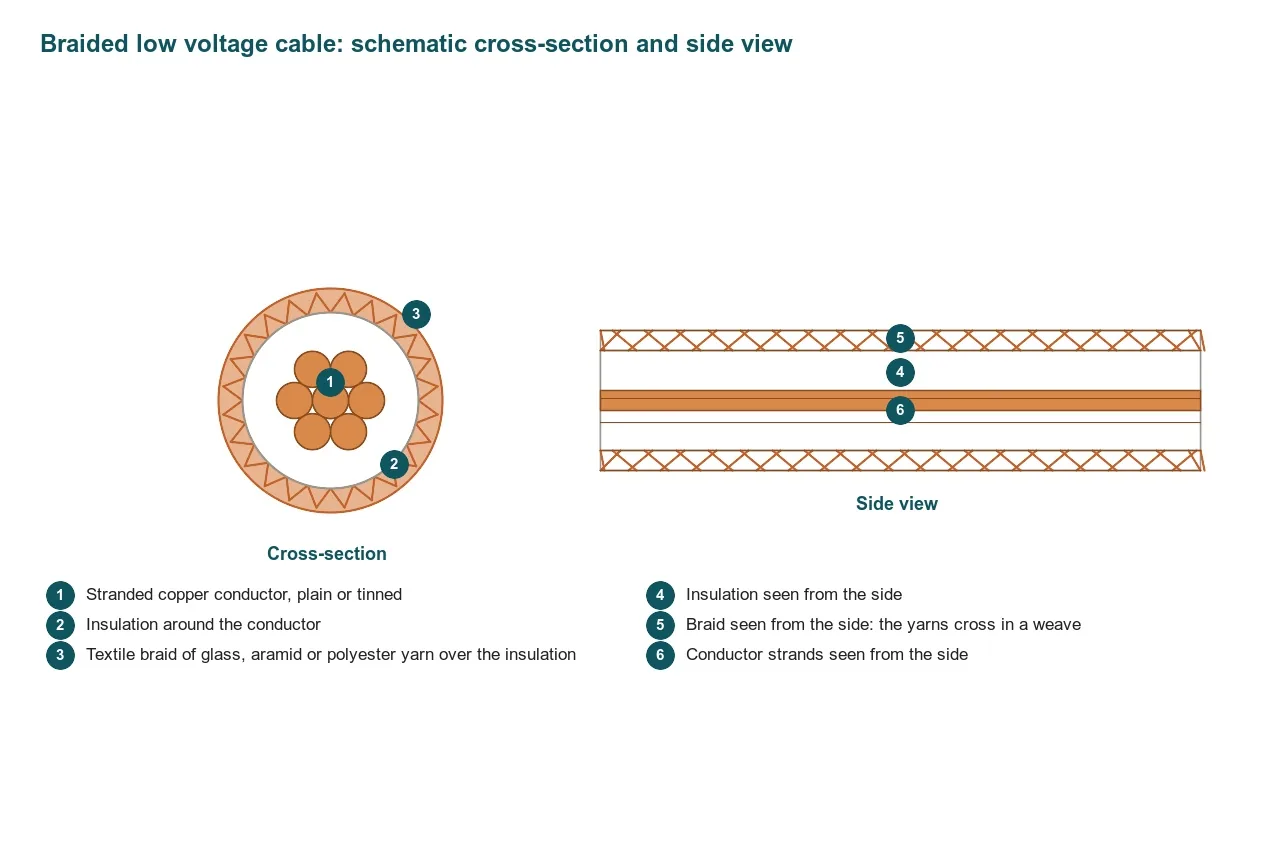
Diagram: SpecForge original drawing of a braided cable in cross-section and from the side, made for this page.
Five things decide a braided automotive cable purchase. First the conductor size, because it sets current capacity and voltage drop. Second the core insulation and its temperature rating, because the braid does not insulate. Third the braid material and finish, which decide abrasion, heat and fluid survival. Fourth the voltage family the cable belongs to, 60 V DC or less for road vehicles, against industrial and high voltage cable that look alike. Fifth the termination: strip length, terminal and crimp, and how the screen or ground end is bonded. Get those five right and the cable outlives the parts it feeds.
Chapter 1 / 06
What a Braided 60 Volt Class A Automotive Cable Is and How It Works
The cable has three working parts stacked from the center out: a conductor of stranded copper, a layer of insulation extruded onto it, and a braid of many yarns interlaced around the insulation. The insulation holds the voltage away from the chassis. The braid is not an electrical barrier; it is a mechanical sleeve. Its yarns cross one another in a helical weave, so the sleeve opens and closes as the cable bends and keeps the insulation from being scuffed through when the cable moves against a sharp edge. A lacquer or saturant is applied after braiding and dries into the weave, binding the yarns so that cut ends do not fray and fluids cannot creep along the fibers.
In a vehicle the cable does the work of every other primary or battery wire. It carries current from the battery and the charging circuit to lighting equipment and electric lamps, to ignition and to the accessories behind the dashboard. What the braid changes is where the cable can be used and how it is handled. A braided cable passes through a grommet, over a bracket and along a frame rail without the slick, hard surface of a thermoplastic jacket, so it stays where it is laid and does not chafe its neighbors. It accepts the clamps and ties of a harness without creeping, and in a vintage vehicle it matches the appearance of the original loom.
The principle of the braid is that of a woven rope sheath. Carriers of yarn travel around the cable in two opposing directions, and every yarn passes over and under the yarns moving the other way. The angle at which the yarns cross sets how the sleeve behaves. A steep angle gives a close, firm sleeve with high coverage that resists penetration but stretches little. A flatter angle gives a looser sleeve that follows tight bends and expands over the strands at a terminal. Because the yarns cross rather than wind in one sense, a cut end tends to open, and the finish that locks the weave is what stops it unravelling when the cable is stripped. Coverage, the share of the surface the weave hides, rises with more yarns.
The conductor is where the electrical work happens, and the copper material is soft-annealed electrolytic tough-pitch copper, supplied bare or tinned. The strands are bunched or laid concentrically, and that choice is visible in the core wire codes: type A is a symmetrical concentric strand of 7 or 19 wires, type B an asymmetrical bunch of 12 to 196 finer wires. Concentric strands keep a round, uniform end that strips cleanly and enters a miniature crimp barrel without stray whiskers. Tinned copper is chosen where humidity, salt or battery acid reach the stripped end. Upstream, every strand is drawn from copper wire rod. The drawing also fixes the lay length and the lay direction of the outer layer, since an end that untwists will not enter a barrel cleanly.
The insulation is the only part of the cable that holds voltage, and its wall is thin. In thin-wall primary wire the minimum wall runs from 0.20 mm (0.008 in) at 0.35 mm2 to 0.52 mm (0.020 in) at 25 mm2, so the whole outside diameter of a 0.5 mm2 core is between 1.40 mm (0.055 in) and 1.60 mm (0.063 in). Polyvinyl chloride carries the common grades at a temperature rating of -40 to 105 degrees Celsius (-40 to 221 degrees Fahrenheit). Cross-linked polyethylene and fluoropolymers raise the limit for engine compartments. The braid sits over this wall and protects it, but it is porous: a wire that has lost its insulation under a braid is live to whatever wets the braid.
What physically happens in service is simple. Current through the conductor produces heat in proportion to its resistance, which for thin-wall wire is 52.0 milliohms per meter at 20 degrees Celsius at 0.35 mm2 and falls to 0.743 milliohms per meter at 25 mm2. The insulation and the braid see almost no electrical stress, because the nominal system voltage of a vehicle circuit is 60 V DC (25 V AC) or less and most networks run at 12 V, 24 V or 48 V. Their stress is thermal and mechanical: heat from the conductor and from the engine, rubbing from the body, and fluids from the road and the engine bay.
Chapter 2 / 06
Braided 60 Volt Class A Automotive Cable Types and Structural Variants
The braid material is the first variant. Cotton yarn with a lacquer finish is the historic type: a copper conductor with PVC insulation under one layer of cotton braid and lacquer, rated at 60 V DC for automotive and tractor use, in gauges from 10 to 18 AWG. Glass fiber is the material of the hot zones: braided over silicone rubber and other high-temperature cores, it is almost always saturated with a high-temperature lacquer that stops fraying, keeps moisture out and bonds the fibers. Engine harness wire rated from -40 to 200 degrees Celsius (-40 to 392 degrees Fahrenheit) for 3,000 hours takes that braid, and oxygen sensor wire reaches 225 degrees Celsius (437 degrees Fahrenheit). Aramid yarn is braided where mechanical protection counts for more than heat.
The core insulation is the second variant, and it sets the temperature rating. PVC covers the passenger compartment and ordinary body circuits: the older standard-wall wire is rated at -40 to 85 degrees Celsius or up to 105 degrees Celsius, thin-wall PVC at 105 degrees Celsius, and a heat-resistant PVC at up to 125 degrees Celsius (257 degrees Fahrenheit). Cross-linked polyethylene, rated at 120 to 150 degrees Celsius (248 to 302 degrees Fahrenheit), is the material of engine harness wire; one grade of it stands in for PTFE and nylon in fuel system wire. A polyurethane elastomer serves at 85 to 125 degrees Celsius and cross-linked PVC at 100 to 115 degrees Celsius. Fluoropolymers, including a cross-linked ETFE and a cross-linked fluororubber, reach 150 to 200 degrees Celsius.
The conductor and the wall make the third variant. Thin-wall constructions have a reduced insulation wall: the thin-wall core runs from 0.35 mm2 to 25 mm2, with concentric type A strands up to 2.5 mm2 and bunched type B strands throughout, and the reduced wall trims bundle diameter and weight by up to 25 percent against standard-wall wire. Thick-wall, or standard-wall, wire keeps a thicker insulation, and the thin-wall cross-linked types carry the SAE J1128 type letters TXL and GXL from 0.22 mm2 to 8.00 mm2. For the hottest routes the conductor plating changes too: bare and tinned copper are rated to 200 degrees Celsius (392 degrees Fahrenheit) and nickel-plated copper to 250 degrees Celsius (482 degrees Fahrenheit).
A metal braid turns the cable into a screened wire. Here the braid is a weave of tinned copper, silver-plated copper or nickel-plated iron strands, and its job is to stop electrical interference from leaving the cable and reaching low-voltage signal circuits. On the 600 V automotive battery cables that sit just outside this family, a shielded construction is built with 95 percent braid coverage, and a 60 V screen is specified the same way. The screen is bonded to the chassis where the wiring diagram says, through a terminal, a clamp or a drain wire. Battery cables and ground straps form the heavy end: stranded copper from 8.00 mm2 to 120.0 mm2, and flat woven copper straps for engine-to-chassis bonds. An irradiation cross-linked polyolefin battery cable insulation is 10 percent more flexible than EPDM rubber and silicone.
Three neighbors are easy to confuse with this cable and are not the same purchase. A control cable, a power cable or a shielded cable built for industrial installations belongs to a different voltage family, with thicker walls, a voltage class for fixed wiring and a test list that knows nothing of engine fluids, road salt or a moving chassis. High-voltage cable for electric vehicles, the 600 V automotive battery cables and the interconnects between battery cells are other families again, with their own standards, thicker insulation and screened or jacketed constructions. A wiring harness is an assembly of many cables, cut, crimped, wrapped and routed to a vehicle, and this page stops at the bulk cable that goes into it.
Chapter 3 / 06
Key Specification Parameters and Standards
The 60 V in the designation is a system voltage, not a test level. SAE J1128 covers low voltage primary cable for a nominal system voltage of 60 V DC (25 V AC) or less, SAE J1127 covers low voltage battery cable to the same limit, and ISO 19642-3 covers single core copper conductor cables where the nominal system voltage is less than or equal to 30 V AC or 60 V DC, including the individual cores of multi-core cables. Both SAE scopes say their tests qualify cables for normal applications with limited exposure to fluids and physical abuse, so a harsh route needs more than the base qualification. ISO 19642-7 adds the sheathed, screened or unscreened constructions, and ISO 19642-2 defines the test methods that the other parts call on.
The letter A in the title does not come from those standards. No SAE or ISO title or scope defines a class A. Two lettered systems do run through this cable family. The first is the core wire code, where FLRY-A is the concentric type A conductor and FLRY-B the bunched type B conductor of thin-wall PVC wire. The second belongs to the superseded ISO 6722-1, which graded cables by letter, class B being thin-wall PVC at 105 degrees Celsius and the letters running up to H; it was withdrawn on 24 July 2023. A braided cable sold as class A is therefore sold under a supplier grade. The order must make the supplier state whether the letter means the type A conductor, a temperature class or an internal quality grade.
Each property on a datasheet is measured by a named method. Conductor resistance is the direct current resistance per meter at 20 degrees Celsius, 37.1 milliohms per meter for a 0.5 mm2 thin-wall core and 7.60 milliohms per meter for 2.5 mm2. Thin-wall wire is proved by a 1 kV AC dielectric withstand test and by a spark test of 3 kV to 5 kV AC on every meter. Flame behavior is a 45 degree propagation test in which the flame goes out within 70 seconds and leaves at least 50 mm (2 in) unburned. Heat aging runs 3,000 hours at the rated temperature and cold bending at -40 degrees Celsius (-40 degrees Fahrenheit). Fluid tests immerse the insulation in fuel, engine oil, brake fluid, coolant and dilute acid. Ozone, abrasion and insulation resistance complete the set.
Parameter
Value or range
What it means for the buyer
Nominal system voltage
60 V DC (25 V AC)
Ceiling for the vehicle circuits the cable is qualified for; 12 V, 24 V and 48 V networks sit below it
Conductor
7 or 19 wires
Type A is a concentric strand; type B is a bunched strand of 12 to 196 wires; bare or tinned copper
Core sizes, metric
0.35 to 25 mm2
Thin-wall PVC core; type A up to 2.5 mm2, type B up to 25 mm2
Core sizes, AWG
10 to 18 AWG
Gauges in which cotton braid primary wire is commonly offered
60 V thin-wall family
0.13 to 6.0 mm2
Primary circuits; battery cable from 8.00 mm2 to 120.0 mm2
Minimum insulation wall
0.20 to 0.52 mm (0.008 to 0.020 in)
Thin-wall core from 0.35 mm2 to 25 mm2
Core outside diameter
1.20 to 9.40 mm (0.047 to 0.37 in)
Over the core insulation, before the braid is applied
Conductor resistance at 20 degrees Celsius
52.0 to 0.743 milliohms per meter
0.35 mm2 to 25 mm2; equal to 15.8 to 0.226 ohms per 1000 ft
PVC core temperature
-40 to 105 degrees Celsius (-40 to 221 degrees Fahrenheit)
Thin-wall class B core with a 3,000 hour rating
Engine harness core
-40 to 200 degrees Celsius (-40 to 392 degrees Fahrenheit)
85 to 200 degrees Celsius (185 to 392 degrees Fahrenheit)
PVC, polyurethane, cross-linked polyethylene, silicone rubber and fluoropolymers by grade
Dielectric test
1 kV AC
Withstand test on thin-wall core, with a spark test of 3 kV to 5 kV AC on every meter
Flame test
70 s
Propagation test at 45 degrees; at least 50 mm (2 in) unburned
Put-up lengths
10 to 2250 ft (3 to 686 m)
Cut lengths and bulk spools of cotton braid wire
Chapter 4 / 06
Selection and Duty Calculations
Selecting a braided 60 V cable is a sequence of four decisions taken in order: the current the circuit carries, the temperature of the route, the braid the route deserves, and the termination that suits the core. Each decision narrows the next, and the calculations are short enough to run on the drawing.
The first decision is the conductor size, and it starts with the current. Where the load is known, the current is its rated power divided by the system voltage. Where it is not known, a clamp meter around the existing wire reads the running current, and the starting current of a motor is watched as well. The conductor must carry that current without its temperature rising past the rating of the insulation, and the fuse protecting the circuit must open before the conductor can overheat. On a vehicle a cable is therefore chosen one or two steps above the steady current wherever a load has a heavy start, and the fuse is matched to the conductor, not only to the load.
The second check is voltage drop, and it is the one that most often sets the size on a long run. The resistance of thin-wall wire is tabulated per meter at 20 degrees Celsius: 37.1 milliohms per meter at 0.5 mm2, 12.7 at 1.5 mm2 and 7.60 at 2.5 mm2. The drop is the current multiplied by the resistance of the whole loop, out and back. Take a 0.5 mm2 cable in its 100 ft (30 m) put-up, used as one continuous run: the loop is 61 m, its resistance is 2.3 ohms, and every ampere of load takes 2.3 V from a 12 V supply. The same run in 2.5 mm2 comes to 0.46 ohms.
The third decision is the temperature rating, and it follows the route rather than the vehicle. A cable behind the dashboard lives at passenger compartment temperature; the same circuit routed over an exhaust manifold or beside a turbocharger needs a core rated for 150 or 200 degrees Celsius (302 or 392 degrees Fahrenheit). Where the route is new, a temperature humidity recorder strapped to the structure for a full duty cycle gives the real peak, including the soak after the engine stops. The conductor adds its own heat, so the cable is rated for the sum of ambient and self-heating. Near the engine the choice is a cross-linked or fluoropolymer core under a saturated glass braid, with nickel-plated strands where the temperature passes the limit of tinned copper.
The fourth decision is the braid itself. Cotton with a lacquer finish belongs to vintage and tractor work, where appearance and 60 V DC service in a dry loom are all that is asked. Glass fiber saturated with a high-temperature finish belongs near heat. Aramid belongs where the cable is pulled over sheet metal edges. A metal braid belongs where a circuit carries or rejects interference. For every textile braid the finish matters as much as the yarn: an unsaturated braid frays at the cut, wicks oil along its length and lets the insulation chafe against the body. Color is woven in as a base shade with one or more tracer threads, parallel or crossing, and the core underneath carries its own extruded color and stripe.
The last selection is the put-up and the termination, which decide how much waste the harness line produces. Cotton braid wire is sold in lengths of 10, 25, 50, 100, 500, 1000 and 2250 ft (3, 7.6, 15, 30, 152, 305 and 686 m), and thin-wall core comes on plastic spools or in barrel packs for high-speed cut, strip and crimp machines. A concentric type A conductor strips cleanly and is preferred for automatic stripping, ultrasonic splicing and miniature crimp terminals; a bunched type B conductor needs a terminal barrel that gathers the stray ends. The order states the put-up that matches the harness lengths, so that offcuts of a costly braided cable do not pile up beside the cut machine.
Decision
What to specify
What it settles
Conductor size
mm2 or AWG, by current and by length of run
Current capacity and voltage drop
Conductor type
A: 7 or 19 wires; B: 12 to 196 wires
Clean stripping and flexibility on the cut line
Core insulation
PVC, polyurethane, cross-linked polyethylene, silicone rubber or fluoropolymer
Temperature rating and fluid resistance
Temperature class
105 to 225 degrees Celsius
Where the cable may run in the vehicle
Braid material
Cotton, glass fiber, aramid or metal
Heat, abrasion and screening
Braid finish
Lacquer or saturant, natural or colored
Fraying, wicking and identification
Screen bond
Terminal, clamp or drain wire at a chassis point
Interference control
Put-up
10 to 2250 ft (3 to 686 m)
Waste and handling on the cut and crimp line
Meaning of class A
A written statement from the supplier
That the grade ordered is the grade shipped
Chapter 5 / 06
Installation, Maintenance, and Typical Failure Modes
Almost every failure of a braided low voltage cable is a failure of the insulation or of the termination, not of the copper. Installation is therefore about protecting the core while it is cut, stripped, crimped and routed, and maintenance is about finding the damaged place before it finds the fuse.
Stripping a braided cable is a two-layer operation. The braid is cut and folded back over the strip length, the core insulation is then removed with a strip tool set so that the blade does not nick the strands, and the strands go into the barrel unsoldered. Solder in the barrel stiffens the end and lets strands break under vibration, which is why crimping is chosen over soldering on a vehicle that shakes. The terminal is an open or closed barrel crimp, stamped from brass or tin bronze and plated, with an insulation support or a sleeve for strain relief, landing on a terminal block or a stud. Hand tools with a ratchet stop or a press close it, and a sample is pull-tested on a tensile testing machine.
Routing decides the life of the insulation. A braided cable is clamped at close enough intervals that it cannot sag into a moving part, kept clear of steering and pedal travel, and laid so that it crosses a sharp edge through a grommet or a bulkhead pass through connector rather than over it. Where it cannot be kept clear, it runs inside a conduit, a corrugated loom or a sleeving that takes the rub in place of the braid; on a restoration the loom is left open so that the braid stays visible. Ties are tensioned so that they do not crush the braid against the insulation, and a service loop is left at each end for future repairs.
Braided battery cables and ground straps carry the highest currents in the vehicle and are the first place to look when a circuit is dim or slow. Each connection is a resistance in series with the load, and a loose or corroded lug shows as a voltage drop that appears only under current. A digital multimeter with fine test leads across the connection, read while the circuit is loaded, shows that drop in millivolts; an unloaded reading finds nothing. Resistance from the engine block to the chassis is checked with a micro ohmmeter in its four-wire setting. A screen braid is bonded to clean bare metal, never to a painted surface.
Maintenance is inspection by eye, by touch and by instrument. The braid hides the insulation, so a cable that has been rubbing is opened and the core examined where the weave is worn flat, darkened by heat or stiffened by oil. An insulation resistance tester between the conductor and the chassis finds a leak that has not yet blown a fuse. A high voltage tester proves a repaired cable on a bench, never a vehicle fitted with electronic control units. Under load an infrared thermometer finds the hot lug, the hot crimp or the hot ground strap. Chafed insulation against the chassis, a corroded lug, a loose crimp, a wicking braid and a core melted from inside are the failures that recur on a vehicle in service.
Disconnect the battery negative cable first and use insulated tools near the posts.
Read the voltage at the load and at the supply end with a digital multimeter while the circuit is on, and subtract.
Walk the route for wear at both ends, at every clamp and grommet, and where the braid touches metal.
Measure each connection unloaded, then clean, re-crimp or replace the one that reads high.
Repair the length, prove it with an insulation resistance tester, and reconnect the battery last.
Check or failure
What is seen
Action
Braid worn flat or broken
Shiny or dark patch where the cable rubs
Reroute, add a grommet or a conduit, replace the cable
Heat-hardened core
Stiff or discoloured insulation under the braid
Replace with the next temperature class and a saturated glass braid
Oil-soaked braid
Braid dark and wicking along the cable
Replace and order a finish rated for the fluid
Loose or corroded lug
Voltage drop under load, heat at the terminal
Clean the surfaces and re-tighten or replace the lug
High-resistance crimp
Strands outside the barrel, low pull-out force
Re-crimp with the right applicator and pull-test a sample
Replace with a bunched type B core and add a service loop
Chapter 6 / 06
Industry Applications and Procurement Checks
Braided 60 V cable is bought wherever a vehicle needs a low voltage connection that an ordinary jacketed wire would not survive, or where an original look is required. Vintage cars, trucks and tractors take cotton braid wire for lighting, ignition and instrument circuits, and restoration harnesses are built from it. Modern engine compartments take glass braid over high-temperature cores for sensors and actuators near the exhaust. Commercial vehicles and trailers use screened and battery sizes for charging circuits, lamps and brake leads, and off-road machines such as agricultural tractors, construction machines and a forklift take the same cores on 12 V, 24 V and 48 V networks. Fire apparatus and other special purpose motor vehicles run long looms of it for body controls and lighting.
The buyers fall into three groups. Harness manufacturers consume thin-wall core on spools and in barrel packs on automated cut, strip and crimp lines, where tight diameter and concentricity tolerances keep the machines from jamming. Restoration shops and individual restorers buy cotton braid wire by the cut length, in the colors and tracer patterns of the original loom. Fleet and workshop buyers keep a few sizes for repair: a battery cable size, a mid-range primary size and a ground strap. All three ask the same things of a supplier: a stable diameter, a braid that does not fray when cut, and a core that keeps the temperature class printed on its datasheet.
Cost and lead time are driven by the conductor and by the braid, not by the copper price alone. A concentric type A core and a high-temperature fluoropolymer insulation cost more than a bunched PVC core, a saturated glass braid more than cotton, and a metal screen more than either. Small cut lengths carry the handling of a full spool; bulk put-ups of 2250 ft (686 m) tie up stock on a shelf. Tracer colors that are not stock are braided to order, which adds lead time, and so does any put-up other than the standard lengths. What arrives is checked with a caliper micrometer over the core and over the braid, against the diameters on the drawing, before the cable goes to the cut line.
A purchase order for a braided 60 volt class A automotive cable must state the conductor size in mm2 or AWG, the conductor type, concentric or bunched, and whether the copper is bare or tinned. It must name the core insulation with its temperature rating in degrees Celsius. It must describe the braid: cotton, glass fiber, aramid or metal, with its finish, its color and tracer pattern, and a coverage figure where a screen is involved. It must state in writing what the class A of the title means, and which standard the cable is supplied to: SAE J1128 for primary cable, SAE J1127 for battery cable or ISO 19642-3 for 60 V DC copper conductor cable. It must give the put-up in feet or meters, the length marks required along the cable and the spool or barrel pack type. Finally it must ask for the batch test report: conductor resistance, dielectric withstand, flame, fluid resistance and heat aging.
FAQ
What is a braided 60 volt class A automotive cable?
It is a cable for the electrical system of a road vehicle, rated at 60 V DC (25 V AC) or less, in which a stranded copper conductor and its thin insulation are covered by a woven textile braid instead of an extruded jacket. The braid is a mechanical sleeve that resists abrasion and, in vintage work, reproduces the look of the original loom. Cotton with a lacquer finish is the historic form, glass and aramid yarns the high-temperature forms, and a metal braid makes the cable a screened wire. The core underneath is ordinary automotive primary or battery wire. The class A of the title is a supplier grade to be resolved on the datasheet.
What does class A mean on a braided automotive cable?
The current standards do not define it. SAE J1128, SAE J1127 and ISO 19642-3 identify these cables by scope, conductor and insulation, and their titles and scopes carry no lettered class A. Two lettered systems exist nearby. In the thin-wall core wire codes, FLRY-A is the concentric type A conductor of 7 or 19 wires and FLRY-B the bunched type B conductor. In the superseded ISO 6722-1, cables were graded by letter, with class B the thin-wall PVC class at 105 degrees Celsius and the letters running up to H; that standard was withdrawn on 24 July 2023. A buyer should have the supplier state in writing which reading, if either, the grade word carries.
Is crimping or soldering better for a car wiring harness?
Crimping, for every connection on a vehicle that vibrates. A crimped terminal cold-welds the strands into a barrel and stays flexible just behind the joint, so bending is spread along the wire. A soldered joint ends in a stiff section where the wire leaves the solder, and strands snap there after enough door closings or engine hours. Solder also wicks under the insulation and takes up strip length. The conditions for a good crimp are the right barrel for the conductor, a tool that closes to a set stop, no nicked strands and no solder on them, an insulation support or sleeve for strain relief, and a pull test on a sample from each batch.
How do I size braided automotive wire for a 12 V circuit?
Start with the current, and pick a conductor that carries it without exceeding the temperature class of its insulation. Then check voltage drop on the run. Thin-wall wire of 0.5 mm2 has 37.1 milliohms per meter at 20 degrees Celsius, 1.5 mm2 has 12.7 and 2.5 mm2 has 7.60; multiply by the loop length, out and back, and by the current to get the drop in volts. A 0.5 mm2 run 30 m long is 2.3 ohms round trip and loses 2.3 V per ampere on a 12 V supply. Size the fuse to the conductor, so that it opens before the conductor can overheat.
Can braided automotive cable be used near the engine or exhaust?
Only with a core and a braid rated for that heat. A cotton braid with a lacquer finish belongs to dry, cool vintage looms. Near the engine the core moves to cross-linked polyethylene at 120 to 150 degrees Celsius (248 to 302 degrees Fahrenheit), a fluoropolymer at 150 to 200 degrees Celsius (302 to 392 degrees Fahrenheit) or silicone rubber, and the braid to glass fiber saturated with a high-temperature lacquer. Engine harness wire is rated from -40 to 200 degrees Celsius (-40 to 392 degrees Fahrenheit) for 3,000 hours, and oxygen sensor wire reaches 225 degrees Celsius (437 degrees Fahrenheit). The plating follows: bare and tinned copper to 200 degrees Celsius, nickel-plated copper to 250 degrees Celsius.
How do I identify wires in an old braided harness?
By the woven color code and by the circuit diagram of the vehicle. Cotton braid wire comes in base colors from white and black to red, green, blue, yellow, brown, gray and orange, alone or with tracer threads: parallel tracers running along the length, or cross tracers woven diagonally. A two-black-parallel-tracer white wire is a different circuit from a white wire with a green cross tracer. Under the braid the PVC core has its own extruded color and stripe. Where printing is required it goes on the core or on a label at each end, because a woven surface does not take a legible legend.
What should I put on a purchase order for braided automotive cable?
Write the conductor size in mm2 or AWG, the conductor type and whether the copper is bare or tinned, the core insulation and its temperature rating, and the braid material with its finish and color pattern. State the standard the cable is supplied to, SAE J1128 for primary cable, SAE J1127 for battery cable or ISO 19642-3 for 60 V DC copper conductor cable, and what the class A of the title means. Give the put-up, from 10 ft (3 m) cut lengths to 2250 ft (686 m) spools, and the length marks you need. Ask for the test report: conductor resistance, dielectric withstand, flame, fluid resistance and heat aging.