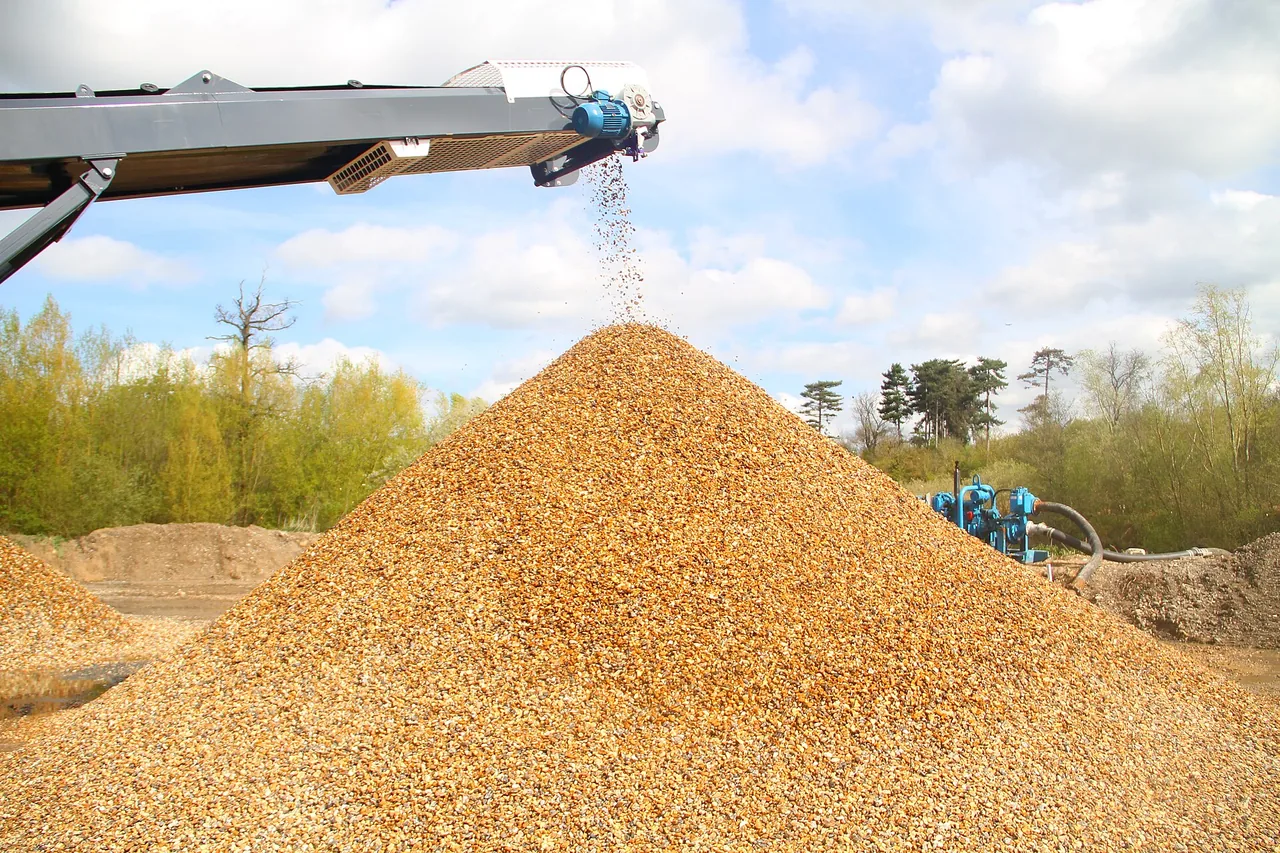
Natural aggregate is sand, gravel or crushed stone taken from natural deposits and used with little more than crushing, washing and sizing. A USGS bulletin defines it as rock fragments used in their natural state except for those operations, with roughly 25 percent or more of the pieces retained on a 4.75 mm (No. 4) sieve. The geology of the deposit fixes what the material can do. River and glacial sands and gravels were rounded and sorted by water and ice; limestone, granite, basalt and sandstone are quarried, blasted and crushed. The particles fill 60% to 75% of the volume of concrete, so the grading, shape, strength and durability of the aggregate pass directly into the finished work.
Buying it looks simple and is not. Two loads of the same size number can differ in shape, cleanliness, absorption and durability, and each difference appears later as added water, segregation, popouts or cracking. A short list of tests measures what matters: sieve analysis for grading, the Los Angeles machine for resistance to degradation, sulfate soundness and freeze-thaw exposure for weathering, and mortar-bar and chemical tests for alkali reactivity. Specifications then set the limits, among them ASTM C33/C33M for concrete aggregate in North America, EN 12620 in Europe and national highway specifications for base and asphalt courses. This page follows the material from the deposit to the stockpile and ends with the checks to apply before an order is placed.
The buying decision concentrates on four points: the source and its service record, because durability cannot be judged from one test result; the grading and size number, because they set water demand and workability; the cleanliness and shape of the particles; and the moisture state at delivery, because absorbed and free water change the batch. Add a test certificate for abrasion, soundness and alkali reactivity, a stockpiling method that prevents segregation, and a dust control plan at the plant, and the purchase is defined.
Chapter 1 / 06
What Natural Aggregate Is and How It Works
Natural aggregate is the mineral skeleton of concrete, asphalt and granular bases. Fine aggregate is sand or crushed stone with most particles smaller than 5 mm (0.2 in.). Coarse aggregate is gravel or crushed stone with particles generally between 9.5 mm (3/8 in.) and 37.5 mm (1.5 in.). In concrete the two fractions occupy 60% to 75% of the volume and 70% to 85% of the mass. The fine material fills the voids between coarse particles and gives the fresh mix cohesion, while the coarse particles form the rigid framework that carries load after hardening. The aggregate must stay inert and dimensionally stable while cement paste or bitumen binds it, so a property matters here only through its effect on that job, on the mixing water or on the volume of the work in service.
Sand and gravel deposits begin when bedrock weathers and the products are carried away by water or ice. Transport abrades, rounds and sorts the grains, so a river channel or terrace, a glacial outwash plain or a seabed yields material that needs only washing and screening; deposits below the water table are dredged. Crushed stone comes from open quarries in bedrock. Limestone, granite, dolomite, traprock such as basalt, sandstone, quartz and quartzite are the rocks the crushed stone industry processes most often. The rock is drilled and blasted, oversize blocks are broken with drop hammers, and the broken stone is crushed in stages. The minerals set the behavior: granite is quartz, feldspar and mica, and most limestone is calcite and dolomite.
At a sand and gravel plant the raw material is dug with power shovels, draglines, bulldozers, front-end loaders or excavators, or lifted from under water by suction or bucket dredges, and moved to the plant by barge, truck, belt conveyor or pump. A grizzly of parallel bars over the hopper stops cobbles and boulders. Scalping screens remove the oversize, which may go to a crusher in 1 or 2 stages to make crushed aggregate, and a battery of vibrating screens, single or multideck, or rotating trommel screens with water sprays split the remainder into size ranges. Log washers or rotary scrubbers free the sand from clay and organic matter. The sand is then sized by water classification and dewatered with screws or cones, and the products leave for the stockpiles by belt conveyors, bucket elevators or screw conveyors, with water sprayed on the material through the screening.
Crushed stone is reduced in stages. An apron feeder or belt feeder under the bin delivers the blasted rock to the primary crusher; jaw crushers, impactors or gyratory crushers are usual for the first reduction and give a product of roughly 7.5 to 30 cm (3 to 12 in.). A vibrating scalping screen takes out the undersize, which can be sold as base material. Cone crushers, with impact crushers in some plants, bring the oversize down to about 2.5 to 10 cm (1 to 4 in.) in the second stage, and a tertiary circuit of a sizing screen with a cone or impactor produces the final fractions, typically 0.50 to 2.5 cm (3/16 to 1 in.). Washing, air separators and classifiers follow where a clean product or manufactured sand is required. Every one of these steps emits dust if it is not controlled.
Each property stands for a physical event. The sieve analysis reports how the sizes are distributed, and that distribution decides how many voids the paste or bitumen must fill. Angular, rough or elongated particles need more mixing water for the same workability, but they give a better bond and, in asphalt, more contact between grains. The Los Angeles machine tumbles a graded charge with steel balls in a rotating drum and weighs the material worn away. Sulfate soundness cycles grow salt crystals in the pores and so imitate the pressure of freezing water. Alkalis from cement attack reactive silica and form a gel that takes in moisture, expands and cracks the aggregate and the paste around it.
The rules come in 3 layers. Product specifications define the material: ASTM C33/C33M covers the grading and quality of fine and coarse aggregate for concrete and leaves out lightweight and heavyweight aggregate, and EN 12620 covers aggregates for concrete with an oven-dried particle density above 2000 kg/m3. Test methods define how a property is measured: ASTM C136/C136M for sieve analysis, ASTM C127 and ASTM C128 for relative density and absorption, ASTM C131/C131M for Los Angeles abrasion, ASTM C88/C88M for sulfate soundness and ASTM C1260 for alkali-silica reactivity. Job specifications then set the limit for each use and name the tests to run; the FHWA standard specifications for federal highway projects, FP-24, work in US customary units and serve as the worked example in this page.
Chapter 2 / 06
Natural Aggregate Types and Geological Variants
Natural sand and gravel are the uncrushed branch. Water or ice rounded and sorted the particles, so a pit or a dredged bed can yield a sand and a gravel that are ready after washing and screening. Bank-run or pit-run gravel is sold with little or no processing for fill, bedding, subbase and base. Rounded, smooth grains need less mixing water than angular ones and place well in concrete that has to be pumped, but they give less friction in a bituminous mixture, and a gravel known to polish is barred from surface courses. Marine-dredged material brings 2 problems, seashells and salt. Land deposits can carry wood, lignite and clay, which washing, scrubbing and rising-current classification remove, and a material that is weakly bound conglomerate can be crushed into gravel.
Crushed stone is the quarried branch, and the rock sets its grade. Limestone and dolomite are widespread and serve well when hard and dense, but softer beds are weak and absorptive, and some dolomitic limestones are alkali-carbonate reactive. Granite, quartz, feldspar, dolomite and compact limestone are low-shrinkage aggregates, whereas sandstone, shale, slate, hornblende and graywacke are associated with high drying shrinkage. Basalt and related dark rocks are worked as traprock. Sandstone differs from sand only in being coherent, with quartz grains cemented most often by silica, and a friable sandstone is worked for sand. Chert appears in both gravel and crushed stone. Porous chert of relative density below 2.40 has low resistance to weathering and causes popouts, and some cherts are alkali reactive.
By size, the material divides into fine and coarse. Fine aggregate is natural sand, manufactured sand made by crushing and classifying stone to a top size of 0.50 cm (3/16 in.), or a blend of the 2. Coarse aggregate is gravel, crushed gravel with at least 1 fractured face on substantially all fragments, or crushed stone, sold in standard size numbers. Size No. 57 runs from 25.0 mm (1 in.) down to the 4.75 mm (No. 4) sieve, No. 67 from 19.0 mm (3/4 in.) down to that sieve and No. 7 from 12.5 mm (1/2 in.) down to it, and the nominal maximum-size sieve may retain 5% to 15% of a size number. Coarse size fractions can be stockpiled and batched separately and are blended at the plant or the batching plant to the ordered grading.
Shape separates the types further. A particle counts as flat and elongated when its length is more than a fixed multiple of its thickness, 5 to 1 in the FHWA specification. PCA guidance would keep such particles to about 15% by mass of the total aggregate, and FHWA allows 10% maximum in asphalt concrete aggregate. For bituminous courses angularity is wanted: the FHWA specification asks for 90% minimum fractured faces in asphalt concrete aggregate and 70% minimum in subbase, base and surface aggregate, with a fine aggregate angularity of 40.0% minimum. For concrete the choice runs the other way. Bond rises as particles go from smooth and rounded to rough and angular, which matters where flexural strength is needed, while rounded gravel of the same rock and grading gives about the same compressive strength as crushed stone with less water, and it is easier to pump.
By use, 3 families appear. Concrete aggregate is specified for grading, cleanliness, strength and alkali reactivity, and its coarse fraction is limited to a Los Angeles abrasion loss of 40% maximum under FP-24. Asphalt concrete aggregate is held to 35% maximum abrasion loss, 90% minimum fractured faces, a sand equivalent of 45 minimum and the 10% limit on flat and elongated particles. Subbase, base and surface aggregate is crushed stone or crushed gravel, with 35% maximum abrasion loss and 12% maximum sulfate soundness loss; the liquid limit is 25 maximum for subbase and base courses and 35 maximum for surface courses. Its grading is a band on a table of sieve ranges: base grading C, for example, allows 80% to 100% passing 25.0 mm (1 in.), 31% to 54% passing the No. 4 sieve and 4.0% to 7.0% passing No. 200. Underdrain backfill is a single size from size numbers 3, 4, 5, 57, 67 or 7.
Two neighbors bound the scope. Artificial aggregate, the manufactured and lightweight material such as expanded clay or shale, air-cooled blast-furnace slag and crushed waste concrete, is a separate product with its own leaf, and this page treats sand, gravel and crushed stone only. Building stone, or dimension stone, is rock cut to size for facing and masonry, not broken, washed and graded. Natural aggregate sits between the quarry or the pit and the concrete batching plant, the asphalt plant or the earthworks: it arrives as graded fractions and leaves as part of ready-mix concrete, asphalt, base, bedding, filter and drainage layers. Cement is its binder rather than its subject: cement paste hardens around the grains, and the grains decide how much paste and water the mix needs.
Chapter 3 / 06
Natural Aggregate Key Specifications and Standards
Grading is the first parameter. A sieve analysis by ASTM C136/C136M gives the mass percent passing each sieve of the standard series, from 150 um (No. 100) through 4.75 mm (No. 4) to 150 mm (6 in.). The fineness modulus adds the cumulative percentages retained on the sieves of that series and divides the sum by 100. As the PCA guide summarizes ASTM C33/C33M, fine aggregate must show a fineness modulus not less than 2.3 nor more than 3.1, must not vary more than 0.2 from the typical value of its source, and must not have more than 45% retained between any two consecutive sieves. Most specifications allow 5% to 30% to pass the 300 um (No. 50) sieve. Coarse aggregate is bought by size number against the grading limits of the specification; the blend of fractions is set by the mix designer.
The physical parameters decide quantities and mix design. Loose bulk density is about 1200 to 1750 kg/m3, or 75 to 110 lb/ft3, and void content about 30% to 45% for coarse and 40% to 50% for fine. Relative density, by ASTM C127 for coarse and ASTM C128 for fine, lies between 2.4 and 2.9, and absorption is 0.2% to 4% for coarse and 0.2% to 2% for fine. The Los Angeles test of ASTM C131/C131M measures the degradation of coarse aggregate smaller than 37.5 mm (1.5 in.), BS 812-110 gives the aggregate crushing value and BS 812-111 the ten per cent fines value, each a relative measure of resistance to crushing. ASTM C88/C88M estimates weathering resistance by sulfate soundness; an FHWA lesson gives 10% to 12% loss as typically accepted in sodium sulfate and 15% to 18% with magnesium sulfate.
Cleanliness and durability carry the rest. The harmful constituents are few and named: clay lumps and friable particles, which spoil workability and cause popouts; material finer than the 75 um (No. 200) sieve, which coats the particles, weakens the bond and raises water demand; coal, lignite and other lightweight pieces, which stain and pop out; soft particles; and organic matter, which delays setting and hardening. Limits belong to the specification. FP-24 allows 3.0% maximum passing the No. 200 sieve in fine aggregate for concrete, 12% maximum loss in 5 sodium sulfate soundness cycles for coarse and fine aggregate, and a mortar-bar expansion of 0.10% maximum at 16 days after casting by ASTM C1260. EN 12620 specifies properties of the same kind for aggregates for concrete, including filler aggregate.
Parameter
Value or limit
Method and what it controls
Fineness modulus of fine aggregate
2.3 to 3.1
Sieve analysis, ASTM C136/C136M; requirement of ASTM C33/C33M, with 0.2 allowed drift from the source value
Material passing 75 um (No. 200) sieve
3.0% maximum
Washing and sieving of fine aggregate for concrete; FP-24 limit for cleanliness and bond
Coarse aggregate size No. 57
25.0 to 4.75 mm
Grading of a standard concrete and base stone, 1 in. to the No. 4 sieve; ASTM C33/C33M size numbers
Flat and elongated particles, 5 to 1
10% maximum
FHWA limit for asphalt concrete aggregate; PCA guide advises about 15% by mass of total aggregate
Los Angeles abrasion, concrete stone
40% maximum
Los Angeles machine test; ASTM C131/C131M gives the ASTM procedure; FP-24 limit for coarse aggregate for concrete
Los Angeles abrasion, base and asphalt stone
35% maximum
Los Angeles machine test; ASTM C131/C131M gives the ASTM procedure; FP-24 limit for subbase, base, surface and asphalt concrete aggregate
Sulfate soundness, 5 cycles
12% loss maximum
Sodium sulfate soundness; ASTM C88/C88M gives the ASTM procedure; FP-24 limit for 5 cycles
Loose bulk density
1200 to 1750 kg/m3
Mass to volume conversion for ordering and bins; 75 to 110 lb/ft3; by rodding, jigging or shoveling
Relative density
2.4 to 2.9
ASTM C127 for coarse and ASTM C128 for fine aggregate; oven-dry or saturated surface-dry basis
Absorption
0.2% to 4% coarse
ASTM C127 and ASTM C128; moisture held at saturated surface dry, 0.2% to 2% for fine aggregate
Alkali-silica reactivity, mortar-bar expansion
0.10% maximum
ASTM C1260 at 16 days after casting; FP-24 acceptance for fine and coarse aggregate
Fine aggregate angularity
40.0% minimum
Uncompacted void content by the AASHTO method, Method A; friction of asphalt fine aggregate
Sand equivalent
45 minimum
AASHTO sand equivalent test on fine aggregate; FP-24 cleanliness limit for asphalt aggregate
Fractured faces
90% minimum
Particles with 1 or more fractured faces; 70% minimum in subbase, base and surface aggregate
Chapter 4 / 06
Natural Aggregate Selection and Duty Calculations
Selection runs as a chain of 4 steps: match the source to the exposure, fix the top size from the member and the reinforcement, fix the grading from the placing method, then convert the test results into batch quantities. The calculations below are the ones an engineer makes before an order is confirmed.
A deposit with a service record in a similar exposure is accepted on it; a new one is tested. Under FP-24 coarse aggregate for concrete may lose no more than 40% in the Los Angeles test, and aggregate for asphalt concrete or for subbase, base and surface courses no more than 35%; the latter two groups also with a sodium sulfate soundness loss of 12% maximum after 5 cycles. Where concrete freezes, look hardest at the coarse fraction: porous particles of medium pore size saturate, expand and cause popouts or D-cracking. For skid resistance, which a polished stone value test measures, FP-24 bars from bridge decks and surface courses carbonate aggregate with less than 25% by mass of insoluble residue. EN 1097-2 names the Los Angeles test as its reference method and the impact test as the alternative; a suspect aggregate is screened for alkali-silica reaction by ASTM C1260.
The top size follows the member. The PCA guide keeps the maximum size within 1/5 of the narrowest dimension of the member, 1/3 of the depth of a slab and 3/4 of the clear spacing between reinforcing bars and between bars and formwork, though the engineer may waive this when workability allows placing without honeycomb. A size number is named by its nominal maximum size, the sieve that may retain 5% to 15% of the material. Size No. 67 thus has a maximum size of 25.0 mm (1 in.) and a nominal maximum size of 19.0 mm (3/4 in.), with 90% to 100% passing the latter. Small sizes need more water and cement, so the rule is to buy the largest size the section allows.
Grading is chosen for the placing method. A sand with only 5% passing the 300 um (No. 50) sieve is sufficient for easy placing and for concrete that is mechanically finished, as in pavements. Hand-finished floors call for at least 15% passing that sieve and 3% or more passing the 150 um (No. 100) sieve. Angular, crushed or poorly graded material raises water demand, and added water raises the water-cement ratio unless the mix is corrected. The moisture calculation recurs on every batch. The moisture state is oven dry, air dry, saturated surface dry or damp; absorption, found by ASTM C127 or ASTM C128, is the dividing line. Free water above absorption is deducted from the batch water, and the batch mass of damp aggregate is raised so that the mass of dry aggregate stays as designed.
Bulking is the trap in volume batching. Surface tension in the moisture film holds damp sand grains apart, so damp sand occupies more volume than the same mass dry. The PCA chart shows the effect peaking in the first few percent of moisture: the volume of a fine grading rises to nearly 40% at about 5% moisture, that of a medium grading to about 30% and that of a coarse grading to just under 20%, and all fall back as the sand nears saturation. The remedy is to weigh every fraction instead of measuring it. Free water differs by fraction as well, usually 0.5% to 2% on coarse aggregate and 2% to 6% on fine aggregate, and a fine aggregate can hold 3% to 8% when drained while a coarse one holds 1% to 6%.
Quantities are converted with the two densities. Loose bulk density, about 1200 to 1750 kg/m3, or 75 to 110 lb/ft3, turns a tonnage into a stockpile, bin or truck volume, measured by rodding, jigging or shoveling as the maximum size requires. Relative density, between 2.4 and 2.9, enters the absolute-volume method of mix proportioning, in which an approximate water density of 1000 kg/m3, or 62.4 lb/ft3, is commonly used. Uniformity belongs to selection as much as the first result does: the fineness modulus may not drift more than 0.2 from the source value, and a natural material short of a middle size is blended with a crushed fraction. For asphalt the file is completed by angularity and cleanliness, 90% minimum fractured faces, 40.0% minimum fine aggregate angularity and a sand equivalent of 45 minimum.
Situation on the job
What to specify
Check before ordering
Thin walls and heavily reinforced members
A small nominal maximum size, No. 7 or No. 67 stone
Top size within 1/5 of the member width and 3/4 of the bar spacing
Footings, mass concrete and base slabs
A larger size, up to 37.5 mm (1.5 in.) stone
That placing equipment can handle the top size
Exterior concrete in a freeze-thaw climate
Sound coarse aggregate with a service record
Sulfate soundness loss at or under 12%; porous chert and shale absent or limited
Concrete exposed to abrasion or traffic
Hard, strong stone with low degradation
Los Angeles loss at or under 40%; siliceous content of the fine aggregate at least 25% for skid resistance
Bituminous surface course
Angular crushed aggregate with fractured faces
35% maximum Los Angeles loss, 90% fractured faces, 10% maximum flat and elongated, sand equivalent of 45
Untreated base and subbase
Dense-graded crushed stone or gravel
35% maximum Los Angeles loss, 12% maximum soundness loss, liquid limit of 25 maximum
Pipe bedding and underdrain backfill
A single size, No. 3, 4, 5, 57, 67 or 7
Grading and cleanliness of the delivered size
Sand bought by volume or batched damp
Fine aggregate of stable grading
Fineness modulus within 0.2 of the source value; moisture test on each delivery; weigh, do not volume-batch
Deposit suspected of alkali reactivity
An alkali-silica test report with the offer
ASTM C1260 expansion at or under 0.10% at 16 days after casting
Chapter 5 / 06
Natural Aggregate Handling, Maintenance and Typical Failure Modes
Aggregate does not wear out in storage, but it changes there: it segregates, degrades, picks up contamination and dries or drains. Handling is therefore the maintenance of the product itself, and most failures trace back to a stockpile or a bin. The checks that follow are the routine ones.
Stockpiles are built in thin layers of uniform thickness. In the truck-dump method, dump trucks discharge each load tightly against the last and a front-end loader reclaims vertical slices from the edges of the pile from bottom to top, so that every slice holds part of every layer. A clamshell bucket in a cast-and-spread method serves where trucks cannot go, and a rubber-tired dozer may spread material that does not degrade. Piles built high and cone-shaped by dropping from a height segregate and should be avoided; where a cone exists, the loader works around its circumference to blend the sizes. Crushed aggregate segregates less than rounded gravel, and large sizes segregate more than small ones.
Contamination and degradation are controlled with simple hardware. Bulkheads or dividers between stockpiles must be high enough to prevent intermingling of materials. Dry fine aggregate dropped from buckets or conveyors loses its fines to wind, and damp fine material segregates less than dry material, so sand is best kept damp and handled little. Storage bins should be circular or nearly square, with bottoms sloping not less than 50 degrees from the horizontal on all sides to a center outlet. Material should fall vertically over the outlet, because chuting it against the bin sides causes segregation, and baffle plates reduce that further. Bins kept as full as possible show less breakage of particles and less segregation. Washed aggregate should stand in the stockpile until it drains to a uniform moisture content.
Routine checks keep the delivered material equal to the approved one. The grading of each coarse size and the fineness modulus of the sand are re-run at intervals, because friction and abrasion in handling lower the fineness modulus and raise the content finer than the 75 um (No. 200) sieve. Moisture is measured on every delivered or reclaimed fraction, in the plant laboratory or with a moisture analyzer, and the result goes into the batch correction; the belt scale or hopper scale is checked against a known weight. For dust, the OSHA exposure control table specifies water spray or mist at crushers, hoppers, conveyors, sieves and discharge points. Where controls cannot hold the exposure below the limit, the standard requires respiratory protection, in practice respirators or dust masks chosen for the task, and hearing protectors serve against crusher noise; a dust detector can confirm that the controls hold.
In service the failures have recognizable faces. A popout is a conical fragment that breaks off the surface, with the offending particle at the bottom of the void: a porous chert, a shale, a clay lump or a lightweight piece. D-cracking is a close network of cracks parallel to the joints of a pavement, caused by coarse porous particles that saturate in the base, freeze and expand, and it has been seen after 3 or more years of service. Alkali-silica reaction gives map cracking and expansion from a gel formed where alkalis meet reactive silica in opaline or strained quartz, and some rocks show it only after the concrete is over 20 years old. Excess fines or very angular material appears earlier, as a stiff mix that demands more water, and coal and lignite leave stains.
Match the delivery ticket to the order: source, size number or sand grading, and the reference of the test certificate.
Take a sample from the load as it is placed, and run a sieve analysis by ASTM C136/C136M and a washing test for the minus 75 um content.
Measure the moisture of each fraction and enter it in the batch correction.
Place the load in thin layers on the correct side of the divider, clear of the adjacent sizes.
Record the result against the source, so that a drift in grading or fineness modulus shows early.
Symptom or check
Likely cause
Action
Grading drifts from load to load
Segregation in a cone-shaped pile or in a bin fed at an angle
Build in thin layers, reclaim by slices from bottom to top, keep bins full
More material passing the 75 um sieve
Degradation in handling, or contamination by soil and dust
Reduce drops and rehandling, test dividers, wash where required
More water needed for the same workability
Higher fines, more angular particles or drier aggregate
Check grading, shape and moisture; correct the batch water
Strength varies from batch to batch
Free moisture not deducted from batch water
Test moisture on each fraction; keep the water-cement ratio constant
Concrete falls short when batched by volume
Bulking of damp fine aggregate
Weigh the aggregate instead of measuring volume
Popouts on the finished surface
Porous chert, shale, clay lumps or lightweight pieces
Limit lightweight pieces; blend or change the source
Map cracking and expansion
Alkali-silica reaction in reactive particles
Test by ASTM C1260; change or blend the aggregate, or prevent the reaction in the mix
D-cracking along pavement joints
Coarse porous particles saturating and freezing
Use durable coarse aggregate, a smaller top size and drainage under the slab
Dust around crushers, screens and conveyors
Uncontrolled crushing, screening and handling
Water spray or mist at the emission points; exposure assessment and respiratory protection
Chapter 6 / 06
Natural Aggregate Applications and Procurement Checks
Applications follow the size and the hardness of the fraction. Concrete for buildings, pavements and precast units takes No. 57 or No. 67 stone with a natural or manufactured sand. Asphalt base, binder and surface courses and chip seals call for crushed aggregate in finer gradations, laid by an asphalt paver, under the angularity and cleanliness limits of the surface course. Untreated base, subbase and surface courses take dense-graded crushed stone or gravel up to 63 mm (2.5 in.) for the coarsest grading, compacted by a road roller. Underdrains take single-size backfill, filter rock and riprap protect slopes and channels, and smaller sizes serve as bedding and as aggregate for flowable backfill and shotcrete. The deposit decides whether a fraction can serve: a soft and absorptive limestone is weak where abrasion matters, and a gravel known to polish cannot serve a surface course.
The material reaches a site in 3 forms. Bulk loads come by dump truck from the pit or quarry or by barge where a waterway serves, and are tipped into plant hoppers or onto the stockpile; direct tipping saves a handling step, and each handling or processing step adds cost to the product. Bulk bags suit small jobs, repairs and places with no hopper. A ready-mix concrete producer receives separate coarse sizes and sand so that moisture and grading can be corrected at the concrete batching plant, and its concrete mixer truck or a concrete pump truck makes the shape of the sand matter, because angular or poorly graded aggregate is harder to pump. In each form the delivery note carries the source and the size number, which is what the stockpile divider and the batch record refer to.
Cost and lead time follow from the geology and the distance. Aggregate is a high-mass, low-value product and each handling or processing step adds cost, so the nearest approved source governs the delivered price, and a distant source adds haul time to every load. Inside the plant, more crushing stages, washing, scrubbing and classification add effort, and a deposit with overburden, clay seams or reactive rock calls for selective quarrying and more testing. Stricter limits narrow the usable faces of a quarry: low Los Angeles loss, high fractured faces, a soundness test and an alkali-silica or petrographic report all reduce what can be sold from it. Lead time lengthens when a new source must be qualified or re-qualified, because the tests and the field record have to exist before supply starts, and a job that needs several separately blended sizes waits on the slowest size.
A purchase order for natural aggregate should state the standard and the use: ASTM C33/C33M or EN 12620 for concrete, or the highway specification for base and asphalt, with the size number or the grading by sieve and the tolerance on each. State the limits that matter for the exposure: Los Angeles abrasion loss, sulfate soundness loss, flat and elongated content, fractured faces, material passing the 75 um sieve, and the alkali-silica test by ASTM C1260 where the deposit is suspect. Ask for the source name and location, a recent test certificate with the sieve analysis, relative density and absorption of each fraction, and the typical fineness modulus of the sand. Define delivery: bulk trucks or bulk bags, the weighed quantity and the scale used, the free water accepted at delivery, the stockpiling instruction, and the dust control at the plant. Reserve the right to sample each delivery and to reject a load that fails the grading.
FAQ
What is natural aggregate?
Natural aggregate is sand, gravel or crushed stone taken from natural deposits, such as river beds, glacial outwash, terraces and rock quarries, and used for concrete, asphalt, stabilized base and drainage layers after washing, screening and crushing. A USGS bulletin describes it as rock fragments used in their natural state apart from crushing, washing and sizing. Sand and gravel are dug or dredged; crushed stone is quarried, blasted and reduced in crushers. The grains make up 60% to 75% of the volume of concrete, so the geology of the deposit, through grading, particle shape, strength and durability, shapes the finished work.
What is the difference between fine and coarse aggregate?
Size draws the line. Fine aggregate is sand or crushed stone with most particles under 5 mm (0.2 in.): it passes the 9.5 mm (3/8 in.) sieve, almost all passes the 4.75 mm (No. 4) sieve and most is held on the 75 um (No. 200) sieve. Coarse aggregate is gravel or crushed stone with particles commonly 9.5 mm (3/8 in.) to 37.5 mm (1.5 in.), sold in size numbers such as No. 57. Sand fills the voids and gives cohesion; stone builds the load-bearing frame. A fineness modulus between 2.3 and 3.1 marks a normal concrete sand; river grains are rounded and crushed grains angular.
Which aggregate specifications matter most?
Grading comes first: the sieve analysis and, for sand, the fineness modulus, which ASTM C33/C33M keeps between 2.3 and 3.1. Cleanliness follows, measured as the material passing the 75 um (No. 200) sieve, 3.0% maximum in fine aggregate for concrete under FP-24. Strength shows in the Los Angeles abrasion loss, 40% maximum for concrete stone. Weathering shows in the sulfate soundness loss, 12% maximum after 5 cycles. Relative density and absorption enter the batch quantities. Alkali-silica reactivity, 0.10% maximum mortar-bar expansion by ASTM C1260 at 16 days, has to be cleared once per source. For asphalt, add fractured faces, fine aggregate angularity, flat and elongated particles and sand equivalent; EN 12620 applies in Europe.
How do I choose the right aggregate?
Work from the use and the weather it will face. Pick the source on its service record and tests: a Los Angeles loss of no more than 40% for concrete stone and 35% for base or asphalt stone, and sound stone where concrete freezes. Set the top size by the member: no more than 1/5 of its narrowest width, 1/3 of a slab depth and 3/4 of the clear space between bars. Set the grading by the placing method, richer in fines for hand-finished floors. Where a deposit is suspect, ask for the ASTM C1260 result before the first load. Then write the size numbers, the limits and the test certificate into the order.
How should aggregate be handled and stored?
Lay stockpiles down in thin, even layers and take them up the same way: a loader cutting vertical slices from bottom to top, or a clamshell casting and spreading. Steer clear of tall cones, which sort coarse from fine, and put bulkheads between sizes that are high enough to stop mixing. Keep sand damp, since dry fines blow away, and give washed material time to drain to an even moisture. Feed bins from directly above a center outlet in bins that are round or nearly square, with bottoms at 50 degrees or steeper from the horizontal, and keep them full. Weigh what you batch: damp sand swells in volume and cheats the measure.
What drives the cost and lead time of aggregate?
Haul distance comes first: a tonne of aggregate is worth little and a distant source adds haul time to every load, so the nearest source that passes the specification wins. The deposit comes next: rock that must be blasted, crushed in several stages, scrubbed, washed and classified costs more than gravel that needs screening alone, and a seam with clay or reactive minerals forces the quarry to pick and test more. The strictness of the specification then decides how much of the output is sold, since limits on abrasion loss, fractured faces and soundness cut out the weaker beds. Time is needed to prove a new source: tests and a service record are not bought off the shelf.
Is aggregate dust dangerous, and which standards apply?
It can be. Quartz-bearing rock such as granite, quartzite and many sandstones hold crystalline silica, and crushing, screening and handling release respirable dust. The OSHA construction standard on respirable crystalline silica, 29 CFR 1926.1153, sets a permissible exposure limit of 50 micrograms per cubic meter as an 8-hour time-weighted average and an action level of 25 micrograms. Its exposure control table prescribes water spray or mist for crushing machines at the crusher and at hoppers, conveyors, sieves and discharge points. Product standards such as ASTM C33/C33M and EN 12620 say nothing about dust, so the purchase order and the site plan have to.