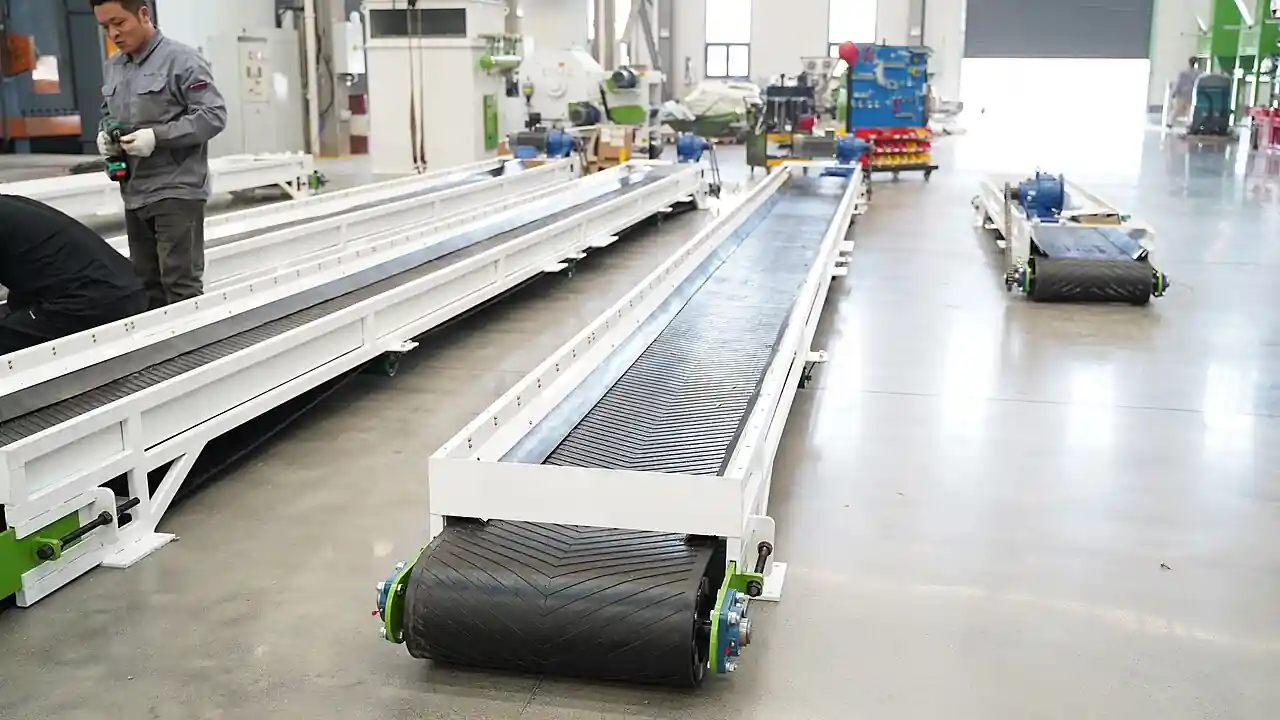
A belt feeder is a short, slow-running belt set directly under the outlet of a hopper, bin, or stockpile, drawing bulk solids out of the opening and discharging them at a controlled volumetric rate. Its rate is set by three things together: the width of bed the skirts allow, the depth of bed cut by a gate at the hopper exit, and the speed of the belt. FEECO, one of the two builders whose product notes this page draws on, describes it as the way to take material that arrives in a bin at an uncontrolled rate and introduce it to a process at a controlled feed rate; Metso presents it as precision feeding with crusher protection. What follows is written around the feeder and the hopper opening it serves, because the two succeed or fail as one.
It speaks to the bulk-handling engineer who is committing a belt width, a bed depth, a speed range, and a hopper outlet for a feeder under a bin, a blend silo, or a reclaim tunnel, whether for a new plant, a rate change, or a revamp of a unit that plugs, tracks off, or dusts. Chapter by chapter it takes up what the feeder does and what is actually being bought, how the hopper outlet, the belt, and the gate do the work, which types suit fine, lumpy, and wet materials, the figures that recur on supplier data sheets, the choices and RFQ wording that decide whether the feeder holds its rate, and the installation, tensioning, and wear practice that keep a short belt running true.
The decision concentrates in five places: the material, its lump size, moisture, and bulk density, since they set the hopper that will flow and the belt that will survive; the hopper outlet and the interface above the belt, where the real capacity limit usually sits; the bed, its width, the depth cut by a shear gate, and the belt speed, which multiply into the rate; the belt, pulleys, and tension that keep a short belt tracking; and the drive and its speed range, together with the question the page answers last, whether the duty is volumetric or needs a weigh feeder.
Chapter 1 / 06
What a Belt Feeder Is and What Is Being Decided
The machine this page describes is a belt on a short frame with a hopper sitting over its tail end. A tail pulley takes the return run under the back of the hopper, the carrying run passes beneath the outlet between two skirtboards that hold the bed in shape, and a head pulley at the front drives the belt and lets the material fall into a discharge chute. Material lies on the belt across the whole hopper opening, and as the belt moves it drags the bottom layer out while the material above settles behind it. A gate at the front edge of the hopper shears the moving bed to a set depth, so what leaves the hopper is a ribbon of fixed cross-section moving at the belt's speed.
Buying a belt feeder means buying an even draw at a chosen rate, and the two cannot be separated. The order comes down to a handful of numbers: so many cubic meters or tonnes per hour at a named bulk density, out of a hopper opening of this length and width, with the material leaving every part of that opening and not only its front edge, and with a belt, skirt, and drive that keep doing so between maintenance stops. Belt width, speed range, gate opening, and motor power serve those numbers. The feeder meters by volume, so a tonnes-per-hour figure holds only while bulk density and bed depth hold.
The feeder sits wherever a hopper or a stockpile has to let material out at a chosen rate. In a crushing plant it draws crushed ore from a bin and feeds a cone crusher or a high pressure grinding roll evenly, a duty Metso lists along with feeding screens. In a cement plant it draws cooled clinker, gypsum, and limestone from bins and silos, while the raw materials a vertical roller mill grinds are proportioned and fed to the mill by weigh feeders, because the chemistry of the meal depends on the mass of each component, and in a grinding plant it feeds a hammer mill, with a magnet over the belt to catch tramp iron. In a reclaim tunnel several feeders draw from a stockpile built above them by a stacker, the same yard a stacker-reclaimer serves when the plant reclaims with a machine instead of a tunnel. FEECO lists clinker, coal, woodchips, bark, sludge, and sand among its applications, and Metso adds wet cake discharged from filters.
One short belt serves very different plants. An aggregate or mining producer buys heavy extraction feeders under bins of crushed ore, the largest lumps already reduced, where the belt needs a thick top cover and impact idlers. A cement plant buys lighter feeders for limestone, gypsum, and cooled clinker, and feeders under blend bins where gentle handling keeps the mix intact. A pulp mill buys feeders for woodchips and bark. A power plant buys feeders for coal handling, from rail unloading and stockpile reclaim up to the bunkers, enclosed against dust and fire, and weigh feeders where the fuel rate to the mills is set by weight. A chemical or food plant buys small, cleanable feeders for granular products. The material's lump size, moisture, and abrasiveness, more than its tonnage, write the belt, the skirts, and the drive.
The economics follow from metering by volume. A belt feeder has no load cells and no weight controller, so it costs less and has less to go wrong than a gravimetric machine, and where a process needs a steady flow that an operator can check, it is the right buy. Its limit is that a volumetric rate turns into a mass rate only through the bulk density, and density moves with moisture, size distribution, and how the material settled in the bin. When the process needs a rate by weight, or a recorded tonnage, the machine to buy is a weigh feeder, and this page sends the buyer there rather than dressing a belt feeder with instruments it was not built around.
One shift's run shows how the parts work together. The belt is commonly started with the bin full and material already lying on it, which is why the drive is sized for the loaded start and ramps instead of jolting. It reaches its set speed through a VFD, the gate stands at its marked depth, and the ribbon leaves at its full width within a belt length. Operators watch the belt edge for drift, the gap under the skirts for spillage, and the bin for a sign that material is drawing from one end only. To stop, the belt stops under the bin and the material above it stays where it is, since emptying the belt is a maintenance step done with the bin's shut-off gate closed.
Chapter 2 / 06
How a Belt Feeder Does the Work
Extraction is a dragging action, not a carrying one. The belt slides under a column of material that may be meters deep and presses on it with far more weight than the ribbon on the belt weighs. Friction between belt and material carries the bottom layer forward, the layer above flows down to replace it, and the hopper empties from the whole outlet only if every point of the outlet sees the same belt movement. A feeder that draws strongly at its front and weakly at its back leaves a dead zone in the bin, takes fines from one end and coarse from the other, and opens a rat hole in material that consolidates. The art of the machine is in making the draw uniform.
Hopper geometry sets how hard that is. A mass flow hopper, with steep smooth walls and an outlet wide enough that the material cannot bridge, has every particle in motion and needs a feeder that draws evenly across the full outlet. A funnel flow hopper empties through a channel in the middle and leaves stagnant material at the walls. On a belt feeder the outlet is usually a long slot, and the opening above the belt widens from the tail toward the discharge, so the area the belt sees grows along the run and each section of the hopper contributes. The outlet width must pass the largest lump, commonly by a factor of three or more.
Skirtboards and the shear gate shape the bed. The skirtboards are plates of steel set a little narrower than the belt, lined with wear strips of rubber or polyethylene, that keep the material off the belt edge and stop it from spilling; they run the length of the hopper and a short distance beyond. Their height above the belt sets the deepest bed the feeder can carry. At the hopper's front edge a gate, hand adjusted or fixed, hangs down to shear the bed to the working depth, and its opening has to clear the largest lump with room to spare. Fixed skirts and gate suit one material and one rate; adjustable skirts and an adjustable gate let one feeder serve several.
The rate follows from that geometry by one multiplication, and the steps below show it on a working example: a 1,200 mm belt with skirts 1,000 mm apart, a gate set at 250 mm, a belt speed of 0.10 m/s, and coal at a loose bulk density of 0.85 t/m3. The volumetric flow equals the area of the bed on the belt times the belt speed, and the constant that turns seconds into hours is 3,600. In SI units, cubic meters per hour equal 3,600 times bed width in meters times bed depth in meters times belt speed in meters per second, and multiplying by bulk density in tonnes per cubic meter gives tonnes per hour. The bed is taken as a flat rectangle the depth of the gate opening, which is what a shear gate leaves, so no heap is counted; slip at the drive and the way the material packs under the gate move the real rate either way, which is why the rate is settled by catching a sample.
Bed area: width between skirts times depth at the gate, 1.0 m times 0.25 m, gives 0.25 m2.
Volumetric flow: 3,600 times area times belt speed, 3,600 times 0.25 times 0.10, gives 90 m3/h (about 3,200 ft3/h).
Mass rate: volumetric flow times bulk density, 90 times 0.85, gives 76.5 t/h (about 84 short tons per hour).
US units: the same constant with feet and feet per second gives cubic feet per hour; multiply by density in pounds per cubic foot and divide by 2,000 for short tons.
The belt, pulleys, and tension decide whether the machine runs cleanly. The belt is a heavy rubber belt with a thicker top cover than a conveyor of the same width needs, because material pressed on it by the hopper grinds the cover as it passes. The head pulley drives it through a lagged face, and where a crown is used it is there to help the belt track, since the traction comes from the lagging; the tail pulley carries a screw take-up, the belt tensioner used on all but the largest feeders, which hold their tension with a gravity or hydraulic take-up. A feeder belt is short, often only a few meters, so a tracking idler has little belt to act on: the belt must be cut and spliced square, the pulleys set level and parallel, and the tension held high enough to stop slip at the drive pulley without dragging the belt hard on the bed.
The drive sets the rate and holds it against the hopper's drag. An AC motor turns a helical gear reducer, by V-belt or through a shaft-mounted unit, and the reducer drives the head pulley; where speed must be trimmed, a VFD commonly gives a range of about ten to one below base speed, and a PID controller trims it to a set point or to the level in the bin that follows. The motor is sized not for the ribbon on the belt but for the friction of the material under the hopper, which can be several times larger and is highest at start-up with a full bin. On an incline a backstop or brake motor holds the belt against running back, and a speed pickup tells the control system whether the belt follows its speed command.
Chapter 3 / 06
Belt Feeder Types and Machine Boundaries
Support, duty, and arrangement divide the product, and every variant is the one machine. By belt support there are idler-belt feeders, in which the carrying run rides on closely spaced idlers and suits the wide, heavy machines, and slider-bed feeders, in which the belt slides on a steel or plastic deck and suits narrow, light machines where an even bed matters more than low friction. By duty there are heavy-duty extraction feeders for coarse material, with thick belts, impact idlers, and long hopper openings, and light-duty feeders for fine, free-flowing material, short and simple. An apron belt feeder, a heavy type in which the belt runs on a steel apron or pan support instead of on idlers, is still a belt machine and not an apron feeder.
Skirts and gates make further types. Fixed skirts and a fixed shear gate are set for one material and one rate and cost least. Adjustable skirts raise or lower the walls, and an adjustable gate, by hand wheel or counterweight, changes bed depth while the feeder runs, so one machine covers a range of rates with less dependence on speed. FEECO's own parts diagram names the parts every feeder carries, an engineered feed hopper, a tail pulley take-up, impact idlers, a drive pulley, a discharge chute, and a skirtboard, while by installation Metso lists fixed feeders for reclaim from bins and stockpiles, movable units that serve a crusher from more than one position, and feeders that discharge wet cake from filters.
The boundaries of the product are easiest to state against its neighbors. The belt feeder is not an apron feeder, which carries material on overlapping steel pans and takes the lumpy, hot, and abrasive duties; the finer materials and the blend bins, where gentle handling matters, are left to a belt feeder, and that belt feeder is the machine this page describes. It is not a weigh feeder, the gravimetric machine whose load cells weigh the belt and whose controller trims speed to hold a rate by weight; that page uses the words belt feeder for its own belt version, and a duty that needs rate by weight belongs there. Nor is it a belt conveyor, which carries material over distance and does not draw it from an opening, nor a hopper scale, in which the bin itself rests on load cells and a gate, screw, or belt beneath it is driven to hold a rate of weight loss; a belt feeder weighs nothing.
The belt feeder sits between a storage vessel and a process machine. Above it are the bin, silo, or stockpile whose outlet it serves; a level transmitter on the bin signals when to refill it, and on material that picks up moisture from the air the open belt is the weak point, so the bin is kept closed and blanketed with dry air, or a closed feeder such as a rotary airlock or a screw feeder replaces the belt altogether. Below it the discharge chute leads to a crusher, a mill, a screen, or the first belt conveyor of a transport run, and a bucket elevator lifts where the route turns. A screw conveyor moves material on once it has left the hopper, a vibrating conveyor carries hot or fragile material without a belt, and vibrating feeders shake it along a trough; none of them meters by a gate-sheared bed.
Material factors draw the limits of the type. Fine, dry, free-flowing powders can flood, flowing like a liquid through the interface faster than the belt can carry them, so the gate is closed down and the skirts sealed. Moist coal, clay, and fines stick to the belt, build up under the skirts, and carry back along the return run. Lumpy abrasive ore wears the cover and the skirt strips and may call for an apron feeder instead. Dust is contained by enclosing the skirting fully, as FEECO lists among its features, by closing the gap between skirt and belt, and by a closed discharge chute, and on combustible material such as coal the enclosure is matched with an explosion-proof motor and dust hazard area practice.
Chapter 4 / 06
Key Specification Parameters
A belt feeder data sheet is read through one product: width, depth, and speed multiply into the rate, and none of the three can be changed without moving another. A wider belt or a higher gate lets the feeder run slower and dust less; a faster belt lets it stay narrow but wears the cover and throws fines; a larger outlet above the belt changes what the hopper can deliver. The table that follows gives working ranges for these and for density, length, belt, drive, power, gate, and tramp metal protection. Each range is wide because the material's flow properties and the hopper that holds it decide where in it a feeder runs, and a short trial in the bin narrows it better than any catalog figure.
Parameter
Typical catalog range
What it decides
Belt width
A few hundred mm to 2,000 mm (12 to 79 in) for most plants; the largest mining feeders are wider
Bed width; maximum rate
Belt speed
Usually under 0.3 m/s (60 ft/min)
Rate range; wear; dusting
Bed depth at gate
Commonly 100 to 500 mm (4 to 20 in)
Rate; skirt height
Bulk density
Material specific, about 0.3 to 2.4 t/m3
Converts volume to mass
Extraction rate
Width times depth times speed times density
Feeder size class
Feeder length
Roughly 2 to 12 m (6.5 to 39 ft) for most plants; the largest mining feeders are longer
Four lines on a belt feeder offer deserve distrust when they arrive without their basis. A rate quoted without its bulk density, bed depth, and belt speed cannot be checked against the hopper and the belt it is sized for. Motor power figured for the belt load alone, leaving out the drag of a full hopper, will be too small at start-up. A speed range given as the drive's range rather than the feeder's ignores that the bed at a fixed gate does not follow the speed cleanly at either end, since fine powders at low speed run under the gate faster than the belt carries them and a fast belt throws fines from the sheared bed. Belt life without the material's abrasiveness and the hours run is only a label. Asking for the rate calculation behind each figure and for the draw pattern expected from the hopper tells a supplier that calculated the draw from one that copied a size.
Materials of construction follow the wear and the material. The frame is welded steel channel or I-beam, sized stiff enough that the hopper load does not twist it. Skirtboards are plate steel with bolted wear strips of rubber or polyethylene, and the belt is a ply or steel cord carcass with a top cover one grade heavier than transport service; food and chemical duty calls for a cleanable cover and stainless surfaces. Seals at the skirt line and at the back of the hopper are rubber or elastomer strips held by clamps. Pulleys are steel, lagged where the belt needs traction. Each wearing part is bolted, so it is replaced rather than cut out.
Chapter 5 / 06
Selection Decision Factors and RFQ Language
Choosing a belt feeder begins in the hopper, with the material and the outlet that has to let it flow. The flow properties, measured in a shear cell, and the largest lump decide whether the bin can be a mass flow bin, how wide and long its outlet must be, and whether a belt can draw from it evenly at all; a material that bridges over a narrow slot needs a wider opening before it needs a bigger feeder. Moisture, clay content, and the fraction of fines decide whether the belt will stay clean or build up and carry back. The bulk density, loose and settled, converts the volumetric figure the feeder controls into the tonnes per hour the process asks for. The hopper, not the frame, sets most of the feeder.
The second choice is how the rate will be set and held. A feeder sized to run near the top of its speed range wears its cover and throws dust, so the belt is commonly made wide and the gate deep enough that normal duty sits in the lower third of the range. Where one feeder must cover several rates or several materials, adjustable skirts and an adjustable shear gate give more turndown than speed alone, and a VFD gives the fine trim. A bed that is too shallow lets lumps catch under the gate, and a belt that is too slow lets a flooded powder run ahead of it. The right speed range is found by running the example calculation at the minimum and the maximum rate.
The third choice is the boundary. A belt feeder is bought for finer, gentler material and for blend bins; an apron feeder is bought for large lumps, sharp ore, and hot clinker that would cut a belt to pieces. A belt conveyor is bought to carry material over distance once it has been drawn out. And when the process needs rate by weight, a recorded tonnage, or blending to a recipe, the machine is a weigh feeder, which weighs the load on its belt with load cells and trims its own speed; adding a belt scale to a volumetric feeder reports the rate but does not hold it. Where the feeder feeds a crusher, a suspended magnetic separator and a metal detector with a flop gate belong in the same purchase, and a zero-speed switch on the tail pulley guards against a broken belt.
The table below sets out the decision factors that recur across belt feeder projects and the question a buyer should answer for each before the RFQ goes out. A factor left open here comes back after start-up as a feeder that spills, plugs, or delivers a rate nobody can state.
Decision factor
What the buyer must state
Consequence if left open
Material and bulk density
Loose and settled density, lump size, moisture, flow properties
Rate stated in volume only; hopper cannot flow
Hopper and outlet
Bin type, mass flow or funnel flow, outlet length and width
Uneven draw; dead zones; rat holes
Extraction rate
Cubic meters and tonnes per hour, normal, minimum, and peak
Feeder sized for a rate it cannot hold
Belt width and speed
Width, bed depth at gate, speed range, VFD or fixed speed
Fast narrow belt that wears and dusts
Skirts and gate
Fixed or adjustable; seal type; gate opening for the largest lump
Spillage; bed that varies with speed
Dust and fire
Enclosure, dust collection tie-in, dust hazard area for the motor
Emissions; combustible dust left unmanaged
Volumetric or gravimetric
Whether gravimetric control is actually required
Wrong machine bought for a weight-controlled duty
Downstream machine
Crusher, mill, or conveyor served; tramp metal protection
Damage from tramp iron; uneven feed
Wear parts
Belt, skirt strip, and pulley lagging life targets; spares held
Long stops; wear budget overrun
Acceptance test
Rate check at three speeds against a measured catch
Rate dispute at start-up
Belt feeder RFQ wording should pin down the material, the hopper, and the rate before it names a machine. A usable specification reads: material and bulk density, loose and settled, with lump size, moisture, and flow properties; extraction rate in cubic meters and tonnes per hour, normal, minimum, and peak; the hopper opening or belt width, with the outlet length and width and whether the bin is mass flow or funnel flow; whether gravimetric control is actually required, in which case the duty goes to a weigh feeder rather than this machine; belt speed range and the bed depth at the gate, with fixed or adjustable skirts and gate; the dust enclosure, dust collection tie-in, and the dust hazard area class for the electric motor; the downstream machine and the tramp metal protection supplied; belt, skirt, and lagging materials with expected life; and the acceptance basis, a rate check at three speeds against a weighed or measured catch.
Chapter 6 / 06
Installation, Standards, Failure Modes, and Maintenance
Installation is alignment work, because a short belt forgives nothing. The frame is set level and to line under the hopper outlet, the head and tail pulleys are set square to the frame and parallel to each other, and the belt is spliced with its ends cut square. The skirtboards are then set parallel to the belt edges, leaving the free belt edge the maker calls for, tens of millimeters to more than a hundred on each side as in the 1,200 mm belt of the example, and their seal strips are set a few millimeters above the cover or just touching it, and the back of the hopper is closed to the belt so material cannot spill behind the tail pulley. Commissioning runs the belt empty and trims the take-up until the edge holds its line, then sets the shear gate and measures the rate at three speeds with a caught and weighed sample.
Standards for a belt feeder are hopper practice, belt conveyor practice, and fire practice rather than a single product standard. The hopper is designed from flow properties measured in a shear cell, the test of ASTM D6128 among them, with the outlet sized to prevent arching. Belt tension, pulley diameter, and drive power follow the ISO, DIN, and CEMA belt conveyor design standards, and guarding and emergency stops follow the conveyor practice of ASME B20.1 or the local machinery rules. For combustible dust the buyer names NFPA 660, the consolidated standard for combustible dusts and particulate solids that now carries the dust hazard analysis, or the earlier NFPA 652 and NFPA 654 where the local code still adopts them. The edition in force at purchase governs each of them.
The recurring failure modes concentrate on the belt edge and the interface. A belt that drifts rubs the skirtboards, frays its edge, and spills; the cause is usually a crooked splice, a misaligned pulley, or material wedged under the tail pulley. Material escapes under the skirts when the seal strips wear or the belt sags between idlers. The belt slips on a lagged head pulley when tension is low or the lagging is polished, and its cover wears through under the hopper, where the pressure of the material above the outlet bears on it while the belt slides. Wet fines build up on the return run and drip along the feeder. A bin that bridges or floods starves or buries the belt, and tramp iron tears a cover or jams the gate.
Wear-part scheduling is the maintenance plan. Skirt seal strips are checked on every shift walk and replaced as soon as the gap opens, since a leak that starts as dust ends as a stream of material under the belt. The belt cover is measured at the hopper zone on a calendar and the belt ordered before the cover reaches its carcass. Pulley lagging is inspected for wear and polish and regrooved or replaced when traction falls. Take-up travel is watched to know when the belt has stretched too far to track. Quicklime on its way to a lime slaker is one case where the seal between bin and belt matters twice over, since humid air leaking in slakes the lime in storage.
A belt feeder gives daily evidence of its condition: a dust leak at the skirts, a belt edge creeping toward the rub, or a ribbon that no longer fills the gate. Usual intervals follow; the maker's manual and the wear found at each inspection take precedence.
Item
Typical action
Typical cadence
Belt edge and tracking
Look for drift and rub marks; trim take-up
Each shift
Skirt seals
Check the gap under the skirts; replace worn strips
Each shift; replace as needed
Spillage and build-up
Clear under the skirts and the return run
Each shift
Belt cover
Measure thickness under the hopper zone
Monthly
Pulleys and lagging
Inspect wear, polish, and bearing noise
Quarterly
Take-up and tension
Check travel and belt stretch
Quarterly
Shear gate and skirts
Check setting, level, and adjustment travel
Quarterly
Drive
Check reducer oil, V-belt tension, and backstop
Per supplier interval
Rate check
Catch and weigh a sample at each working speed
After any change, at least yearly
FAQ
How does a belt feeder work?
A short, slow belt runs under the outlet of a hopper, with skirtboards on both sides holding the bed in shape. As the belt moves it drags the bottom layer of material out, the material above settles behind it, and a gate at the hopper's front edge shears the moving bed to a set depth. What leaves the hopper is a ribbon of fixed width and depth moving at the belt's speed, so the rate is bed area times speed, and a VFD that changes speed changes the rate. The feeder is volumetric: it controls cubic meters per hour, and tonnes follow only through the bulk density.
What are the types of belt feeder?
By belt support there are idler-belt feeders, with the carrying run on closely spaced idlers for the wide heavy machines, and slider-bed feeders, with the belt sliding on a deck for narrow light ones. By duty there are heavy-duty extraction feeders for coarse material and light-duty feeders for fine, free-flowing material, and the heaviest type, an apron belt feeder whose belt runs on a steel apron, still feeds on a belt. Skirts and the shear gate may be fixed or adjustable, and by installation there are fixed reclaim units, movable units that serve a crusher from more than one position, and feeders that take wet cake from filters.
Which belt feeder specifications matter most?
Four numbers carry most of the decision: belt width, bed depth at the shear gate, belt speed, and bulk density. Their product gives the rate: cubic meters per hour equal 3,600 times the width of the bed between the skirts in meters times the depth at the gate in meters times the belt speed in meters per second, and the bulk density converts that to tonnes per hour. Speeds are low, usually under 0.3 m/s (60 ft/min), and widths run from a few hundred millimeters to two meters, with the largest mining feeders wider. Alongside them read the hopper opening, which must let the material flow evenly, the motor power, which is set by the drag of a full hopper rather than by the belt load, and the expected belt and skirt life.
How is a belt feeder chosen between an apron feeder, a belt conveyor, and a weigh feeder?
By the material and by what has to be controlled. A belt feeder is bought for finer, gentler material and for blend bins where a rubber belt handles the material kindly and stays clean. An apron feeder is bought for large lumps, sharp ore, and hot clinker that would cut a belt. A belt conveyor is bought to carry material over distance once it has left the hopper. A weigh feeder is bought when the rate must be held by weight, recorded as tonnage, or blended to a recipe, because it weighs the belt with load cells and trims its own speed; a belt feeder meters by volume only.
What maintenance does a belt feeder need?
Most of it is at the skirt line and the belt edge. Seal strips under the skirtboards are checked every shift and replaced as soon as the gap opens, because a dust leak soon becomes a stream of material under the belt. Tracking is watched and corrected at the take-up, the belt cover is measured under the hopper zone, pulley lagging is inspected for polish that lets the belt slip, and spillage is cleared before it packs under the return run. The rate is checked by catching and weighing a timed sample after any belt change or gate adjustment. The drive's reducer oil and V-belt tension follow the supplier's interval.
What drives the cost and lead time of a belt feeder?
Width, length, belt construction, and drive class drive the price, and the hopper interface drives the engineering. A feeder is sized with its hopper, so a supplier who tests the material's flow properties and builds the outlet with the feeder is quoting from data. Heavy extraction feeders need thick belts, steel frames, and larger drives than light-duty units, and a VFD, an enclosed dust cover, or an explosion-proof motor for coal service each add cost and lead time. Spare belts, skirt strips, and lagging are a small share of the price and a large share of availability, and should be quoted with the feeder.
What safety and dust standards apply to a belt feeder?
Belt conveyor practice covers the machine, and combustible dust practice covers the material. Guarding and emergency stops follow the conveyor practice of ASME B20.1 or the local machinery rules, with the head and tail pulleys fenced and a pull cord along the length. Where the dust is combustible, as with coal, the work starts with a dust hazard analysis under NFPA 660, the consolidated standard for combustible dusts and particulate solids, or the earlier NFPA 652 and NFPA 654 where the local code still adopts them. The usual results are an enclosed skirt and discharge chute, a dust collection tie-in at the transfer points, and an electric motor and apparatus rated for the dust hazard area.