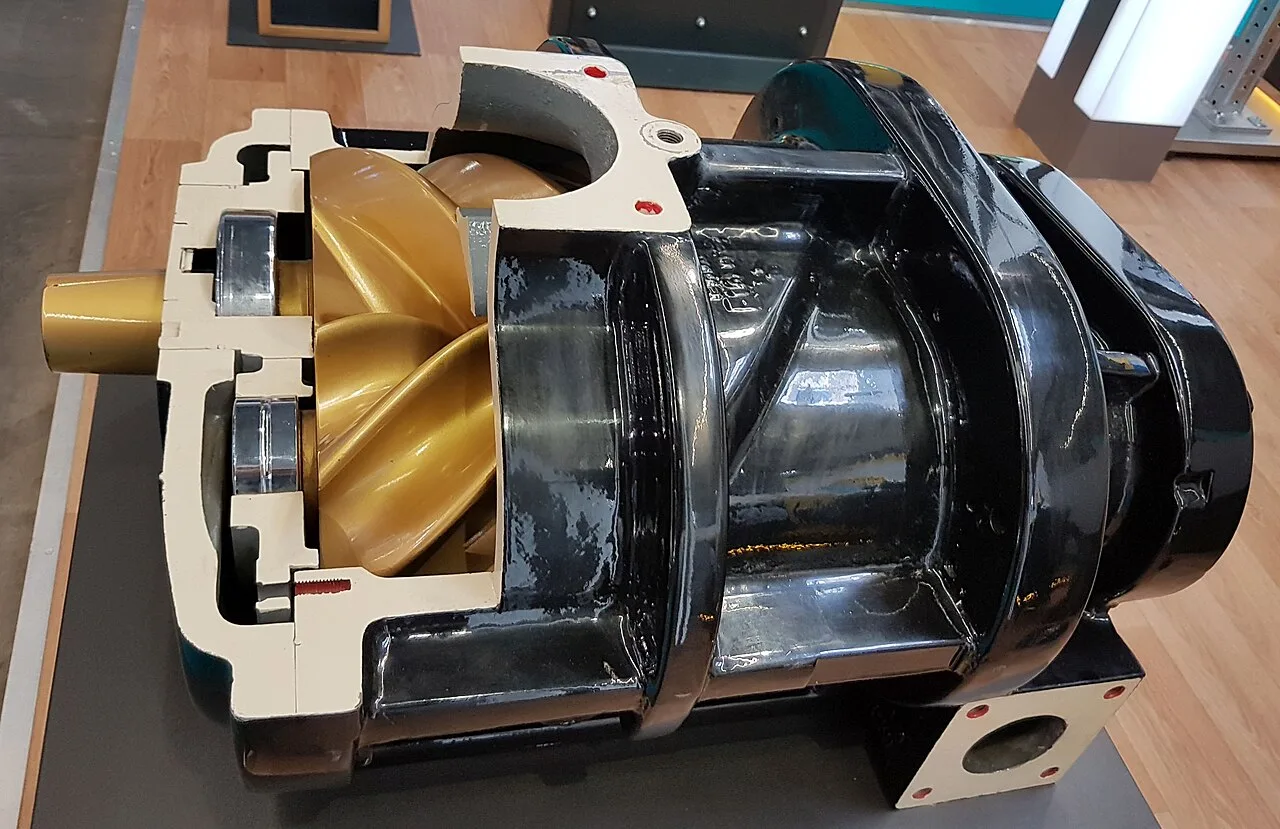
An on site oxygen generator separates oxygen from atmospheric air at the point of use, replacing delivered liquid or compressed oxygen with a plant that runs on electricity and air. The dominant industrial architecture is pressure swing adsorption, PSA, in which a compressor feeds air through pretreatment dryers into twin beds of zeolite adsorbent that hold nitrogen under pressure and release it on depressurization, cycling the beds so one adsorbs while the other regenerates and delivering 90 to 95 percent oxygen continuously. Vacuum swing, VPSA, swings the beds between low pressure and vacuum for lower energy at larger flow, membrane separators permeate oxygen fast from a polymer fiber bundle at 30 to 45 percent oxygen for small enrichment duty, and at the large end the cryogenic air separation unit, ASU, distills liquefied air to deliver 95 to over 99.5 percent oxygen and co products at any scale, at the price of a cryogenic plant.
Procurement engineers meet these machines on wastewater aeration and ozone generation, on glass, steel, and kiln combustion enrichment, on mining and leaching duty, on aquaculture and biogas desulfurization, on hospitals as medical grade systems outside this industrial page's scope, and on chemical oxidation processes. The decision this page settles is which architecture fits the flow and purity the process actually needs: PSA for most small and mid flows wanting 90 to 95 percent, VPSA above roughly 200 to 1,000 cubic meters per hour where its energy advantage pays, membrane for modest enrichment, and an ASU or liquid backup when purity above 95 percent or massive flow rules. The answer lands as an RFQ line set, flow and purity and pressure and duty cycle, feed air conditions, buffer storage, and safety scope, and every chapter below feeds that line set so the generator is bought against the process it feeds rather than against a catalog cubic meter number.
This page treats the industrial oxygen generator as a purchasing object: how PSA and VPSA beds make 90 to 95 percent oxygen and what limits them, when membranes and cryogenic plants take over, what feed air quality and buffer storage do to reliability, how oxygen enrichment changes the safety envelope, and how the whole decision folds into a defensible RFQ with energy and backup basis included. It is written for engineers who issue purchase specifications on gas generation equipment, not for readers who want a brochure summary.
Chapter 1 / 06
What an Oxygen Generator Is and What Is Being Decided
The defining act of the machine is selective separation of air at the point of use, and every architecture does it differently. Adsorption machines exploit chemistry: lithium or sodium zeolites adsorb nitrogen far more strongly than oxygen under pressure, so a pressurized bed passes an oxygen rich stream until it saturates, then releases the nitrogen when the pressure swings down. Membrane machines exploit diffusion rates: oxygen and water permeate a polymer fiber faster than nitrogen, so a pressure differential across the bundle yields a permeate enriched to 30 to 45 percent oxygen. Cryogenic machines exploit boiling points: compressed, purified, and refrigerated air liquefies and distills in columns, separating oxygen, nitrogen, and argon as liquids and cold gases with purities that adsorption cannot reach. The purchase decision starts by admitting which of those three physics the process actually needs, because paying for 99.5 percent cryogenic purity to feed an aeration basin is as wrong as feeding a kiln burner 35 percent membrane gas.
What is being decided in this purchase is four commitments at once. First an architecture and purity band: 90 to 95 percent PSA oxygen for most duty, VPSA for large flows wanting the same band, 30 to 45 percent membrane for enrichment, or ASU plus backup where purity and scale rule. Second a capacity basis: design flow at a stated purity and pressure, the turndown band the process runs, and the duty cycle, continuous against batch, because swing machines idle badly and buffer tanks paper over short peaks at a price. Third a feed air system: compressor type and pressure, pretreatment dryers and filters, and ambient conditions, dust, humidity, and hydrocarbon vapor, that the inlet must survive. Fourth a delivery and safety envelope: buffer storage volume, delivery pressure or booster compressor scope, oxygen clean materials practice, and the enrichment hazard analysis the installation owes. A buyer who lets any of the four default to the vendor has bought a skid and inherited its assumptions.
Against its neighbors the oxygen generator occupies precise ground in the industrial gas house. A nitrogen generator is the sibling machine, same PSA architecture with carbon molecular sieve holding oxygen instead, and its page is the nitrogen authority. An ozone generator is frequently the downstream customer, ozone being made from oxygen rich feed gas for water treatment and disinfection, and the two skids are often bought as a train. Oxygen detectors and analyzers are the instrumentation that police the safety and quality of everything here. The industrial gas page covers the delivered and merchant gas marketplace this machine competes against, liquid or compressed supply, and the honest selection chapter prices the machine against the truck it replaces. Medical oxygen concentrators are regulated devices outside this industrial page entirely. Naming the neighbors keeps vendors quoting the same machine against the same duty.
Standards and references frame the datasheet. Pressure vessel components, receiver tanks and vessels, follow local code, and oxygen system safety practice, cleanliness, materials, and velocity limits, follows the industrial oxygen guidance tradition of the gas and welding associations and the insurer literature, because oxygen enrichment turns ordinary materials into accelerants. Compressed air pretreatment follows dryer and filter practice covered on the air dryer and coalescing filter pages. Performance of the generator itself is vendor guaranteed territory: purity at flow, specific energy, and recovery, stated at reference conditions the buyer must pin down, inlet pressure and temperature, because every PSA curve moves with them. A datasheet that quotes flow without inlet conditions and purity basis is a price tag, not a specification.
The station around the generator deserves naming in the RFQ too. Feed air starts with a compressor, screw or scroll machines dominate small systems, feeding a receiver and then dryers and coalescing and precision filters that strip oil aerosol and particulate before the beds, because zeolite is poisoned by oil and water in different ways, water competitively adsorbs and oil coats. Downstream, a buffer tank of minutes of production rides out valve switches and load steps, a pressure transmitter and oxygen analyzer police quality, a flowmeter or thermal mass flowmeter accounts production, and a booster compressor delivers line pressure where the process wants more than the PSA outlet gives. Relief protection on the air and oxygen sides, with a safety relief valve on each coded volume, completes the skid. Buying the generator without its air and buffer scope is how startup arguments start.
Chapter 2 / 06
How PSA and VPSA Beds Make Oxygen
The PSA cycle in its common two bed form runs a four beat rhythm. Feed air, compressed to typically 4 to 8 bar and dried, flows through bed A, whose zeolite holds nitrogen and lets a 90 to 95 percent oxygen stream pass to the product line; meanwhile bed B, saturated with nitrogen, depressurizes and vents to regenerate. Equalization steps, the beds share pressure through a valve before venting and before repressurization, recover part of the compression energy with each switch, and cycle times run seconds to a couple of minutes by design. The product pulses with the switching, which is why the buffer tank is integral, not optional, and the continuous purity the plant sees is a blend the vessel delivers.
Purity, recovery, and energy trade against each other along a curve the RFQ should force into the open. Running the same beds to a higher product purity, 93 against 90 percent, means accepting lower recovery, more feed air per unit of oxygen, and more energy per cubic meter, and the relationship is steep near the top of the band: the last percent of purity costs more than the first several. Flow behaves the same way, a machine pushed past its design flow delivers lower purity or needs more purge. Specific energy for PSA oxygen lands commonly in the 0.4 to 0.8 kilowatt hour per cubic meter of oxygen band by size and conditions, and VPSA cuts that meaningfully at scale, which is why the purity target should come from the process need, not from the biggest number a datasheet can print.
VPSA changes the swing, not the chemistry. Beds cycle between near atmospheric pressure and vacuum, blowers feed and vacuum pumps regenerate, and the cycle enjoys a lower energy per cubic meter because it does not compress the whole feed to several bar, at the cost of blowers, vacuum machinery, larger beds, and a taller valve and control scope. VPSA economics typically begin somewhere above a few hundred cubic meters per hour of oxygen and dominate the mid range into the thousands, with specific energy figures commonly quoted in the 0.3 to 0.5 kilowatt hour per cubic meter class by size. The architecture boundary against cryogenic ASU then moves with purity: VPSA delivers the same 90 to 95 percent band, so processes needing more purity skip it entirely regardless of scale.
Feed air quality is the silent specification. Zeolite beds die two deaths: water, which adsorbs competitively and cuts nitrogen capacity, is managed by the dryer train and cycle design, and oil, which coats the zeolite irreversibly, is managed by compressor selection and coalescing filtration with carbon polishing where aerosols are a risk. Dust and pipeline rust block beds and valves, hydrocarbon vapors compete and foul, and warm feed air carries more water, so the pretreatment train, refrigerated or desiccant dryer stage, filters, and the ambient conditions basis, belongs in the RFQ with the same seriousness as the beds themselves. A generator quoted with marginal pretreatment is a machine with a countdown in it.
Oxygen service practice writes the safety envelope once the gas exists. Above roughly 23 percent oxygen concentration, materials burn easier and faster: oils and greases not rated for oxygen service can ignite spontaneously, velocities in piping are limited to keep particle impact energy down, and cleanliness standards for anything wetted, oxygen clean practice with solvent cleaning and bagging, apply from the generator outlet onward. The hazard analysis covers enrichment of the room the machine sits in, venting of the waste nitrogen stream, which is itself an asphyxiation hazard indoors, and the electrical classification of the space. None of this is decoration, and the RFQ that scopes it early buys a skid that passes its safety review instead of a retrofit.
Chapter 3 / 06
Architectures, Purity Bands, and Duty Boundaries
The catalog reads in four families. Twin bed PSA generators, skid or container mounted, cover roughly 1 to 300 cubic meters per hour of 90 to 95 percent oxygen, dominate the small and medium market, and package a compressor, pretreatment, beds, valves, and control into one buyable machine. Multi bed PSA and VPSA plants cover the mid range into the thousands of cubic meters per hour at the same purity with better energy, engineered rather than purely packaged, with blowers and vacuum machinery, and they reward a proper lifecycle bid evaluation. Membrane separators, compact fiber bundles with an air feed, deliver 30 to 45 percent oxygen at small flows for enrichment duties, ozone feed polishing where dilute gas serves, aquaculture, and combustion lancing, with the simplicity of no cycling valves and the limit of purity. Cryogenic ASU plants, from packaged mini ASUs to world scale, deliver 95 to 99.5 plus percent oxygen with nitrogen and argon co production, at capital and complexity that only scale and purity justify.
Within PSA hardware there are purchase significant variants. Bed count and cycle design set the buffer and purity behavior, two bed machines being simplest and multi bed smoother at scale. Adsorbent type, lithium zeolites in modern machines, carries the nitrogen capacity and the purity floor the vendor guarantees, and the guarantee basis, purity at flow at reference inlet conditions, is the comparable number between bids. Containerized and outdoor packages trade acoustic and weather scope against building cost. Oxygen boosters, piston or screw machines that raise delivery pressure, bring their own oxygen clean materials discipline and vibration scope, and their purchase belongs inside the same evaluation because the machine and booster efficiencies compound. Redundancy philosophy, twin trains at half duty against one train plus liquid backup, is a reliability decision the process availability target writes.
Membrane duty deserves its own blunt paragraph. A membrane oxygen separator is a bundle of hollow polymer fibers fed with dry compressed air, typically 8 to 12 bar, permeating an oxygen enriched stream at roughly a third to 45 percent oxygen and a nitrogen rich non permeate stream that plants often use as a byproduct nitrogen source, the mirror of the nitrogen generator page's membranes. The machine is quiet, continuous, valve free, and small, and it is the wrong answer the moment the process needs more than about half of air's oxygen content raised. Ozone generation at high concentration, combustion where true oxygen enrichment is needed, and any duty specifying 90 percent class gas all exclude membranes immediately, and the selection chapter says so plainly.
Boundaries are worth stating equally bluntly. This page is the industrial on site oxygen authority and does not write medical oxygen concentrator pages, which are regulated medical devices with their own standards trail. It does not double the nitrogen generator, its sibling with carbon sieve, or the ozone generator, its frequent customer. It is not the industrial gas procurement page, which covers delivered merchant gas, though the selection chapter prices the machine against delivery honestly, including liquid backup. The architecture map below compresses the boundaries into one table a specifier can scan before writing the RFQ.
Architecture
Purity band
Flow class
Best duty
Avoid when
Twin bed PSA package
90 to 95 percent
1 to 300 Nm3/h
Most small and medium industrial duty, ozone feed, aeration
Purity above 95 percent or flows into VPSA territory
Multi bed PSA
90 to 95 percent
100 to 1,000 Nm3/h
Continuous mid flows wanting smooth supply
Energy is the dominant cost at scale, VPSA wins
VPSA with blowers and vacuum
90 to 95 percent
200 to 5,000 Nm3/h
Large continuous flows, energy driven economics
Small flows, tight plots, purity above 95 percent
Membrane separator
30 to 45 percent
1 to 500 Nm3/h air feed
Modest enrichment, aquaculture, lancing, small ozone
Any duty specifying 90 percent class oxygen
Cryogenic ASU
95 to 99.5 plus percent
500 Nm3/h to world scale
High purity, co products, very large tonnage
Small or intermittent duty, 93 percent gas would serve
Chapter 4 / 06
Key Specification Parameters
The table below decodes the datasheet lines that decide whether a quoted generator matches the process. Each row is a purchase defining parameter; the paragraphs after the table explain what to demand and what a weak answer looks like.
Attribute
Typical range or options
What it decides
Product purity
90 to 95 percent PSA; 30 to 45 membrane; 95 plus ASU
Architecture eligibility and the energy paid per cubic meter
Product flow
1 to 5,000 Nm3/h by architecture
Bed or plant size and the buffer strategy around it
Delivery pressure
PSA 2 to 5 bar g typical; booster to line pressure
Booster scope, oxygen clean piping, and energy
Specific energy
PSA 0.4 to 0.8; VPSA 0.3 to 0.5 kWh per Nm3 O2 class
Operating cost that amortizes the whole purchase
Duty cycle and turndown
Continuous or batch; turndown band stated
Buffer volume and idle behavior of swing machinery
Feed air basis
Pressure, temperature, humidity, cleanliness
Pretreatment train scope and guarantee reference point
Pretreatment
Dryer, coalescing and carbon polish, precision filter
Zeolite or membrane life, the countdown in the machine
The purity and energy rows deserve a paragraph of their own because they are the same row. Demand the purity against flow and energy curve, not a point: purity at design flow with specific energy at the same point, and the degradation at, say, 110 percent flow, because swing machines trade those three continuously and a vendor quoting one corner of the curve is quoting the flattering corner. Pin the reference inlet conditions, pressure and temperature, of every figure, and restate them to your site's ambient, hot and humid inlet air costs capacity and energy. The purity target itself should be challenged: aeration and most combustion duty runs on 90 to 93 percent happily, and each percent above the need is energy and capital burned for a number on a report.
The feed and buffer rows carry the reliability. State ambient conditions worst case, summer temperature and humidity, and dust and hydrocarbon environment, and demand the pretreatment train sized for them, with dryer type and filter stages named and their consumable lives quoted. Buffer volume should be justified by the duty: minutes of production to ride switching on continuous duty, sized to the batch profile where the process cycles, and the oxygen analyzer and pressure transmitter logic that rides the buffer should be scoped so quality is measured at the delivery point, not assumed. The second table compresses the delivery decision the way a specification meeting argues it.
Process need
Configuration to specify
Check before order
Aeration or leaching, 90 to 93 percent serves
PSA package with dryer train and buffer
Energy at your ambient, not reference; turndown band
Ozone generator feed
PSA at 90 to 93 percent, oil free feed discipline
Feed cleanliness to ozone dielectric requirements
Kiln or furnace enrichment, large continuous
VPSA with blowers, lifecycle bid
Specific energy guarantee at site conditions; plot
Small enrichment or aquaculture
Membrane separator, simple and quiet
Confirm 30 to 45 percent actually serves the process
High purity or co products
ASU or ASU plus liquid backup
Scale honesty against delivered gas economics
Intermittent critical duty
Twin trains or liquid backup bridging
Availability math and backup sizing at peak draw
Chapter 5 / 06
Selection Decision Factors and RFQ Language
The decision sequence is short enough to run as a specification meeting checklist, and each step eliminates a class of quotations before price comparisons begin.
Fix the process need as numbers: minimum acceptable oxygen purity, flow at design and peak, delivery pressure, and the duty cycle, continuous or batch with its profile, because those four numbers choose the architecture by themselves.
Price the alternative before the machine: delivered liquid or cylinder economics at your consumption, including rental, vaporizer, and logistics, so the generator bid competes against a real number.
Choose the architecture from the chapter 3 map: PSA through mid flows, VPSA for large continuous, membrane only for genuine enrichment duty, ASU for purity and scale.
Fix the energy basis: specific energy guaranteed at site ambient conditions at design and one off design point, with the purity at those same points.
Scope the feed air honestly: compressor type with oil discipline, dryer train, filtration stages, and worst case ambient data, with consumable lives quoted.
Size the buffer and delivery: storage minutes against the duty profile, booster scope with oxygen clean practice, and line materials and velocity limits downstream.
Set the safety scope: room oxygen enrichment and nitrogen vent analysis, oxygen clean documentation, electrical classification, and relief protection on all coded volumes.
Fix the verification evidence: performance test method at site conditions, purity and energy guarantees with tolerance, and component warranty basis, adsorbent life above all.
Against neighboring equipment the comparison a specifier needs runs as follows, and it belongs here in the selection chapter rather than in the page title. A nitrogen generator is the sibling architecture on the other sieve, and plants often buy one of each from the same feed air room. An ozone generator is the downstream customer for much of this oxygen, and the ozone skid's feed specification, dry, oil free, oxygen rich, writes requirements back into this RFQ. Delivered industrial gas, liquid or compressed, is the competitor the lifecycle math must beat, including its logistics and vaporizer scope. Membrane versus PSA is an internal boundary this page settles on purity grounds. Name the neighbors in the RFQ and every vendor quotes the same machine against the same duty.
The RFQ block should be written once and reused. A complete block reads: required oxygen purity minimum and normal; design, peak, and minimum flow with the duty profile; delivery pressure at the battery limit; site ambient conditions worst case including humidity and dust; electrical supply and energy price for the evaluation; architecture proposed with bed count and cycle basis or membrane area; guaranteed specific energy at site conditions at design flow with purity at the same point; feed air system scope, compressor with oil discipline, dryer, filtration stages and consumable lives; buffer storage volume with control logic; booster compressor scope with oxygen clean practice where line pressure exceeds PSA outlet; instrumentation list with oxygen analyzer, pressure transmitter, flowmeter, and alarms; safety scope including vent handling and enrichment analysis; redundancy or liquid backup philosophy with availability target; and the performance test method with guarantees and tolerances. A quotation returned without specific energy at site conditions or adsorbent life is incomplete at any price.
Chapter 6 / 06
Installation, Standards, Failure Modes, and Maintenance
Installation quality decides whether the skid delivers its curve. Feed air piping arrives dry and clean, the compressor room ventilation supports the worst summer day, and the dryer and filter train installs with its drains and indicators visible, because pretreatment is where capacity quietly leaves. The oxygen side installs with oxygen clean discipline from the generator outlet onward: degreased lines, bagged fittings until closure, valves and components rated for oxygen service, and velocities within the guidance limits, and the vent line for waste nitrogen routes outdoors away from intakes and occupied pits, since the asphyxiation hazard of the waste stream is as real as the enrichment hazard of the product. The buffer and booster, where fitted, follow pressure vessel and oxygen machine practice respectively, foundations for the booster's dynamics included.
Commissioning proves purity, energy, and the safety case. Run the performance acceptance at site conditions, not reference: purity at design flow on the oxygen analyzer, specific energy from the power meter against produced cubic meters on the flowmeter, and the purity stability through buffer cycles recorded over hours, not minutes. Challenge the turndown, run the process profile through the machine and watch the buffer and control response, because the batch corner is where swing machines stumble. Prove the safety scope: vent discharge measured and verified outdoors, room oxygen readings at the analyzer during a full production run, relief valves proven on their set pressures, and the alarm chain from oxygen analyzer and pressure transmitter to the control room exercised end to end.
Failure modes in service follow a short and predictable list. Capacity fade traces to adsorbent aging or pretreatment slip: water breakthrough from a tired dryer cuts nitrogen capacity first, oil aerosol from a compressor fault coats zeolite irreversibly second, and the purity trend at constant flow is the early signal both give. Valve wear is the mechanical heartbeat, switch valves and equalization valves cycle millions of times and their seats and solenoids are the wearing parts, announcing themselves as cycle noise, longer equalization, or purity dips at switching, and the maintenance kit strategy exists because of them. Compressor and dryer faults are the familiar utility story, belt or bearing wear on the screw machine, drain failures flooding the dryer, filter differential climbing on the coalescing stages. Buffer and booster issues track pressure equipment and rotating machine practice, and oxygen side contamination, a greasy fingerprint inside a fitting during maintenance, is the failure mode that does not forgive, which is why oxygen clean procedure applies to every opening of the wetted path.
Maintenance intervals scale with running hours and air quality more than with calendar. Continuous duty machines earn quarterly filter and drain service, dryer attention on its own calendar, and an annual valve and adsorbent health review reading the purity and energy trend against commissioning, with the adsorbent life warranty the reference point. Consumables budget honestly, filters, dryer media, valve kits, and the eventual adsorbent change, because they are the operating cost the specific energy figure does not include. Instrumentation calibration, the oxygen analyzer above all, is the quality of the plant's numbers, and every campaign produces data, purity and energy trend, filter life, valve service, that calibrates the next RFQ, which is how a purchasing file gets smarter instead of just older.
FAQ
What purity do PSA oxygen generators actually deliver?
The industrial PSA band is 90 to 95 percent oxygen, with the balance mostly argon and a little nitrogen, and the exact number inside that band is a dial the vendor sets by trading recovery and energy. Pushing toward 95 percent costs disproportionately, so buy the purity the process needs, most aeration and combustion duty runs happily at 90 to 93 percent, and demand purity guaranteed together with specific energy at the same operating point.
When does VPSA beat PSA?
On continuous mid to large flows, commonly from a few hundred cubic meters per hour up, where the vacuum swing's lower specific energy, roughly the 0.3 to 0.5 kilowatt hour per cubic meter class against 0.4 to 0.8 for PSA, repays the blower and vacuum machinery capital within the evaluation window. Below that band, the simpler pressurized PSA package usually wins on capital and plot. Both deliver the same purity band, so purity never chooses between them.
Can a membrane system give me 90 percent oxygen?
No. Membrane separators enrich air to roughly 30 to 45 percent oxygen, a physics limit of the polymer selectivity, and they are the right tool only for duties that genuinely run on enriched air, aquaculture, lancing, small ozone at dilute feed. If the process specifies 90 percent class oxygen, the membrane is excluded before the meeting starts, and PSA or an ASU is the conversation.
How important is feed air treatment?
It is the life of the machine. Water competitively adsorbs on the zeolite and cuts capacity, and oil aerosol coats it irreversibly, so the compressor choice with its oil discipline, the dryer, and the coalescing and carbon filtration stages are specification content, not accessories. Quote their consumable lives and monitor filter differential and dryer performance as the early warning trend, because adsorbent replacement is the expensive way to learn.
Do I need a buffer tank?
Yes for PSA and VPSA, because swing machines deliver a pulsing product that the vessel blends into a continuous quality, and the buffer also rides load steps and short peaks. Size it in minutes of production against the duty profile, continuous duty wants switching smoothing, batch duty wants profile coverage, and put the oxygen analyzer at the delivery point so quality is measured where the process receives it.
How do I compare a generator against delivered liquid oxygen?
Build the delivered side honestly, tank rental, vaporizer, logistics, and price per cubic meter, against the machine side, specific energy at your ambient, consumables, maintenance, and capital amortized over adsorbent life, at your actual consumption profile. Below a few cubic meters per hour delivery usually wins, at continuous mid flows the generator usually wins on cost and autonomy, and many sites hedge with a liquid backup sized to bridge maintenance.
What safety scope comes with oxygen generation?
An enrichment and asphyxiation analysis of the installation space, oxygen enrichment accelerating fire above roughly 23 percent and the nitrogen waste stream displacing air in confined spaces, oxygen clean materials and cleanliness practice for everything wetted from the outlet onward with velocity limits in piping, relief protection on coded volumes, and continuous monitoring where the machine occupies a room. Scope it in the RFQ, because retrofitting safety into an installed skid is how projects stall.