
Pneumatic air picks in the 1-15 kg tool-weight class match 80-110 cfm compressors and are sized to bridge-site chipping of cured concrete, rebar exposure, and bearing-pad removal where electric breakers trip GFCI or where ATEX zone classification forbids spark-risk tools [S2].
Bridge work splits into three tool-demand bands: light chipping (1-3 kg picks, 80-90 cfm), medium demolition (5-9 kg picks, 90-100 cfm), and heavy bridge-deck or pier removal (10-15 kg picks, 100-110 cfm); pairing a pick outside its compressor cfm band wastes 15-30% of the tool's rated striking energy [S2].
Material and Air Demand: Concrete, Steel, Timber
Concrete, steel, and timber cover over 98% of U.S. bridge materials, and the AHP ranking of state DOTs puts maintenance, lifecycle cost, and lifespan ahead of first cost; that ranking is the same logic that drives air-pick choice, since the tool is consumed on the maintenance and rehab side, not the new-build side [S1]. Prestressed concrete dominates new bridge material selection, so the heaviest air-pick demand on a rehabilitation job is chipping concrete cover off post-tensioned tendons without cutting strands, a job that maps to 9-15 kg picks with 1-1/8 in. hex shank [S1].
Steel bridges are governed by ANSI/AISC 303-22 and ASTM A709 grades; air picks on steel bridges show up as descaling chisels before recoating and as rivet/bolt removal where 90 psi air supply is already plumbed for the painting crew, so the pick rides on existing 80-100 cfm compressors and does not justify buying a new prime mover [S5]. Timber bridges, where local highway officials disproportionately select the material, are a low-demand use case: 2-4 kg picks with moil-point or scraping chisels for decayed-member removal and hardware extraction [S1].
Selection Criteria: Cfm, BPM, Shank, Vibration
Air pick selection on a bridge site is driven by five numbers: required blows per minute (BPM, typically 900-1500 for 5-15 kg picks), air consumption (80-110 cfm at 90 psi), shank size (round 0.580 in., hex 3/4 in., hex 1-1/8 in. for heavy chipping), weight class, and vibration/ATEX class for the work zone [S2]. For bridge deck removal and pier-column chipping, contractors running 50-900 t gantry cranes and 70 m/min hoisting speeds cannot afford a pick that stalls every 20 minutes; matched cfm keeps the tool inside its continuous-duty BPM window and prevents 15-25% productivity loss from under-supply [S2].
A typical comparison band, drawn from OEM data cited in [S2], looks like: 1-3 kg picks at 80-90 cfm and 900-1200 BPM fit chipping and rebar exposure; 5-9 kg picks at 90-100 cfm and 1000-1300 BPM fit deck spall repair and bearing-pad removal; 10-15 kg picks at 100-110 cfm and 1200-1500 BPM fit bridge-deck and pier-column demolition. A 5/8 in. round shank is wrong for bridge heavy chipping: it shatters in 0.5-2 hours under 10 kg class impact energy, and crews waste 1-2 hours per shift on shank change-out.
Who Air Picks Are For (and Are Not For) on Bridge Sites
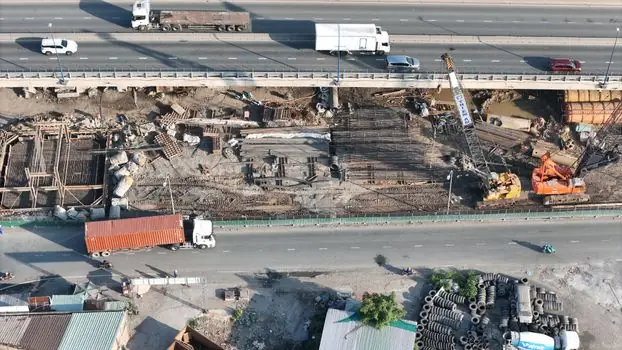
Air picks are the right tool for chipping concrete, scarifying bridge decks, descaling steel, and driving spikes on timber rail; they are the wrong tool for cutting rebar, post-tensioning strand, or structural steel sections, where a cut-off machine or stud welder or a hydraulic shear does the work in 10-20% of the time [S2]. For structural steel surface prep ahead of recoating, an angle grinder with the right disc and dust class finishes faster than a pneumatic pick, and on coated weathering steel (ASTM A709 Grade 50W) per ANSI/AISC 303-22 corrosion-protection rules, picks destroy the patina and force re-weathering [S5].
Air picks are also the wrong tool for finish sanding of bearing-seat concrete before setting elastomeric pads, where a sander matched to substrate and dust class returns a flatter surface in half the shift hours; for rebar exposure and partial-depth deck removal, the 5-9 kg class pick still beats a 30 lb electric breaker because it does not trip site GFCI on wet decks and does not require 480 V three-phase that bridge jobs rarely have at the deck level [S2].
Site Logistics: Air Supply, ATEX, and Crane Interface
Bridge sites already run 185-375 cfm diesel compressors for sandblasting and painting, so a 5-15 kg air pick ties into the same 1-1/2 in. air main at 90 psi with a 3/4 in.
On floating-crane bridge jobs the air-pick operator works inside the 5-7 degree maximum list/trim window of the barge, with 60 mph wind rating on the lift plan; pneumatic tools tolerate vessel motion better than electric, which is a second reason air picks are preferred over demolition hammers for over-water pier repair [S2]. For ATEX zone 1 coating-removal work inside bridge box girders, vendors offer low-spark brass-bushing picks, but contractors must verify the certification rather than assume it: a non-certified pick voids the hot-work permit and shuts down the job.
Comparison: Pick Class vs Bridge Task vs Compressor

Three decision criteria line the options up: air consumption, BPM under load, and shank durability. Class A (1-3 kg, 80-90 cfm, 900-1200 BPM, 5/8 in. round or 3/4 in. hex) fits rebar exposure, light spall, and timber-bridge hardware. Class B (5-9 kg, 90-100 cfm, 1000-1300 BPM, 3/4 in. hex or 1-1/8 in. hex) fits partial-depth deck removal, bearing-pad extraction, and pier-column spall repair. Class C (10-15 kg, 100-110 cfm, 1200-1500 BPM, 1-1/8 in. hex) fits full-depth deck chipping, pier-cap demolition, and abutment removal [S2].
For steel-bridge surface prep before coating system application per ANSI/AISC 303-22 fabrication-quality rules, the pick is a scaler, not a chipper, and 2-4 kg body with a descaling chisel head is the right call, not the heavy chipping class.
Standards, Failure Modes, and Sourcing
Bridge steel work references ANSI/AISC 303-22 and ASTM A709 grades for material and erection, and the air pick is governed by ISO 15744 for vibration and EN 792-4 for pneumatic hand-held tools; OSHA 29 CFR 1926.302(c) caps air-nozzle pressure at 90 psi for chipping and cleaning, which is why the 90 psi / 80-110 cfm envelope is a hard ceiling, not a recommendation [S5]. The three failure modes that show up on bridge sites are: under-supplied BPM (cfm too low, hose too long, manifold undersized), shank mismatch (5/8 in. round hex driven into 1-1/8 in. hex holder with a sleeve adapter, shank fractures inside the cylinder), and unlubricated air (no inline oiler, tool seizes within 2-4 hours under continuous duty).
For deck-rehab contractors, the procurement signal is to spec 1-1/8 in. hex picks for any work above 9 kg class, plumb a 3/4 in. whip hose with locking chuck and inline lubricator, and dedicate a 185 cfm compressor zone to picks so sandblasting spikes do not starve them; the next trackable signal is the 2026 release of revised ANSI/AISC 303 erection guidelines, where surface-prep tool callouts have been flagged in committee for tighter wording on pneumatic scaler use before coating application [S5].
Component reference pages worth checking: air pick, overhead bridge crane, and construction tools.