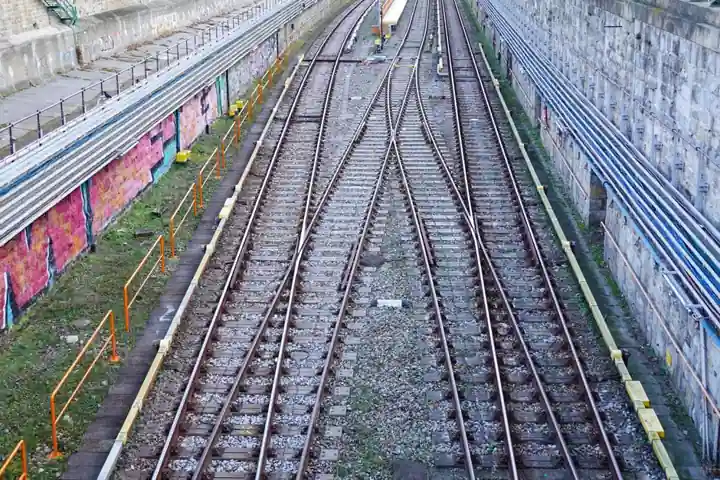
Rail-foundry buyers in 2026 are sizing automatic molding lines against a narrow band: 60-180 molds/hr, flask inner sizes from 500x400x150/150 mm up to 1200x800x350/350 mm, and specific squeeze pressure held at 8-12 kgf/cm2 across KSF, KSP and SPD machine families from Kailong Machinery [S3][S5].
Most railway components in gray and ductile iron (brake shoes, side-frame fillers, pantograph base castings, axle-box covers) weigh 5-150 kg per piece, which is exactly the envelope where a horizontal flaskless line with 18-30 sec cycle time is the cheapest qualified answer, per the published cycle-time envelope of 18-25 sec/mould on Kailong horizontal flaskless platforms [S6].
Three Line Architectures Compete for Rail-Component Work
Three architectures are bidding for the same railway casting work in 2026: horizontal flaskless shooting-and-squeezing, static-pressure green-sand with hydraulic multi-piston squeeze, and V-process (vacuum-sealed) lines for steel [S3][S5][S9].
The horizontal flaskless KSF family covers flask inner sizes of 500x400x150/150 mm, 600x500x200/200 mm and 700x600x250/250 mm, with 30-36 sec/cycle at 8-12 kgf/cm2 squeeze and a published moulding rate of >=98% [S5]. For heavier rail castings, the static-pressure KSP family steps up to 800x600x200/200 mm through 2300x950x350/350 mm flasks at 30-60 sec/cycle with the same 8-12 kgf/cm2 squeeze band, and the SPD double-station version of the same architecture halves cycle time to 20-24 sec by adding a pattern-exchange station [S3].
For steel rail components, V-process moulding uses plastic-film sealed flasks and a vacuum pump to develop a pressure differential that compacts dry sand, eliminating the green-sand loop entirely and removing moisture-related defects in steel pouring [S9]. A spec-first comparison of how these three architectures map to typical rail castings is laid out in the section that follows.
Selection Criteria by Part Type and Weight Envelope
Match the line to the part, not the brochure: rail castings split cleanly across flask-size and squeeze-pressure bands, and crossing bands usually means a 6-9 month custom-engineered delivery [S7].
Small grey-iron rail hardware (brake shoes, signal-mount brackets) typically lands in the 5-30 kg range and fits the KSF50/KSF60 flaskless platform with cycle times of 30-36 sec/mould, no-core-setting, and moulding rates >=98% [S5]. For mid-weight ductile-iron bogie castings and bolster covers in the 30-80 kg band, the KSF70 (700x600x250/250 mm) and KSP80 (800x600x200/200 mm) platforms both operate at the 8-12 kgf/cm2 squeeze window that the same family uses across all models, holding surface hardness at 80-92 GF and side hardness at 85-90 GF [S3][S5].
Large steel or heavy iron rail castings above 80 kg push buyers to the KSP100, KSP120 or KSP230 static-pressure machines with flasks up to 2300x950x350/350 mm and 30-60 sec/cycle, or to the SPD double-station layout when 20-24 sec/cycle is needed at 800-1200 mm flask widths [S3]. The decision rule documented in the 2026 sizing guide is to keep flask utilisation between roughly 70-85% of the rated inner area; selecting outside these bands usually means a custom engineered line with 6-9 month delivery [S7].
Throughput, Cycle Time and Sand-System Sizing
Horizontal flaskless lines from Kailong deliver cycle times as short as 18–25 seconds per mould [S6].
High-volume iron foundries running dedicated rail-component work have published throughput at 60-180 molds/hr on horizontal sand molding lines; one US iron foundry lists Line 1 at 900x700x250/250 mm flask and 180 molds/hr, with Line 2 at 1100x1000x300/300 mm flask and 60 molds/hr, fed by two dual-track induction furnaces [S4].
The hidden capacity lever in any automatic molding line is the sand plant: a typical green-sand loop needs a mix rate of 2.0-2.5x the net sand consumption to cover moisture make-up, bentonite addition and return-sand conditioning, so a 120 molds/hr line at 195 kg/mold needs a 50-60 t/hr mixer [S7]. For more detail on cross-industry sizing logic, the molding line reference covers the band selection for green-sand vs no-bake loops, and the static pressure molding machine page covers the squeeze-pressure physics that ties a 8-12 kgf/cm2 window to mould hardness 80-92 GF.
Controls, Hydraulics and Servo Stack Now Standard
2026 rail-foundry deliveries now ship with Siemens S7 PLCs, Ethernet networking, SEW or Siemens servo drives, Rexroth variable-frequency drives, Rexroth hydraulic valves, and Schneider low-voltage electricals, per the KSP/SPD control-stack listing [S3].
The mechanical subsystems on a fully automatic horizontal parting line consist of upper and lower molding modules, pushing mechanisms and sand cylinders, with five hydraulic cylinders, three pneumatic cylinders and multiple solenoid valves sequencing each cycle [S8]. On ZHY Casting's automated horizontal parting design, the twin molding machines each carry independent cope and drag modules, sand magazines, and hydraulic systems for pattern draw and mold push-off, the three mechanisms that drive cycle time [S10].
Robotic demoulding of stack-molded parts, when applied to large rail inserts and cover plates, uses a side-entry robot on guided linear rails that removes parts horizontally from the mold's rear, with the rear gate removed [S2]. Linear guide rails from suppliers such as Rollon (a Timken company) are one of the motion-component options for the slide axes of these demoulding robots, and Rollon introduced HVC-MG and H1C-MG telescopic rails on 6 July 2026 for higher-load motion paths in this class of equipment [S1].
V-Process vs Green-Sand: When to Switch
For steel rail castings and any component where moisture-related gas defects are unacceptable, V-process (vacuum-sealed) moulding replaces the green-sand loop with a plastic-film-sealed flask, dry sand, and a vacuum pump that develops the pressure differential to compact the sand [S9].
There is no moisture make-up, no bentonite conditioning, and no return-sand cooling tower, which removes the largest auxiliary equipment in a green-sand foundry. The trade-off is pattern cost (plastic film per cycle) and the vacuum-pump duty, so V-process is a fit for steel rail coupler knuckles, steel brake discs, and certain austempered rail components where surface finish and metallurgical consistency justify the higher per-mould consumable cost. Green-sand static-pressure remains the default for any iron rail casting where 8-12 kgf/cm2 squeeze pressure and 80-92 GF mould hardness give the dimensional stability and surface roughness the rail specification needs [S3][S5].
Quality Numbers, Sand Hardness and Pour Windows
Mould hardness on the KSF platform is specified at 80-92 GF on horizontal and parting surfaces, and 85-90 GF on the mold side, measured with a GF hardness tester, with specific squeeze pressure held at 8-12 kgf/cm2 [S5].
Static-pressure moulding with airflow plus hydraulic multi-piston squeeze compaction gives a rigid, dense mould, dimensional stability and improved surface roughness, a higher moulding efficiency, and a high mould-plate utilisation rate, the four points the Kailong static-pressure datasheet lists as the architecture's main advantages [S3]. The published moulding rate of >=98% on the KSF family is the number to anchor a quality conversation around when a rail buyer asks about first-pass-good moulds at speed [S5].
Sand preparation is the same problem regardless of architecture: a 120 molds/hr line at 195 kg/mold sand consumption needs 50-60 t/hr mixer throughput, the 2.0-2.5x net-consumption rule that holds across both green-sand and the wet-edge of static-pressure work [S7]. For the broader process picture on how a shell molding machine compares against flaskless horizontal lines for small rail hardware batches, the encyclopedia entry on molding traces the same hardness-vs-throughput trade-off for the resin-bonded process.
Trackable signals for the next planning window: Kailong's SPD double-station pattern-exchange machines are the fastest-published 2026 platforms for 800-1200 mm flask work at 20-24 sec/cycle, and any new 2026 rail-bogie tender above 150 kg/mold now reads as static-pressure rather than flaskless [S3][S7]. The relevant cross-industry reference, the automatic level page, frames what "fully automatic" means in tender documents when the spec must say no operator on the moulding station.
Related analysis: Automatic Molding Line Spec Map for Lighting Fixtures.