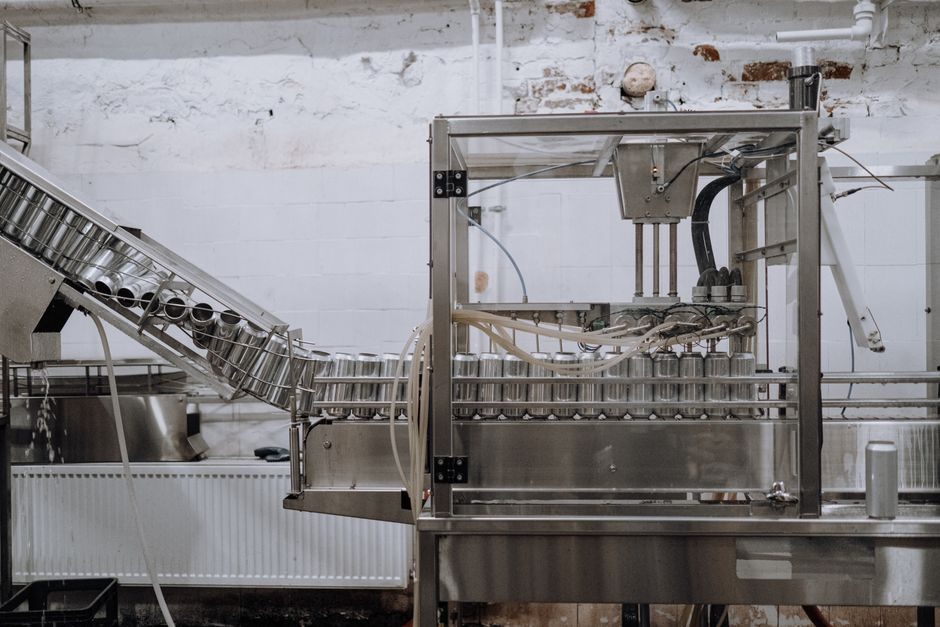
A chain conveyor moves unit loads or palletised product through a production line using a continuous loop of chain engaged with sprockets at the head and tail drums — a basic definition drawn from industrial dictionary usage [S3].
Specifying one correctly requires resolving seven gates before a RFQ is released: load mass, conveying length, environmental exposure, temperature, chain pitch, drive location, and the accumulation method. Each gate eliminates whole equipment families, which is why early shortlisting beats late-stage redesign on these systems [S1][S2].
Gate 1: Load Class and Unit Geometry
Conveyor chain systems are engineered for unit loads — totes, trays, pallets, drums, automotive skids — rather than bulk flow. A chain-driven roller variant such as the Rulmeca series 138 uses a 40-63 mm diameter PVC or steel tube with an interchangeable pinion at the end to transmit motion via a friction sleeve; this design suits light to medium carton or tote handling in FMCG and packaging lines [S1].
For heavy pallets, drums, or unit accumulation under back-pressure, a fully metallic double-friction roller such as the Rulmeca FDN/FDR series in 76 mm or 89 mm diameter is the reference class; the metallic construction provides the radial friction needed to overcome deformation and run reliably under sustained stall pressure [S2]. Selecting a light-duty roller for a heavy pallet zone is the most common spec-side failure on greenfield lines.
As a side note, when weighing metal-construction roller lines against framed storage upstream, the storage rack load class criteria decision follows similar load and geometry gates — useful cross-reading when a conveyor feeds a racked warehouse.
Gate 2: Chain Pitch, Speed, and Polygon Effect
Pitch sets the polygon effect — the velocity ripple caused by a finite-link chain wrapping a multi-tooth sprocket. Large-pitch conveyors (typical 100 mm, 125 mm, 150 mm, 200 mm) are designed for heavy, slow unit handling where ripple is tolerable; their selection principles are covered in technical literature on large-pitch chain conveyor design [S3].
For high-speed light packaging, a small-pitch roller chain (e.g. 25.4 mm to 50.8 mm) with a high sprocket tooth count reduces the ripple to a level that the conveyed product can tolerate. Specifying the wrong pitch is the second classic error: a 200 mm pitch at 30 m/min on a carton line will throw the product off the rollers.
Gate 3: Drive Mechanism and Roller Diameter

Chain conveyors drive via sprocket-to-chain engagement at the head shaft; the chain then drives the rollers that carry the load. Chain-driven rollers in the Rulmeca 138 series use diameters between 40 mm and 63 mm, with the sprocket mounted on a friction sleeve that transmits torque to the tube [S1].
The FDN/FDR heavy-load variant moves to 76 mm or 89 mm tube diameter — the larger diameter distributes point load across a longer roller-tube contact patch, reducing deflection on heavy totes or skids [S2]. When roller diameter is undersized for the load, you see sleeve wear, tube ovalisation, and chain jump at the sprocket within months of commissioning.
Gate 4: Material Selection and Corrosion Exposure
Material choice is the gate that turns a standard catalog line into a stainless, zinc-plated, or polymer-bushed special. PVC or zinc-plated steel suits dry ambient lines; stainless 304 or 316 enters the spec as soon as the conveyor passes a washdown zone, food contact zone, or chemical exposure. The 138 series lists PVC and steel as standard tube material options [S1]; the FDN/FDR series is fully metal by construction [S2].
For plants in coastal or chemical atmospheres, a higher stainless grade plus sealed-for-life bearings becomes mandatory — comparable to the stainless vs copper material selection debate where the environment gate outweighs the cost gate on every long-life line.
Gate 5: Temperature, Lubrication, and Re-Lube Access
Standard chain conveyors run in -10 °C to +80 °C ambient with periodic re-lube of the chain pins. Above 80 °C, the lubricant base oil thins, chain elongation accelerates, and the auto-tensioner cycles more often; below -10 °C, the chain lubricant can gel and pin/bushing contact goes from boundary to marginal lubrication. [S1]
Specifying high-temperature chain grease, sealed pin-bushings, or a fully enclosed drip-free chain is the response — but each of these multiplies the unit cost of the chain and the sprockets. Re-lube access (drop-down catwalks, removable guards, auto-lube rails) must be confirmed in the layout, otherwise the line is never serviced correctly and chain life drops 40-60%.
Gate 6: Span, Slope, and Accumulation Behaviour
Span and slope dictate whether a single-drive chain, dual-drive chain, or chain-with-cable-pull arrangement is required. On inclines above 5°, a toothed chain engaging sprockets at both ends is mandatory; a smooth round-link chain will skip teeth under load. [S2]
Accumulation mode is the other branch: zero-pressure (each zone controlled by a sensor and clutch), or full-line pressure (a continuous back-pressure build-up). The Rulmeca FDN series is described as providing temporary accumulation with radial friction that absorbs motion resistance, even under stalled conditions [S2] — exactly the behaviour needed for accumulation zones in pallet conveyor or end-of-line buffering.
Gate 7: Standards, Sourcing, and Lifecycle Cost

Chain conveyors are not governed by a single global standard; instead, they are assembled from components (chains to ISO 606, sprockets to ISO 606 or DIN 8187, rollers to CEMA or ISO 2184, motors to IEC 60034, guards to ISO 13857) [S1][S2]. The integrators — not the chain maker alone — carry the integration responsibility.
Lifecycle cost is dominated by chain replacement, sprocket wear, and re-lube labour, not the original purchase. A heavier chain and a higher-grade sprocket can double the headline price but push service intervals from 12 months to 36 months; on a 24/7 line, that gap decides the spec. For budgetary framing, side-reading the belt conveyor price 2026 cost map helps anchor the chain variant against the belt variant on the same line. The mechanical gates that govern chain conveyor selection also feed into the roller bearing selection 2026 gates used for the head/tail shaft bearings, where the load and speed axes overlap directly.
Selection between the two main equipment families is therefore a clean four-axis call: light FMCG carton/tote (138 series, 40-63 mm tube, PVC/steel, small pitch) versus heavy pallet/drum (FDN/FDR, 76-89 mm tube, all-metal, larger pitch) on cost, temperature ceiling, corrosion resistance, and lead time [S1][S2]. A useful related comparison structure is the aluminum vs carbon steel material gate set, which uses the same cost-versus-environment axis and is worth pulling into a spec review.
Track these three signals between 2026-06-23 and the next RFQ: (1) whether the plant standard drawing still allows PVC-tube rollers on washdown lines — a tightening here is the most common late-stage re-spec event; (2) whether the head-shaft motor has a variable-frequency drive (VFD) or direct-on-line start, which fixes the soft-start requirement on the chain and sprocket; (3) whether the auto-lube system is in the base scope or on a separate quote, because chain life is dictated by lube interval more than by chain grade.