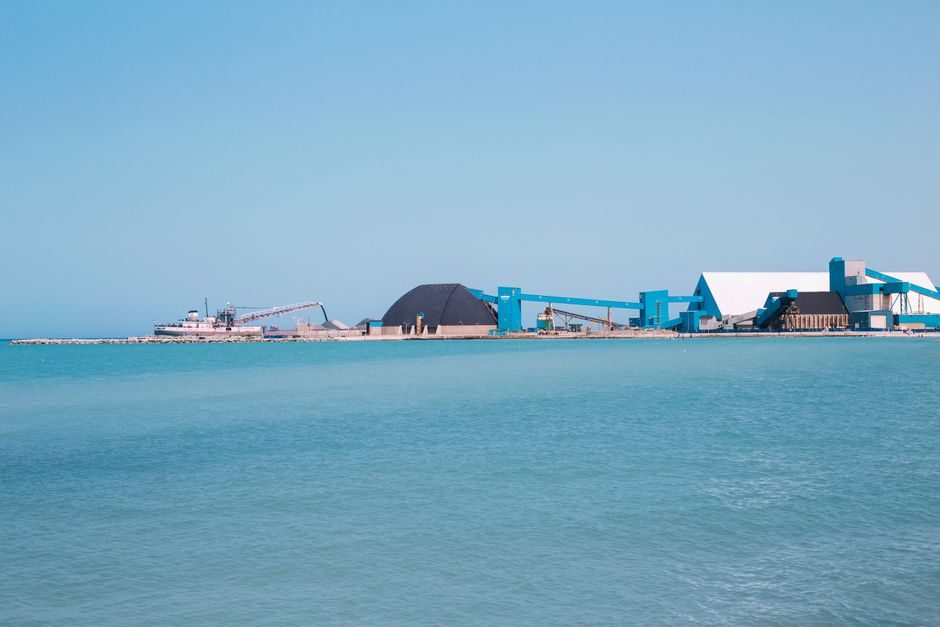
Global desalination capacity is on track to exceed 120 million m³/day of installed nominal production by the end of 2026, with seawater reverse osmosis (SWRO) accounting for the majority of new contracted capacity in the Gulf, North Africa, and the Chinese coastal provinces [S1][S6].
The shift is structural: thermal multi-stage flash (MSF) and multi-effect distillation (MED) still anchor legacy Gulf operations, but every greenfield project tendered in 2025–2026 that we surveyed defaulted to RO as the primary process train, with thermal units relegated to brine-concentration or hybrid roles [S1]. Energy-recovery devices (ERDs) — isobaric pressure exchangers and Pelton turbines — are now specified on essentially every new SWRO train larger than 20,000 m³/day, cutting specific power consumption on the high-pressure pump circuit to roughly 2.5–3.5 kWh/m³ [S1][S6].
Technology mix: where RO ends, FO and MED begin
Seawater reverse osmosis is specified for feed total dissolved solids (TDS) up to roughly 45,000 mg/L and recovery rates of 35–50% in two-stage configurations, with single-pass product conductivity targets below 600 µS/cm on potable trains [S1]. Brine concentration beyond about 70,000 mg/L TDS is the operational ceiling where RO becomes uneconomic, which is the boundary where forward osmosis (FO) pilots, MED crystallizers, and selective electrodialysis are entering commercial demonstration [S1].
For brackish water reverse osmosis (BWRO), feed TDS typically runs 1,000–10,000 mg/L and recovery climbs to 65–85%, with two-pass trains required when permeate must drop below 200 µS/cm for industrial reuse [S1]. The 2026 procurement environment is therefore a three-tier decision: SWRO for new coastal capacity, BWRO for inland industrial reuse, and thermal or FO/ED for high-recovery brine polishing. Engineers evaluating pressure transmitter ranges for high-pressure RO feed lines should expect working pressures of 60–85 bar on standard seawater trains, climbing to 120 bar on second-pass brackish units.
Specific energy consumption and the ERD retrofit decision
Payback on the ERD upgrade for an existing 100,000 m³/day plant falls inside three years at industrial electricity tariffs above $0.08/kWh, which is the threshold most Gulf utilities have now crossed [S6].
The 2026 decision matrix for ERD type is straightforward: isobaric pressure exchangers (PX) win on efficiency (96–98% mechanical) and footprint; Pelton turbines remain preferred on feed pressures above 80 bar or where the unit is also expected to act as a flow-metering reference for the flow meter on the reject circuit. Fouling tolerance is the dominant counterweight — isobaric units need feed SDI below 3, while Pelton turbines tolerate SDI up to 5 with the trade-off of slightly higher energy loss [S1].
Pre-treatment: UF versus conventional dual-media

Ultrafiltration (UF) membranes with nominal pore size 0.01–0.05 µm have displaced conventional dual-media sand filters on roughly two-thirds of new SWRO tenders since 2024, on the strength of stable SDI₅ output below 2 regardless of raw seawater turbidity spikes [S1].
For plants drawing from open intakes in areas with seasonal algal blooms, dissolved air flotation (DAF) followed by UF is the standard 2026 chain; beach-well intakes remain the lowest-fouling option but are site-restricted to permeable coastal aquifers. The instrumentation list on a modern pre-treatment skid typically includes a pressure sensor per vessel, a turbidity analyzer on the UF filtrate header, and differential pressure transmitters across each RO stage — the latter being the single most reliable early indicator of fouling or scaling onset.
Materials of construction: why super-duplex is winning the high-pressure circuit
High-pressure RO pump casings, ERD rotors, and the first-stage piping run on super-duplex stainless steel (UNS S32750 / S32760) once feed chloride concentrations exceed roughly 18,000 mg/L — a level reached on most open-intake seawater feeds without blending [S1]. The 2026 NACE MR0175 environment for sour service is increasingly referenced even on desalination projects where the concentrate stream is later injected into Class II disposal wells.
For lower-pressure brine and permeate piping, glass-reinforced vinyl ester (GRE) and high-density polyethylene (HDPE) PE100 remain the cost-default, with service life ratings of 25 years at 40 °C continuous exposure. Engineers specifying industrial valve bodies for the brine circuit should match the trim to the concentrate chloride level: 316L is acceptable below 5,000 mg/L Cl⁻, while super-duplex becomes mandatory above 18,000 mg/L Cl⁻. Engineers working in the parallel process industries can compare notes with downstream operators through the LNG Industry 2026: Capacity Super-Cycle, US-Qatar Anchor, Demand Catch-Up coverage, where the same material selection logic applies on gas dehydration and seawater injection packages.
Control architecture: PLC-centric, with HART still on the analog loop
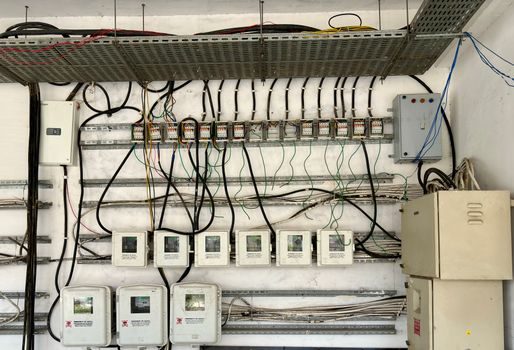
Every SWRO plant of 50,000 m³/day or larger delivered in 2025–2026 ships with a PLC-centric control architecture: redundant controllers, Ethernet-APL or PROFINET fieldbus, and HART retained on the legacy 4–20 mA loops for valve positioners and variable-frequency drives [S1]. Foundation Fieldbus and PROFIBUS PA are encountered on older Middle Eastern installations but are not the default for new tenders; Ethernet-APL is the 2026 selection for greenfield because it carries both power and process data on a two-wire trunk and survives the longer cable runs typical of intake-to-plant topologies.
Variable-frequency drives on the high-pressure pump and the energy-recovery booster pump are now standard, and the latest plants pair them with servo motor-actuated valve trim on the chemical dosing skids to maintain ±2% accuracy on antiscalant and sodium bisulfite injection. Cybersecurity has moved up the specification list, with IEC 62443-3-3 SL-2 being the most common target level for plant-floor networks on 2026 builds [S1].
Brine management: the bottleneck nobody wants to discuss
For every cubic meter of permeate produced, a seawater RO plant discharges 0.5–1.5 m³ of concentrate at 60,000–75,000 mg/L TDS — a volume that the 2026 contract landscape is increasingly offloading to zero-liquid-discharge (ZLD) trains when outfalls are constrained [S1][S6]. The cheapest ZLD path remains thermal evaporation with a brine crystallizer downstream, but the energy penalty is roughly 15–20 kWh/m³ of concentrate, which is why FO and electrodialysis reversal (EDR) pilots are attracting 2026 funding.
Discharge limits are tightening in the Mediterranean and along the Chinese coast: the typical 2026 contract specifies a maximum receiving-water salinity increase of 2 ppt at the edge of the initial dilution zone, which rules out surface outfall for plants larger than 50,000 m³/day in enclosed basins. The engineering trade-off is therefore not whether to treat the brine, but whether to spend the capex on a longer outfall, a deeper diffuser, or an inline brine concentrator — and the answer is increasingly the concentrator where land is available and power is subsidized. For context on how this siting logic is being reshaped in adjacent heavy industry, see the Top Petrochemical Companies 2026: Capacity, Capex and Spec Cut coverage on intake and outfall reuse.
What 2026 procurement will track next
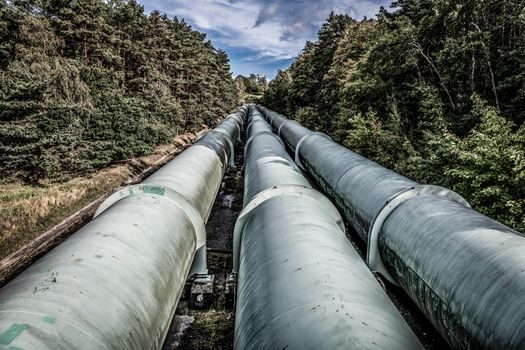
Two signals to watch through Q3/Q4 2026: the award of the next tranche of Saudi Vision 2030 SWRO capacity (multiple tenders above 200,000 m³/day each), and the publication of the next round of Chinese reclaimed-water tariffs that effectively set the floor for industrial reuse contracts in Tianjin and Shandong [S1][S6]. A third, lower-visibility signal: commercial deployment of FO-RO hybrids at the 50,000 m³/day scale, which would mark the first step beyond pilot for that technology class.