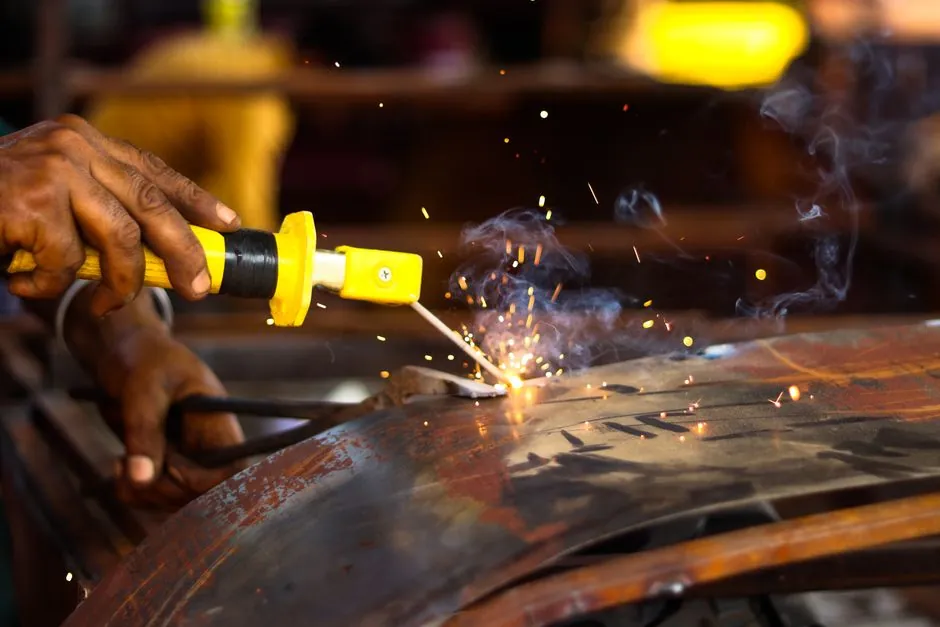
On demolition and shoring rebuilds, the electroslag pressure welder specified for column rebar splicing runs at 40-50 V DC with welding current around 600 A, scaling to 1,000 A when the largest bar in the cage exceeds 32 mm [S1][S2].
The slag bath reaches roughly 1,900 degrees C, hot enough to melt the HJ431 flux and the bar ends inside a clamped mold, and the machine then applies axial upset force to forge a weld collar that ground flush before concrete placement [S2][S4].
Rebar EPW vs Plate ESW: Two Different Machines on the Same Truck
Electroslag pressure welding (EPW) for rebar and electroslag welding (ESW) for plate both run current through a conductive molten flux pool, but only the rebar variant applies axial upset pressure to forge a bar-to-bar joint inside a flux-filled mold, and the code paths do not overlap [S4].
EPW is sized for diameters typically from 16 mm to 40 mm on vertical or inclined bars within roughly a 4:1 gradient, and produces a visible weld collar that is later ground flush; ESW, in contrast, deposits consumable wire between water-cooled copper shoes to join plate thicknesses that historically reached 75 mm and beyond, with the modern narrow-gap NGI-ESW variant operating in an approximately 19 mm gap [S4].
For demolition shoring rebuilds, the plate ESW branch is almost never the right pick, because the slag bath must be held by water-cooled shoes and gravity in near-vertical orientation, and below roughly 25 mm plate thickness the bath cannot be reliably established, which is why demolition column work lives in the EPW lane [S1][S4]. For a side-by-side spec map of the stud-welder side of a demo crew's kit, see Stud Welder Picks for Demolition and Heavy Steel Cutting Jobs.
Process Window: Voltage, Current, and the Per-Diameter Schedule
No-load voltage on a rebar EPW source must hit 70-90 V, well above a general arc welder, so the arc can strike through the granular flux and establish the conductive slag pool on the first attempt [S2].
Once slag is established, the schedule in JGJ 18-2012 table 4.6.6 for HJ431 flux governs both welding current and welding time, and both numbers rise with bar diameter; a ZX7-630 class machine advertises 200-650 A welding current and 35-45 V arc-process voltage across a 16-32 mm bar range [S2][S3].
The practical ceiling for off-the-shelf single-head EPW is around 40 mm bar diameter, with above-32 mm work demanding a 1,000 A source rather than a 630 A unit, and a hydraulic upset head rather than a manual clamp, to keep weld-collar geometry inside JGJ 18-2012 limits on axial offset and bar mismatch [S2][S4].
Equipment Classes a Demolition Contractor Will See on a 2026 Quote
Manual clamp, AC transformer EPW, single bar range 16-32 mm: lowest first cost, light head that one worker can carry up a column cage, but weld-collar quality tracks operator skill, and AC sources are increasingly hard to source new [S4].
Manual clamp, inverter DC EPW, 16-40 mm range, programmable arc-to-upset timer: higher first cost than the AC unit but more repeatable collars, preferred on tall shoring columns where the worker climbs with the head and the deck-stage power source stays put [S3][S4].
Semi-automatic dual-operator rig, 25-50 mm range with hydraulic upset: best collar consistency on large-diameter bars, heavier head that needs crane lifts, so it only pays on a project splicing hundreds of joints per week [S4].
For the column prep side of the same workflow, Rebar Bender Selection for Concrete Work: Bar Size, Code Radius, and Tool Class covers how the EPW head's upstream bar tolerances are set.
Where EPW Fits a Demolition Job, and Where It Does Not
EPW is the right tool for vertical column rebar in cast-in-place shoring towers, abutment stems, and retaining wall lifts where bars run true and the crew can stage a flux-filled mold around the joint; it is also widely used on cast-in-place bridge piers, columns, and pile caps [S2][S4].
EPW is not the right tool for horizontal slab splices, for quenched-and-tempered or alloyed rebar grades that cannot tolerate the slow cooling produced by the large slag mass, or for stainless or high-alloy reinforcement, because coarse prior-austenite grain and a wide heat-affected zone push HAZ hardness above the bands sour-service or low-temperature toughness regimes will accept [S1][S2].
On a demo site, the rule of thumb is simple: if the bar is vertical, low-carbon, HRB400/HRB500 or ASTM A615 grade 60/80, and 16-40 mm, EPW is the productivity play. If any of those four conditions breaks, fall back to a mechanical coupler or a lap splice, and route the plate-cutting work to a Demolition Hammer Selection for Interior Finishing: 2026 Spec Map style pneumatic or hydraulic tool, not to an EPW head.
Failure Modes and Inspection Thresholds to Lock Before Bid
JGJ 18-2012 sets the axial offset, bar-diameter mismatch, and visible defect thresholds that the equipment must hit under production rate, not just on a lab coupon, and AWS D1.4/D1.4M is the comparable US framework for welding reinforcing steel [S2][S4].
The dominant in-process failure mode is lack of fusion at the bar end, caused either by current too low for the diameter, slag temperature not yet stabilised, or upset force applied before the bar ends reach the plastic, near-molten state, and the visible symptom is a collar that sits short of the expected upset length or shows slag inclusions on a ground flush [S1][S2].
Out-of-position work is mechanically impractical with a standard EPW rig because the molten pool and slag must be held by gravity and copper shoes, and any tilt beyond the roughly 4:1 gradient tends to leak slag and undercut the collar, which is one reason JGJ 18-2012 restricts EPW to near-vertical orientations [S1][S4].
Standards, Code Paths, and What to Put on the Submittal
For rebar EPW in China the governing standard is JGJ 18-2012 (Specification for Welding and Acceptance of Reinforcing Steel Bars), with JGJ/T 27 covering test methods for welded rebar joints; in the US the comparable path is AWS D1.4/D1.4M Structural Welding Code for steel reinforcing bars, with ACI 318 splice provisions referenced for development length [S2].
For plate ESW in the US the governing code is AWS D1.5 (Bridge Welding Code), constrained on fracture-critical members by the FHWA memorandum dated 2018-05-10, after the original tolerance for ESW on main structural tension members was rescinded in notice N 5040.23 dated 1977-02-16 following brittle-fracture findings on a fracture-critical I-79 member near Pittsburgh [S4].
The submittal package for a demolition shoring column should therefore name JGJ 18-2012 (or AWS D1.4/D1.4M for US projects), the HJ431 flux designation, the bar grade and diameter range the head accepts, the welding current and time schedule per the standard's table, and the upset force the head delivers at the largest diameter in the cage, because these four numbers together decide whether the machine can heat the largest joint quickly enough to avoid lack of fusion [S1][S2][S4].
Trackable signals over the next quarter: any 2026 update to JGJ 18-2012 table 4.6.6 schedule values, and any new inverter DC EPW models in the 16-40 mm range with programmable arc-to-upset timers entering the Chinese export channel, since both directly shift the productivity math on a demolition shoring column [S2][S3].
The underlying component specifications are covered under electroslag pressure welder, demolition hammer, and aerial work platform.