
The global in-wheel motor sub-segment was estimated at USD 808 million in 2021 and was projected to reach USD 4,395 million by 2026, expanding at a 40.3% CAGR [S1]. That figure sits inside a much larger automotive motor market sized at USD 39.38 billion in 2025, forecast to grow at 6.22% CAGR through 2031 with DC brushed units as the fastest-growing segment [S2].
For spec engineers sourcing traction motors in 2026, the working assumption is: most EV passenger cars still use a single radial-flux permanent-magnet (PM) machine between 60 and 250 kW, while axial-flux and in-wheel layouts remain pre-volume alternatives with different cost, thermal and unsprung-mass trade-offs [S1][S3]. The relevant upstream signal to track is neodymium supply, which directly drives PM motor cost.
Market size anchors and what they actually mean
The narrow in-wheel motor number is the most cited growth figure: USD 808 million (2021) to USD 4,395 million (2026) at 40.3% CAGR, segmented by propulsion (BEV/HEV/PHEV/FCEV), motor type (axial vs radial), cooling (air vs liquid) and power output bands of up to 60 kW, 60-90 kW and above 90 kW [S1]. The wider automotive motor market — every starter, wiper, window, pump and seat motor, not just traction — is USD 39.38 billion in 2025 with a 6.22% CAGR through 2031 [S2]. Both numbers are externally published forecast figures; the gap between them is the closest publicly available proxy for the traction-motor slice in 2026 [S1][S2].
Growth is gated by EV penetration rather than the motor itself. Countries including Japan, China, Germany, France, the Netherlands, Norway, the UK and the US account for more than 90% of global EV sales, and EV unit sales rose 38% in 2020 versus 2019 despite the COVID-related contraction of the conventional vehicle market [S1]. A useful internal cross-check for any traction-motor bill of materials is the upstream magnet market, where neodymium is tracked from USD 2.1 billion (2025) to USD 5.0 billion (2036) at 8.0% CAGR [S4].
Motor topology split: PM, wound-rotor, induction and induction-reluctance
Permanent-magnet motors held above 75% share of the electric car market every year from 2015 through 2024, driven by power density and efficiency per kilogram of motor mass [S3]. The rare-earth supply chain remains concentrated in China, with export controls and price volatility persisting into 2025; magnet prices peaked in 2021/2022, settled in 2023 and remained a live risk into 2025 [S3].
To dilute that exposure, several European OEMs have moved to magnet-free designs: Renault and BMW adopted wound-rotor synchronous machines and Audi uses induction motors, while in 2023 Tesla announced a next-generation PM motor that eliminates rare earths and instead uses ferrite-based alternatives [S3]. From a sourcing perspective this means a 2026 RFP can credibly ask for either NdFeB-based PM, ferrite-PM, wound-rotor (externally excited synchronous) or squirrel-cage induction, each with different cost, efficiency and continuous-power profiles.
Axial-flux and in-wheel: where the volume is not yet
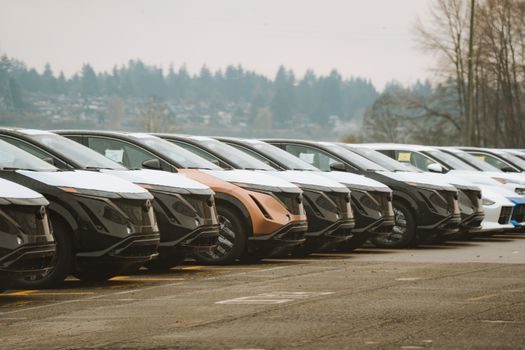
Axial-flux machines route magnetic flux parallel to the rotation axis (versus perpendicular in radial-flux), which gives a higher power and torque density in a flat, pancake form factor that suits in-wheel, transaxle and eVTOL packaging [S3]. In-wheel mounting removes the driveshaft and integrates the power electronics into the wheel corner, cutting part count and enabling per-wheel regenerative braking, at the cost of higher unsprung mass, NVH challenges and packaging constraints around the brake and suspension [S1].
Both technologies are described in 2026 trade literature as emerging rather than mainstream; IDTechEx covers them explicitly as forecast categories through 2036 alongside eVTOL and eCTOL aircraft motor demand [S3]. For industrial buyers, the practical 2026 reading is: specify axial-flux for prototype or low-volume multi-rotor applications where space is at a premium, and continue to source radial-flux PM machines for volume passenger-car and light-commercial platforms.
Selection criteria a 2026 spec engineer should put on the datasheet
Four decision criteria dominate a 2026 traction-motor datasheet: peak and continuous power (kW), peak and continuous torque (Nm), peak efficiency (%) at a declared operating point, and coolant interface (water-glycol jacket flow in L/min and inlet temperature). Beyond those, working groups should ask for the magnet material grade (NdFeB N42SH/N48SH vs ferrite), the lamination steel grade (typically 0.35 mm or 0.25 mm non-oriented silicon steel), the resolver or encoder protocol (typically servo-motor feedback standards) and the inverter bus voltage (400 V or 800 V architectures). [S1]
A short comparison set is useful when trialling suppliers: (1) radial-flux PM, the 2015-2024 default, above 75% car market share, NdFeB-dependent, highest power density [S3]; (2) wound-rotor externally excited synchronous, magnet-free, used by Renault and BMW, lower efficiency at part load but supply-chain de-risked [S3]; (3) induction, magnet-free, used by Audi, robust, slightly lower power density [S3]; (4) axial-flux PM, highest torque density, pancake form factor, low-volume in 2026 [S3]. The traction motor in many modern drivetrains sits in series with or replaces a hydraulic motor on auxiliary loads, so the duty cycle for any e-machine specification must be drawn jointly with the rest of the ac motor bill of materials.
Cost drivers, constraints and failure modes
The two material-cost levers that move a 2026 traction-motor quote the most are NdFeB magnet content (grams of rare earth per kW of peak power) and copper content (kg of hairpin or round-wire winding). IDTechEx notes that even within the PM camp, OEMs are reducing grams of rare earth per motor, and ferrite-magnet alternatives are an active development thread with mass-adoption challenges [S3]. The neodymium market itself is forecast to grow from USD 2.1 billion (2025) to USD 5.0 billion (2036) at 8.0% CAGR, so magnet buyers should expect tight, price-volatile upstream conditions through the middle of the decade [S4].
Failure modes that have shown up in 2024-2025 field data include: demagnetisation at sustained high rotor temperature (especially on N42SH-grade magnets driven above 180 degrees C), insulation breakdown in hairpin windings where impulse voltage spikes from 800 V inverters exceed partial-discharge inception, and coolant-jacket fouling in cold-plate designs that share the linear motor coolant loop with the inverter. In-wheel designs add unsprung-mass-induced wheel bearing and suspension wear, plus reduced brake-caliper packaging space, which is why in-wheel remains a sub-segment (USD 808 million in 2021 toward USD 4,395 million in 2026 at 40.3% CAGR) rather than the mainstream traction architecture [S1].
Standards, sourcing and what to track next
There is no single ISO or IEC standard that covers EV traction motors end-to-end; relevant type-test references include IEC 60034 rotating-machine standards and IEC 61851 / ISO 6469 for the EV drivetrain envelope, while magnet materials should be qualified to the OEM's own Dy-diffusion and grain-boundary-diffusion specs on top of the supplier data sheet. Sourcing categories spec engineers ask for in 2026 include the motor itself (radial-flux PM, wound-rotor, induction or axial-flux), the inverter, the gearbox, the resolver or encoder feedback device, the motor protector and the coolant pump — often bought as a matched kit rather than separate line items. [S3]
Two trackable signals for the next 12 months: first, the share of 800 V architectures in new BEV platforms, which raises switching frequency and reduces stator-current RMS, changing the optimal magnet grade; second, the share of rare-earth-free motors in the European OEM mix, which determines whether NdFeB price volatility continues to be a 2026 budget line or fades. Buyers who need a current production-car reference point can compare pricing structure against the V-Ribbed Belt Suppliers and Manufacturers: 2026 Sourcing Map for adjacent drivetrain accessories, and watch neodymium spot quotes for the 6-12 month magnet-content cost trend. For a long-horizon view, the eVTOL and eCTOL motor demand in the Wind Turbine Blade Upstream and Downstream Industry Map: 2026 Specs and Sourcing Signals reflects the same axial-flux and high-power-density supply chain that EV traction motors will pull from through 2036 [S3].