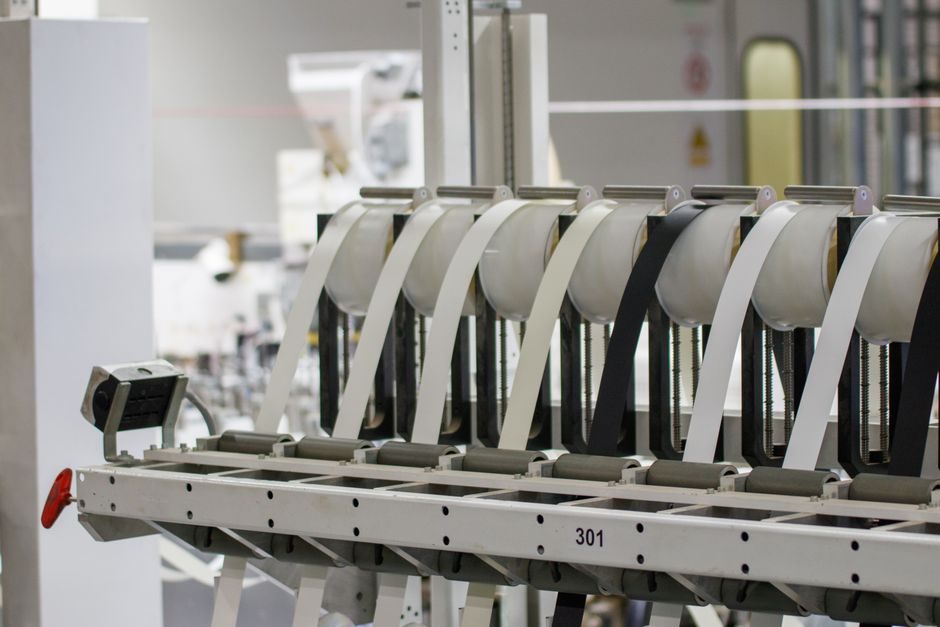
Flat belts in 2026 split cleanly into two industrial families: thin stainless/synthetic endless strips for robot and automation kinematics, and multi-ply rubber or PU flat belts for conveyor and light power transmission, with Chinese OEM channels listing both styles from roughly US$1 to US$200 per square metre at MOQ [S3][S4].
A buyer walking into a 2026 RFQ for a flat belt needs five numbers on the table before any supplier quote means anything: peak tensile load, belt speed, shaft centre distance, smallest pulley diameter, and the chemical/temperature envelope the belt will live in. The materials and constructions that win the order change completely when any one of those five moves.
Two flat-belt families, two spec languages
The "flat belt" search on industrial portals returns two largely non-overlapping product lines. Family one is the endless metal or synthetic strip running on crowned or flanged pulleys in robotics, packaging and light automation — DYMCO's "DO" series flat belt in stainless steel sits in this group, marketed specifically for robots and automation cells [S1]. Family two is the multi-ply fabric/rubber carcass used as a conveyor belt or as a low-power transmission element, where the standard Chinese export SKU is a T2-grade, NN/EP multi-ply fabric flat or chevron rubber belt [S3].
These two families are not interchangeable. The kinematics flat belt is sized by tensile strength per unit width, elongation at working load, and joint construction (endless woven, welded, or mechanically laced); a conveyor flat belt is sized by carcass ply count (EP/NN fabric), cover compound (T2 heat/abrasion-resistant rubber), and overall belt width in millimetres. Specifying one where the other is needed is a fast way to burn through a commissioning budget.
Load, speed and centre distance set the floor
For transmission flat belts, three engineering numbers gate the selection. First, the design power must be multiplied by a service factor (typically 1.0–1.5 for uniform load, climbing past 2.0 for shock-loaded or reversing drives) before belt selection; under-speccing the service factor is the most common root cause of premature stretching or joint failure. Second, belt speed dictates whether a flat belt is even appropriate — flat drives lose efficiency rapidly above roughly 20 m/s as centrifugal tension starts to consume the available tight-side capacity. [S1]
Third, the centre distance and smallest pulley diameter must satisfy the belt manufacturer's minimum-bend and minimum-arc-of-contact rules. For leather and composite flat belts, the typical floor is a pulley diameter at least 30–40× the belt thickness; for high-modulus PU or steel flat strips, that ratio drops, but the arc-of-contact rule (≥120° on the small pulley for friction drives) still applies. The flat-belt pulley market on Made-in-China exposes both cast iron and aluminium flat-belt pulleys at US$1–200 MOQ-level pricing, with diamond/poly-groove and square-bore options listed alongside plain flat-face crowns [S4].
Material and construction comparison
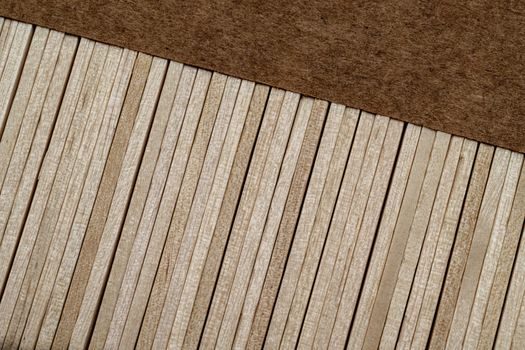
Four constructions cover almost every industrial flat-belt RFQ in 2026, and they line up against the same decision criteria in a way an engineer can audit. [S2]
Stainless steel endless strip — highest temperature ceiling (continuous service well above 200 °C with appropriate alloy), zero elongation, cleanroom-friendly, but heavy and noisy. Suits robot kinematic links, food/pharma conveyors with washdown, and high-heat ovens; spec example is the DYMCO DO stainless flat belt for robots and automation [S1]. Polyurethane flat belt (PU, often with steel or aramid tensile cords) — quiet, low-stretch, clean, available in food-grade colours; the default pick for packaging machinery and short-centre light power transmission.
Rubber multi-ply flat/carcass conveyor belt (NN/EP fabric + T2 cover rubber) — the workhorse for bulk material handling, quarry, aggregate and mining conveyors; sized by width (300–2200 mm typical), ply count (2–8), and cover thickness (3–12 mm top, 1.5–6 mm bottom). T2 cover grade is the heat/abrasion-resistant SKU shown on Chinese export listings [S3]. Leather or composite flat belt (chromed leather, rubber-impregnated fabric, polyamide composites) — the traditional low-power machine-drive belt, still common in older textile and woodworking machinery where quiet operation and high friction coefficient matter more than cleanliness.
Environment, standards and failure modes
Environment kills more flat belts than load does. Heat pushes the cover compound past its glass-transition or cure point; oil and solvent attack nitrile and natural rubber covers but leave PU and stainless largely intact; dust and abrasive fines wear through fabric covers within months on under-protected conveyors. For any food-contact flat belt, FDA/EC 1935-grade PU and 300-series stainless are the baseline; for ATEX-classified areas, antistatic compound to ISO 1813 and a documented grounding path on the drive are the usual spec lines, with the rule of thumb that belt resistance below roughly 10⁶ Ω across the running surface is needed for static dissipation. [S3]
The most common failure modes on a flat belt conveyor are cover wear, carcass delamination, edge fray, and joint pull-out; the most common on a transmission flat belt are stretch past the take-up limit, slip on the small pulley, and mid-span sag from under-sized tension. Specifying a belt tensioner with at least 1.5–2 % of centre distance as travel and using crowned pulleys on the flat drive is the cheap insurance against the second and third of those.
Sourcing and price benchmarks in 2026

Chinese B2B portals are the dominant discovery channel for both flat-belt families in 2026. Made-in-China's "flat belt price" index lists T2 heat/abrasion-resistant conveyor belts, NN/EP multi-ply fabric flat/chevron rubber belts, and specialty PU endless belts as the top returning SKUs, with manufacturer pricing on inquiry and MOQ typically starting at one square metre or one roll [S3]. The companion "flat belt pulley" index shows US$1–200 per piece as the working MOQ range for cast iron and aluminium pulleys, with bore, keyway and crown profile all negotiable [S4].
For a serious RFQ, three sourcing signals cut risk. First, ask for a sample loop with the actual splice or endless joint — never accept a quote for a transmission flat belt without seeing the joint geometry. Second, demand tensile-strength-per-ply, elongation-at-break, and cover-durometer data on the conveyor carcass, not just "T2 grade" as a marketing word. Third, align the belt and pulley purchase with the same supplier where possible so the crown profile, bore tolerance and balancing grade are guaranteed to match; mixing a cheap flat belt pulley with a premium belt is a common source of vibration and tracking issues.
Who should and should not specify a flat belt in 2026
Flat belts are the right call for clean, low-noise, low-maintenance drives and conveyors where slip is acceptable or actively desired (fuse belts, clutch drives, tension-controlled conveyors), and where centre distance is long relative to pulley diameter. They are the wrong call where synchronous timing matters — that is the job of a timing belt or a ribbed belt — and where shock loads, tight synchronous registration, or very high power density in a small envelope dominate the spec, which is the crossed-roller guide and servo-drive territory covered in current motion-control buying guides. [S4]
For automation cells where a flat belt runs over a linear guide carriage or drives a pick-and-place axis, pair the belt selection with the linear-guide supplier and the servo sizing on the same RFQ to avoid the classic mistake of over-dimensioning the belt and under-dimensioning the drive. For a packaging or labelling line build-out, the same logic drives you to look at a Servo Motor 2026 Price & Cost Guide and a Labeling Machine 2026 Price & Cost Guide in parallel, so the belt, the drive and the labelling head are quoted as one motion stack rather than three isolated line items.
Two signals to watch in the next sourcing cycle: Chinese flat-belt and pulley suppliers tightening T2 compound certifications against updated ISO 14890 conveyor-belt test methods, and more stainless/PU hybrid flat belts being offered with factory-formed endless loops in sub-500 mm lengths for collaborative-robot cable management and small-format conveyors.