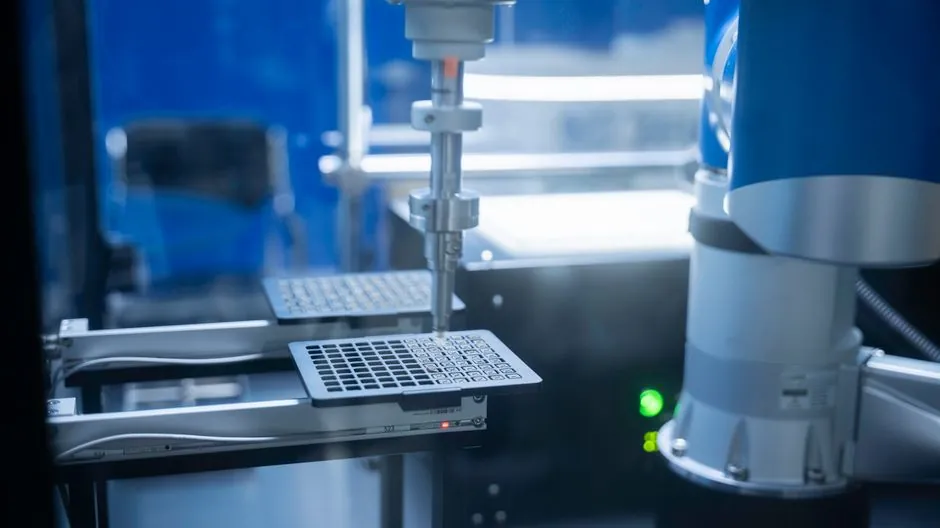
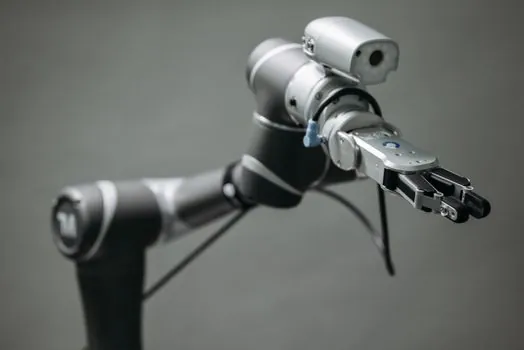
Torsion-rated high-flex shielded robot cable is the top tier of industrial flexible cable, designed for combined bending, twisting, and tensile load on 6-axis articulated arms, rotary tables, and energy chains carrying servo, hybrid, and bus signals [S1][S4].
Unlike fixed-installation or generic drag-chain cable, robot cable must survive 5 to 20+ million flex cycles, sustain ±180° of torsion per metre of cable length, and bend to a 4–7.5× outer-diameter radius while maintaining shield integrity against EMI/RFI on servo and data pairs [S1][S2][S4][S5].
Defining High-Flex Shielded Robot Cable: Where It Sits in the Cable Hierarchy
Four cable families are routinely confused in robotics procurement: flexible cable, drag-chain (towline) cable, high-flex cable, and robot (torsion-rated) cable, and only the last two are built for the multi-axis motion a robotic arm actually performs [S4].
Robot cable sits at the top of that hierarchy because it must withstand three simultaneous mechanical loads: continuous flexing at every joint, torsion from the rotating axes, and tensile load from the cable's own weight and acceleration. A 6-axis articulated robot does not just bend; it rotates continuously to orient the tool, which twists the cable in both directions, and without a torsion-resistant structure the internal copper strands get squeezed asymmetrically and fail [S5]. Per igus, chainflex robot cables are rated for torsional stresses of ±180° per 1 m cable length, with shielding implemented as torsion-resistant, tinned copper rope rather than conventional braided copper, because braids fatigue and lose coverage under repeated twisting [S1].
Drag-chain cable is engineered for linear, single-plane motion in cable carriers (5–20+ million cycles, Class 6 stranding, low-friction jacket layers) and will fail prematurely if routed into a torsion loop, while a standard flexible cable with multi-stranded conductors and soft PVC/PUR insulation is only intended for occasional or moderate movement and typically cannot survive continuous high-frequency flexing [S4].
Construction: Stranding, Insulation, Shielding, Jacket
Fine or superfine bare copper strands to VDE-0295 Class 5 or Class 6 (IEC 60228), with rope-lay or high-strand-count concentric stranding, form the conductor baseline; higher strand counts directly improve both flexibility and flex life, and aramid strength members (Kevlar) are added to absorb pulling and torsional load [S2][S3].
Insulation is typically a special-formulation TPE rather than PVC because PVC does not recover elastically after millions of compression cycles, while the jacket is almost always black polyurethane (PUR), chosen for combined resistance to oils, microbes, hydrolysis, UV, solvents, acids, hydraulic fluids, and alkalis, and for a non-stick surface that prevents adhesion between adjacent cables in a packed energy chain [S1][S2]. Northwire notes that aramid can be stranded in multiple configurations to tune tensile strength against flexibility, and that silver- or nickel-plated copper is preferred over bare copper when the application temperature exceeds 150°C [S3].
Shielding distinguishes a "high-flex cable" from a "high-flex shielded robot cable": a recent high-flex automation cable release supports 1 Gbps data transmission up to 40 m using finely stranded copper conductors with an "Ultra-Shield" EMI/RFI construction, and igus chainflex robot cables include shielded variants (servo, measuring system, bus) designed to withstand millions of bending and torsional cycles [S1][S8]. For reference, an ROBOFLEX 790-series 3-core 2 AWG (35 mm²) part weighs 1046 lb/Mft with a 28.8 mm nominal OD, while a 24 AWG 7-core version is just 6.2 mm OD and 11 lb/MFt, demonstrating the same cable family spans milliamp instrumentation to heavy power [S2].
Electrical and Mechanical Ratings: Numbers to Verify
Working voltage for the ROBOFLEX 790 family is 300/500 V (24 & 22 AWG variants are derated to 350 V), test voltage is 1500/3000 V, flexing bending radius is 7.5× OD, flexing temperature range is -40°C to +80°C, static range -50°C to +80°C, insulation resistance is greater than 20 MΩ·km, and the jacket is flame-retardant to IEC 60332.1-2, with approvals to VDE-0245/0250/0281/0282, CE Low Voltage Directive 2014/35/EU, and RoHS [S2].
For comparison, an NA6UCRSB-series 600 V high-flex shielded mobile power cable carries UL/CE recognition plus CSA AWM compliance for North American robotic skids [S9]. igus' chainflex test lab runs 2 billion test cycles per year across 2,750 m² of floor space, validating torsion, bending, and tensile claims against published cycle counts rather than theoretical extrapolations, and the lab data backs the ≥5–10 million cycle baseline for robot cable versus "a few thousand cycles" for a standard industrial cable of the same cross-section [S1][S5].
Selection Criteria: When Robot Cable Is and Is Not the Right Call
Robot cable is the correct call when the route includes combined torsion and bending on a 6-axis arm, a rotary index table, a welding robot, or a 3D pick-and-place gantry, or when the cable is dressed through an energy chain that itself reverses direction; it is the wrong call for a single-plane linear cable carrier where a high-flex drag-chain cable delivers the same cycle life at lower cost and stiffness [S1][S2][S4][S5].
The three decisions that drive part selection are: (1) conductor class (Class 5 for moderate torsion, Class 6 for long travel or high acceleration), (2) shielding geometry (tinned-copper rope braid for servo and data, aluminium/PET foil plus braid for the highest EMC integrity), and (3) jacket chemistry (PUR for general factory oils and coolants, TPE or specialty compounds for high-temperature or cleanroom). Helukabel's three mechanical challenges, continuous flexing, torsion, and tensile load, map directly to those three decisions, and the consequences of a wrong pick are predictable: strand breaks, signal loss, mid-cycle trip, and the production downtime that costs more than the cable saving [S5].
Comparison: Robot Cable vs Drag-Chain vs Flexible vs Fixed Cable
On minimum bending radius, fixed cable rates 10–15× OD, drag-chain and high-flex cable rate roughly 6–10× OD, and torsion-rated robot cable drops to 4–7.5× OD, which is the single biggest reason robot cable is mandated in articulated arms [S5]. On flex life, fixed cable is "not designed for repeated bending," generic flexible cable handles occasional movement, drag-chain cable is rated 5–20+ million linear cycles, and robot cable is rated 5–10+ million cycles under combined flex + torsion [S1][S4][S5]. On torsion capability, every alternative is "not supported" while robot cable sustains ±180°/m continuous, and on conductor stranding robot cable uses fine Class 5+ (rope-lay or high-count concentric) versus the large, few-strand conductors of fixed cable [S1][S2][S5].
A practical decision rule: if the routing diagram contains a twist, robot cable; if it contains only a single-plane bend loop in a cable carrier, high-flex drag-chain cable; if it contains neither, flexible cable will do, and fixed cable is correct only for the static trunk between the cabinet and the energy-chain entry point [S4][S5]. For a deeper dive into the cable vs. cable-carrier mechanical interface and related cable tray routing, the layout choices upstream of the flex section drive the bend-radius budget the robot cable has to live within.
What Failed Designs Look Like and How to Avoid Them
Three failure modes dominate field returns: shield fatigue from a standard braid being used in a torsion loop (signal noise and lost servo feedback), jacket abrasion from PUR-on-PUR adhesion in a packed chain (use a non-stick jacket or spacer), and copper strand fracture from underspec'd stranding (rope-lay or high-count concentric, not concentric alone) [S1][S2][S3][S4].
Northwire's design checklist reinforces the same points: identify the robot type and motion profile, quantify the environment (temperature, fluids, concentration, frequency of exposure), separate "needs" from "nice-to-haves," and decide upfront whether flexibility (suppleness) or flex life (cycle count) is the binding constraint, because the two trade off against cost and OD [S3]. For hybrid power+data constructions, note that shielded cable selection must hold the rope-braid geometry across the full bend, otherwise the data pair's return path opens up exactly where the cable is being twisted, and that is where gigabit servo feedback gets corrupted first [S1][S8]. For gland and strain-relief sizing at the cabinet entry, the cable gland selection has to match the robot cable's actual OD and the chain's radius, otherwise the gland becomes the failure point the cable was specified to prevent.
Standards, Compliance, and Trackable 2026 Signals
Compliance paths to verify on the datasheet, not in the marketing copy, include: CE Low Voltage Directive 2014/35/EU, RoHS, VDE-0245/0250/0281/0282 for the ROBOFLEX 790 family, IEC 60332.1-2 for flame retardance, UL/CE plus CSA AWM for the NA6UCRSB series, and IEC 60228 / VDE-0295 Class 5 or 6 for the stranding classification [S2][S9]. A reference comparison of cable constructions and their typical cable voltage classes is useful when matching a robot cable to a specific servo drive or fieldbus segment.
Trackable signals over the next procurement cycle: (1) wider release of 1 Gbps / 40 m hybrid robot data cables with verified rope-braid shielding, of the type covered in the August 2026 automation-cable launch, replacing legacy feedback pairs on new 6-axis cells [S8]; (2) increased PUR/TPE jacket options rated for cleanroom and food-grade zones as cell builders standardise on fewer SKUs; and (3) more published torsion test data from independent labs, since the published 5–10 million cycle claim is currently OEM-specific and varies by cable diameter, acceleration, and bend radius [S1][S5][S8]. For users comparing the high-voltage tester routine needed after field installation, the 1500/3000 V test-voltage rating of the ROBOFLEX family is a useful proxy for the on-reel hipot level a 300/500 V robot cable must survive before energising [S2].
This topic is covered further in ISO 16331-1: Favorable vs Unfavorable Range Conditions for Laser Distance Meters.