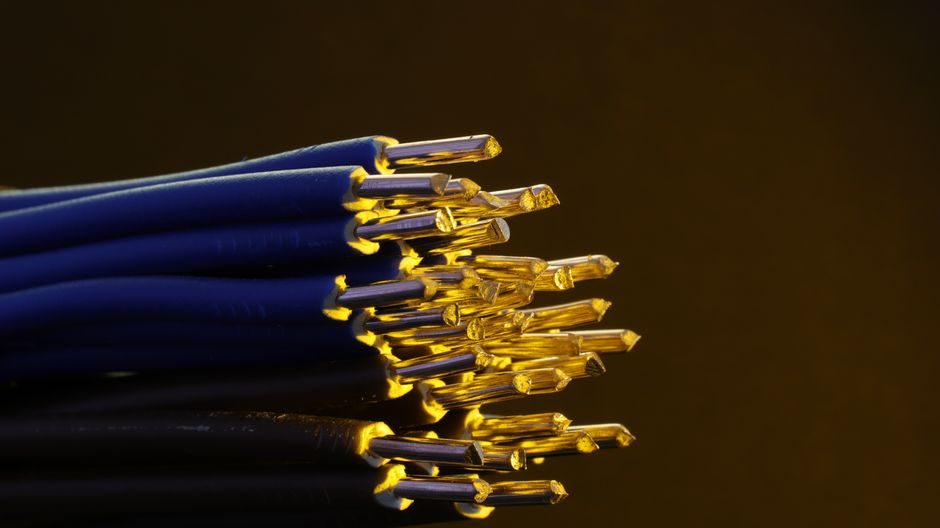
An industrial Ethernet switch is a network switch hardened for cabinet, track, substation and roadside environments — operating temperature typically -40 °C to +75 °C, conformal-coated PCBs, DIN-rail or rack mounting, and certifications that commercial-office switches do not carry [S1][S6].
Selection in 2026 reduces to seven hard gates: port count and media type (RJ45, SFP, SFP+, M12, SC single-mode/multi-mode), managed versus unmanaged architecture, layer 2 versus layer 3 routing, PoE/PoE+ budget per port, environmental rating, mounting form, and application-specific certification (EN 50155 rail, IEC 61850-3 substation, ATEX Zone 2) [S1][S2][S4][S6].
Port Architecture: RJ45, SFP, SFP+, and M12 in Real Cabinets
Port count is the first line on a bill of materials. The DirectIndustry industrial-Ethernet-switch index lists 6-port, 24-port, and rack-mount builds as the most-searched form factors, with combined RJ45 + SFP/SFP+ uplinks dominating new designs [S1]. The Phoenix Contact FL SWITCH 3008 (P/N 2891031) ships eight RJ45 ports at 10/100 Mbps with a -10 °C to +60 °C operating window — typical of entry-level managed DIN-rail units still being specced for indoor cabinets [S6].
For fibre-heavy sites, SFP and SFP+ slots support single-mode and multi-mode optics, with 1 GbE on SFP and 10 GbE on SFP+ becoming the de-facto split between access-layer and aggregation-layer switches [S1]. On rail vehicles and mobile equipment, M12-coded D-coded or X-coded connectors replace RJ45 to survive vibration; Konten Networks lists M12 switches explicitly under its EN 50155 rail family [S2]. Gigabit throughput (10/100/1000Base-T) is now baseline on managed product lines from Phoenix Contact, Konten, and the SYSMATE TOP-TEK series [S2][S4][S6].
Managed vs Unmanaged, L2 vs L3: When to Spend the Extra
Unmanaged switches are passive fast-Ethernet or gigabit repeaters — no Web UI, no redundancy protocols, lowest unit cost. SYSMATE's EMC Level 4 non-network-management guide type is the typical Chinese-OEM unmanaged SKU for cabinet fan-out where the upstream ring switch already handles determinism [S4]. They are fit-and-forget but cannot participate in MRP, MRP, or ring recovery.
Managed switches add VLAN, IGMP snooping, port security, SNMP, and redundancy protocols. Layer 3 adds inter-VLAN routing and limited static/dynamic routing — required for plants running PROFINET, EtherNet/IP, or Modbus TCP across multiple VLANs [S2]. The DirectIndustry category counts 6 layer-2 product lines against 2 layer-3 product lines among indexed industrial manufacturers, consistent with field reality: L3 lives at the control-room aggregation tier, L2 lives at the cell/cabinet tier [S1]. A SCADA software 2026 buying guide downstream will look for SNMPv3, IEEE 802.1X, and NTP support — all of which force the managed decision.
PoE Budget: Powering Cameras, APs, and Field Phones

PoE switches feed powered devices over the data cable — industrial cameras, wireless access points, VoIP phones, and increasingly, industrial sensors and small HMI panels. PoE+ (IEEE 802.3at) delivers up to 30 W per port; PoE++ (IEEE 802.3bt Type 3/4) reaches 60-90 W per port for PTZ cameras and thin clients. Konten Networks explicitly markets a Layer 3 PoE managed-switch family, signalling that PoE plus routing is now a standard catalog tier rather than a custom build [S2].
Spec the PoE budget at the chassis level, not the port level: a 24-port PoE+ switch at full load draws ~720 W plus switch overhead, so upstream DIN-rail power supplies and cabinet thermal budgets must be sized to match. Sizing a single port in isolation is a common procurement error that surfaces as browned-out APs during cold-cabinet startup.
Environmental Hardening: Temperature, EMC, Vibration, Conformal Coat
Industrial Ethernet switches are defined by what they survive. Operating-temperature windows split into three commercial bands: -10 °C to +60 °C (commercial/light-industrial, e.g. FL SWITCH 3008 [S6]), -40 °C to +75 °C (full industrial, the de-facto 2026 default for outdoor cabinets and substations), and -40 °C to +85 °C (rail and roadside). EMC immunity is rated per IEC 61000-4-2/3/4/5/6; SYSMATE's EMC Level 4 (industry-grade) claim targets the upper tier where variable-frequency drives and welding inverters share the cabinet [S4].
Mechanical hardening covers IEC 60068-2-6 vibration, IEC 60068-2-27 shock, and conformal coating (acrylic or urethane) for condensing humidity and corrosive atmospheres such as wastewater and offshore. IP30 is the minimum cabinet-internal rating; IP67 switches exist for in-field mounting but trade port density for sealing. Buyers in chemical, marine, and mining sites should treat conformal coat as a line item, not an option.
Mounting Form Factor: DIN-Rail, Rack, Panel, Embedded
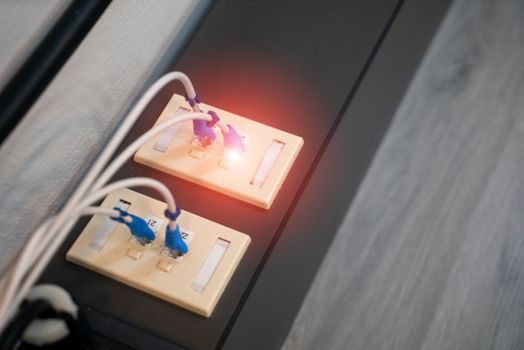
DIN-rail (35 mm top-hat) is the dominant control-cabinet form factor; rack-mount (1U/19 in) lives in server rooms and aggregation closets; panel-mount is rare and usually reserved for human-machine interface kiosks. The DirectIndustry index shows embedded and rack-mount as the two non-DIN-rail variants on offer, with embedded switches typically integrating into a customer's own backplane for OEM machinery [S1].
For OEM machine builders, an embedded switch module saves panel space and shifts the EMC boundary to the OEM integrator. For end-user plant projects, DIN-rail remains the lowest-friction choice because it shares the same mounting hardware as terminal blocks, power supplies, industrial buzzers, and circuit breakers. Comparing the industrial switch ecosystem on mounting and certifications usually narrows the candidate list from 30 SKUs to 4-5 before price is even considered.
Application Certifications: EN 50155, IEC 61850-3, ATEX, DNV
Application-class certification is where industrial switches diverge hardest from IT switches. EN 50155 governs rail-rolling-stock electronics — temperature, humidity, shock, vibration, and supply-voltage transients on board trains; M12 connectors are essentially mandatory under this rule [S2]. IEC 61850-3 covers substation communication networks (including the IEEE 1613 sub-set), required for switchgear integration in transmission and distribution projects.
ATEX/IECEx Zone 2 certification is required when a switch sits in a classified area adjacent to flammable atmospheres — petrochemical, paint lines, grain handling. DNV/GL type approval is the maritime equivalent for shipboard and offshore-platform builds. None of these certifications are retrofittable in the field: they must be ordered on the SKU, validated by a part-number suffix, and reflected on the nameplate. Procurement teams that buy the wrong certification end up with stranded inventory and a re-spec cycle.
Redundancy and Ring Recovery: MRP, PRP, HSR, ERPS

Deterministic ring recovery is the core reason managed industrial switches exist. Media Redundancy Protocol (MRP, IEC 62439-2) provides sub-500 ms failover on ring topologies typical of PROFINET cells. Parallel Redundancy Protocol (PRP) and High-availability Seamless Redundancy (HSR, both IEC 62439-3) achieve zero-loss failover for substations and process skids where a 500 ms blip would trip the line. ERPS (G.8032) is the carrier-Ethernet equivalent for telecom-grade rings [S1][S2].
The DirectIndustry index flags "redundant" as a top-three requested feature across indexed industrial switch lines, and "convergence" (sub-50 ms recovery) as a distinct sub-feature on hardened managed SKUs [S1]. Buyers running EtherNet/IP DLR (Device Level Ring) or PROFINET MRP should require the protocol name printed in the datasheet, not a generic "ring redundancy" claim — the protocol layer and the recovery time are both binding spec lines.
Decision Matrix: 4 Switch Families Against 5 Selection Criteria
Four switch families cover almost every plant-floor 2026 use case: unmanaged fast-Ethernet, managed L2 DIN-rail, managed L3 PoE aggregation, and EN 50155 rail/M12. Unmanaged fits low-cost fan-out with no determinism requirement and limited PoE need. Managed L2 fits the cell tier with VLAN, ring recovery, and SNMP. Managed L3 PoE fits the control-room tier with inter-VLAN routing plus powered-device aggregation. EN 50155 M12 fits rolling stock, mining, and any high-vibration cabinet. [S1]
On cost, unmanaged is the lowest and EN 50155 the highest. On port density, rack-mount L3 wins. On PoE budget, L3 PoE chassis win. On environmental survivability, EN 50155 and -40 °C to +75 °C industrial SKUs win. On configuration depth, managed L3 wins. The matrix collapses 30 catalog SKUs down to 1-2 candidates per application once the columns are weighted. Procurement shortlists that treat cost first and certification last almost always re-spec inside 12 months — reverse the order.
What to Verify on the Datasheet Before Issuing a PO
Four datasheet lines catch most field failures: the exact operating-temperature range (not "extended"), the PoE power budget at the chassis level (not per-port maximum), the redundancy protocol name and recovery time (not "ring support"), and the certification file numbers (EN 50155, IEC 61850-3, ATEX) with expiry dates. A switch that quotes -40 °C to +75 °C "storage" only is not an industrial-temperature switch. [S2]
Trackable signals for 2026 follow-on work: 25 GbE uplinks on aggregation-tier industrial switches (Cisco IE-class and Hirschmann RSP lines already shipping), TSN (IEEE 802.1Qbv/Qbu) profiles converging with PROFINET v2.4 and EtherNet/IP CIP Sync, and a slow shift from RJ45 to M12 X-coded 10 GbE on rail and mining sites [S1][S2].