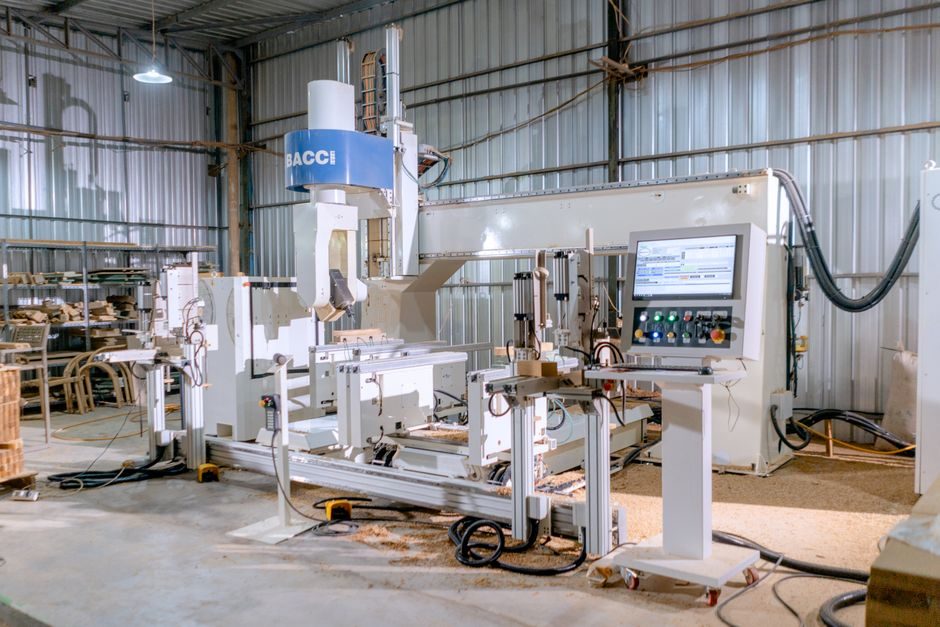
An industrial robot is a multi-axis programmable manipulator — most commonly a six-revolute-joint articulated arm — built from three physical subassemblies: the mechanical body, the electrical cabinet, and the pipeline pack (the cable/hose loom that ties the two together) [S6]. Modern units pair those subassemblies with smart actuators that integrate the servo motor, controller, sensors, and fieldbus communication into a single module, so the same module can be reconfigured into a different kinematic chain without rewiring the cabinet [S2].
At the workcell level the body, cabinet, and pipeline pack are the three subassemblies that drive both throughput and idle energy, and they are the exact three cost blocks any 2026 robot-production flow-shop scheduler optimizes against [S6]. Production software stacks that originally lived in CNC — graphical simulation, kinematic modelling, motion planning, and NC code generation — are now standard off-line programming (OLP) toolchain for both 5-axis manufacturing cells and 6-axis welding cells [S1]. Buyers in 2026 should treat a robot purchase as the sum of those three physical blocks plus the OLP toolchain that drives them, not as a single black-box SKU.
Body Subassembly: Links, Joints, and the 6-DOF Reference Architecture
The body is the kinematic chain — base, rotating column, shoulder, upper arm, forearm, wrist, and end-effector flange — typically arranged as six revolute joints that deliver six degrees of freedom (6-DOF) and the ±0.02–0.1 mm repeatability that defines a modern industrial arm [S1][S4]. Off-line programming literature treats a five-revolute-joint chain as the minimum useful architecture for general manufacturing cells, while six-revolute chains remain the reference build for welding because the extra wrist axis is what lets a torch reach a seam at a constant travel angle [S1].
Throughput on a production line is set by cycle time — the time the arm takes to pick, move, place, and reset — and modern arms routinely beat manual cells on cycle time while removing operators from dangerous zones such as welding, stamping, and paint [S4]. Where the body alone cannot raise throughput further, the gain now comes from smart-actuator retrofits: replacing an integrated servo pack with a module that bundles motor, controller, sensors, and communication lets the same arm be reconfigured for a new fixture or a new product family without a full cabinet swap [S2].
Electrical Cabinet: Drive Stack, Controller, and Fieldbus
The electrical cabinet houses the servo drives, the robot controller (motion planner + safety PLC), the I/O, and the fieldbus gateway. In a smart-actuator build that function is distributed — each joint module carries its own drive, sensor, and comms electronics — so the cabinet shrinks to a power distribution and safety node rather than a six-axis drive stack [S2]. Either way, the cabinet is the second of the three manufacturing subassemblies that a 2026 energy-efficient flow-shop model breaks the bill of materials against, and it is the largest single contributor to idle (non-cutting) losses between cycles [S6].
Servicing the cabinet is the dominant field-cost line: a typical service contract covers fault diagnosis on the controller, drive replacement, encoder calibration, and firmware updates across both ABB and KUKA fleets from a single provider [S3]. For OEM selection in 2026 the practical filter is whether the cabinet supports the fieldbus the plant already runs — PROFINET, EtherNet/IP, EtherCAT, or CC-Link IE — because swapping an entire cabinet to chase a protocol is more expensive than picking the right arm in the first place [S3].
Pipeline Pack: Cables, Hoses, and the Hidden Failure Mode
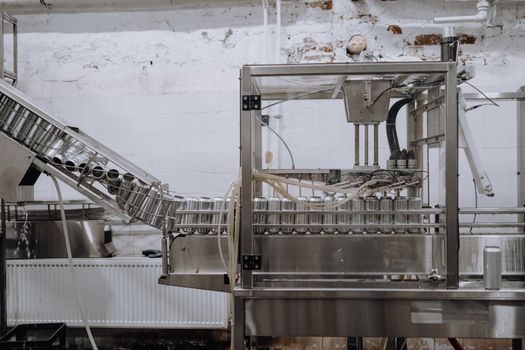
The pipeline pack is the dressed loom of motor power cables, encoder cables, and pneumatic hoses that runs from the cabinet, through the column, along the upper arm, and out to the wrist. It is the third explicit subassembly in the 2026 flow-shop decomposition and the one most often under-specified at purchase, because it is usually bundled as an option rather than a line item [S6].
The practical spec gates on a pipeline pack are: (1) bend radius rating versus the arm's actual joint travel — most field failures are fatigue cracks at the dress pack, not motor burn-out; (2) ingress rating of the cable connectors (IP67 minimum for any cell with coolant or weld spatter); and (3) the mean time between failures quoted for a dressed, not bare, axis [S3]. Buyers who skip this gate tend to discover the real cost of the arm in year two, when the dress pack is the first thing to fail on a high-duty welding or machining-tending cell.
Off-Line Programming and the 2026 Digital Thread
Off-line programming (OLP) is the software half of a modern robot cell: a graphical simulator of the arm and workcell, a kinematic model of the robot, a motion planner, and an NC-code generator that posts the resulting program directly to the controller [S1]. The same OLP pipeline that the 2004-era reference paper applied to a 5-axis manufacturing cell and a 6-axis welding cell is now a baseline capability on every Tier-1 OEM controller, and the differentiation in 2026 is in the post-processors and the digital-twin fidelity, not in the OLP concept itself [S1].
Two adjacent shifts matter for process engineers. First, OLP is the prerequisite for any green-production claim, because it is the only practical way to simulate cycle time and idle energy before committing to a fixture layout [S6]. Second, energy-efficient scheduling — explicit modelling of both active and idle energy across the body, cabinet, and pipeline pack — is now a peer-reviewed scheduling discipline rather than a marketing slide, and it is the lever that lets a 2026 cell cut kWh per part without buying new hardware [S6].
Selection Criteria: Payload, Reach, Repeatability, and Service
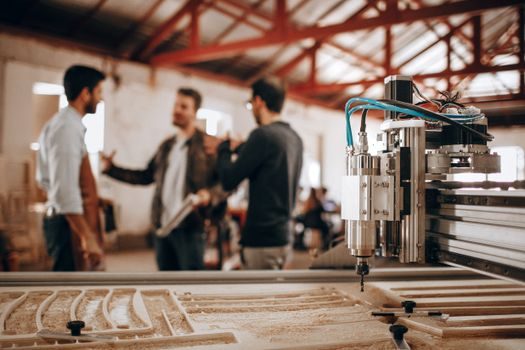
A spec-first comparison of the four criteria that actually drive an arm choice in 2026 lines up as follows. <strong>Payload</strong> ranges from ~3 kg (benchtop assembly) to 800+ kg (heavy-payload machine tending and palletizing), and the rule of thumb is to derate the published payload by 25–30 % once a wrist tool and dress pack are fitted. <strong>Reach</strong> is set by the arm's longest link, typically 0.5 m for small parts to 3.2 m for body-in-white welding. <strong>Repeatability</strong> sits in the ±0.02–0.1 mm band for the articulated arms that dominate the 2026 fleet, and any quoted number outside that band is either a specialty unit or a typo [S1][S4]. <strong>Service</strong> — fault diagnosis, spare parts, controller firmware support, and cross-OEM coverage — is the criterion that decides lifecycle cost and is the one most buyers negotiate last [S3].
The who-it-is-FOR list is clear: high-mix welding cells, machine tending, palletizing, painting, and any process where the cycle time is human-limited or the hazard is real. The who-it-is-NOT-FOR list is just as clear: low-volume, high-variance assembly with frequent retooling still beats a robot on unit economics, and ultra-high-precision tasks below ±0.02 mm are the domain of machine tools, not articulated arms [S4].
Failure Modes, Standards, and the Sourcing Trail
The three field failure modes that account for the majority of unplanned downtime on a 2026 articulated arm are, in order: (1) dress-pack fatigue at the dress pack bend (cable or hose); (2) encoder or resolver faults traced to contamination of the joint connector; and (3) drive or controller faults usually tied to cabinet cooling, not the drives themselves [S3]. All three are addressable at purchase time with the right spec language, which is why a service contract is best read as a list of excluded failure modes before it is read as a price.
Standards sourcing for industrial robot cells in 2026 follows the functional split: robot safety is governed by ISO 10218-1/-2, cell-level risk assessment by ISO/TS 15066, and functional safety on the controller by IEC 61508 / IEC 62061, with CE marking under the Machinery Directive 2006/42/EC for the European market. Buyers in 2026 should verify the supplier's declarations against those four documents before signing, not after, because retrofitting safety after a cell is built is roughly an order of magnitude more expensive than specifying it at order [S3][S4]. Industrial robot application is also shown to promote green technology innovation in the manufacturing sector, mediated by green R&D investment and moderated by environmental regulation — a signal that the 2026 procurement case is increasingly ESG-linked, not just throughput-linked [S5].
Adjacent Process Map: Where Robot Cells Sit in a 2026 Plant
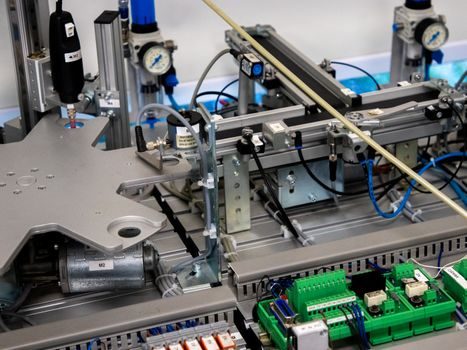
A robot cell is rarely the end of a 2026 production line; it is one node in a connected flow. The same OLP and digital-twin stack that drives the arm also drives the upstream coding machine or vacuum packer on a packaged-goods line, the cell-to-pack battery assembly on an EV line, and the semiconductor back-end test handler on a fab output line. The shared discipline is the same: a body subassembly, a control cabinet, a cabling pack, and an OLP toolchain that lets the cell be re-optimized without tearing it down. [S1]
Trackable signals for the next planning cycle: (1) the share of new 2026 robot orders that ship with a smart-actuator module rather than a centralized cabinet — driven by reconfigurability demand on high-mix lines [S2]; and (2) the share of new cells whose quoted kWh/part figure is backed by an explicit active-plus-idle energy model rather than a nameplate number [S6]. Both are public, both are searchable on OEM datasheets and conference papers, and both tell a buyer whether a 2026 robot quotation is a hardware line item or a flow-shop tool.
For component-level specifications, see additive manufacturing material, multifunction process calibrator, and v process line.