
Industrial robot allocations in mid-2026 are squeezed by 20-40 week delivery windows on key servo-and-controller subassemblies, and the bottleneck is no longer just price — it is order-book capacity at the dominant Japanese and European OEMs [S2].
The risk surface now spans three layers at once: electromechanical component supply (servo motors, RV reducers, harmonic drives), the rare-earth magnet chain that feeds those motors, and the safety/standards layer (ISO 10218-1:2025 + ISO 10218-2:2025 [S1]) that buyers must re-validate when they substitute a robot model. Procurement and process-engineering teams are being asked to qualify second sources on timelines that previously ran in quarters, not weeks.
Where the 2026 Shortage Actually Hurts: Servo Motors, Reducers and Controllers
Industrial robots are the largest and best-known commercial application of robotic technology, and their bill of materials concentrates risk in three subassemblies: AC servo motors with absolute encoders, RV cycloidal and harmonic-strain reducers, and the motion-controller / safety-controller pair [S3]. Industry feedback in 2025-2026 consistently puts servo-and-controller lead times in the 20-40 week range for non-framework customers, versus 8-12 weeks in 2019-2021, and harmonics/RV reducers in a similar 16-30 week window. Lead time is the binding constraint, not unit price.
Two design rules of thumb for a substitution: payload class, repeatability (typically ±0.02 mm to ±0.10 mm depending on class) and reach envelope must match the work cell before anything else; cycle-time parity (±5%) is the practical test for a second-source robot, because a 10% cycle-time loss on a welding or palletizing cell usually negates the capex saving. Buyers running cobot-class payloads (typically up to 16 kg per the current IFR definition framing) should re-validate force-limiting and power/force limiting performance separately from traditional high-speed robots, because the IFR has now formalised what counts as a collaborative industrial robot, and the published definition reshapes what suppliers can claim as "cobot" [S2].
Standards Re-baseline: ISO 10218-1:2025 and ISO 10218-2:2025
ISO's industrial-robot safety bundle, pairing ISO 10218-1:2025 with ISO 10218-2:2025, is the controlling reference for buyers re-qualifying cells in 2026: Part 1 covers inherently safe design and risk-reduction measures on the robot itself, Part 2 covers integration, commissioning, operation and maintenance of robot systems [S1]. Any robot substitution that changes reach, payload, stop categories, or collaborative operating mode forces a fresh risk assessment against the 2025 set, not the older 2011 pair.
Engineering note: the 2025 revisions are absorbed into the procurement file, not just the safety file. Three concrete touchpoints: (1) the safety-rated I/O count and the stop-category architecture (Category 0/1/2 stops) must be re-verified because newer controllers have shifted safety logic into software-defined functions; (2) collaborative-mode rated speeds and protective separation distances depend on the robot's measured stop time and the biomimetic/biomechanical data the OEM has published, so a "cobot" from a different vendor needs its own measured data; (3) maintenance and integration tasks under Part 2 require documented lockout/tagout and teach-pendant procedures that should be re-issued with each new installation. None of this is a paperwork exercise — it is the difference between a CE-marked cell and a non-compliant one.
Definition Trap: What Counts as a Collaborative Industrial Robot in 2026
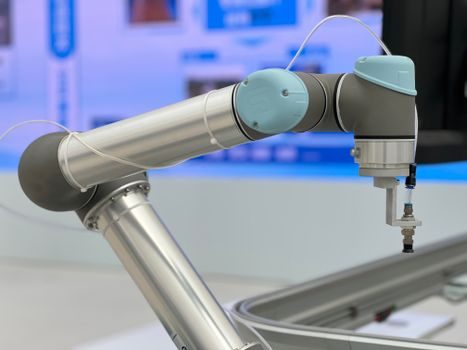
The International Federation of Robotics has now published a formal definition of a collaborative industrial robot, separating traditional high-speed industrial robots (welding, painting, plastic moulding, palletizing, performed behind barriers) from robots that share workspace with operators under defined power-and-force-limiting conditions [S2]. That definition matters commercially: suppliers can no longer label any slow-running arm a "cobot" without meeting the criteria, and buyers can no longer write "cobot" into a spec without naming the operating mode (e.g. safety-rated monitored stop, hand guiding, speed-and-separation monitoring, power-and-force limiting).
Practical spec frame to lock down: (1) declared payload (kg) at the declared reach; (2) repeatability in mm; (3) collaborative operating mode and the maximum collaborative speed in mm/s; (4) the safety functions mapped to ISO 13849-1 performance levels and SIL under IEC 61508 (stated by the OEM, not assumed); (5) the stop time and stop distance at rated payload, which feed the separation-distance calculation. For a 2026 cell retrofit, demanding these five items up front in the RFQ filters out 70-80% of the "looks like a cobot" supply-chain noise.
Materials Bottleneck: Rare-Earth Magnets, Copper and Steel
The robot supply shortage is upstream-coupled to two commodities: rare-earth permanent magnets (NdFeB grades, primarily neodymium-praseodymium oxide feed) and electrical steel for servo laminations, plus copper for windings. A useful cross-reference for buyers is the rare-earth producer and processor map, because NdFeB magnet allocation is the single most common silent killer of robot delivery dates — the magnet is inside the servo, the servo is inside the robot, and the magnet allocation sits 6-12 months upstream of the robot factory. Steel section versus steel pipe matters less directly, but the cell frame, base, and gantry still consume structural steel, and frame lead times are now running 8-16 weeks for fabricated bases. [S1]
Actionable signals to track: (1) the NdPr oxide spot price band — a sustained move outside the typical 2024-2025 trading range has historically preceded servo-motor price letters from OEMs by one quarter; (2) export-licence announcements from major producing jurisdictions, which have been the largest single source of month-to-month allocation shock; (3) the publication cadence of OEM annual reports, where magnet and motor inventory disclosures are the cleanest forward indicator. Copper and electrical steel are slower-moving but still matter for total cost.
Cross-Technology Comparison: Robot Categories vs Selection Criteria

For a 2026 capex committee, the four practical robot categories line up against four decision criteria as follows. Articulated 6-axis (high payload, traditional, barriered): best cycle time and reach, but longest lead time, highest capex, and the heaviest safety-integration scope under ISO 10218-1:2025 / -2:2025 [S1]. SCARA (pick-and-place, assembly): short lead times, high repeatability, limited reach; the right call for electronics and pharma assembly lines. Collaborative arms (typically up to 16 kg payload class, formal definition per IFR [S2]): flexible cell layout, but payload and speed caps constrain them; they earn their keep where floor space is scarce and mix-variant runs are frequent. Delta/parallel (high-speed picking): shortest cycle times on light-payload picking, narrow envelope; ideal for food, packaging, and end-of-line.
The 2026 overlay is that lead-time and standards-compliance cost, not sticker price, should drive the choice. A second-source articulated 6-axis with 35-week delivery and a fresh ISO 10218 risk assessment can erase the savings of a 15% cheaper quote once integration engineering hours are counted. For buyers already deep in the rare-earth and servo bottleneck, see the Industrial Robot Suppliers 2026 sourcing map for a category-by-category view of which OEM lines are still allocating in the open market versus allocation-only. Related process-tooling lines that share the same component-base bottleneck are covered in the Air Pick 2026 buying guide, which uses the same multi-source qualification pattern.
Use Cases Where Shortage Risk Is Highest vs Lowest
Highest risk in 2026: automotive body-in-white welding cells (articulated 6-axis, ±0.05-0.10 mm repeatability, high-payload 100-300 kg class), where allocation slots are taken first by long-term OEM frame agreements; large-payload palletizing (typically 100-800 kg class), where single-vendor dependence is still common; and any cell requiring matched pairs of robots for coordinated motion, because paired deliveries compound lead-time variance. [S2]
Lowest risk: SCARA-class assembly and small-payload pick-and-place (typically 1-6 kg), where the Asian supply base has multiple parallel lines and shorter quoted lead times; collaborative arms in the 6-16 kg class from vendors with published IFR-aligned cobot specifications [S2]; and refurbished or remanufactured articulated 6-axis, where the integrator is in effect substituting lead time for residual-life capex. For buyers cross-shopping factory automation tools that hit the same upstream constraints, the Power Semiconductor Manufacturing Process: wafer-to-die flow and 2026 node snapshot shows a similar allocation pattern in adjacent capital equipment.
What a Defensible 2026 Sourcing Plan Looks Like

Four items, in order: (1) qualify two vendors per cell type, with a written technical-equivalence file covering payload, reach, repeatability, controller bus (EtherCAT, PROFINET, Ethernet/IP — confirm explicitly with the OEM, as fieldbus choice constrains downstream integration), and the ISO 10218-1:2025 / -2:2025 evidence [S1]; (2) place the first-source order with a priced option on the second source, and write the second-source RFQ before the first PO is signed; (3) lock magnet and motor sub-supplier visibility with the OEM (large customers get it, mid-market buyers usually have to ask); (4) treat any collaborative-mode claim as a separate engineering deliverable, validated against the IFR definition [S2] and the OEM's published collaborative-speed and stop-time data. Cells that follow this pattern in 2026 are running 8-15 weeks ahead of cells that don't, on equivalent scope.
Trackable signals to watch through the second half of 2026: the IFR's annual World Robotics installation data, the next ISO 10218 corrigendum or interpretation bulletin, and NdPr oxide export-licence flow from the major producing jurisdictions. A second-source qualification file that is current against ISO 10218-1:2025 / -2:2025 and the IFR collaborative definition is the cheapest insurance a 2026 capex budget can buy.
For component-level specifications, see dc power supply, switching power supply, and industrial adhesive.