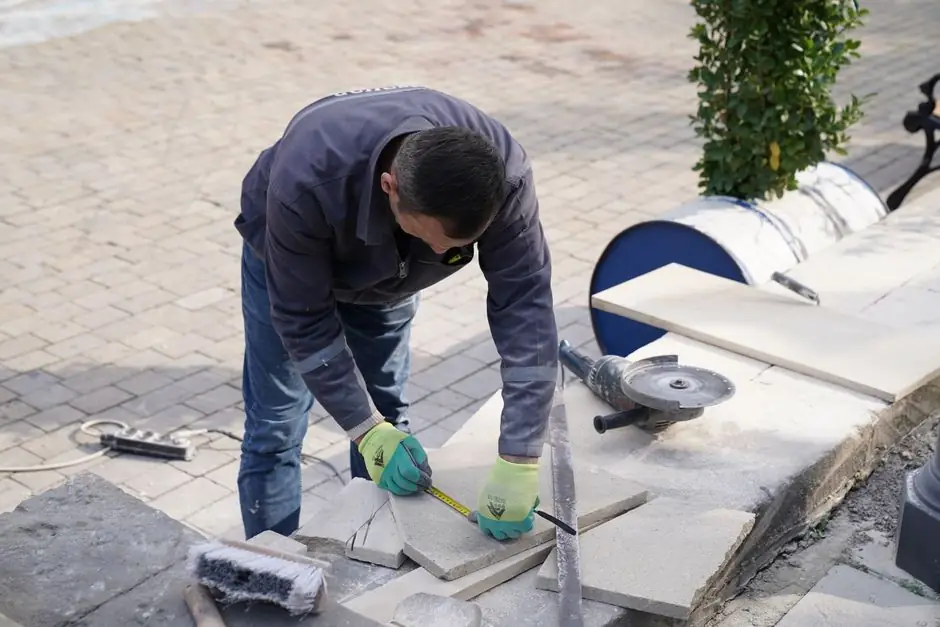
A masonry sanding system that pairs a 150mm planetary grinder with mesh abrasives stepped from P40 to P320 and a 130 CFM HEPA dust extractor is the current flatwork benchmark, replacing random-orbit sanders that stall on cured concrete [S6]. For hand work on brick, stone, and tile, a 20-grit fluted silicon-carbide rub brick, sized 6 x 3 x 3.5 in with an ergonomic handle, remains the standard low-cost touch-up tool at roughly $14.99 to $22.99 per unit [S2].
Selection has consolidated around three job profiles: planetary grinding for floor flatwork and coating prep, random-orbit sanding for detail finishes on cured walls, and hand rubbing for mortar cleanup and field corrections. Matching the sander class to the substrate, abrasive bond, and dust class is now treated as a bill-of-materials exercise rather than a brand decision [S5][S6].
Tool Classes and Where Each One Earns Its Keep
Planetary sanders with a 150mm head and mesh abrasive discs (P40, P80, P150, P320 in sequence) are specified for concrete flatwork preparation, where continuous stock removal and dust capture dominate the workflow [S6]. Random-orbit sanders, typified by 5 in pad units with variable speed from 4,000 to 12,000 OPM, are the right pick for finishing passes on cured masonry where swirl-free surfaces are required for paint or sealant adhesion [S3].
Hand sanders, including 20-grit rub bricks with fluted silicon-carbide faces, handle detail work: removing mortar smears, smoothing form lines, and dressing stone where a power tool would over-profile the joint [S2][S5]. Detail sanders running at roughly 14,000 OPM and multi-function units with micro-filter dust boxes are used for tight-corner and trim work, but they are not rated for heavy stock removal on concrete [S5].
Abrasive Selection: Grit, Bond, and Mesh vs Paper
Mesh abrasive discs on planetary heads are preferred over paper on concrete flatwork because the open structure clears dust and resists loading during P40 and P80 cuts, with the sequence typically P40 to P80 to P150 to P320 for coating-ready finishes [S6]. Diamond and silicon-carbide grains are the standard abrasive families for masonry; fluted silicon-carbide rub bricks at 20 grit are the common hand-tool specification for brick, block, and stone dressing [S2].
Bond hardness is substrate-driven: medium ("M") bonds suit limestone and brick, while soft ("S") bonds are restricted to veneer-topped masonry where heat build-up must be minimised to avoid burning the face [S6]. For random-orbit finishing on masonry, 5 in hook-and-loop discs in the P80 to P220 range are the typical pairing, with P220 and finer used only when a coating system requires it [S3].
Dust Control: CFM, HEPA, and Antistatic Plumbing
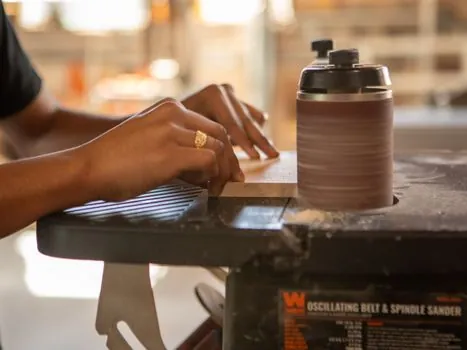
Concrete and masonry dust carries a respirable crystalline silica fraction, which drives the dust-extraction specification rather than the sander choice. A 130 CFM HEPA-class extractor paired to the sander through 35mm antistatic hose is the published baseline for masonry sanding systems; lower-CFM shop vacs will choke mesh discs and bleed dust past the shroud [S6].
On-tool dust shrouds are treated as mandatory on planetary and random-orbit masonry sanders; an integrated dust collection port on the sander body, feeding the extractor, is the spec line item, not an optional accessory [S3][S5]. PPE overlays the system: P100 or N100 respirators, sealed safety goggles, and hearing protection are required because the high-CFM extractor does not capture the fine fraction that escapes during shroud lift-off [S3][S4].
Comparison of Masonry Sander Classes
Planetary grinders win on flatwork throughput and dust containment but are overkill on detail joints. Random-orbit sanders give the best surface finish for paint or sealant but lack the torque for heavy stock removal on cured concrete. Hand rub bricks are cheap, quiet, and dust-light, yet impractical for more than a few square feet per hour. [S5]
Power, Speed, and Ergonomics: What the Spec Sheet Must Show
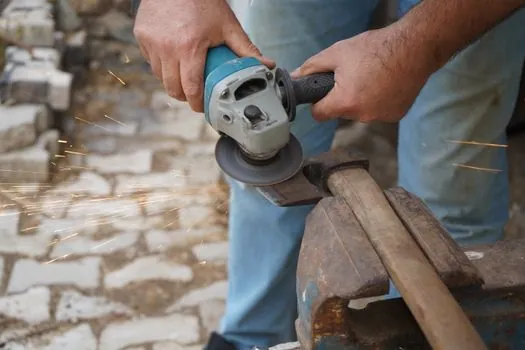
Variable speed is non-negotiable on random-orbit masonry sanders because limestone, brick, and concrete each want a different orbit rate to avoid glazing the disc; the 4,000 to 12,000 OPM band is the working window most 5 in units are sold into [S3]. Cordless 18 to 20 V random-orbit models are now common for site work where a generator or mains drop is not available, but sustained heavy stock removal still favours corded units for thermal headroom [S5].
Ergonomic features that show up consistently across the spec sheets: rubberised or overmoulded grips, counterbalance to drop vibration below 2.5 m/s², and a dust port sized to standard 32 to 35mm hose cuffs so off-the-shelf extractors bolt straight on [S3][S6]. Hand sanders in the masonry space are mostly specified by grit and face geometry, not by handle electronics, because the operator controls cut rate directly [S2].
Application Map: Which Sander for Which Masonry Job
For concrete floor prep ahead of epoxy or polyurethane coatings, the workflow is planetary grinder with P40 mesh disc, edge work with a 5 in random-orbit, then a full P150 to P320 sequence with a 130 CFM HEPA extractor running throughout [S6]. For brick wall repointing and paint prep, a 5 in random-orbit at 8,000 to 10,000 OPM with P80 to P150 discs handles the field, while a 20-grit fluted rub brick cleans mortar lines without rounding the joint profile [S2][S3].
For stone veneer and architectural concrete, soft-bond ("S") diamond pads on a variable-speed polisher are the published spec to avoid burning the face, and a hand rub brick is used for the arris and any fielded detail [S6]. For HVAC and electrical penetrations through masonry walls, an air pick handles the bulk demolition while the sander dresses the cut edge to a paint-ready profile; this division of labour keeps abrasive cost down and tool life up.
Limitations, Failure Modes, and What to Avoid
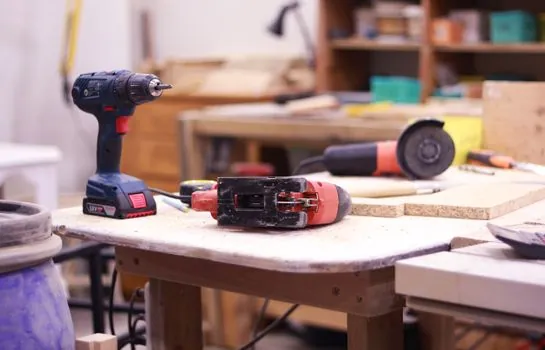
Random-orbit sanders stall on uncured or green concrete and burn out clutches when forced; if the surface cannot be scratched with a coin, it is a planetary grinding job, not an orbital job [S6]. Mesh discs glaze and tear if run without sufficient CFM at the extractor, so a low-spec shop vac turns a $5 disc into a consumable per square foot [S6].
Hand rub bricks cross-contaminate between masonry types: a brick used on limestone picks up fines that then score softer stone, so colour-coded bricks per substrate are the standard site practice [S2]. Cordless random-orbit units throttle under continuous load; for any job over roughly 20 m² of masonry sanding per shift, plan on a corded head to avoid battery-swap downtime [S5].
Related Site Work and Standards Context
Masonry sanding is one node in a larger site system that includes layout, forming, and material handling. For vertical concrete and masonry lifts, the sander spec is downstream of the formwork choice, where climbing formwork sets the line and the sander dresses the lift joint. Layout accuracy upstream of the sander is handled by laser levels and infrared line levels, so the sander is correcting within millimetres, not centimetres. [S5]
Access during the sanding pass is typically via aluminium ladders for low work and steel scaffolding for high work; ladder duty class and scaffold load rating set the working envelope the sander and its extractor have to fit inside. PPE for silica dust falls under general occupational respiratory protection rules, with masonry sanding classed as a high-dust task requiring sealed eyewear, P100 or better respiratory protection, and hearing protection above 85 dBA continuous exposure [S3][S4].
Trackable Signals to Watch Next
Watch for the next round of cordless 18 to 20 V random-orbit masonry sanders pairing brushless motors with auto-oscillating edge shrouds, which would close the dust gap that currently forces site teams to run corded heads. Also watch the silicon-carbide rub brick segment: several OEM lines are moving from solid brick to fluted-faced, ergonomic-handle formats in the 6 x 3 x 3.5 in size class, signalling that hand-tool ergonomics are now a procurement line item, not an afterthought [S2][S5].
For the relevant spec sheets and selection criteria, see sander, masonry insulation, and pressure transmitter.
