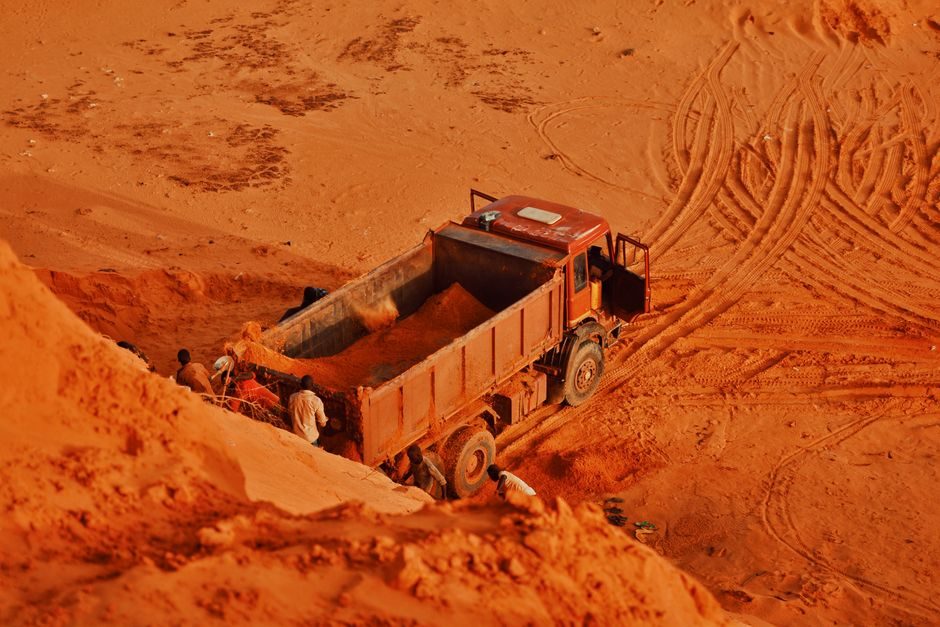
A 90-ton-class mining dump truck such as the XCMG XG90, delivered in bulk to a 310 m-deep lead-zinc pit in Kazakhstan, runs 24/7 on 5 km uphill grades carrying ore [S2]. A 25,000 L IMO 1 / ISO 1496-3 tank container runs Class 3 dangerous goods between rail terminals, ports and chemical plants under IMDG, ADR/RID and CSC plate rules. The two share a truck-and-trailer silhouette but solve different problems and answer to different regulatory regimes.
Specifying one where the other is needed is a common but expensive error. This 2026 reference cuts the decision by payload class, road class, certification, and total cost of ownership so fleet engineers, EPC buyers and logistics leads can match the right asset to the right haul.
Definition and Operating Scope
Off-highway mining dump trucks (also called rigid haul trucks or dump truck variants) are purpose-built for open-pit metal mines, coal mines, and large earthworks. Payloads cluster at 30 t, 45 t, 55 t, 90 t, 100 t, 150 t, 220 t and the ultra-class 290–363 t (Caterpillar 793, 797, BelAZ 75710, Komatsu 980E). A 105-ton-class machine dominates Chinese OEM catalogues for iron-ore and copper concentrate haulage [S4]. A standard 6×4 on-road tipper such as the HOWO GCC-certified 8×4 dumper is a different machine again — a road-legal 40 t payload unit for civil construction, not a rigid-frame mining truck [S5].
Tank containers are stainless-steel or carbon-steel cylindrical vessels mounted in ISO 1161 corner-cast frames, capacities 20,000 L (T20) up to 30,000 L (T50), pressure-coded for the product carried. They are built to ISO 1496-3, ASME U-stamp or EN 14025, ADR/RID for European road and rail, IMDG for maritime, and CSC plate for intermodal handling. Operating scope is any sealed intermodal lane — rail, road, sea, barge — where a liquid, gas or powdered bulk needs to stay sealed and certified between modes.
Selection Criteria Side-by-Side
Four decision gates separate the two assets cleanly. (1) Payload class: mining dump trucks are rated at 30–363 t, while a T50 tank container carries around 25 t of liquid. (2) Road class: mining trucks run on private haul roads with grades of 8–14 %, while tank containers must stay on public roads, rails, and sea lanes that observe bridge-axle and tunnel-category rules. (3) Certification: a mining truck is governed by ISO 3457, ISO 5010 and mine-site rules, while a tank container is governed by ADR 2025, RID, IMDG, ASME U2W or U3W, and CSC. (4) Duty cycle: mining trucks log 5,000–8,000 engine hours per year against a 6,000–10,000 hour engine overhaul; tank containers are rated for repeated loading cycles measured in years of service, with periodic pressure test and tank inspection every 2.5 or 5 years per ADR. [S1]
Concretely: the XG90 runs AC-drive or mechanical-drive on a 310 m deep pit ramp at sustained 8–10 % grade [S2], while a 25,000 L ADR Class 3 tank container has no business being loaded into a pit and would fail any site's risk assessment on gradient and ground-bearing pressure. Conversely, putting a 90-ton rigid haul truck on a public motorway is illegal in nearly every jurisdiction; it is too high, too wide, and too heavy per axle for highway code.
Who Each Asset Is For — and Who It Is Not For
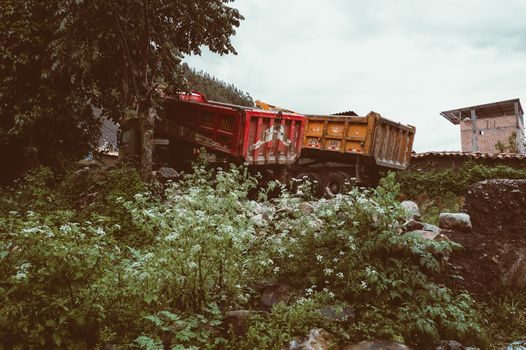
The mining dump truck is for: open-pit metal mine operators, coal mine contractors, large quarry operators, and hydro-dam earthworks moving 50,000–500,000 t of material per day. It is the right tool when the haul road is private, when cycles are short (under 30 minutes one-way), and when the unit cost per ton hauled must drop below USD 0.05/t·km. It is the wrong tool for: public-road bulk haul, last-mile construction tipper work below 30 t, and any operator who cannot fund 24/7 maintenance coverage. The 6×4 HOWO tipper at 40 t sits in that lower envelope and covers road-legal civil work [S5].
The tank container is for: chemical manufacturers, fuel and lubricant distributors, AdBlue and DEF logistics, food-grade liquid shippers, and intermodal operators with rail or deep-sea access. It is the right tool when ISO corner-cast compatibility, ADR/RID/IMDG certification, and intermodal transfer without decanting are mandatory. It is the wrong tool for: short last-mile fuel runs (a road tanker truck is cheaper per litre), slurry or high-viscosity products above the pump's NPSH window, and any lane that lacks a gantry crane, reach stacker or rail-loading point. For an automotive-side AdBlue and lubricant spec cut, see the 2026 tank container reference.
Operating Economics and Sourcing Reality
Mine-truck pricing is dominated by powertrain and frame: an XCMG XG90 batch shipped to Kazakhstan [S2] sits in the USD 600,000–900,000 band ex-works, while a 105-ton heavy-duty unit on Alibaba [S4] and a 6×4 HOWO tipper [S5] are quoted down to USD 16,000–17,000 ex-works for the road-legal class. Mainline Chinese OEM production for blasting and emulsion trucks at 15 t MEMU/MMU class runs at 5,000 sets/month capacity for the largest vendors [S1][S5]. Buyers looking at 6×4 dumper contracts need to check tipper-body steel grade (Hardox 400/450 vs Q345) and hoist angle — both are common warranty disputes.
Tank container pricing is set by material and pressure code: a 25,000 L stainless 316L T50 with IMO 1 and ADR marking lists around USD 18,000–28,000 ex-works, with CO2 or specialty-gas T50 units reaching USD 45,000+. Lead time runs 60–90 days from major Chinese fabricators; 30 days faster from European rebuild yards. Reefer/heated variants for bitumen or chocolate add 20–35 % to the price. Used CSC plate age must be verified — containers past 10 years from manufacture lose major intermodal lanes without recertification.
Failure Modes, Constraints and Common Specification Errors
Mining dump trucks fail in three modes: (a) frame fatigue around the dump body pivot, driven by inadequate body steel (Q345 instead of Hardox 450), a fault that costs an overhaul cycle; (b) hoist cylinder seal failure from contaminated hydraulic oil, predictable at 8,000–10,000 hours; (c) brake fade on sustained 12 %+ descents — retarder spec, not service-brake spec, is the gate to check. The 310 m pit at the Kazakhstan XG90 site is exactly the service condition where retarder capacity, not engine power, decides whether a truck survives the 24/7 cycle [S2].
Tank containers fail in three modes: (a) shell corrosion at the weld seam when stainless 304 is specified where 316L is required for chloride-bearing chemicals; (b) pressure-relief valve drift between test cycles, a common ADR inspection finding; (c) corner-cast cracking from over-ISO stacking. Specifiers who mix classes — for example, a 21,000 L IMO 1 with insufficient MAWP for an oilfield brine service — create paperwork-only compliance, not real compliance. Anyone moving Class 3 flammables must verify the T-code, the relief valve set pressure, and the IMDG packing group for the specific product.
Standards, Sourcing and Trackable Signals
Mining trucks are anchored by ISO 3457 (tipping body safety), ISO 5010 (off-road steering), and ISO 6016 (machine classifications); China GB/T 35180 covers electric-drive mining trucks and is now commonly cited on new tenders. Tank containers are anchored by ISO 1496-3 series, ASME BPVC Section VIII Div 1 (U-stamp), EN 14025 for European road, ADR 2025 / RID for tank codes, IMDG Code for sea, and the CSC plate for intermodal. [S2]
Trackable signals to watch over the next two quarters: the 2025 revision of ADR took effect on 1 January 2025, with a 6-month transition for tank containers in service — operators should confirm tank-code re-marking completion by mid-2026. On the mining side, deliveries of 90-ton-class AC-drive units to Central Asia and Africa continue to scale — the XCMG XG90 Kazakhstan fleet [S2] is one of several 2024–2026 deployments and a reasonable benchmark for upcoming Mongolia and DRC tenders. For buyers comparing earthmoving choices more broadly, the bulldozer spec gates and truck crane selection criteria follow the same four-gate logic and can be read as a cross-check on this asset class.