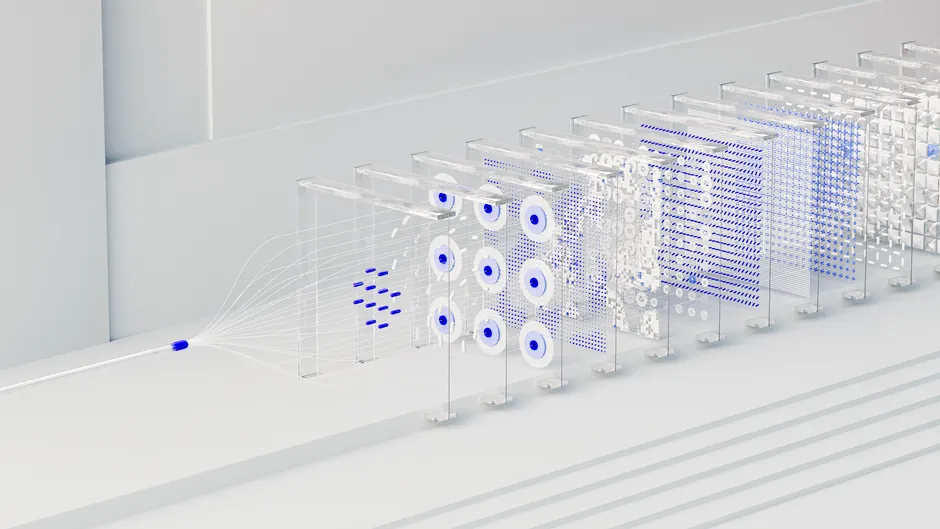
NVIDIA commands an estimated 80-85% of the data center AI accelerator market by revenue in 2026, down from roughly 92% in 2023, with AMD at 5-7%, Google TPU at 6-8% by deployed FLOPS, and AWS Trainium 2 at 2-3% [S1].
The structural change is software as much as silicon: AMD's ROCm 6.0 now supports PyTorch 2.5+ and TensorFlow 2.16+, and the open-source Triton compiler is slowly eroding CUDA's lock-in across 4 million developers and 3,000+ optimized applications [S2]. The competitive pressure matters for any buyer building or refreshing an AI cluster in the second half of 2026, where total cost of ownership per token, not peak FLOPS, drives procurement. That pressure is also pulling adjacent categories, from industrial filtration to SCADA system industry shifts in 2026, into closer coupling with accelerator specs on the factory floor.
Blackwell Ultra (B300) vs B200/B100: Memory, Bandwidth, and the 1,450W Wall
NVIDIA's Blackwell Ultra (B300) ships with 288 GB of HBM3e per GPU at 8 TB/s memory bandwidth, NVLink 6.0 delivering 1.8 TB/s of inter-GPU bandwidth, and a 208-billion-transistor die on TSMC 4NP, with 20 PFLOPS at FP16 and 40 PFLOPS at FP4, and a 1,450W TDP per GPU [S2].
The earlier B200 sits at 192 GB HBM3e, 8 TB/s, 2.5 PFLOPS at FP8, 1,000W TDP, and 1.8 TB/s NVLink, while the B100 is the lower-bin part at 1.8 PFLOPS FP8 and 700W [S3]. The GB300 NVL72 rack-scale system packages 72 GPUs with 36 Grace CPUs into 1.4 exaflops of FP4 inference, and allocation is still constrained at the top end of the stack [S1][S2]. For buyers comparing accelerator generations, the practical takeaway is that the H100/H200 cohort remains the deployment workhorse, the B200/B300 cohort is what is allocation-constrained, and the Rubin generation is announced for the 2026-2027 window but not yet in volume [S1].
AMD MI400 (Antares): 3nm Compute, 6nm I/O, 25-30% Price Discount
AMD's Instinct MI400 (codename Antares) uses CDNA 4 with 3D chiplet stacking, TSMC 3nm for the compute dies and 6nm for the I/O die, 256 GB HBM3e at 6.4 TB/s, 18 PFLOPS at FP16 and 36 PFLOPS at FP8, 1,200W TDP, and Infinity Fabric 4.0 at 1.2 TB/s [S2].
AMD prices the MI400 25-30% below the B300 while delivering 85-90% of training performance and matching NVIDIA in inference, with the MI300X and MI325X already mature in the field at Microsoft and Meta [S1][S2]. The MI355X and MI400 are ramping as the direct B200 competitor, while Strix Halo (Ryzen AI Max+) targets the local AI workstation and mini-PC segment [S1]. A real procurement question is whether the memory-capacity advantage matters for your model: 256 GB on a single MI400 part reduces the number of tensor-parallel shards for an LLM, which is a direct knob on inference latency and per-request cost.
Intel Gaudi 4: Intel 18A, 24x 400GbE RoCE, 900W
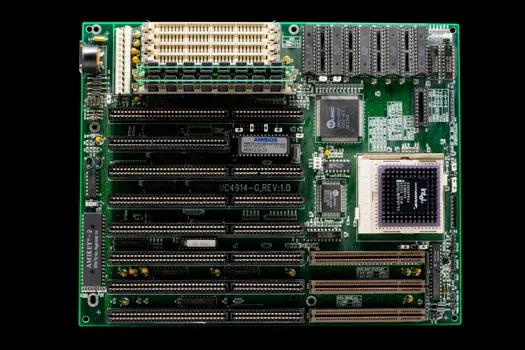
Intel Gaudi 4 ships on Intel 18A (1.8nm-class with RibbonFET), with 192 GB HBM3e at 5.2 TB/s, 14 PFLOPS at FP16 and 16 PFLOPS at BF16, a 900W TDP, and 24 integrated 400GbE RoCE ports per chip, which removes the need for external NICs in cluster configurations [S2].
The integrated networking is the genuine differentiator: for a 256-accelerator LLM serving cluster, the absence of a separate NIC layer simplifies topology, reduces switch count, and tightens tail latency, and the Intel 18A node gives a transistor-density advantage that should translate to better performance-per-watt [S2]. On the software side, oneAPI and SYCL are improving but still lag CUDA and ROCm in framework coverage, and Intel's bet on the Hugging Face partnership plus open-source contributors is the path to closing that gap [S2]. Market share sits at roughly 1-2% with modest growth, well behind NVIDIA, AMD, and the hyperscaler captive fleets [S1].
Hyperscaler Custom Silicon: TPU v6, Trainium 2, Maia 200
Google TPU v6 (Trillium) and a TPU v7 preview are not sold commercially; access is GCP-only, and the 6-8% market share by deployed FLOPS is concentrated inside Google Cloud and Google internal workloads [S1].
AWS Trainium 2 captures 2-3% of the broader market, growing on inference cost arbitrage and driven by AWS-internal workloads including Anthropic Claude inference and AWS Bedrock [S1]. Microsoft's Maia 200 rounds out the hyperscaler custom-silicon trio, and the combined direction is that the three largest cloud operators are intentionally building their own accelerators to compress the dollar-per-token gap to NVIDIA [S2]. This is also why TPU market share does not show up as a separate line item that competes with NVIDIA in third-party deployments, and why a buyer evaluating on-prem versus cloud is increasingly facing a vendor-captive silicon choice on the cloud side.
On-Device AI: A Separate $25-35B Market
On-device inference, including Apple Silicon, Qualcomm Hexagon, Intel NPU, and AMD XDNA, is a separate market of roughly $25-35 billion in 2026, with Apple as the dominant single-vendor across M5 Max, M5 Ultra, and the Apple Neural Engine [S1].
Qualcomm's Hexagon NPU in Snapdragon X and Snapdragon 8 Gen 4 leads Android and Windows-on-Arm, Intel's Lunar Lake and Panther Lake NPUs are the Windows x86 reference for Copilot+ PCs, and AMD's Ryzen AI XDNA is the x86 alternative, while NVIDIA's Jetson Thor targets robotics edge and Google's Tensor stays Pixel-only [S1]. The practical procurement signal is that NPUs are now standard hardware in laptops and edge devices, and any PLC retrofits or edge gateways using NPU-assisted inference are running into the same on-device TOPS ceiling regardless of vendor. For a new edge-AI build, the choice between Jetson Thor, Ryzen AI, and a Hexagon NPU is a TOPS-per-watt question, and the supply chain running through that decision is described in the 5G Industrial Modules 2026 spec map.
Decision Matrix: Training vs Inference, Front-End vs TCO
For 2026 cluster builds, the decision splits cleanly along four axes: training frontier models, large-scale inference, cost-sensitive inference, and edge or local deployment. [S2]
On frontier training, NVIDIA B200/B300 with NVLink 6.0 at 1.8 TB/s and 40 PFLOPS FP4 is the only part with the installed base and software maturity to support multi-thousand-GPU runs [S1][S2]. On large-scale inference, the GB300 NVL72 rack delivers 1.4 exaflops of FP4 compute with 288 GB of HBM3e memory per GPU, while AMD's MI400 series, built on CDNA 4 architecture with 3nm process technology, has closed the gap in inference workloads [S2]. On cost-sensitive inference in Ethernet-networked clusters, Intel Gaudi 4 with 24x 400GbE RoCE and 900W is the dark horse where external NIC spend dominates the build [S2]. For edge and local inference, Jetson Thor, Strix Halo, and Apple M5 Max are the practical answers depending on power budget and operating system, and a servo motor cell with a Jetson coprocessor is now a common bill of materials on 2026 robotics lines.
Selection Criteria and Failure Modes

The first selection criterion is software: CUDA still has 4 million developers and 3,000+ optimized applications, and any team that has not built a ROCm or SYCL path carries migration cost when leaving NVIDIA [S2]. The second is memory capacity per GPU, since 192 GB on B200, 288 GB on B300, 256 GB on MI400, and 192 GB on Gaudi 4 each define how a 70B-class LLM is sharded, and the wrong choice inflates the parallel-factor and drops tokens-per-second-per-dollar. The third is power and cooling: 1,450W on B300, 1,200W on MI400, and 900W on Gaudi 4 are not interchangeable, and a data center built for 700W H100s will need retrofits before it takes Blackwell Ultra density. The fourth is supply: H100/H200 are widely available, B200/B300 allocation is constrained, MI355X/MI400 are ramping, Gaudi 4 is orderable, and the Cerebras/Groq/Etched/Tenstorrent niche sits at about 1% combined but is the right answer for specific sparse-model and deterministic-latency workloads [S1].
Standards, Sourcing, and Trackable Signals
No new industry standard governs accelerator interoperability at the hardware level in 2026; the de facto standard is NVLink on the NVIDIA side, Infinity Fabric on AMD, and Ethernet (with RoCE) on Intel and most hyperscaler fleets, and that fragmentation is the reason buyers evaluate on TCO rather than on a common benchmark [S2]. For revenue triangulation, NVIDIA's Q4 FY26 data center segment exceeded $35 billion, AMD AI revenue is reported quarterly, and other vendors are estimated from analyst triangulations, all of which means the 80-85% NVIDIA share carries a +/-2-3 point error band that any sourcing team should annotate [S1].
Two signals are worth tracking into Q4 2026: first, the Rubin generation announcement and any 2026-2027 timeline slip, and second, whether AMD's MI400 ramp closes the allocation gap that is currently keeping B200/B300 buyers in queue. Adjacent procurement tracks on 2026 supply maps, like the additive manufacturing supplier file at Additive Manufacturing Material Suppliers 2026 and the laser line spec map at Industrial Laser Production Line 2026, are converging with the same vendor concentration risk that the AI accelerator market now shows, and the next article in this series will benchmark the ROCm 6.0 against CUDA 12.x on a matched 70B-parameter inference workload.
Spec-level background on the components involved: pressure transmitter.