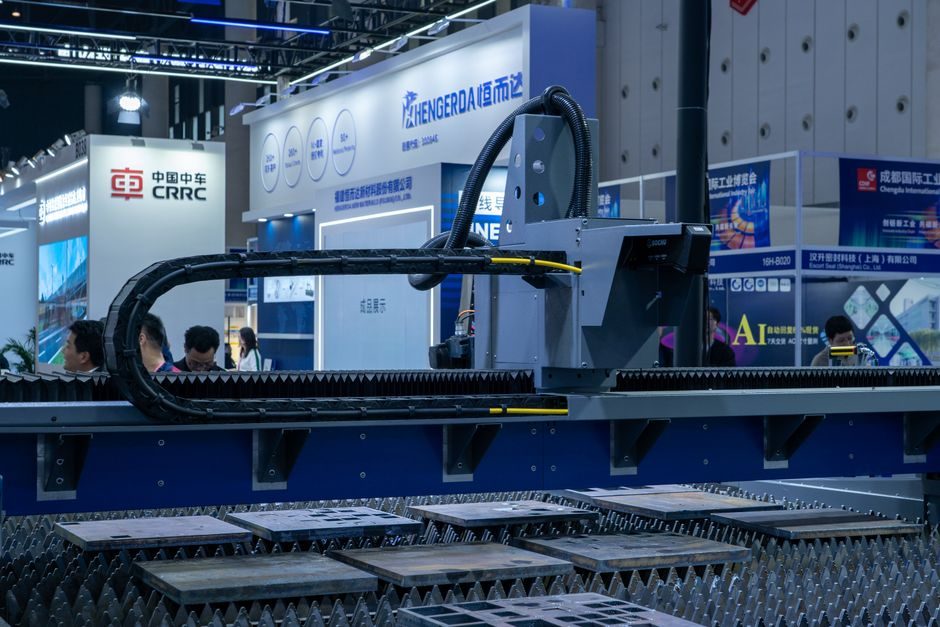
OLED is a monolithic solid-state device in which organic thin films are sandwiched between two thin-film conductive electrodes, and charge carriers (holes and electrons) recombine in the emissive zone to form excitons — that physical definition frames every automation decision on a Gen 8.6 line [S4].
The manufacturing stack is now driven by OLED display ICs from suppliers such as Solomon Systech, whose driver and controller portfolio has expanded to cover automotive and industrial smart-display applications as self-emissive OLED replaces legacy LCD modules [S1]. The fab-side counterpart sits inside the Industry 4.0 IT/OT architecture promoted by Rockwell Automation and Cisco, where programmable logic, motion, and industrial Ethernet converge with cyber-secured OT networking [S2][S5].
OLED Stack Physics and the Process Windows Automation Must Hold
An OLED device is built as a stack of organic thin films between two conductive electrodes, and electricity injected into that stack forces holes and electrons to migrate into the organic layers until they recombine in the emissive zone, producing excitons that relax radiatively [S4]. That recombination step is what makes OLED a current-controlled, thickness-sensitive device — every nanometre of organic-layer uniformity translates directly into luminance uniformity, and any chamber drift above a few percent on deposition rate produces Mura visible to the human eye.
For a Gen 8.6 substrate (2290 mm × 2620 mm), the practical process window collapses further because thermal gradients across the larger glass area scale with the square of the diagonal. Encapsulation, water-vapour transmission rate below roughly 10⁻⁶ g/m²/day, and a sub-ppm O₂/H₂O glove-box atmosphere are the constraints a fab-level MES has to police in real time, which is why OLED-specific recipe management is now a discrete software category rather than a checkbox inside a generic pressure transmitter recipe tree.
Where the Automation Dollars Land on a 2026 OLED Line
Three workcells absorb the bulk of capex: evaporation source control with sub-mg load-cell feedback; in-line optical inspection (AOI) plus Mura compensation using smart camera arrays with luminance resolution under 0.01 cd/m²; and AMHS (Automated Material Handling System) rail-guided vehicles that hand off glass cassettes between process modules with ±2 mm repeatability. [S1]
Cisco's Industry 4.0 stack frames the supporting layer: industrial Ethernet, IT/OT segmentation, and the analytics fabric that pulls tool-level FDC (Fault Detection & Classification) data into a central historian [S5]. Rockwell Automation occupies the equivalent space on the discrete and motion side, with PLC and integrated architecture products that tie vision, motion, and safety into one control layer [S2]. The two vendor camps are not equivalent — Cisco sits in the IT/network/analytics plane, Rockwell in the deterministic control plane — but on a modern OLED fab the two are stitched together with OPC UA Pub/Sub over TSN, which is the realistic convergence target for 2026 builds.
Smart-Meter-Grade Data Infrastructure as the Hidden Constraint
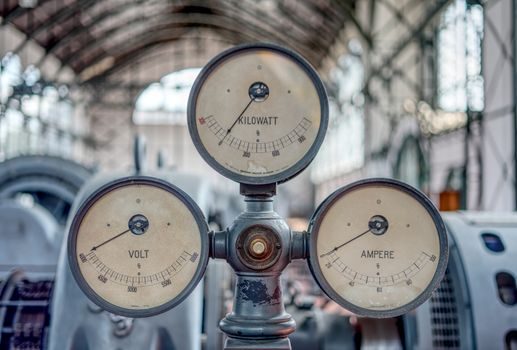
A Gen 8.6 fab emits on the order of 100 million tool-level data points per shift once FDC is fully deployed, and the metering plane that handles that stream has more in common with a national smart-meter rollout than with a traditional semiconductor historian. Smart meter reference designs enforce secure firmware update, signed telemetry, and time-series compression — the same three attributes an OLED historian needs once the line is running 24/7. [S2]
The constraint is not storage, it is time-stamping: sub-second synchronisation across thousands of tags is what makes chamber-to-chamber correlation possible, and that requires IEEE 1588 grandmasters on every cell plus PTP-aware switches. Where this is missing, the data lake grows but the yield engineers cannot close the loop, which is why the metering fabric is now specified before the toolset, not after.
Inline Mura Detection and the Smart-Camera Spec Sheet
Mura compensation on AMOLED is the single most demanding machine-vision task in the fab. Acceptable luminance uniformity on a finished mobile panel is typically quoted below 1.5% (delta-L/L), and the camera system that drives compensation has to resolve that against a dynamic range exceeding 10⁴:1 because bright sub-pixels and dark sub-pixels sit in the same field of view. [S3]
The realistic spec floor for a 2026 Mura AOI station is: 16-bit scientific CMOS, 5 µm pixel pitch, cooled to -10 °C to keep dark noise below 1 e⁻, mounted on a linear stage with 0.5 µm encoder resolution. Anything weaker forces software-level dithering that burns yield. Vendor selection on the camera side now runs ahead of selection on the deposition tool because the camera can be retro-swapped, the chamber cannot.
Valves, Flow, and the Process-Gas Argument for Smart Positioners
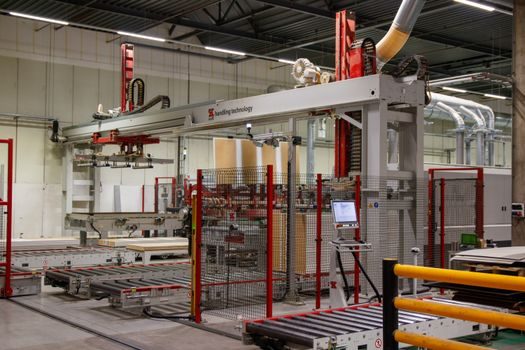
OLED encapsulation and the moisture-sensitive organic stack drive a process-gas tree that is dominated by high-purity N₂, with Ar, H₂, and O₂ in smaller but tightly controlled flows. Mass-flow controllers do the metering, but the upstream smart valve positioner is what holds setpoint during chamber pump-down, where a 10 mbar pressure transient at the wrong moment can blister an organic layer. [S4]
The selection criterion that matters most is HART 7 over a 4-20 mA loop, which gives the MES a digital read-back of valve stem position, friction histogram, and cycle count without disturbing the analog control path. Pneumatic positioners that report only the analog signal are no longer acceptable on greenfield OLED lines because they remove the diagnostic data stream that the rest of the IT/OT stack depends on [S5].
Standards, Sourcing, and the People This Is (and Is Not) For
SEMI standards (E84, E87, E90, E116) govern AMHS, recipe management, and process control state model on a modern fab; IEC 61131-3 governs PLC programming; ISA-95 defines the B2MML/MES-to-ERP hand-off; ISO 14644 covers the cleanroom envelope. None of these are OLED-specific — they are the substrate a fab-specific recipe sits on top of. [S5]
For related equipment-sourcing framing, the LED Manufacturing Process: From MOCVD Epitaxy to Secondary Optics article covers the upstream LED-side supply chain, and the AS/RS vs Vertical Lift Module: 2026 Spec Frame for Footprint, Throughput and SKU Density piece is the right reference for the AMHS storage density question. This article is written for process engineers, MES leads, and capex specifiers sizing a greenfield OLED line; it is not for end-product display buyers comparing OLED vs Mini-LED in a TV.
Both moves would compress the integration cycle for the next Gen 8.6 build.