
A Programmable Logic Controller (PLC) is a microprocessor-based industrial control device that stores logic, sequencing, timing, counting and arithmetic instructions in programmable memory and actuates machinery through digital and analog I/O [S1]. Over 200 manufacturers offer more than 300 distinct PLC product families globally, applied in automotive (23%), grain processing (16%) and other discrete/batch industries [S2].
Selection is governed by hard spec numbers — I/O count, scan cycle, program memory, supported fieldbus, and operating temperature — not by brand familiarity. The criteria below rank the levers that drive a working PLC specification, the standards that anchor the design, and the failure modes that re-work a budget.
I/O Count and Signal Type as the First Filter
Total I/O point count plus the mix of digital input (DI), digital output (DO), analog input (AI) and analog output (AO) is the single largest determinant of PLC model and backplane size. A typical small machine retrofits inside 16 to 64 points; a mid-range skid or material-handling line usually lands between 128 and 512 points; a plant-floor main controller commonly exceeds 1024 points with distributed I/O over PROFIBUS, PROFINET or EtherNet/IP [S1].
Analog I/O drives channel cost far harder than digital. A single 4-20 mA AI or AO channel can equal the cost of 8 to 16 DI/DO channels on the same rack, so channel density for thermocouples, RTDs, 0-10 V and 4-20 mA loops must be counted up front. Selection must also reserve 10-20% spare I/O for commissioning churn; panels shipped at 100% utilisation typically fail site acceptance because trim changes cannot be absorbed.
Scan Time, Program Memory and Instruction Set
Scan cycle — the time to read all inputs, execute the user program, and write all outputs — defines the fastest controllable event. Small PLCs advertise 0.1-1 ms per 1 k of boolean logic; high-end controllers with structured text, motion and PID blocks commonly run 1-10 ms per program k-step. For closed-loop motion or PID controller loops on fast processes, scan time becomes the binding spec; for sequencing a conveyor or a tank-cleaning cycle, it rarely is [S1].
Program memory is split into volatile (RAM) and non-volatile (flash/EEPROM) regions. Most modern PLCs ship with 128 KB to 4 MB program memory; complex recipes, batch logs and asset diagnostics push that toward 16 MB and above. The instruction set must cover the blocks actually required — IEC 61131-3 languages ladder (LD), function block diagram (FBD), structured text (ST), instruction list (IL) and sequential function chart (SFC) — otherwise the project pays in conversion overhead and third-party soft-PLC licenses.
Communication Protocols and Network Architecture
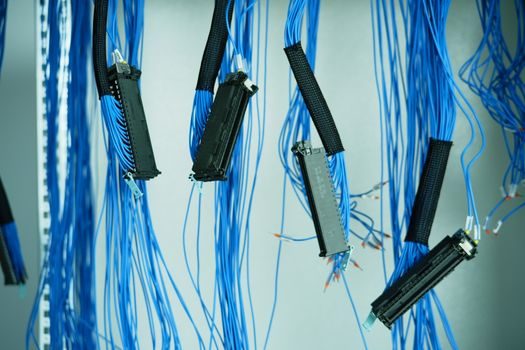
Fieldbus choice is a hard spec, not a preference. PROFINET, EtherNet/IP, Modbus TCP, EtherCAT, PROFIBUS DP/PA and CC-Link still dominate greenfield panels, with OPC UA running above them as the IT/OT hand-off. Specifying a PLC whose CPU speaks only PROFINET on a brownfield PROFIBUS-PA instrument yard forces a gateway or a card retrofit; matching the fieldbus at selection avoids both [S1].
Industrial Ethernet variants are not interchangeable. PROFINET IRT, EtherCAT and CC-Link IE deliver deterministic sub-millisecond cycles for motion controller axes, while standard TCP/IP Ethernet is fine for SCADA, HMI and vision controller data logging but unsuitable for closed-loop motion. For hazardous-area networks carrying HART, PROFIBUS-PA or Foundation Fieldbus, the physical layer must meet IEC 60079-x for intrinsic safety; HART itself is a 1200/2200 Hz FSK signal superimposed on a standard 4-20 mA loop and is not a digital fieldbus replacement.
Environmental Ratings, Hazardous Area and Power
Ambient temperature, humidity, vibration and ingress define the mechanical envelope. Standard commercial PLCs are rated 0-55 °C; ruggedised and conformal-coated modules extend that to -25 °C to +70 °C and to 5 g vibration, suitable for mobile equipment and marine bridge installations. For dusty or wash-down sites, an IP65 or IP67 faceplate and sealed cable glands are non-negotiable. [S1]
Hazardous area selection is governed by regional schemes: ATEX 2014/34/EU (Europe), IECEx (global), and the NEC Class/Division system (North America). Zone 1 / Zone 2 (gas) and Zone 21 / Zone 22 (dust) require either intrinsically safe I/O (Ex ia/ib) mounted in safe area, or flameproof / increased-safety (Ex d / Ex e) enclosures. A gas alarm controller or gas mass flow controller feeding analog channels into a PLC in a Zone 1 area must terminate on a certified barrier or in an Ex d enclosure — the wrong pairing invalidates the loop certification and voids insurance.
Comparison Snapshot: Compact, Modular and Rack PLCs Across Four Decision Criteria
Three architecture tiers cover roughly 90% of industrial applications. Compact (fixed I/O) PLCs suit 16-64 point, single-machine jobs with the lowest unit cost and the smallest footprint. Modular PLCs add swappable I/O and communication cards, scaling from 64 to 1024 points on a backplane. Rack / distributed PLCs split a CPU from remote I/O over PROFINET, EtherNet/IP or PROFIBUS, scaling past 5000 points and supporting redundant CPUs. [S2]
On cost per point, compact PLCs lead, but lose on flexibility: any I/O change requires module replacement. On scan time, modular and rack PLCs typically halve compact-class scan cycles because their CPUs are 32-bit versus the 16-bit cores common in compact units. On protocol support, compact PLCs usually ship with Modbus TCP plus one industrial Ethernet option; modular PLCs add PROFINET, EtherNet/IP and OPC UA without external gateways. On hazardous-area fit, compact PLCs are most often limited to Zone 2 / Class I Div 2 with no I.S. barriers; modular and rack platforms offer dedicated I.S. modules and SIL-rated safety CPUs (IEC 61508) up to SIL 3.
Redundancy, Cybersecurity and Lifecycle Cost
Process-critical applications — power, water, petrochemical, and any line where an unplanned stop costs more than the PLC — should specify a redundant CPU configuration with sub-100 ms bumpless takeover. Hot-standby pairs, synchronised over a dedicated fibre link, protect against the most common failure mode: a single CPU card failing during operation. For safety functions, a separate SIL-rated safety PLC or safety CPU on the same rack implements IEC 61508 / IEC 61511 logic; mixing standard and safety I/O on the same non-safety backplane is a common audit finding. [S3]
Lifecycle cost is dominated by firmware support windows and spare-part availability, not purchase price. A PLC whose manufacturer commits to 10-15 years of repair and firmware updates, and ships long-lifecycle CPUs (industrial-grade rather than commercial), is cheaper over a plant's 20-year life than a cheaper unit with a 5-year production run. Cybersecurity now sits on the same checklist: IEC 62443-4-2 certification for the controller and signed firmware updates are increasingly required by plant cyber policies and by insurance carriers.
Failure Modes and Common Sourcing Mistakes

The most frequent re-work is under-sized I/O — panels arrive at site with no spare channels and the integrator is forced to add remote I/O racks, breaking the network architecture drawn at design. The second is mismatched fieldbus: a CPU selected on price speaks PROFINET, but 80% of the existing instruments are PROFIBUS-PA, and a late-stage gateway becomes a permanent single point of failure. The third is a temperature spec missed at order entry: a panel built around a 0-55 °C PLC is installed in an unventilated outdoor cabinet, and the CPU faults the first summer heatwave [S1].
A useful sanity check before PO release: confirm I/O spare ratio (10-20%), confirm scan time against the fastest controlled event, confirm fieldbus compatibility down to the device level (not just the network level), confirm operating temperature against the worst-case cabinet interior, and confirm hazardous-area certification matches the installation drawing. If any one of those five does not close out, the spec is not yet finished.
For a 2026 panel build, two signals are worth tracking: IEC 61131-3 is the binding programming-language standard across all major vendors, and PROFINET + OPC UA continues to displace point-to-point wiring and legacy serial buses on new plant builds. Buyers specifying today should pin both on the data sheet and verify them in the type-test report, not on the brochure.
For related coverage, see Tank Cleaning Machine Selection: Pressure, Nozzle Type, Zone Rating.