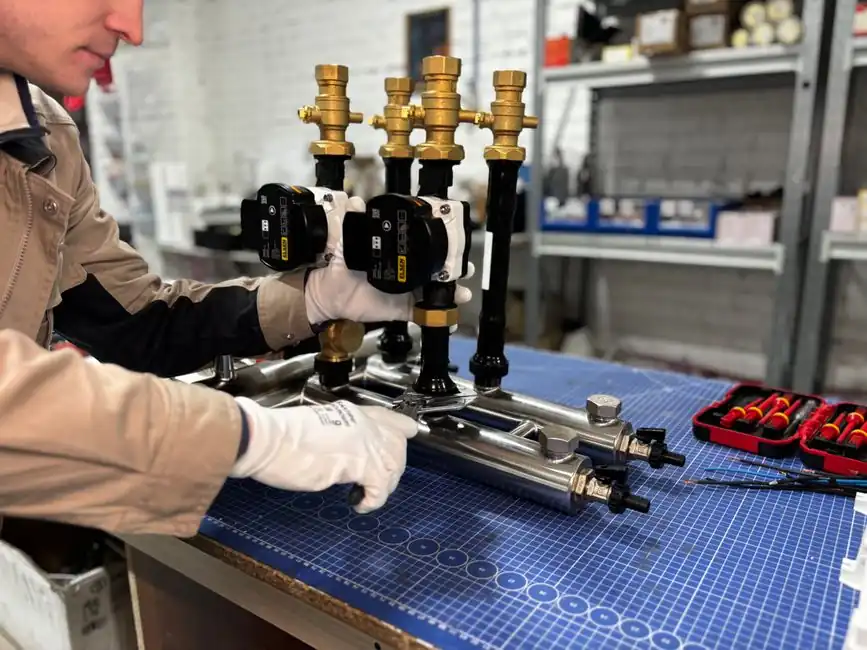
For a plumbing job the laser tool is either a rotating grade laser on a tripod, used to set fall over 50 m+ drainage runs and datum across a wet-area slab, or a self-levelling pipe laser that sits inside the trench and shoots a visible dot to a target plate in the next pipe length [S1][S5].
Single grade (one slope direction) covers most plumbing work; dual grade is only needed for wet-area slabs that fall to a waste from multiple directions or for larger drainage catchments, and the cheapest workable kit is a single-grade manual rotary with a millimetre receiver [S1][S5]. Concrete floor prep for plumbing is a separate machine class: a ride-on boom laser screed like the Somero S-22EZ fits open industrial floors above roughly 1,400 m² per day, while a walk-behind unit is the right answer for slabs under that area or for pour widths where a ride-on will not pass [S4].
Grade Laser vs Pipe Laser: Two Tools, Two Reference Planes
A rotary grade laser sits on a tripod above the work and projects a continuous rotating reference plane, with a millimetre receiver on a staff reading fall at any point along the run; a pipe laser is a specialised dot laser that sits inside the pipe and shoots straight down the run to a target plate in the next pipe length, so the plumber sees the dot without chasing a receiver [S1][S5].
The two solve different geometry problems: grade lasers cover drainage fall across a site, datum / RL transfer, GPO and tap height marking, and pre-pour slab or screed prep, while pipe lasers handle precise sewer and stormwater pipe laying where both alignment and gradient have to be set in one step [S1]. For a 1-in-60 fall the rule is divide the first number by the second, giving 1.667%, which is a standard pipe-laser dial-in value along with 2% on most digital units [S1][S5].
Single vs Dual Grade and How the Grade Is Set
Single grade covers one slope direction, which is what 80% of plumbing fit-outs need; dual grade is required only for wet-area slabs (bathroom or laundry floors falling to waste from multiple directions) or larger drainage catchments, and it costs more because the slope remote or controller has to manage two axes at once [S1].
Grade-setting method is the second decision: Manual uses a slope remote to tilt the beam and is the cheapest route on entry-level units, Auto Grade Match is a one-button match to receiver height that speeds up long runs, and Digital Dial-a-Grade is a numeric percentage entry that locks the slope directly without a remote [S1][S5]. A wet-area slab being pre-poured for a bathroom group typically runs 1.5-2% fall to the floor waste, and the same rotary used for the pipe work will also handle the slab prep if the laser has dual-grade capability.
How a Laser Screed Hits Ff/Fl Targets on the Plumbing Slab
A laser screed cannot fix a soft sub-base: the head only corrects what it reaches, and on a slab thicker than 150 mm a soft spot will telegraph into the Ff number even with a perfectly calibrated head, so the sub-base must be verified to a ±10 mm tolerance over a 3 m straightedge before form setup [S2]. Capillary break material, typically 150-300 mm of crushed stone or open-graded aggregate, is compacted to 95% Modified Proctor before the vapor barrier is rolled out, with 10-15 mil polyethylene for dry-storage slabs and 15 mil minimum puncture-resistant sheet when adhesive-applied flooring is going down [S2].
Laser reference calibration is a four-corner plus mid-span check: a deviation greater than 1.5 mm across the diagonal indicates a tripod set-up error or air-temperature banding near windows or HVAC inlets, and the corrective action is shade the tripod and re-zero the receiver at every 20 m of head travel [S2]. Acceptance targets under ASTM E1155 and ACI 117 typically run Ff 30 / Fl 20 minimum for warehouse and industrial slabs, with Ff 50 / Fl 30 or higher specified for narrow-aisle racking above 8 m tall [S2][S4].
Mix, Slump, and Delivery Rate That Match the Screed Head
A laser screed pulls a head through concrete at a rate set by delivery volume, not by machine speed; if trucks cannot feed the head continuously, the slab develops cold joints and the Ff target slips [S2]. For a 3 m strike-off head running at a typical 5-8 m/min, the concrete demand is set by the slab thickness, and the receiver must be re-zeroed every 20 m of head travel to hold the laser plane under thermal drift [S2].
Slump loss at the head shows up as tearing at the strike-off surface, and the practical control is to keep the truck queue ahead of the head so slump is within the placement window when concrete reaches the strike-off plate; this is the same logic used on a hot pour day in Fayette County, AL, where an 86,000 sq ft sheriff-center pour was planned over a 2-day window but consolidated into one pour to avoid cold joints on a 3-4 m head [S2].
Tunnel and Invert Pours: When a Ride-On Class Is the Only Answer
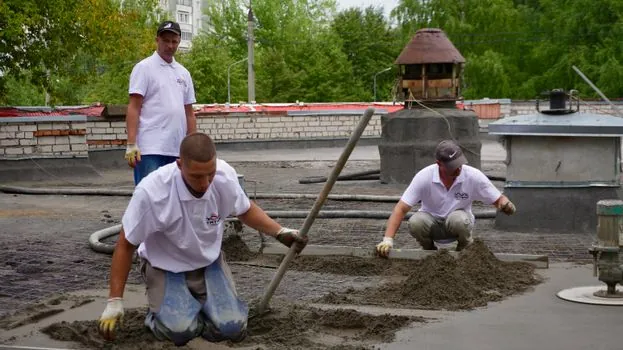
Underground work rules out GNSS, so a tunnel-spec screed is sized on engine power, vibration width, and 2D control rather than 3D stringline, and the 2026 YG commercial line segments into three working envelopes: 22 kW walk-behind (CL300 series, 2.5-3.0 m head, 50-300 mm leveling), 35.5 kW ride-on ZP30 (3.1 m head, 100-450 mm leveling), and 63.9 kW heavy ride-on ZP40 (4.0 m head, 100-500 mm leveling) [S3].
The 35.5 kW ZP30 is the realistic floor for continuous mainline tunnel invert pours above 1,000 m² per shift because its 100 L fuel tank supports an 8-10 hour working day without rehandling, while the 22 kW walk-behind's 20 L tank forces refuel stops every 3-4 hours under load [S3]. Travel speed separates the classes further: walk-behind units cap at 0-4 km/h and ride-on units run 4-8 km/h, which is the difference between 200 m²/h and 400-500 m²/h effective placement on a 200 mm slab, and is the deciding factor for tunnel segments where pour windows are tight [S3]. For related on-site tool chains on plumbing-prep work, see the shotcrete machine selection for HVAC installation spec map and the air pick selection for concrete work reference for break-out and prep on cast-in plumbing sleeves.
2D Paving Control in GNSS-Denied and Confined Slab Pours
Tunnel work cannot use GNSS, so screed control falls back to 2D averaging using sonic tracers, stringline skis, or rotary laser receivers referenced to a fixed elevation benchmark; the Topcon P-32 2D paving system is one of the few purpose-built 2D control packages that explicitly covers concrete paving "under open skies, in tunnels, or on obstructed jobsites" [S3]. A P-32 stack reads sonic or laser elevation on each side of the screed head and averages the two, which handles the failure mode you actually see in tunnels: uneven formwork height, rebar chair deflection, and varying head pressure from the truck chute [S3].
2D averaging is a deliberate downgrade from 3D stringless, and the trade-off is that the operator must verify cross-fall and slope against a manual level at every 10-15 m station; for long invert pulls the practical workflow is P-32 averaging for grade plus a pipe laser or equivalent instrument for line, because the same pipe-laser principle that lays sewer at 1.667-2% fall in an open trench re-appears here as a stationary reference for cross-passage inverts [S3][S1].
Plumbing Pre-Pour Check: Sub-Base, Receiver, and Mix, in That Order
Symptom: a soft spot under a slab thicker than 150 mm shows up as a localised low that survives the pour. Root cause: the sub-base was not verified to ±10 mm over a 3 m straightedge before form setup. Corrective action: re-compact the capillary break to 95% Modified Proctor, re-roll the vapor barrier, and re-set the form to the same datum the laser transmitter will broadcast [S2]. If the deviation is greater than 1.5 mm across the diagonal of the four-corner check, the fix is not more concrete, it is a tripod shade and a re-zero of the receiver at every 20 m of head travel [S2].
Symptom: tearing at the strike-off surface, low Ff on the first pass. Root cause: slump loss at the head, meaning concrete has sat too long in the truck queue. Corrective action: hold the truck queue ahead of the head and keep slump within the placement window when concrete reaches the strike-off plate; do not pour water on the surface to recover workability, because adding water at the surface kills the Ff number [S2]. When the slab is in a wet-area plumbing zone (bathroom, laundry, plantroom) and a 1.5-2% fall to waste is required, the same dual-grade rotary used for pipe work will handle the slab prep if the receiver is moved to the screed mast and the form is set to the broadcast datum [S1][S2].
Trackable next signals: ACI 117 and ASTM E1155 floor flatness revisions (no specific date in the research), wider deployment of 2D averaging on tunnel pours as more Topcon P-32 stacks appear on non-tunnel industrial sites, and the gradual migration from Manual grade entry to Digital Dial-a-Grade on plumbing rotary kits as the price gap closes [S1][S3][S4]. For trades working alongside plumbing prep on the same slab, the aluminum ladder selection for HVAC install spec map covers access equipment, and the angle grinder selection for electrical installation reference covers cut-off work on cast-in sleeves.
Detailed specification references: laser level, and laser marker.