
For industrial process work, a power mixer is sized by viscosity first, solids size second, and tank geometry third — not by motor horsepower alone; the same 7.5 kW nameplate can be the right call for a 5 m³ low-viscosity blending tank and the wrong call for a 0.5 m³ high-viscosity paste vessel [S1].
Selecting on brand reputation alone is the most expensive mistake buyers make: most field failures traced back to undersized gearboxes, wrong impeller-to-tank ratio (D/T), or a service factor (SF) that the duty cycle demanded but the supplier did not quote [S7].
Match Mixer Architecture to Viscosity and Flow Regime
Mixers fall into three functional classes — low-shear blending, high-shear dispersion, and high-viscosity helical mixing — and each is mapped to a different Reynolds number band, so a unit that looks similar on a datasheet is built for a completely different job [S1]. Low-viscosity blending (Newtonian fluids below roughly 1,000 mPa·s) is typically handled by a power mixer fitted with a marine propeller or pitched-blade turbine at shaft speeds of 350–1,750 rpm and tip speeds in the 3–8 m/s window; these designs are also what buyers looking for a sand mixer configuration in foundries evaluate first, because sand wets out fast under axial flow.
High-viscosity duty (10,000–500,000 mPa·s) demands helical or anchor impellers running at 10–60 rpm with tip speeds under 2 m/s, and a gearbox sized for the radial load that a high-torque shaft imposes — this is the regime where a general-purpose 1,500 rpm unit fails within months [S7].
High-shear dispersion (emulsions, pigment grinds) uses a rotor-stator generator head with tip speeds of 20–40 m/s and a tight batch-size envelope; the same 4 kW motor on a high-shear head delivers very different hydraulic shear than the same 4 kW on a pitched-blade turbine, so nameplate substitution is the classic mis-spec.
Solids-Handling, Particle Size and Abrasive Duty
If the slurry carries solids above 1 mm, the impeller passage, shaft diameter, and seal face must be sized so the largest particle clears the geometry — typical practice is to keep particle size below one-third of the impeller-to-shaft gap, and below one-fifth of the discharge port opening on a rotor-stator head [S3].
Abrasive or corrosive service pushes buyers toward 316L stainless wetted parts, hard-faced seal faces (tungsten carbide vs. silicon carbide vs. ceramic), and either single or double mechanical seals with a flushed seal chamber; rubber-lined or polyurethane-lined shafts are also common in mining slurries where 25–40% solids by weight is routine [S3].
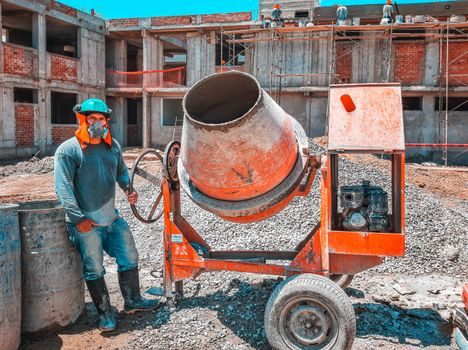
A foundry-style sand mixer running silica or chromite sand is a special case: tip speed is held under 12 m/s to limit airborne dust, and the gearbox is derated to AGMA Class II service factor — a frame that would carry continuous mixing duty on a polymer tank will be undersized for a concrete mixer truck drum drive or a foundry muller on a two-shift cycle.
Motor, Gearbox and Service Factor — the Real Cost Drivers
Industrial mixer drive packages are usually quoted as motor kW × output rpm × service factor, and the SF is the number that controls bearing and gear life on a 24/7 duty cycle — a 1.0 SF unit is rated for peak load only, while 1.5–2.0 SF units carry continuous duty and the start-stop transients common in batch processes [S7].
Three-phase induction motors dominate the industrial range (0.55–75 kW standard frame sizes), with inverter-duty (VFD-rated) windings becoming the default for variable-speed units because the gearbox and seal life both depend on running below the critical speed during ramp-up.
For hazardous-area service, ATEX/IECEx zone classification (Zone 1 vs. Zone 2 for gas, Zone 21 vs. Zone 22 for dust) decides whether the motor is a standard TEFC frame, a flameproof Ex d enclosure, or an increased-safety Ex e unit — and the price delta between a safe-area and a Zone 1 Ex d motor at the same kW is typically 2× to 3× before the gearbox is even counted, which is why spec-driven selection beats brand-driven selection on both safety and budget.
Tank Geometry, Baffling and Power Number
Power draw scales with the dimensionless Power number (Np), the impeller diameter, shaft speed, fluid density, and viscosity — so the same impeller in a deeper tank draws more power, and a unit oversized for a shallow vessel will churn air and oxidize the product instead of mixing it [S1].
Standard practice is D/T = 0.33–0.50 for turbine and propeller impellers (impeller diameter D to tank diameter T), with four full-length wall baffles at T/12 width; unbaffled tanks can cut required power by 50–70% on low-viscosity Newtonian fluids but they induce a deep central vortex and poor top-to-bottom turnover.
For viscous service, a helical impeller with D/T = 0.9–0.98 and no baffles is normal, and the design power number is much higher — that is why a 7.5 kW motor on a helical in a 2 m³ paste tank is correctly specified, while the same 7.5 kW on a propeller in the same tank would be wasted headroom.
Selection Criteria Compared Across Mixer Types

Side-by-side on the four decision criteria that show up in almost every RFQ, the three common architectures line up as follows: low-shear turbines win on cost and continuous-blending capacity but lose on solids above 5 mm and on viscosities above 5,000 mPa·s; high-shear rotor-stator units win on droplet and particle size reduction (typical outlet droplet 1–10 µm in emulsions) but lose on batch volume, since head-chamber flow is the bottleneck; high-viscosity helical units win on high-Np torque transfer and on scraper action for heat transfer, but lose on speed range and on capex per kW of installed power [S1][S7].
For foundries and dry-blend processes specifically, a sand mixer is typically a muller or a continuous intensive mixer, and is treated as its own class because the "fluid" is a granular bed — power draw is set by muller wheel weight and pan speed rather than Np correlations.
Seal, Material and Maintenance-Access Levers
Lip seals are acceptable only on light-duty, non-toxic, non-flammable service at near-ambient temperature; once the fluid is flammable, hot, abrasive, or hygienic, the spec drops to a single mechanical seal (John Crane Type 2 / Burgmann M7N class), or a double seal with barrier fluid for products that cannot tolerate trace lubrication [S7].
Materials scale from cast iron and carbon steel wetted parts on water and sludge duty, to 304/316 stainless for food, pharma, and personal care, to rubber-lined or FRP-lined shafts for HCl, HF, and brine; for nuclear or NACE MR0175 sour-service duty, full-material traceability and 3.1/3.2 certificates are the minimum bar.
Maintenance access is itself a spec: side-entry mixers need clearance for seal replacement without draining the tank, top-entry units need an overhead crane path for impeller pull-down, and bottom-entry units — common on storage tanks for sludge re-suspension — are the most expensive to seal but the most efficient on settled solids.
Real Use Cases and the Specs That Decide Them
Wastewater equalization tanks typically specify a 1.5–4 kW slow-speed top-entry mixer with a large-diameter axial propeller at 50–120 rpm, sized to keep TSS in suspension without aerating the tank — this is the same envelope as a concrete mixer truck drum idler drive, and the gearbox suppliers overlap heavily [S1].
Pharmaceutical and cosmetic emulsions demand a bottom-entry or side-entry high-shear unit with sanitary tri-clamp connections, electropolished 316L wetted surfaces, and a sterile barrier-fluid double seal — a different instrument class than the wastewater unit, even when the kW nameplate is identical.
Foundry sand preparation and core mixing, by contrast, is a muller or a continuous intensive mixer running at 2–6 rpm pan speed and high wheel loading — here the power mixer selection rules of thumb give way to dry-side design equations, and the spec gates are sand-to-binder ratio, cycle time, and muller wheel weight per pan area.
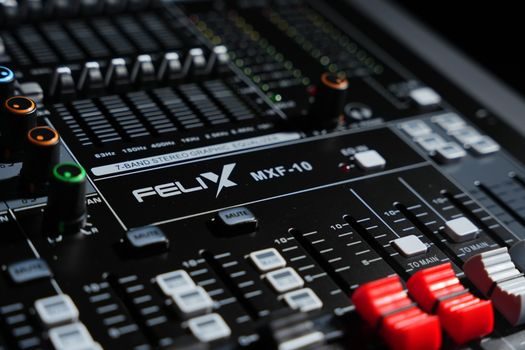
Process skids in chemical plants often ship with a portable power meter on the mixer feed to log kW draw during commissioning — the same instruments used to validate duty cycle on a power transformer feeder are routinely used here, and reading the no-load vs. loaded power is the fastest field check that the impeller is correctly sized.
Failure Modes and Common Mis-Spec Traps
Three failure modes account for most mixer warranty claims: shaft deflection on overhung high-viscosity shafts (the shaft is too long, the impeller is too far from the gearbox, and the bearing span is undersized), mechanical seal failure on dry-run start-up (the tank was emptied faster than the mixer was stopped), and gearbox burnout on SF-1.0 frames running 24/7 [S7].
Buyer-side traps include copying a previous-project spec sheet without re-checking viscosity (the new product is three times more viscous), specifying VFD duty on a non-inverter-rated motor winding (insulation class F or H is required, not just any TEFC frame), and ignoring ambient temperature in outdoor chemical service (above 40 °C ambient, motor derating begins and gearbox oil grade must change).
On hazardous-area sites, the trap is specifying a "waterproof" IP65 motor in place of a properly certified Ex d or Ex e unit — IP rating is environmental protection, not explosion protection, and the two standards do not substitute for each other.
Sourcing, Standards and What to Put on the RFQ
A spec-first RFQ for an industrial power mixer should carry: working volume (m³), fluid viscosity range (mPa·s), density (kg/m³), max particle size (mm), solids fraction (%), tank diameter and liquid height (mm), material of construction (wetted parts), temperature and pressure, hazardous-area classification, duty cycle (hours/day), and the required shaft speed range — this list alone eliminates 60–80% of the catalog noise and forces suppliers to quote on equivalent duty [S1][S7].
Governing standards to call out: ATEX 2014/34/EU for EU hazardous-area equipment, IEC 60079 series for the explosion-protection construction rules, IECEx for international Ex certification, NACE MR0175 for sour-service materials, ISO 5198 / ISO 9905 for centrifugal-pump-style reference testing (commonly re-used for mixers), and the local electric codes for motor supply (IEC 60034 series for rotating machines).
When the duty is solids-handling, a unit originally engineered for a sand mixer line will usually outlast a re-purposed process agitator; buyers looking at the related AGV robot price and cost guide: 2026 bands, navigation levers, and sourcing reality will recognize the same spec-first, brand-second pattern, and a similar spec discipline applies to pneumatic conveying system cost 2026: bands, levers, and sourcing reality when the mixer feeds or receives dry material.
Trackable next signals for the second half of 2026: drive-motor price moves on IE4/IE5 efficiency classes as the EU 2019/1781 second-tier rules bite, and the appearance of more VFD-integrated mixer skids with built-in power meter diagnostics as plant-side IIoT rollouts continue.