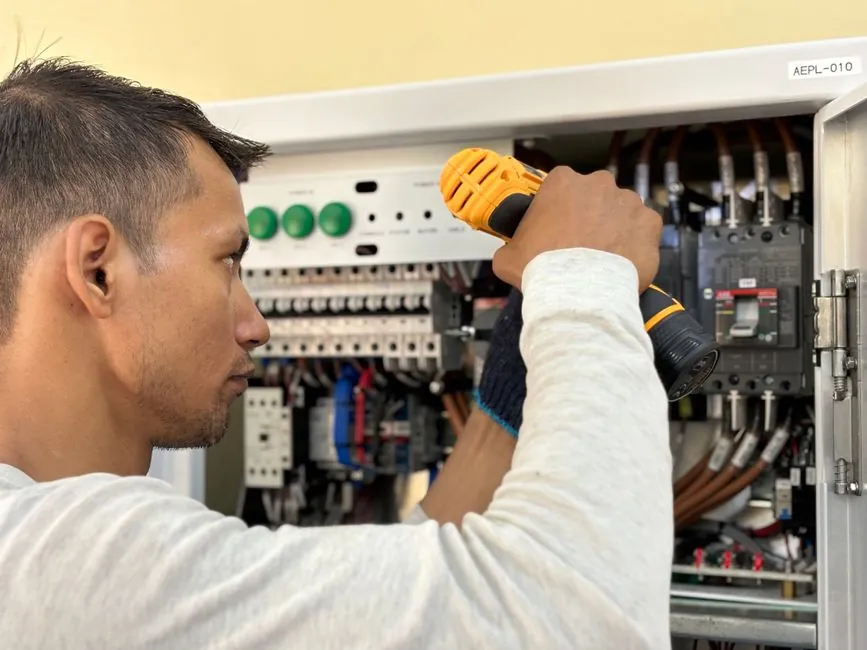
Walk-behind power trowels in the 600-1,000 mm rotor range with 5-9 HP Honda GX-series engines remain the default for HVAC plant-room and chiller-deck slabs under 200 m², with 24-36 inch models covering edge work along duct chases and 36-48 inch machines handling open pours [S1][S2].
Selection turns on four measurable criteria: rotor diameter (24"/600 mm up to 48"/1,220 mm), engine power (3-13 HP), blade speed range (50-200 RPM), and total mass (70-120 kg), and each maps directly to slab size, finish tolerance, and the available headroom under hung ductwork [S1][S2][S5].
Walk-Behind Trowels: 24-36 Inch Class for Tight Equipment Rooms
Compact walk-behind units with 600-920 mm trowel paths fit through standard 36"/914 mm door openings and finish close to walls, a hard requirement inside retrofit chiller rooms and fan-coil vaults where the slab is bordered by steel plinths [S1][S7].
The Master Finish 600 mm trowel lists a 70 kg total weight, a 6.5 HP Honda GX200 4-stroke engine, and a folding handle that matters when the machine has to be craned into a basement mechanical room [S1]. Sealine's SE-S80H and SE-S90H share the 5 HP Honda GX160 / Robin EY20 engine family at 760-920 mm rotor diameter with a 60-100 RPM travel speed and 0-15° blade-pitch range, the same operating window the Excalibur ST-24 to ST-36 line covers at 50-145 RPM with blade dimensions stepping from 220×130 mm up to 350×150 mm [S2][S7].
For HVAC slabs under 50 m² the FM-PTS-3 from Tony & Tony runs a 3 HP single-phase electric motor at 120 RPM with a 12"/305 mm blade set and a 34" base, the smallest credible option when diesel or petrol exhaust is banned in an occupied plant room [S4].
Mid-Range 36-42 Inch Trowels: The General-Workhorse Class
The 36"/915 mm class delivers the best balance of coverage and manoeuvrability for HVAC equipment bases, pipe-rack foundations, and corridor slab strips between 100-400 m² [S1][S5].
The Husqvarna 915 mm walk-behind uses a Loncin GX200F 6.5 HP engine and weighs 77 kg with a wide D-handle for two-handed finishing against formwork edges [S1]. Full-Track's FT-36"/90 cm model scales the same diameter to a GX200 7 HP engine (94 kg, 40-200 RPM) or a GX270 9 HP engine (104 kg, same speed band), with a one-bolt blade-change system that cuts downtime when abrasive HVAC-room slabs wear edges faster than a residential pour [S5].
Sealine's SE-S100H lifts output to 5.5 HP and a 920 mm rotor, identical geometry to the SE-S90H but with the 35×15 cm finishing blade, while the Excalibur ST-36 hits a wider 50-130 RPM speed band that supports both float and hard-trowel passes without swapping machines [S2][S7].
Heavy 48 Inch and Ride-On Trowels: Plant-Room and Large Plenum Slabs
Ride-on and 48"/1,220 mm walk-behind trowels are specified when the pour exceeds roughly 500 m², the floor tolerance is FF50/FL40 or tighter, and ride-on productivity (typically 4-6× a walk-behind) offsets the higher capital cost [S3][S5].
The Husqvarna CRT 48 ride-on trowel delivers 1,220 mm troweling diameter with 10 blades and 27.6-42.5 kW (37-57 HP) petrol or petrol/LPG power options, sized for central-plant chiller halls and large air-handling unit (AHU) rooms [S3]. Full-Track's FT-48"/120 cm line peaks at the GX390 13 HP engine, 265 lb/120 kg, 40-200 RPM, paired with a 40×15 cm finishing blade; Sealine's SE-S120H tops the walk-behind range at 6 HP and a 1,180 mm rotor with 100 RPM travel [S2][S5].
Heavier mass (94-120 kg) is a feature, not a bug, on HVAC slabs: dead-weight presses aggregate down and tightens the surface against the steel base plates of packaged AHUs and chillers, reducing grout voids under sole plates.
Engine, Power Source, and Indoor Air-Quality Trade-Offs
Petrol Honda GX-series engines dominate the category (GX160 at 5 HP, GX200 at 6.5-7 HP, GX270 at 9 HP, GX390 at 13 HP), with diesel and LPG options on ride-on models; the FM-PTE-3 Honda petrol-start / kerosene-run variant at 0.75-1 L/h fuel burn is a fallback where lead-free petrol logistics are weak [S4][S5][S6].
Electric options cluster at 2.15-5.5 HP (1.6-4.1 kW) for indoor HVAC work: the Caterpillar ES 420S draws 1.6 kW at 140 RPM for finish-only work, while the E-4-5H at 4.1 kW covers 30-62 RPM floating, the no-exhaust choice whenever a mechanical room is tied into a return-air system or occupied floor above [S8].
Operators should treat the 3 HP single-phase option on the FM-PTB-3 / FM-PTS-3 as a finish-only machine: 120 RPM with a 12-17"/305-432 mm blade cannot drive down hard-trowel burnish passes, and the diesel RO170F / RO178F alternatives on Sealine SE-S units add torque at the cost of indoor exhaust [S2][S4].
Blade Material, RPM, and Finish Tolerance on HVAC Slabs
Spring-steel and high-carbon-steel blades heat-treated to Rockwell C 40-50 hardness are the industry baseline, with high-carbon blades lasting 20-30% longer than spring-steel on abrasive aggregate mixes, a direct cost driver on HVAC slabs that often use harder crushed-stone mixes for abrasion resistance [S10].
Blade speed is the control variable: 50-100 RPM for floating, 100-145 RPM for the first trowel pass, and 145-200 RPM for hard-trowel burnishing on steel-trowelled finishes under AHU bases, the operating envelope the Excalibur ST-36 (50-130 RPM) and ST-48 (70-145 RPM) cover, while the Full-Track FT-32" through FT-48" lines expose the full 40-200 RPM band in a single machine [S5][S7].
Stainless-steel blade sets on the FM-PTB-3 extend blade life where chemical-resistant floor sealers or condensate exposure attack standard carbon steel, a worthwhile upgrade for natatorium and pool-mechanical-room slabs [S4].
Selection Criteria, Comparison, and When NOT to Power-Trowel
Four spec criteria sort the options: rotor diameter (24"/600 mm to 48"/1,220 mm), engine power (3-13 HP walk-behind, 27.6-42.5 kW ride-on), operating weight (70-120 kg walk-behind), and RPM band (50-200 RPM); a 24-36 inch 5-7 HP walk-behind is correct for retrofit equipment rooms under 200 m², a 36-42 inch 7-9 HP walk-behind handles 200-500 m², and a 48 inch ride-on at 27.6+ kW is the right tool above 500 m² [S1][S2][S3][S5].
Do not power-trowel when the concrete is still bleeding (free water on the surface), when ambient temperature is below 5 °C without cold-weather admixtures, or when the slab design specifies a broom or hard-steel-trowel finish outside the machine's pitch range, the 0-15° pitch on Sealine SE-S units is the upper limit for most walk-behinds, and exceeding it lifts the centre and tears the surface [S2]. Replace the blade set, do not just re-tension, when high-carbon edges show wear beyond roughly 1.5 mm or when finish quality drops below FF25/FL20 on a calibrated test.
Specifying the wrong power class is the most common HVAC-floor failure: an under-powered 3 HP electric unit on a 400 m² chiller-room pour cannot reach 100+ RPM hard-trowel passes, leaving a soft surface that dusting and tile-adhesive failures follow within 12 months. Pair a 36 inch 9 HP walk-behind or larger with a power trowel blade changeout kit, and route any petrol or diesel exhaust through flexible ducting to outside air when indoor HVAC return paths are active during finishing.
Track two signals over the next quarter: OEM updates to the Honda GX160/GX200 emissions tier for 2027 EU Stage V alignment, which would push indoor users toward the 4.1 kW electric E-4-5H class, and any new ride-on models in the 1,200-1,500 mm rotor class that would compress large HVAC plant-room pours below 500 m² into walk-behind economics [S8]. For related on-site tool picks see Angle Grinder Selection for Electrical Installation: A 2026 Spec Map and Scaffolding Selection for Road Maintenance: Asset Class, Load, and Permit Gates.
Spec-level background on the components involved: power cable.