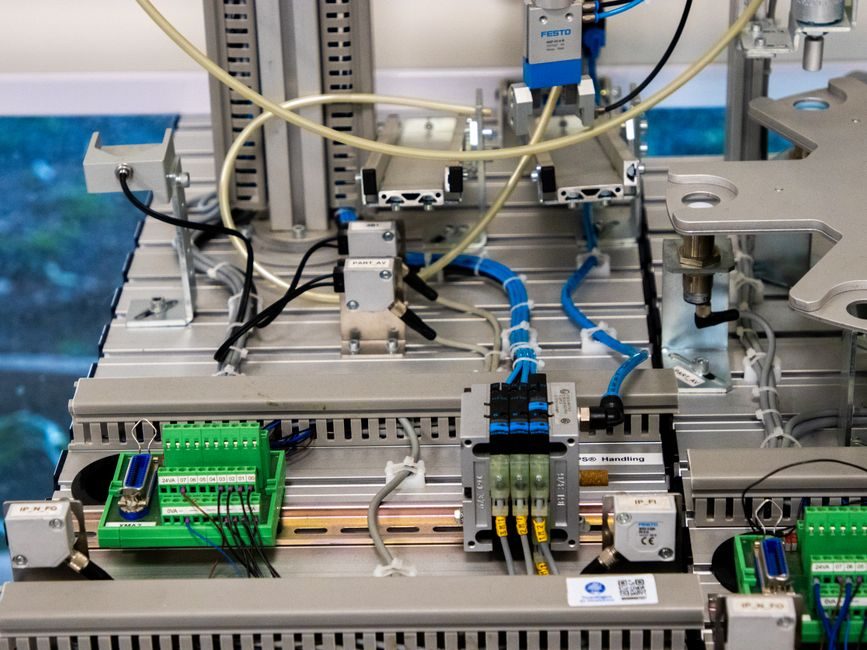
A modern robotics manufacturing cell combines a manipulator (typically 6-axis articulated, SCARA, delta, or collaborative), an end-effector, a controller, and a safety-rated work envelope, with global installed stock passing 4.28 million units in 2024 per IFR World Robotics 2025 reporting referenced in industry coverage [S1].
Eight practical levers shape any robotics manufacturing process line: CNC and machine tending, welding (MIG/TIG/spot), painting and dispensing, assembly, material handling, palletizing, picking, and quality inspection — each selected on payload, reach, repeatability, and cycle-time criteria rather than brand familiarity [S2]. For related process comparisons, see the Lithium Battery Manufacturing Process Overview: Six Stages, Dry-Room Specs and Yield reference and the PV Smart Manufacturing 2026 AI-vision benchmark.
Cell Taxonomy and Repeatability Bands
Articulated 6-axis arms dominate the robotics manufacturing process market, with payload envelopes split into light-duty (≤20 kg, used for electronic assembly and pick-and-place), mid-duty (20–150 kg, the workhorse of CNC tending and welding), and heavy-duty (>150 kg, used for casting handling and palletizing), with repeatability typically published in the ±0.02 mm to ±0.1 mm band for industrial models [S1].
SCARA robots hold ±0.01 mm to ±0.025 mm repeatability in planar assembly tasks and reach 200–800 mm with 1–20 kg payloads, while delta robots reach cycle times under 0.3 s for lightweight picking at 1–8 kg payloads [S2]. Collaborative robots (cobots) are defined by ISO/TS 15066 power- and force-limiting thresholds — typically 150 N quasi-static contact and 250 N transient contact at the tool center point — and are specified for fenceless cells where human-robot distance cannot be guaranteed [S1].
Process Stages and the 5-Step Spec Gate
Specifying a robotics manufacturing process line follows a five-gate workflow: (1) define the part family and process (tending, welding, painting, palletizing, assembly, inspection), (2) set payload + reach + cycle-time targets, (3) select the kinematic family (articulated vs SCARA vs delta vs cartesian), (4) verify the safety and standards envelope (ISO 10218-1/-2, ISO/TS 15066, ANSI/RIA R15.06), and (5) lock the controller protocol (EtherCAT, PROFINET, EtherNet/IP, OPC UA over TSN) before vendor selection [S2].
For each gate, the comparison is mechanical, not commercial: at equal 10 kg payload, an articulated arm typically gives 1.0–1.4 m reach, a SCARA gives 200–800 mm planar reach with the lowest cost per cycle, and a delta gives sub-0.3 s pick time at the highest unit cost but smallest footprint. A cobot substitutes only when the safety gate forces a fenceless layout, not because it is a "modern default" [S1][S2].
Welding, Painting and Dispensing Sub-Processes
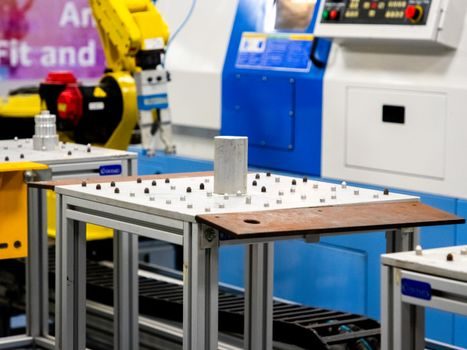
Welding cells (MIG/MAG, TIG, spot) consume roughly 25–30% of the articulated-arm installed base in heavy industry, with the FANUC ARC Mate and similar 6-axis families handling 6–35 kg torches and 0.5–1.5 m weld-seam tolerances; seam-tracking is typically closed-loop through arc-sensor or laser-vision feedback, not open-loop point-to-point [S1].
Painting and dispensing cells use ATEX category 2 or category 3-rated arms when solvent vapors exceed LEL, and the fluid path uses PTFE or stainless 316L with dead-volume <2 mL for color-change; dispensing repeatability is published at ±0.01 g for single-component sealant beads at 50–500 mm/s robot TCP speeds. Palletizing cells target 8–30 cycles/min at 50–500 kg payload with 3.1 m reach — a workload that excludes SCARA and delta entirely [S1][S2].
Machine Tending, Assembly and Inspection Integration
Machine tending — loading blanks into CNC lathes, mills and presses — remains the largest single application of 6-axis arms in the robotics manufacturing process stack, with cells built around a dual-gripper EOAT, a parts-queue conveyor, and a door-interlocked work envelope; typical ROI thresholds are 18–24 months at two-shift utilization above 70% [S1].
For semiconductor and electronics flows, the spec comparison aligns with brownfield automation stacks covered in Semiconductor Smart Manufacturing 2026: AI, GEM300 and Brownfield Automation Stack, where SECS/GEM, GEM300 and OPC UA over TSN dominate the controller-to-host protocol map. AI vision inspection now reaches >99.5% defect-classification accuracy on lighting-controlled lines, but drops below 95% on specular or mixed-finish surfaces without structured illumination [S1][S2].
Standards, Safety Envelopes and Failure Modes

The binding safety framework is ISO 10218-1 (robot itself) plus ISO 10218-2 (cell integration), with ISO/TS 15066 governing collaborative power- and force-limiting operation and ANSI/RIA R15.06 covering the U.S. equivalent; functional safety on the controller typically runs SIL 2 / PL d per IEC 62061 and ISO 13849-1, with safety-rated I/O on a dedicated bus such as PROFIsafe or CIP Safety [S1].
Common failure modes in any robotics manufacturing process line are: encoder drift after >30,000 h duty (replace resolver/encoder stacks), TCP calibration error >0.1 mm after tool change (run automated TCP calibration on every gripper swap), and unplanned stop categories B0/B1 mis-wiring (verify stop categories per IEC 60204-1 with hard-wired E-stop on the safety bus, not on the standard PLC) [S1][S2].
Selection Criteria Comparison Across Cell Types
On four hard criteria — payload, reach, repeatability, and cost-per-cycle — the four dominant robotic types line up as: 6-axis articulated (6–2,300 kg payload, 0.5–3.5 m reach, ±0.02–0.1 mm repeatability, mid cost-per-cycle), SCARA (1–20 kg, 200–800 mm planar, ±0.01–0.025 mm, lowest cost-per-cycle in pick-and-place), delta (1–8 kg, 500–1,300 mm workspace, ±0.05 mm, highest throughput at sub-0.3 s pick), and cobot (3–35 kg, 0.5–1.3 m, ±0.03–0.05 mm, premium cost-per-cycle but eliminates fencing) [S1][S2].
Choose articulated for general heavy industry, SCARA for planar electronics assembly, delta for high-speed lightweight picking, and cobot only when ISO/TS 15066-rated human-robot collaboration is mandatory; do not specify a cobot where the safety gate would otherwise permit a fenced articulated cell, because cycle time and payload density both degrade on the cobot side without safety benefit [S1].
Standard-related packaging, capping and fluid-path process controls are tracked separately in Capping and Sealing Machine Selection Criteria 2026.
For component-level specifications, see additive manufacturing material, multifunction process calibrator, and v process line.